

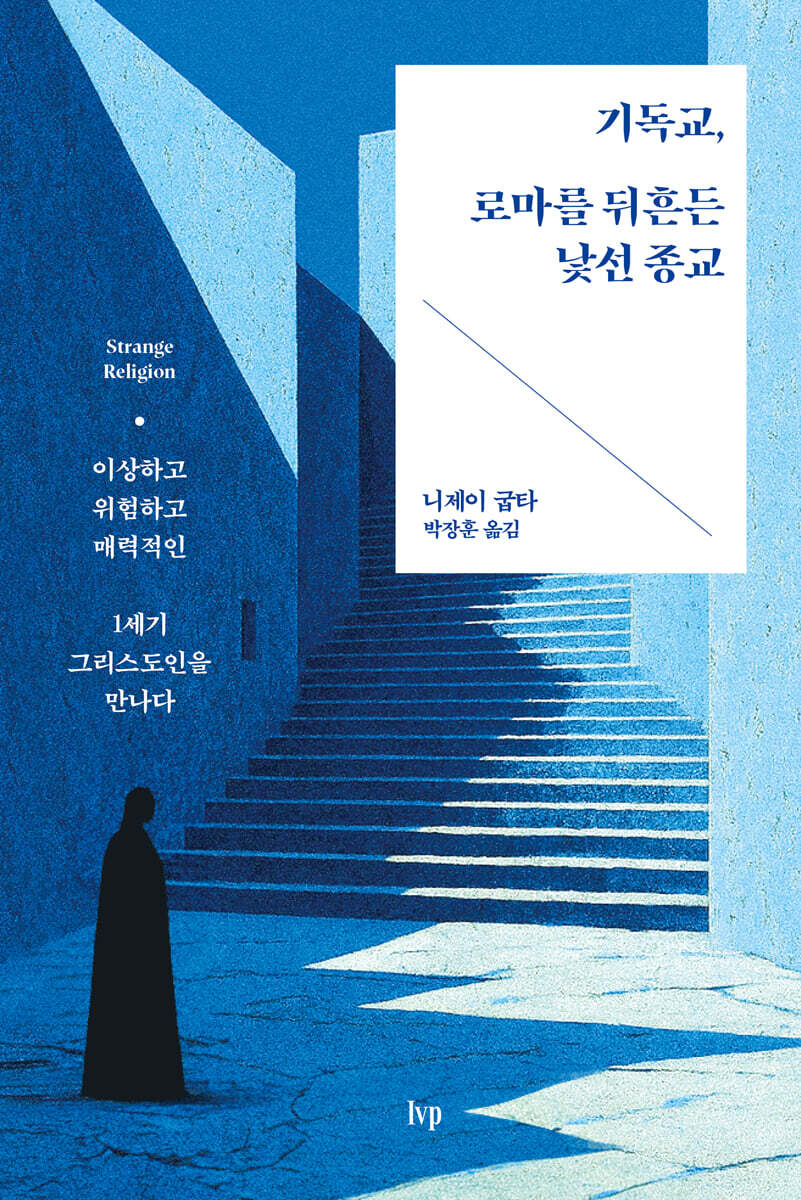
Christianity, the strange religion that shook Rome
 |
Description
Book Introduction
What does it mean to be a Christian?
The extraordinary story of the first-century church told by the eminent theologian Nijay Gupta!
Nijay Gupta, a prominent New Testament scholar and author of "New Testament Word Lessons," examines the essence of the Christian faith from a historical perspective.
The author explores the faith and practice of first-century Christians to restore the essence of being a Christian.
In what ways were the faith and worship of first-century Christians "alien" to contemporary Roman society? The author closely compares Roman society with first-century Christianity, explaining why Jesus' followers were perceived as strange, dangerous, and yet fascinating.
The author's portrayal of the "untamed" nature of Christianity will inject a sense of unfamiliarity into today's all-too-familiar Christianity, allowing us to look at our faith with fresh eyes.
The extraordinary story of the first-century church told by the eminent theologian Nijay Gupta!
Nijay Gupta, a prominent New Testament scholar and author of "New Testament Word Lessons," examines the essence of the Christian faith from a historical perspective.
The author explores the faith and practice of first-century Christians to restore the essence of being a Christian.
In what ways were the faith and worship of first-century Christians "alien" to contemporary Roman society? The author closely compares Roman society with first-century Christianity, explaining why Jesus' followers were perceived as strange, dangerous, and yet fascinating.
The author's portrayal of the "untamed" nature of Christianity will inject a sense of unfamiliarity into today's all-too-familiar Christianity, allowing us to look at our faith with fresh eyes.
- You can preview some of the book's contents.
Preview
index
To Korean readers
preface
Introduction
Part 1: What Does It Mean to Be a Christian?
Chapter 1: Roman Religion and Pax Deorum: Maintaining Peace with the Gods
Chapter 2: "The Believers": The Religious Transformation Caused by First-Century Christians
Chapter 3: Dangerous and Strange Religions: Is Christianity a Superstition?
Part 2: What Did First-Century Christians Believe?
Chapter 4: Believe the Unbelievable
Chapter 5: Offering Strange Worship: A Religious Group Without Smoke or Blood
Chapter 6: Captivated by the Spirit of God
Chapter 7: A Strange Understanding of Time: Starting at the End
Part 3: How First-Century Christians Worshiped
Chapter 8: Family Customs of First-Century Christians: The Family of Faith
Chapter 9: The Church as a Worshiping Community: Priests—God and the Priestly People
Part 4: How First-Century Christians Lived
Chapter 10 Becoming Like God: A Dangerous Encounter with God
Chapter 11: People Who Treat Everyone Equally
Chapter 12: Christians Were Not Perfect
Comprehensive Review: Strange Religion
main
preface
Introduction
Part 1: What Does It Mean to Be a Christian?
Chapter 1: Roman Religion and Pax Deorum: Maintaining Peace with the Gods
Chapter 2: "The Believers": The Religious Transformation Caused by First-Century Christians
Chapter 3: Dangerous and Strange Religions: Is Christianity a Superstition?
Part 2: What Did First-Century Christians Believe?
Chapter 4: Believe the Unbelievable
Chapter 5: Offering Strange Worship: A Religious Group Without Smoke or Blood
Chapter 6: Captivated by the Spirit of God
Chapter 7: A Strange Understanding of Time: Starting at the End
Part 3: How First-Century Christians Worshiped
Chapter 8: Family Customs of First-Century Christians: The Family of Faith
Chapter 9: The Church as a Worshiping Community: Priests—God and the Priestly People
Part 4: How First-Century Christians Lived
Chapter 10 Becoming Like God: A Dangerous Encounter with God
Chapter 11: People Who Treat Everyone Equally
Chapter 12: Christians Were Not Perfect
Comprehensive Review: Strange Religion
main
Detailed image
Into the book
I pray that this book will help Korean readers rediscover the astonishing and devastating beauty of our ancestors in faith.
Rather than simply imitating their strangeness, I hope to gain a deeper understanding of the gospel of Jesus Christ that shaped their lives.
I hope this book reminds you that you are not alone on this narrow path.
Follow the shepherd's voice.
--- From "To Korean Readers"
I should probably say this from the outset: I don't think first-century Christians were trying to be strange simply for the sake of seeming strange.
They were not those who deliberately pursued non-conformism as a political or cultural ideology.
In fact, they wanted to prove, as much as possible, that they were pretty good, 'good' members of society.
Rather, it was the person of Christ, the work of the Holy Spirit, and the fundamental dynamics of the gospel itself that turned them toward God, God's world, God's creation, and God's good purposes.
--- From "Introductory Remarks"
Today, religion is primarily seen as an individual choice for personal or community inspiration.
You can choose a church or experience religion as if you were 'shopping'.
Religious people become consumers, and spiritual things become commodities.
But for the ancients, religion was the exact opposite.
The gods governed everything.
That is, the gods deserved respect and honor, and those who failed to do so were subject to (often literally) hellish consequences.
I will explain later how the ancient Athenians and Ephesians expressed their personal preferences, but the big picture was this.
Religion was a communal duty that had to be performed to protect the well-being of individuals, families, cities, and nations.
--- From "Chapter 1 Roman Religion and Pax Deorum"
Ancient Jews and Christians found themselves in a difficult position in the Roman world.
They were ridiculed and laughed at because they did not have gods, which were so common in ancient religions (and considered essential by many).
The absence of a deity may have been another reason why they stuck to the term 'believer'.
They chose to believe in things unseen, and they saw value and life where others saw nothing (1 Corinthians 1:28).
--- From "Chapter 2, 'The Believers'"
Early Christian historian Larry Hurtado offers a slightly different perspective.
He suggests that what many find interesting, unique, and special about Judaism and Christianity is its emphasis on love.
This was an element not found in Roman religion.
Love was something that was outside the core of religion.
Don't we love the market? Do we love the police chief or the bank loan officer? No, we only respect them.
But the Christians wanted to say two things:
That is, God loves you and cares for you.
You too must respect and love Him.
It was indeed a very strange teaching.
It was strange.
It was dangerous.
--- From "Chapter 3: Dangerous and Strange Religion"
What does a modern evangelical church smell like? (I know, that's a strange question, but let's think about it for a moment.) Most modern churches probably smell like coffee! In fact, modern Western Christians probably don't associate church and worship with smells.
However, for the ancients, the concept of religiosity evoked a strong, sensual association.
It was just smoke and blood.
This is because the offering of sacrifices was the central act of worship.
Without this no one could worship.
--- From "Chapter 5: Offering Strange Worship"
The obsession with prayer was one of the reasons why the Romans viewed Jews and Christians with suspicion.
This seemed like a lack of manners and excessive religious fervor.
Of course, the Romans also prayed.
For example, they regularly prayed to Lares, the household god.
Also, I went to temples and festivals and prayed.
But these Christians took prayer to a whole other level.
The Romans must have been puzzled.
How can you pray without ceasing? Don't you have anything else to do?
--- From “Chapter 9: The Church as a Worshiping Community”
In traditional Roman lists, it was customary to list those of highest rank first (as is done today when thanking donors at charity events).
In the list in Romans 16, all the names are mixed together, regardless of their worldly status.
Women are mentioned alongside men.
Several women are named (like Drubena and Drubosa) without any mention of their husbands or fathers.
Jewish names are mixed with Latin and Greek names.
And what is most shocking is that the servants are praised alongside the free people.
--- From "Chapter 11: People Who Treat Everyone Equally"
It is true that in the ancient world everyone participated in religion.
Everyone saw worship of God as part of their civic duty to ensure their own and their community's well-being.
In that sense, everyone was religious.
But these Christians were truly religious.
It was impossible to have a conversation with a Christian without mentioning Jesus.
It was like, ‘Jesus’ is this, ‘Jesus’ is that.
Everything belongs to the Lord.
Rather than simply imitating their strangeness, I hope to gain a deeper understanding of the gospel of Jesus Christ that shaped their lives.
I hope this book reminds you that you are not alone on this narrow path.
Follow the shepherd's voice.
--- From "To Korean Readers"
I should probably say this from the outset: I don't think first-century Christians were trying to be strange simply for the sake of seeming strange.
They were not those who deliberately pursued non-conformism as a political or cultural ideology.
In fact, they wanted to prove, as much as possible, that they were pretty good, 'good' members of society.
Rather, it was the person of Christ, the work of the Holy Spirit, and the fundamental dynamics of the gospel itself that turned them toward God, God's world, God's creation, and God's good purposes.
--- From "Introductory Remarks"
Today, religion is primarily seen as an individual choice for personal or community inspiration.
You can choose a church or experience religion as if you were 'shopping'.
Religious people become consumers, and spiritual things become commodities.
But for the ancients, religion was the exact opposite.
The gods governed everything.
That is, the gods deserved respect and honor, and those who failed to do so were subject to (often literally) hellish consequences.
I will explain later how the ancient Athenians and Ephesians expressed their personal preferences, but the big picture was this.
Religion was a communal duty that had to be performed to protect the well-being of individuals, families, cities, and nations.
--- From "Chapter 1 Roman Religion and Pax Deorum"
Ancient Jews and Christians found themselves in a difficult position in the Roman world.
They were ridiculed and laughed at because they did not have gods, which were so common in ancient religions (and considered essential by many).
The absence of a deity may have been another reason why they stuck to the term 'believer'.
They chose to believe in things unseen, and they saw value and life where others saw nothing (1 Corinthians 1:28).
--- From "Chapter 2, 'The Believers'"
Early Christian historian Larry Hurtado offers a slightly different perspective.
He suggests that what many find interesting, unique, and special about Judaism and Christianity is its emphasis on love.
This was an element not found in Roman religion.
Love was something that was outside the core of religion.
Don't we love the market? Do we love the police chief or the bank loan officer? No, we only respect them.
But the Christians wanted to say two things:
That is, God loves you and cares for you.
You too must respect and love Him.
It was indeed a very strange teaching.
It was strange.
It was dangerous.
--- From "Chapter 3: Dangerous and Strange Religion"
What does a modern evangelical church smell like? (I know, that's a strange question, but let's think about it for a moment.) Most modern churches probably smell like coffee! In fact, modern Western Christians probably don't associate church and worship with smells.
However, for the ancients, the concept of religiosity evoked a strong, sensual association.
It was just smoke and blood.
This is because the offering of sacrifices was the central act of worship.
Without this no one could worship.
--- From "Chapter 5: Offering Strange Worship"
The obsession with prayer was one of the reasons why the Romans viewed Jews and Christians with suspicion.
This seemed like a lack of manners and excessive religious fervor.
Of course, the Romans also prayed.
For example, they regularly prayed to Lares, the household god.
Also, I went to temples and festivals and prayed.
But these Christians took prayer to a whole other level.
The Romans must have been puzzled.
How can you pray without ceasing? Don't you have anything else to do?
--- From “Chapter 9: The Church as a Worshiping Community”
In traditional Roman lists, it was customary to list those of highest rank first (as is done today when thanking donors at charity events).
In the list in Romans 16, all the names are mixed together, regardless of their worldly status.
Women are mentioned alongside men.
Several women are named (like Drubena and Drubosa) without any mention of their husbands or fathers.
Jewish names are mixed with Latin and Greek names.
And what is most shocking is that the servants are praised alongside the free people.
--- From "Chapter 11: People Who Treat Everyone Equally"
It is true that in the ancient world everyone participated in religion.
Everyone saw worship of God as part of their civic duty to ensure their own and their community's well-being.
In that sense, everyone was religious.
But these Christians were truly religious.
It was impossible to have a conversation with a Christian without mentioning Jesus.
It was like, ‘Jesus’ is this, ‘Jesus’ is that.
Everything belongs to the Lord.
--- From "Comprehensive Reflections: Strange Religion"
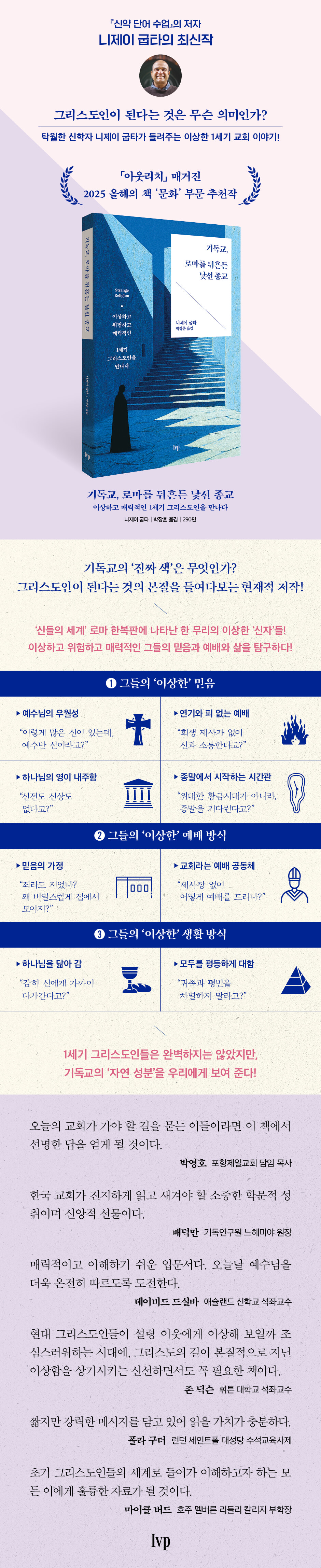
Publisher's Review
★ The latest work by Nijay Gupta, author of 『New Testament Word Class』 ★
★ Outreach Magazine's 2025 Book of the Year "Culture" Category Recommendation ★
“This book makes me excited about being a Christian.”
“A wonderful resource for anyone seeking to understand the world of the early Christians!”
-Recommended by Park Young-ho, Baek Deok-man, David DeSilva, Paula Gooder, Michael Bird, and more!
What is the 'true' color of Christianity?
A vivid work that delves into the essence of what it means to be a Christian.
Today, Christianity is one of the most popular and universal religions in the world.
Moreover, in an age where religion itself is no longer seen as self-evident but rather as a personal choice, we tend to think of even churches as something to be chosen or experienced like shopping.
But was Christianity originally like that? Nijay Gupta, who sought to restore the essential light of Christian language, which had been distorted and misused in "New Testament Word Class," now aims to clearly restore the forgotten nature of the Christian faith in "Christianity: The Strange Religion that Shook Rome."
To this end, the author examines the historical background of first-century Roman society and the context of Roman religion, when the term "Christian" emerged.
In the heart of Rome, the 'world of the gods' where everyone was religious, Christians were a strange group who called themselves 'believers'.
Their beliefs, worship, and way of life seemed strange, dangerous, and attractive to the Romans accustomed to Roman religion.
The author hopes that today we will recover the original nature of Christian faith, the "strangeness" that defies cultural norms and social expectations.
Caritas Dei, not Pax Deorum
A Strange, Dangerous, and Fascinating Exploration of First-Century Christians
So, in what ways were Christians strange, dangerous, and alluring? The author begins by exploring what it means to be a Christian (Part 1), providing a three-dimensional perspective on first-century Christianity within the context of Roman society.
He focuses on the 'Pax Deorum' (peace with the gods), which formed the foundation of Roman society.
In Rome, worship of the gods was the duty of individuals, society, and the state, and the role of man was solely to honor the gods according to established forms, regardless of feelings or inner attitudes.
And when humans fulfilled their duties, the gods were expected to respond appropriately.
However, Christians valued the internal attitude of 'faith', did not offer sacrifices, which are generally forms of worshipping gods, and also rejected idols.
Even blasphemously, they made the bold claim that they could communicate directly with God.
The author develops the argument step by step, helping us to understand that the 'Caritas Dei' (the love of God) emphasized by Christianity is fundamentally different from the Roman religion, and how surprising and strange this must have been to the Roman people at the time.
The author then discusses what first-century Christians believed (Part 2), how they worshipped (Part 3), and how they lived (Part 4).
They were people who believed in the superiority of Jesus in a society with countless gods, practiced strange worship without smoke or blood, were possessed by the spirit of God without temples or statues, and had a strange understanding of time as beginning at the end of all things.
They also called themselves the 'household of faith', gathered in homes, and worshipped as a community without priests, maintaining a priestly identity.
He wanted to live a life that resembled God, and he aimed to treat everyone equally, regardless of whether they were masters or slaves.
A balanced historical study by a distinguished New Testament scholar
A message for us today as we follow the path of Christ
However, the author does not idealize first-century Christians as perfect beings.
They too faced realistic limitations.
They fought and competed with each other, and instead of loving each other, they criticized each other.
It is not much different from what we see today.
Yet, what we should learn from them is that they were not afraid of appearing 'strange' compared to the surrounding culture.
They were more true to their beliefs than concerned about how they would look, and that made them strange, dangerous, yet fascinating messengers of Christ.
In a world where religion has become optional and the pursuit of non-religious spirituality—self-care, ritual, meditation—has become fashionable, believing in Christianity can sometimes seem old-fashioned.
Making others feel comfortable is sometimes considered a Christian virtue.
But Nijay Gupta's book draws our attention to what really matters: the 'natural element' of Christianity.
The lives of those who followed Christ's path in first-century Roman society will bring a sense of unfamiliarity to Christianity, which has become so familiar today, allowing us to look at our faith with fresh eyes and suggest a direction for our future.
Features of this book
- A three-dimensional look at 1st century Christianity within the historical context of Roman society.
- Reliable insights from a distinguished New Testament scholar based on ancient literary sources.
- Practical application that connects the worship and faith of the first-century church to the present age.
- Balanced approach that addresses the ideal image of a first-century Christian while also addressing realistic limitations.
- Seeking to restore faith by focusing on the unfamiliar nature of popular modern Christianity.
Target audience
- Christians who sincerely seek the essence of Christian faith rather than relying on inertial belief
- Small group leaders and members who want to explore a Christianity that is distinct from the world.
- Pastors and seminarians who want to see how the church will move forward based on historical data.
- Readers curious about the background of Roman society and religion in the 1st century when Christianity was gaining attention
- Readers who wish to understand the appearance and religious practices of early Christianity through ancient literature.
★ Outreach Magazine's 2025 Book of the Year "Culture" Category Recommendation ★
“This book makes me excited about being a Christian.”
“A wonderful resource for anyone seeking to understand the world of the early Christians!”
-Recommended by Park Young-ho, Baek Deok-man, David DeSilva, Paula Gooder, Michael Bird, and more!
What is the 'true' color of Christianity?
A vivid work that delves into the essence of what it means to be a Christian.
Today, Christianity is one of the most popular and universal religions in the world.
Moreover, in an age where religion itself is no longer seen as self-evident but rather as a personal choice, we tend to think of even churches as something to be chosen or experienced like shopping.
But was Christianity originally like that? Nijay Gupta, who sought to restore the essential light of Christian language, which had been distorted and misused in "New Testament Word Class," now aims to clearly restore the forgotten nature of the Christian faith in "Christianity: The Strange Religion that Shook Rome."
To this end, the author examines the historical background of first-century Roman society and the context of Roman religion, when the term "Christian" emerged.
In the heart of Rome, the 'world of the gods' where everyone was religious, Christians were a strange group who called themselves 'believers'.
Their beliefs, worship, and way of life seemed strange, dangerous, and attractive to the Romans accustomed to Roman religion.
The author hopes that today we will recover the original nature of Christian faith, the "strangeness" that defies cultural norms and social expectations.
Caritas Dei, not Pax Deorum
A Strange, Dangerous, and Fascinating Exploration of First-Century Christians
So, in what ways were Christians strange, dangerous, and alluring? The author begins by exploring what it means to be a Christian (Part 1), providing a three-dimensional perspective on first-century Christianity within the context of Roman society.
He focuses on the 'Pax Deorum' (peace with the gods), which formed the foundation of Roman society.
In Rome, worship of the gods was the duty of individuals, society, and the state, and the role of man was solely to honor the gods according to established forms, regardless of feelings or inner attitudes.
And when humans fulfilled their duties, the gods were expected to respond appropriately.
However, Christians valued the internal attitude of 'faith', did not offer sacrifices, which are generally forms of worshipping gods, and also rejected idols.
Even blasphemously, they made the bold claim that they could communicate directly with God.
The author develops the argument step by step, helping us to understand that the 'Caritas Dei' (the love of God) emphasized by Christianity is fundamentally different from the Roman religion, and how surprising and strange this must have been to the Roman people at the time.
The author then discusses what first-century Christians believed (Part 2), how they worshipped (Part 3), and how they lived (Part 4).
They were people who believed in the superiority of Jesus in a society with countless gods, practiced strange worship without smoke or blood, were possessed by the spirit of God without temples or statues, and had a strange understanding of time as beginning at the end of all things.
They also called themselves the 'household of faith', gathered in homes, and worshipped as a community without priests, maintaining a priestly identity.
He wanted to live a life that resembled God, and he aimed to treat everyone equally, regardless of whether they were masters or slaves.
A balanced historical study by a distinguished New Testament scholar
A message for us today as we follow the path of Christ
However, the author does not idealize first-century Christians as perfect beings.
They too faced realistic limitations.
They fought and competed with each other, and instead of loving each other, they criticized each other.
It is not much different from what we see today.
Yet, what we should learn from them is that they were not afraid of appearing 'strange' compared to the surrounding culture.
They were more true to their beliefs than concerned about how they would look, and that made them strange, dangerous, yet fascinating messengers of Christ.
In a world where religion has become optional and the pursuit of non-religious spirituality—self-care, ritual, meditation—has become fashionable, believing in Christianity can sometimes seem old-fashioned.
Making others feel comfortable is sometimes considered a Christian virtue.
But Nijay Gupta's book draws our attention to what really matters: the 'natural element' of Christianity.
The lives of those who followed Christ's path in first-century Roman society will bring a sense of unfamiliarity to Christianity, which has become so familiar today, allowing us to look at our faith with fresh eyes and suggest a direction for our future.
Features of this book
- A three-dimensional look at 1st century Christianity within the historical context of Roman society.
- Reliable insights from a distinguished New Testament scholar based on ancient literary sources.
- Practical application that connects the worship and faith of the first-century church to the present age.
- Balanced approach that addresses the ideal image of a first-century Christian while also addressing realistic limitations.
- Seeking to restore faith by focusing on the unfamiliar nature of popular modern Christianity.
Target audience
- Christians who sincerely seek the essence of Christian faith rather than relying on inertial belief
- Small group leaders and members who want to explore a Christianity that is distinct from the world.
- Pastors and seminarians who want to see how the church will move forward based on historical data.
- Readers curious about the background of Roman society and religion in the 1st century when Christianity was gaining attention
- Readers who wish to understand the appearance and religious practices of early Christianity through ancient literature.
GOODS SPECIFICS
- Date of issue: August 12, 2025
- Page count, weight, size: 290 pages | 426g | 147*220*15mm
- ISBN13: 9788932823584
- ISBN10: 8932823588
You may also like
카테고리
korean


korean

![GQ KOREA Mark (Monthly): December [2025]](http://librairie.coreenne.fr/cdn/shop/files/8ef265dbbfbf186523ed75ba7319009d.jpg?v=1765340328&width=3840)


