

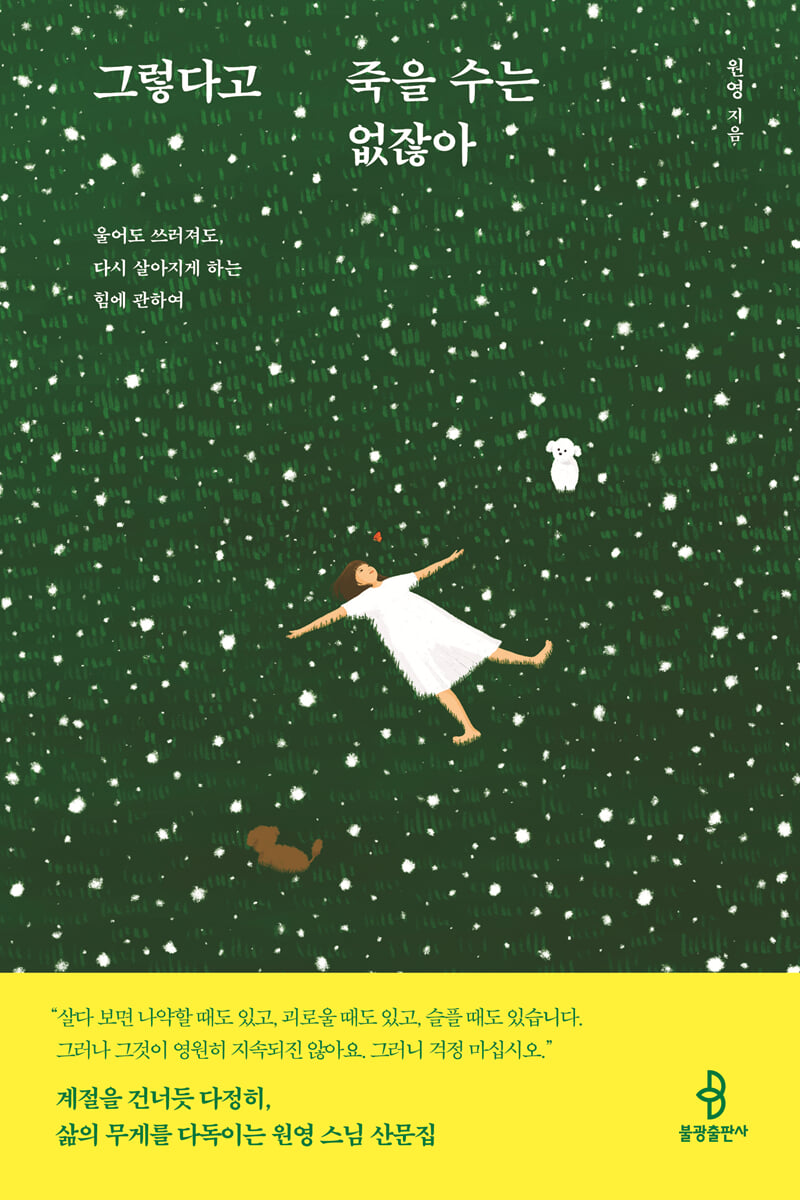
But I can't die like that
 |
Description
Book Introduction
“Don’t worry, I won’t die.”
As affectionately as the seasons pass by,
A collection of essays by Monk Wonyeong that lightens the burden of life
There was a tomb with the inscription, 'The happiest man in the world.'
A man who was curious about who the owner of the tomb was dug up the grave secretly at night and found the coffin empty.
In other words, the unborn are the happiest! This irony perfectly reflects the state of mind of us living today.
“I Can’t Die Like That” is a message of comfort and support from Monk Won-yeong to modern people who live each moment as if enduring.
Even though it may be tiring, difficult, and painful at times, it gives us hope that life is worth living.
The deep affirmation toward life that can be gained by facing reality, the sentences that give you the courage to sit down with yourself, continue gently but firmly.
“People are afraid of the future.
I feel a sense of loss about giving up on my dreams.
But if it gets too hard, you can give up, right? You can quit, right? Giving up on your dream isn't going to be a big deal, and it's not like you're going to die right away.
Monk Wonyoung says that even ‘giving up’ can be another name for wisdom and courage.
The lesson is that life becomes worth living only when we clearly know what we must give up for what we cannot give up.
In this way, this book makes life lighter and easier by reviving a vivid sense of the reality of life that we have tried hard to ignore but must ultimately face.
In a way that lets you take off the weight of life you've built up, piece by piece.
As affectionately as the seasons pass by,
A collection of essays by Monk Wonyeong that lightens the burden of life
There was a tomb with the inscription, 'The happiest man in the world.'
A man who was curious about who the owner of the tomb was dug up the grave secretly at night and found the coffin empty.
In other words, the unborn are the happiest! This irony perfectly reflects the state of mind of us living today.
“I Can’t Die Like That” is a message of comfort and support from Monk Won-yeong to modern people who live each moment as if enduring.
Even though it may be tiring, difficult, and painful at times, it gives us hope that life is worth living.
The deep affirmation toward life that can be gained by facing reality, the sentences that give you the courage to sit down with yourself, continue gently but firmly.
“People are afraid of the future.
I feel a sense of loss about giving up on my dreams.
But if it gets too hard, you can give up, right? You can quit, right? Giving up on your dream isn't going to be a big deal, and it's not like you're going to die right away.
Monk Wonyoung says that even ‘giving up’ can be another name for wisdom and courage.
The lesson is that life becomes worth living only when we clearly know what we must give up for what we cannot give up.
In this way, this book makes life lighter and easier by reviving a vivid sense of the reality of life that we have tried hard to ignore but must ultimately face.
In a way that lets you take off the weight of life you've built up, piece by piece.
- You can preview some of the book's contents.
Preview
index
prolog
Part 1 Spring, but I can't not do it
Has fate dealt you a bad card?
Look into the mirror at the bottom of your heart
If you just blindly insist on something, you'll end up making mistakes.
Even birds return to their nests when they are tired.
Trust in the one who protects your back
I hope for a better life than a machine.
Part 2 Summer, but I can't cry
Who sowed the seeds of conflict?
Discrimination darkens everyone's heart.
Looking back, it was just a weak shield
Everything takes time.
I can't just cry all the time
Don't worry! I won't die.
Part 3 Fall, but we can't fight
To get along well with solitude
Thoughts on the Road
Are you okay now?
They say even sweet potatoes have a story.
If you're going to live, live in harmony.
I am who I am because of you
Part 4 Winter, But I Can't Die
First of all, let's see if it's trash or not.
Every day, every moment remains
But I can't die like that
To not leave any residue in the heart
You can't live a life where you achieve everything you want.
May you live in pieces among the Buddhas
Epilogue
Part 1 Spring, but I can't not do it
Has fate dealt you a bad card?
Look into the mirror at the bottom of your heart
If you just blindly insist on something, you'll end up making mistakes.
Even birds return to their nests when they are tired.
Trust in the one who protects your back
I hope for a better life than a machine.
Part 2 Summer, but I can't cry
Who sowed the seeds of conflict?
Discrimination darkens everyone's heart.
Looking back, it was just a weak shield
Everything takes time.
I can't just cry all the time
Don't worry! I won't die.
Part 3 Fall, but we can't fight
To get along well with solitude
Thoughts on the Road
Are you okay now?
They say even sweet potatoes have a story.
If you're going to live, live in harmony.
I am who I am because of you
Part 4 Winter, But I Can't Die
First of all, let's see if it's trash or not.
Every day, every moment remains
But I can't die like that
To not leave any residue in the heart
You can't live a life where you achieve everything you want.
May you live in pieces among the Buddhas
Epilogue
Detailed image

Into the book
Every year, my goal is to just endure the storms of worldly events without getting caught up in them.
Last year, those concerns were even greater.
In the meantime, the places of those who had left were indifferently filled with new scenery as if nothing had happened.
This is truly an impermanent change.
Your Majesty! Look at your feet!
Actually, my life hasn't really changed even though the year has changed.
Today, too, I go to a small hermitage to see Buddha and offer incense.
--- p.17
In modern society, we are always running, and running seems to have become a habit.
But there comes a time when each of us must stop.
Even as I write this, I can't stop and keep doing something, but I know there are times when I have to stop.
So, even though I am always busy, I try to stay calm and not get caught up in work, and when I sense danger, I try to clear my mind of distracting thoughts and regain peace of mind.
Because I know better than anyone that we shouldn't just let good and bad emotions swirl around.
--- p.35
When I look back on the times of turning points that made me bitter, it was all due to my futile expectations and greed.
Everyone has their own life, but how foolish is it to arbitrarily judge someone else's life and cut off ties?
All my inner conflicts were due to my own greed.
Whether it's a person or an object, there is no end to what one wants.
--- p.82
A life where one thing comes after another, a life that can only be endured if one regards it as a practice.
But no one has ever told you to live like that, so burn yourself and dye yourself beautifully, and that's not bad, it seems like the flowers next to you are cheering you on.
I truly feel at peace thanks to the flowers dozing in the leisurely sunlight halfway up the eaves, patting me on the back.
--- p.127
We seem to live our lives too easily forgetting the obvious truth that every day, every moment, is a reward.
I want to walk the path of life where I can live wisely and freely, keeping my duties even in small actions.
Last year, those concerns were even greater.
In the meantime, the places of those who had left were indifferently filled with new scenery as if nothing had happened.
This is truly an impermanent change.
Your Majesty! Look at your feet!
Actually, my life hasn't really changed even though the year has changed.
Today, too, I go to a small hermitage to see Buddha and offer incense.
--- p.17
In modern society, we are always running, and running seems to have become a habit.
But there comes a time when each of us must stop.
Even as I write this, I can't stop and keep doing something, but I know there are times when I have to stop.
So, even though I am always busy, I try to stay calm and not get caught up in work, and when I sense danger, I try to clear my mind of distracting thoughts and regain peace of mind.
Because I know better than anyone that we shouldn't just let good and bad emotions swirl around.
--- p.35
When I look back on the times of turning points that made me bitter, it was all due to my futile expectations and greed.
Everyone has their own life, but how foolish is it to arbitrarily judge someone else's life and cut off ties?
All my inner conflicts were due to my own greed.
Whether it's a person or an object, there is no end to what one wants.
--- p.82
A life where one thing comes after another, a life that can only be endured if one regards it as a practice.
But no one has ever told you to live like that, so burn yourself and dye yourself beautifully, and that's not bad, it seems like the flowers next to you are cheering you on.
I truly feel at peace thanks to the flowers dozing in the leisurely sunlight halfway up the eaves, patting me on the back.
--- p.127
We seem to live our lives too easily forgetting the obvious truth that every day, every moment, is a reward.
I want to walk the path of life where I can live wisely and freely, keeping my duties even in small actions.
--- p.168
Publisher's Review
Existential comfort expressed in the language of a practitioner
Soothing an anxious mind
The best peace of mind essay!
Monk Wonyeong's writings have a unique flavor.
When I read, my mind becomes at ease.
After reading it, I feel relieved and think, 'Okay, that's okay.'
That is because the monk's writings are honest and transparent.
Because it contains a deep and honest story rather than exaggerated words of comfort.
So, after closing the book, each and every sentence remains in your memory for a long time.
Over the years, Monk Wonyoung has encountered countless stories through broadcasts, lectures, and conversations with people who visit the temple.
As a practitioner, I have been thinking hard about life's problems for a long time.
Those experiences form the basis of this book.
The monk confesses his inner conflicts and waverings openly as a monk and as a person.
The moments when raw emotions burst out, the emotional wounds inflicted in relationships, and the recurring waves of exhaustion and recovery in daily life are expressed in the language of honest experience.
Thanks to this, the monk's writings are not confined to religious doctrines, but they also do not lose the depth of practice.
“What really matters is not what you hold onto now.
If any passion causes me anger or pain, I need to cool it down first.
“It’s good to keep going on the path you’re on without stopping, but if you’re tired and struggling, wouldn’t it be necessary to take a breather first?”
The sermon of Great Master Dharma, the first patriarch of Seon Buddhism, is called the Ansim Dharma Gate.
It means a teaching that comforts a troubled mind.
The same goes for Monk Wonyoung’s writings.
It allows us to see clearly why we are suffering now and what is the nature of the suffering that is causing us pain.
Facing and acknowledging it allows us to take a step back from our fears and obsessions.
The message that the monk conveys through this, “It’s okay to let go,” is not an invitation to give up.
Herein is engraved the principle of life, cultivated through deep thought and reflection, that the moment one puts down and empties, one becomes full again.
How about relaxing your clenched fists a bit?
Sometimes it's okay to cry and fall down,
Spring will come soon!
This book is a testimony of the life of Monk Wonyoung as a human being.
In front of that confident and vivid confession, readers learn again the original value of existence: 'It's okay not to be perfect.'
The monk asks us, who live every day as if we are struggling.
‘Will it be enough to live like that, enduring like that?’ ‘If I grit my teeth, grip my hands tightly, and endure, will happiness suddenly appear at some point?’ In the monk’s view, life doesn’t flow like that.
Rather, happiness reveals itself only when we face the reality before our eyes, acknowledge our greed and reality, and silently carry out what we must do.
This is the driving force that keeps us going in life, even if we cry or fall down.
The point is that when you have the strength to stand up on your own, rather than being pushed by someone from behind, the wrinkles in your heart will gradually unfold.
This book is aimed at ‘everyone,’ but at the moment of reading, it is aimed only at ‘me.’
It whispers to me how to live at a pace that suits me today, at a pace that my senses can handle.
Never persuade with a loud voice.
He gently suggests that you relax, take a breath, and take another step.
As each chapter progresses, readers will feel the weight of life on their shoulders gradually lighten.
It is not because the size of life has become smaller, but because in between, a ‘place’ has been created where I can exist solely as myself.
As time passes by, naturally changing with the seasons, our lives become more profound as time deepens.
And finally you will know.
As the monk said, “Spring is always coming from somewhere.”
** 『The Power to Bring Us Back to Life』 by Monk Wonyoung **
1.
Impermanence - Suffering is not eternal
No matter how great the pain, it does not last forever.
As time passes and the seasons change, the storm in our hearts will eventually subside.
2.
Relationships and Solidarity - Life is reborn through connection.
When we feel like we're about to completely fall apart, there's someone who stands behind us and watches over us.
That connection brings life back to life.
3.
The Inner Spark - The Unquenchable Flame Within Us
Everyone has a 'will to live' and an innate desire to find happiness, even if it's just a little.
Even if we cry and fall, we rise again because that spark never completely goes out.
4.
Emptiness and Newness - Letting Go Opens a New Path
When we let go of past pain and attachments, space is created for new hope to enter.
Soothing an anxious mind
The best peace of mind essay!
Monk Wonyeong's writings have a unique flavor.
When I read, my mind becomes at ease.
After reading it, I feel relieved and think, 'Okay, that's okay.'
That is because the monk's writings are honest and transparent.
Because it contains a deep and honest story rather than exaggerated words of comfort.
So, after closing the book, each and every sentence remains in your memory for a long time.
Over the years, Monk Wonyoung has encountered countless stories through broadcasts, lectures, and conversations with people who visit the temple.
As a practitioner, I have been thinking hard about life's problems for a long time.
Those experiences form the basis of this book.
The monk confesses his inner conflicts and waverings openly as a monk and as a person.
The moments when raw emotions burst out, the emotional wounds inflicted in relationships, and the recurring waves of exhaustion and recovery in daily life are expressed in the language of honest experience.
Thanks to this, the monk's writings are not confined to religious doctrines, but they also do not lose the depth of practice.
“What really matters is not what you hold onto now.
If any passion causes me anger or pain, I need to cool it down first.
“It’s good to keep going on the path you’re on without stopping, but if you’re tired and struggling, wouldn’t it be necessary to take a breather first?”
The sermon of Great Master Dharma, the first patriarch of Seon Buddhism, is called the Ansim Dharma Gate.
It means a teaching that comforts a troubled mind.
The same goes for Monk Wonyoung’s writings.
It allows us to see clearly why we are suffering now and what is the nature of the suffering that is causing us pain.
Facing and acknowledging it allows us to take a step back from our fears and obsessions.
The message that the monk conveys through this, “It’s okay to let go,” is not an invitation to give up.
Herein is engraved the principle of life, cultivated through deep thought and reflection, that the moment one puts down and empties, one becomes full again.
How about relaxing your clenched fists a bit?
Sometimes it's okay to cry and fall down,
Spring will come soon!
This book is a testimony of the life of Monk Wonyoung as a human being.
In front of that confident and vivid confession, readers learn again the original value of existence: 'It's okay not to be perfect.'
The monk asks us, who live every day as if we are struggling.
‘Will it be enough to live like that, enduring like that?’ ‘If I grit my teeth, grip my hands tightly, and endure, will happiness suddenly appear at some point?’ In the monk’s view, life doesn’t flow like that.
Rather, happiness reveals itself only when we face the reality before our eyes, acknowledge our greed and reality, and silently carry out what we must do.
This is the driving force that keeps us going in life, even if we cry or fall down.
The point is that when you have the strength to stand up on your own, rather than being pushed by someone from behind, the wrinkles in your heart will gradually unfold.
This book is aimed at ‘everyone,’ but at the moment of reading, it is aimed only at ‘me.’
It whispers to me how to live at a pace that suits me today, at a pace that my senses can handle.
Never persuade with a loud voice.
He gently suggests that you relax, take a breath, and take another step.
As each chapter progresses, readers will feel the weight of life on their shoulders gradually lighten.
It is not because the size of life has become smaller, but because in between, a ‘place’ has been created where I can exist solely as myself.
As time passes by, naturally changing with the seasons, our lives become more profound as time deepens.
And finally you will know.
As the monk said, “Spring is always coming from somewhere.”
** 『The Power to Bring Us Back to Life』 by Monk Wonyoung **
1.
Impermanence - Suffering is not eternal
No matter how great the pain, it does not last forever.
As time passes and the seasons change, the storm in our hearts will eventually subside.
2.
Relationships and Solidarity - Life is reborn through connection.
When we feel like we're about to completely fall apart, there's someone who stands behind us and watches over us.
That connection brings life back to life.
3.
The Inner Spark - The Unquenchable Flame Within Us
Everyone has a 'will to live' and an innate desire to find happiness, even if it's just a little.
Even if we cry and fall, we rise again because that spark never completely goes out.
4.
Emptiness and Newness - Letting Go Opens a New Path
When we let go of past pain and attachments, space is created for new hope to enter.
GOODS SPECIFICS
- Date of issue: October 13, 2025
- Page count, weight, size: 200 pages | 280g | 140*210*15mm
- ISBN13: 9791172612092
- ISBN10: 1172612099
You may also like
카테고리
korean


korean

![GQ KOREA Mark (Monthly): December [2025]](http://librairie.coreenne.fr/cdn/shop/files/8ef265dbbfbf186523ed75ba7319009d.jpg?v=1765340328&width=3840)


