

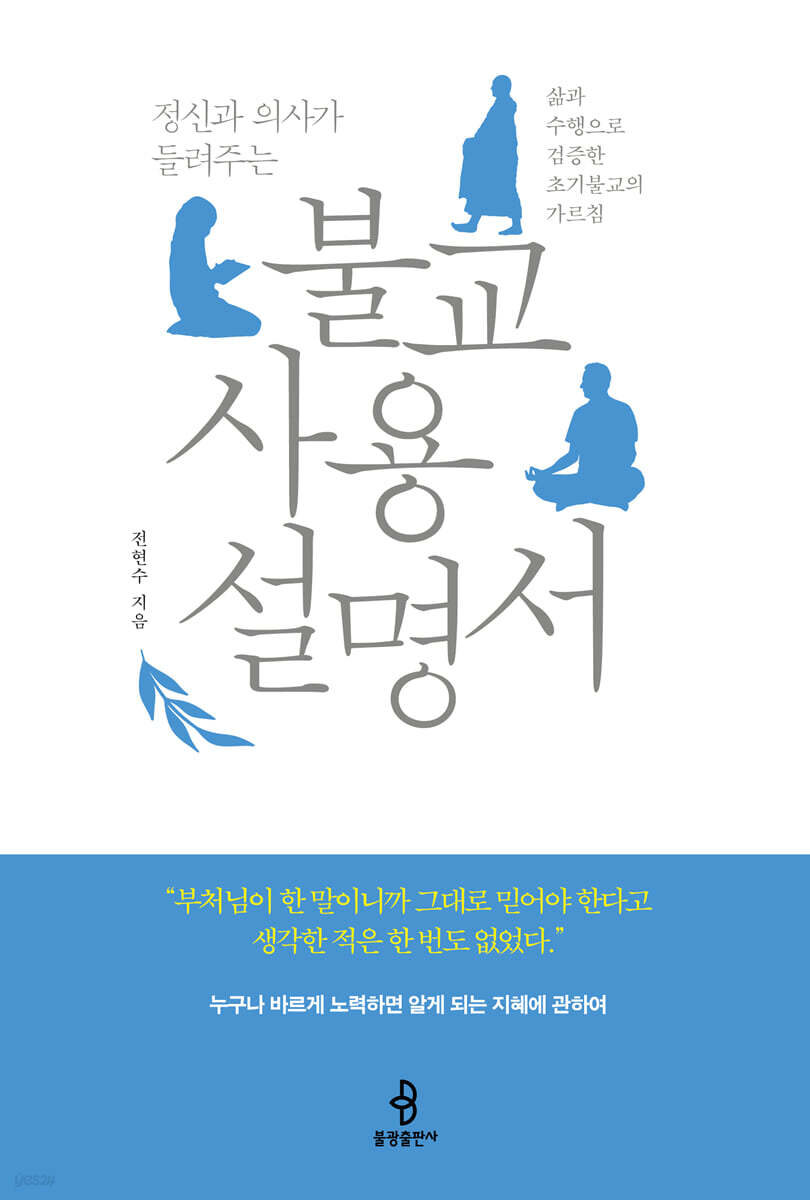
A Psychiatrist's Guide to Buddhism
 |
Description
Book Introduction
Dr. Jeon Hyeon-su, who pioneered the field of ‘Buddhist psychotherapy’ for the first time in Korea,
Speaking of Buddhism, proven through 40 years of study and practice!
Buddhism as wisdom for life, not as knowledge
A Guide to Making the Buddha's Teachings Your Own
There is a big difference between knowing something by learning it and experiencing it firsthand.
If the former is knowledge, the latter is enlightenment.
As you know, Buddhism places importance on enlightenment, that is, truth as an experience.
Only then can knowledge truly touch your skin and true change in life become possible.
Dr. Jeon Hyeon-su, a psychiatrist and early Buddhist practitioner, is a lay Buddhist who has studied and practiced the teachings of Buddha for over 40 years.
He was the first in Korea to incorporate Buddhism into psychotherapy, opening the horizon of ‘Buddhist psychotherapy.’ He shares the teachings of Buddha, which he has personally experienced and verified, with others through lectures and writings.
"A Psychiatrist's Guide to Buddhism" is a book in which Dr. Jeon Hyeon-su has compiled teachings that are helpful to life by condensing his lifelong study of Buddhism.
It is not just the Buddha's words or the scriptures, but it contains teachings that many people should learn and follow, as it is universal wisdom of life for everyone.
Speaking of Buddhism, proven through 40 years of study and practice!
Buddhism as wisdom for life, not as knowledge
A Guide to Making the Buddha's Teachings Your Own
There is a big difference between knowing something by learning it and experiencing it firsthand.
If the former is knowledge, the latter is enlightenment.
As you know, Buddhism places importance on enlightenment, that is, truth as an experience.
Only then can knowledge truly touch your skin and true change in life become possible.
Dr. Jeon Hyeon-su, a psychiatrist and early Buddhist practitioner, is a lay Buddhist who has studied and practiced the teachings of Buddha for over 40 years.
He was the first in Korea to incorporate Buddhism into psychotherapy, opening the horizon of ‘Buddhist psychotherapy.’ He shares the teachings of Buddha, which he has personally experienced and verified, with others through lectures and writings.
"A Psychiatrist's Guide to Buddhism" is a book in which Dr. Jeon Hyeon-su has compiled teachings that are helpful to life by condensing his lifelong study of Buddhism.
It is not just the Buddha's words or the scriptures, but it contains teachings that many people should learn and follow, as it is universal wisdom of life for everyone.
- You can preview some of the book's contents.
Preview
index
introduction
1 Gotama Buddha
Complete enlightenment and the proof of enlightenment│The process of enlightenment revealed by the Buddha│The ten marks of the Tathagata, the ten powers of the Tathagata, and the four fearlessnesses│Faith and precepts│The Buddha's consideration for other religions and heretics│The fruits of giving│The three types of people│The rumor that the Buddha is a magician│Make yourself and the Dharma your island│The sutras, the Vinaya, and the treatises
2 Teachings of Early Buddhism
Emptiness in Early Buddhism│No Record, No Explanation│The Destructive Power of Fire, Greed, Hatred, and Ignorance│Training to Control Wisdom and the Mind│Conflict Resolution│Things to Be Abandoned│Keeping Precepts, the Foundation of Buddhist Study and Practice│Miracles of Supernatural Powers and Teachings│Rahula, Never Be Born Again│Sutras That Protect You When Recited
3. Reincarnation and Karma
There is reincarnation│There is a god│Being born as a human│What is karma│The law of karma and reincarnation 1: Ordinary people and saints│The law of karma and reincarnation 2: Types of karma│The law of karma and reincarnation 3: Conditions for bringing about results│The law of karma and reincarnation 4: Cessation of karma│The law of karma and reincarnation 5: To become a stream-enterer
4 Body, Feelings, Mind, and Dharma
Why is the practice of the Four Foundations of Mindfulness important? │ Right Mindfulness, Right Mindfulness │ Summary of the Maha-Mindfulness Sutra │ Foundation of Mindfulness 1: Mindfulness of in-breath and out-breath │ Foundation of Mindfulness 2: The Four Postures, Clearly Noting │ Foundation of Mindfulness 3: Contemplation of the Thirty-Two Aversions of the Body, Four Great Aggregates, and the Cemetery │ Foundation of Mindfulness and the Mind-Mindfulness of the Mind │ Foundation of Mindfulness 1: Five Obstacles and Five Aggregates, Six Sense-Bases and Fetters │ Foundation of Mindfulness 2: Seven Factors of Enlightenment │ Foundation of Mindfulness 3: Four Noble Truths ① Noble Truth of Suffering, Noble Truth of the Origin of Suffering │ Foundation of Mindfulness 4: Four Noble Truths ② Noble Truth of Cessation, Noble Truth of the Path
5 Final Teachings
The Buddha's final footsteps in the Mahaparinirvana Sutra│Escape from reincarnation to enlightenment│The final retreat, hints of nirvana│The eightfold rule and eightfold liberation│The division of Bodhi into four great powers, the final offering│Under a pair of sala trees│The last disciple, the final instruction│The Buddha's parinirvana│Now, when the Buddha is no longer present
1 Gotama Buddha
Complete enlightenment and the proof of enlightenment│The process of enlightenment revealed by the Buddha│The ten marks of the Tathagata, the ten powers of the Tathagata, and the four fearlessnesses│Faith and precepts│The Buddha's consideration for other religions and heretics│The fruits of giving│The three types of people│The rumor that the Buddha is a magician│Make yourself and the Dharma your island│The sutras, the Vinaya, and the treatises
2 Teachings of Early Buddhism
Emptiness in Early Buddhism│No Record, No Explanation│The Destructive Power of Fire, Greed, Hatred, and Ignorance│Training to Control Wisdom and the Mind│Conflict Resolution│Things to Be Abandoned│Keeping Precepts, the Foundation of Buddhist Study and Practice│Miracles of Supernatural Powers and Teachings│Rahula, Never Be Born Again│Sutras That Protect You When Recited
3. Reincarnation and Karma
There is reincarnation│There is a god│Being born as a human│What is karma│The law of karma and reincarnation 1: Ordinary people and saints│The law of karma and reincarnation 2: Types of karma│The law of karma and reincarnation 3: Conditions for bringing about results│The law of karma and reincarnation 4: Cessation of karma│The law of karma and reincarnation 5: To become a stream-enterer
4 Body, Feelings, Mind, and Dharma
Why is the practice of the Four Foundations of Mindfulness important? │ Right Mindfulness, Right Mindfulness │ Summary of the Maha-Mindfulness Sutra │ Foundation of Mindfulness 1: Mindfulness of in-breath and out-breath │ Foundation of Mindfulness 2: The Four Postures, Clearly Noting │ Foundation of Mindfulness 3: Contemplation of the Thirty-Two Aversions of the Body, Four Great Aggregates, and the Cemetery │ Foundation of Mindfulness and the Mind-Mindfulness of the Mind │ Foundation of Mindfulness 1: Five Obstacles and Five Aggregates, Six Sense-Bases and Fetters │ Foundation of Mindfulness 2: Seven Factors of Enlightenment │ Foundation of Mindfulness 3: Four Noble Truths ① Noble Truth of Suffering, Noble Truth of the Origin of Suffering │ Foundation of Mindfulness 4: Four Noble Truths ② Noble Truth of Cessation, Noble Truth of the Path
5 Final Teachings
The Buddha's final footsteps in the Mahaparinirvana Sutra│Escape from reincarnation to enlightenment│The final retreat, hints of nirvana│The eightfold rule and eightfold liberation│The division of Bodhi into four great powers, the final offering│Under a pair of sala trees│The last disciple, the final instruction│The Buddha's parinirvana│Now, when the Buddha is no longer present
Detailed image

Into the book
The more we understand the Buddha, the more accurately we can see Buddhism and accept the Buddha's teachings internally.
Therefore, we must strive to know the Buddha.
I think that when we understand Buddha, we should focus on the fact that he is 'a person who has made unimaginable efforts.'
I can confidently say that when we try to understand the Buddha's efforts, Buddhism will become clear, and only by following that path will we know what to practice, and anyone who makes as much effort as the Buddha can attain enlightenment.
--- p.32
The world happens according to the law of cause and effect, but because we cannot see it as it is, we either pull it or push it away.
Not seeing things as they are is foolishness, pulling is desire, and pushing is anger.
Anger manifests itself as frowning and getting angry, but it is fundamentally a denial of what has already happened.
The way to extinguish these desires, anger, and foolishness is the Middle Way, the Noble Eightfold Path, and anyone can come and see it and know it for themselves.
--- p.82
The practice on the ball can begin from where you are sitting right now.
Once we eliminate one by one the things that make us tired, troubled, and exhausted, and reach a state where there are no representations of 'this is always, this is enjoyable, this is mine' while sitting, we can go beyond the limitations of 'anicca, suffering, and non-self have limitations, and this too is formed' and reach the state of arhat.
We must get rid of things that do not serve us and attain a state of emptiness.
This is the Buddha's teaching about emptiness.
--- p.134
When you want to reveal a secret story to the public, you must first confirm whether the story is true or not.
Even if it is true, we must consider whether the story is worth telling and whether it can benefit the other person.
Never tell secret stories that are neither true nor untrue and that cannot be of any benefit.
In fact, truth and profit must all be met.
Then, you have to look at the timing and speak with appropriate expressions.
Only when you have these five things can you tell a secret story.
--- p.185
When you get selected, there is joy and happiness.
The function of the mind is feeling and perception.
Since there are always feelings and perceptions when there is mental activity, we practice inhaling and exhaling while experiencing them.
Regarding this, the 『Treatise on Purity』 explains that the water temperature (the aggregate of feelings) and the sang temperature (the aggregate of perceptions) are the functions of the mind.
And he said that we should know that we 'experience the functioning of the mind' through the four dhyanas: the first, second, third, and fourth dhyanas.
When there is a selection, it means looking at the feeling and perception that is there at that time.
--- p.243
The causes of desperation are birth, aging, illness, and death.
If you know that you are born, grow old, get sick, and die, you must prepare with a sense of urgency.
A person who becomes a monk, studies Buddhism, and practices diligently is a person who has developed a very strong sense of urgency.
I think urgency is the most important thing.
People with a desperate heart study Buddhism diligently and make study and practice the top priorities in their lives.
On the other hand, people who don't feel a sense of urgency tend to waste time.
--- p.296
There is something I often hear from people I meet in the clinic.
“I don’t know what the meaning of life is. I don’t know why I should live. Life is too painful. It’s boring and difficult.” If they believe in Buddhism or are interested in it, I answer them like this when the time is right.
“You must become a stream-entry person in this life.” We will reincarnate when our life ends.
But we have three paths.
There is a path that continues to flow and reincarnate, a path that ends reincarnation, and a path of Bodhisattva.
When we read the Nikaya, we see that the Buddha tells us to “end the cycle of reincarnation and become an arhat.”
If we follow these words well, we can live a life that ends the cycle of reincarnation.
Therefore, we must strive to know the Buddha.
I think that when we understand Buddha, we should focus on the fact that he is 'a person who has made unimaginable efforts.'
I can confidently say that when we try to understand the Buddha's efforts, Buddhism will become clear, and only by following that path will we know what to practice, and anyone who makes as much effort as the Buddha can attain enlightenment.
--- p.32
The world happens according to the law of cause and effect, but because we cannot see it as it is, we either pull it or push it away.
Not seeing things as they are is foolishness, pulling is desire, and pushing is anger.
Anger manifests itself as frowning and getting angry, but it is fundamentally a denial of what has already happened.
The way to extinguish these desires, anger, and foolishness is the Middle Way, the Noble Eightfold Path, and anyone can come and see it and know it for themselves.
--- p.82
The practice on the ball can begin from where you are sitting right now.
Once we eliminate one by one the things that make us tired, troubled, and exhausted, and reach a state where there are no representations of 'this is always, this is enjoyable, this is mine' while sitting, we can go beyond the limitations of 'anicca, suffering, and non-self have limitations, and this too is formed' and reach the state of arhat.
We must get rid of things that do not serve us and attain a state of emptiness.
This is the Buddha's teaching about emptiness.
--- p.134
When you want to reveal a secret story to the public, you must first confirm whether the story is true or not.
Even if it is true, we must consider whether the story is worth telling and whether it can benefit the other person.
Never tell secret stories that are neither true nor untrue and that cannot be of any benefit.
In fact, truth and profit must all be met.
Then, you have to look at the timing and speak with appropriate expressions.
Only when you have these five things can you tell a secret story.
--- p.185
When you get selected, there is joy and happiness.
The function of the mind is feeling and perception.
Since there are always feelings and perceptions when there is mental activity, we practice inhaling and exhaling while experiencing them.
Regarding this, the 『Treatise on Purity』 explains that the water temperature (the aggregate of feelings) and the sang temperature (the aggregate of perceptions) are the functions of the mind.
And he said that we should know that we 'experience the functioning of the mind' through the four dhyanas: the first, second, third, and fourth dhyanas.
When there is a selection, it means looking at the feeling and perception that is there at that time.
--- p.243
The causes of desperation are birth, aging, illness, and death.
If you know that you are born, grow old, get sick, and die, you must prepare with a sense of urgency.
A person who becomes a monk, studies Buddhism, and practices diligently is a person who has developed a very strong sense of urgency.
I think urgency is the most important thing.
People with a desperate heart study Buddhism diligently and make study and practice the top priorities in their lives.
On the other hand, people who don't feel a sense of urgency tend to waste time.
--- p.296
There is something I often hear from people I meet in the clinic.
“I don’t know what the meaning of life is. I don’t know why I should live. Life is too painful. It’s boring and difficult.” If they believe in Buddhism or are interested in it, I answer them like this when the time is right.
“You must become a stream-entry person in this life.” We will reincarnate when our life ends.
But we have three paths.
There is a path that continues to flow and reincarnate, a path that ends reincarnation, and a path of Bodhisattva.
When we read the Nikaya, we see that the Buddha tells us to “end the cycle of reincarnation and become an arhat.”
If we follow these words well, we can live a life that ends the cycle of reincarnation.
--- p.365
Publisher's Review
The moment you gain wisdom, not knowledge,
All the troubles of life are solved!
For those who learn and practice Buddhism
A Buddhist User's Manual
There are many groundbreaking stories among the Buddha's words.
For example, in the early Buddhist scripture, the Anguttara Nikaya, the Bhaddiya Sutta, there is a passage like this:
“Baddiya, do not listen to what you hear through hearsay.
Do not believe everything that has been passed down from generation to generation or is in the scriptures.
“Do not follow something at face value, even if you think it is logical, even if you think it is a reasonable reason, even if you think it is consistent with your own opinions, even if it is the words of a powerful person or a teacher.”
This is no different from saying that we should not believe and follow even the Buddha's words as they are.
Usually, if you are the leader of a religion, or even just a small group, you would emphasize that people should believe and follow your words, but Buddha said the exact opposite.
Why would that be? As you know, Buddha was someone who discovered the truth of the world, not someone who created something new from nothing.
He enlightened us to what was originally there, and showed us the way so that anyone can know it.
However, this truth is not simply 'knowledge' that can be understood with the head, but something that must be experienced with the whole body and mind.
Therefore, Buddha emphasized ‘knowledge through individual acquisition.’
Only then can knowledge become wisdom, and with that wisdom, we can change our lives.
“A Psychiatrist’s Guide to Buddhism” is a book for those who want to “know” about Buddhism, as well as those who “want” to practice Buddhism.
The author, who was so devoted to Buddhism that he closed his practice twice to focus on meditation, has compiled the teachings of Buddha verified through his experience over 40 years.
Reading the book's preface gives you a sense of how seriously it was written.
Moreover, the author's unique confidence and belief in the study and practice of Buddhism can be felt.
“While studying Buddhism, I never once thought that I had to believe what the Buddha said just because it was true.
I tried to find out if what the Buddha said was true.
Of course, there were some parts that were difficult for me to gauge.
The more I did so, the more I focused on my practice by diligently reading scriptures and professional books, and I also met and listened to the sermons of those who had studied and practiced before me.
So, 40 years passed.
Now, I want to share Buddhism with people as a truth that has been verified through my own experience and practice.”
- From the introduction
Buddhism is often said to be a religion of self-creation.
It means that one will receive enlightenment or suffering according to one's own actions, not through the help of an absolute being or someone else.
For those who believe in this law of cause and effect, this book is an excellent reference.
This is because I have lived that life more thoroughly than anyone else, and this book was born as a result of that process.
Let life become truth!
The only secret to change and happiness,
Five Core Teachings of Early Buddhism
『A Psychiatrist's Guide to Buddhism』 consists of five chapters.
Chapter 1 reveals the specific process by which the historical figure Gotama Buddha achieved enlightenment and the Buddha's abilities.
This shows us what kind of human image we should pursue.
Chapter 2 then explains the core doctrines of early Buddhism, Chapter 3 discusses reincarnation and karma, Chapter 4 details the practice of the four foundations of mindfulness, an early Buddhist practice, and finally Chapter 5 looks back at the Buddha's final teachings, which are like a testament.
So to speak, this book encompasses the core of the Buddha's life and teachings.
Although it is based on early Buddhist scriptures, it is an example for all Buddhists, regardless of their Buddhist tradition.
The Buddha's teachings focus on resolving our sufferings, both big and small.
If you understand and practice the Buddha's teachings, your suffering will gradually decrease.
I too suffered before I encountered the Buddha's teachings.
There were good times, but the suffering continued.
That's why it was so painful at that time, and that's why it was so painful at that time.
As I came into contact with, understood, and practiced the Buddha's teachings, those sufferings began to disappear.
I have found hope that I can live without suffering.
I am convinced that the Buddha's teachings can be of great help in our lives, and that none of them are wrong.
- From the text
Recently, bookstores are flooded with books containing the words of famous philosophers and saints from both the East and the West.
People find comfort, courage, and hope in reading short quotes that contain life's wisdom.
But words are just words.
Reading and writing doesn't change your life.
The key is how to incorporate those good words into my life.
We already know the answer to this question.
It is about living by doing what you have learned.
Let life become truth.
Just as Shakyamuni Buddha, his disciples, and the author of this book did 2,600 years ago.
This is what this book asks of its readers.
It is the only secret to changing, enriching and making your life happy.
All the troubles of life are solved!
For those who learn and practice Buddhism
A Buddhist User's Manual
There are many groundbreaking stories among the Buddha's words.
For example, in the early Buddhist scripture, the Anguttara Nikaya, the Bhaddiya Sutta, there is a passage like this:
“Baddiya, do not listen to what you hear through hearsay.
Do not believe everything that has been passed down from generation to generation or is in the scriptures.
“Do not follow something at face value, even if you think it is logical, even if you think it is a reasonable reason, even if you think it is consistent with your own opinions, even if it is the words of a powerful person or a teacher.”
This is no different from saying that we should not believe and follow even the Buddha's words as they are.
Usually, if you are the leader of a religion, or even just a small group, you would emphasize that people should believe and follow your words, but Buddha said the exact opposite.
Why would that be? As you know, Buddha was someone who discovered the truth of the world, not someone who created something new from nothing.
He enlightened us to what was originally there, and showed us the way so that anyone can know it.
However, this truth is not simply 'knowledge' that can be understood with the head, but something that must be experienced with the whole body and mind.
Therefore, Buddha emphasized ‘knowledge through individual acquisition.’
Only then can knowledge become wisdom, and with that wisdom, we can change our lives.
“A Psychiatrist’s Guide to Buddhism” is a book for those who want to “know” about Buddhism, as well as those who “want” to practice Buddhism.
The author, who was so devoted to Buddhism that he closed his practice twice to focus on meditation, has compiled the teachings of Buddha verified through his experience over 40 years.
Reading the book's preface gives you a sense of how seriously it was written.
Moreover, the author's unique confidence and belief in the study and practice of Buddhism can be felt.
“While studying Buddhism, I never once thought that I had to believe what the Buddha said just because it was true.
I tried to find out if what the Buddha said was true.
Of course, there were some parts that were difficult for me to gauge.
The more I did so, the more I focused on my practice by diligently reading scriptures and professional books, and I also met and listened to the sermons of those who had studied and practiced before me.
So, 40 years passed.
Now, I want to share Buddhism with people as a truth that has been verified through my own experience and practice.”
- From the introduction
Buddhism is often said to be a religion of self-creation.
It means that one will receive enlightenment or suffering according to one's own actions, not through the help of an absolute being or someone else.
For those who believe in this law of cause and effect, this book is an excellent reference.
This is because I have lived that life more thoroughly than anyone else, and this book was born as a result of that process.
Let life become truth!
The only secret to change and happiness,
Five Core Teachings of Early Buddhism
『A Psychiatrist's Guide to Buddhism』 consists of five chapters.
Chapter 1 reveals the specific process by which the historical figure Gotama Buddha achieved enlightenment and the Buddha's abilities.
This shows us what kind of human image we should pursue.
Chapter 2 then explains the core doctrines of early Buddhism, Chapter 3 discusses reincarnation and karma, Chapter 4 details the practice of the four foundations of mindfulness, an early Buddhist practice, and finally Chapter 5 looks back at the Buddha's final teachings, which are like a testament.
So to speak, this book encompasses the core of the Buddha's life and teachings.
Although it is based on early Buddhist scriptures, it is an example for all Buddhists, regardless of their Buddhist tradition.
The Buddha's teachings focus on resolving our sufferings, both big and small.
If you understand and practice the Buddha's teachings, your suffering will gradually decrease.
I too suffered before I encountered the Buddha's teachings.
There were good times, but the suffering continued.
That's why it was so painful at that time, and that's why it was so painful at that time.
As I came into contact with, understood, and practiced the Buddha's teachings, those sufferings began to disappear.
I have found hope that I can live without suffering.
I am convinced that the Buddha's teachings can be of great help in our lives, and that none of them are wrong.
- From the text
Recently, bookstores are flooded with books containing the words of famous philosophers and saints from both the East and the West.
People find comfort, courage, and hope in reading short quotes that contain life's wisdom.
But words are just words.
Reading and writing doesn't change your life.
The key is how to incorporate those good words into my life.
We already know the answer to this question.
It is about living by doing what you have learned.
Let life become truth.
Just as Shakyamuni Buddha, his disciples, and the author of this book did 2,600 years ago.
This is what this book asks of its readers.
It is the only secret to changing, enriching and making your life happy.
GOODS SPECIFICS
- Date of issue: February 17, 2025
- Format: Hardcover book binding method guide
- Page count, weight, size: 640 pages | 904g | 152*225*30mm
- ISBN13: 9791172611347
- ISBN10: 1172611343
You may also like
카테고리
korean


korean

![GQ KOREA Mark (Monthly): December [2025]](http://librairie.coreenne.fr/cdn/shop/files/8ef265dbbfbf186523ed75ba7319009d.jpg?v=1765340328&width=3840)


