

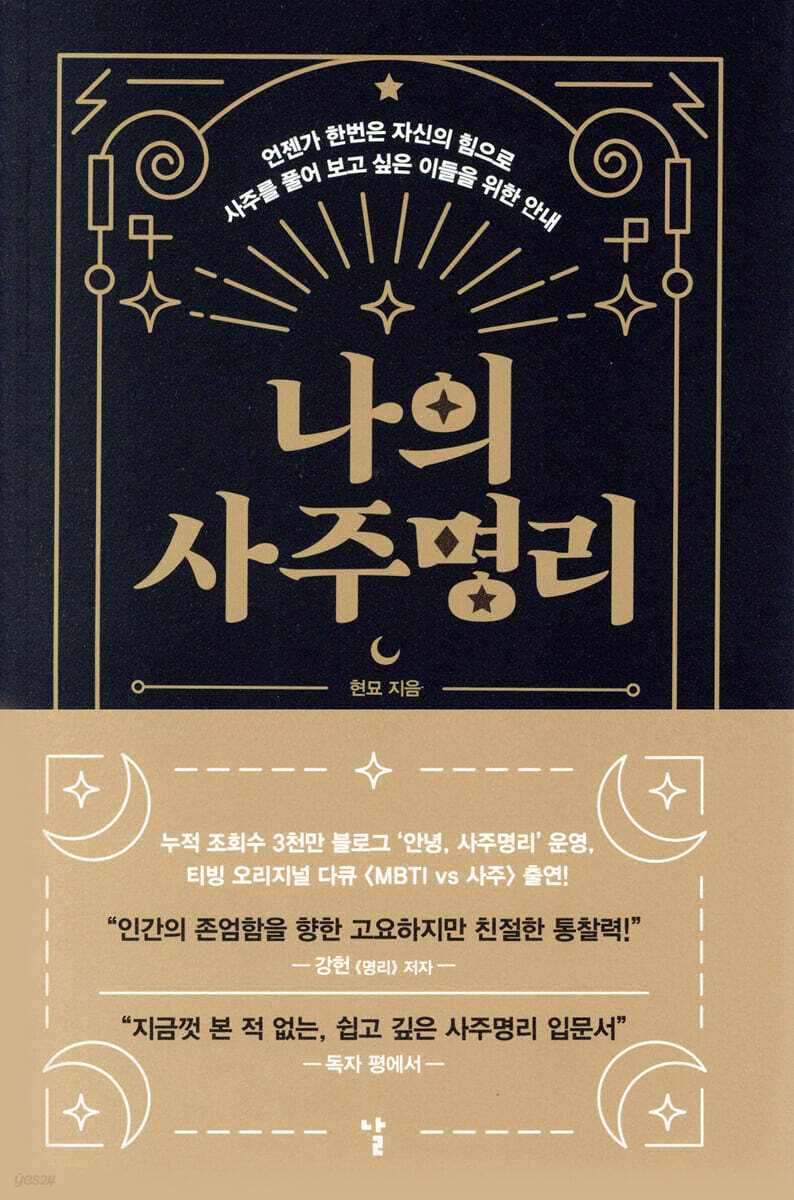
My Four Pillars of Destiny
 |
Description
Book Introduction
“Four Pillars of Destiny is not a talisman to ward off evil, but a way to get to know yourself!”
'My Four Pillars of Destiny', solved with my own hands
Just as there is no night without morning, there is no life without constant suffering.
Everyone knows that life is about good and bad.
Still, when things don't go well or bad things keep happening, it's not easy to avoid talking about fate.
So, at least once, you wonder about the fortune telling of yourself and your life.
'My Four Pillars of Destiny', solved with my own hands
Just as there is no night without morning, there is no life without constant suffering.
Everyone knows that life is about good and bad.
Still, when things don't go well or bad things keep happening, it's not easy to avoid talking about fate.
So, at least once, you wonder about the fortune telling of yourself and your life.
- You can preview some of the book's contents.
Preview
index
prolog
Chapter 1.
perpetual calendar
Numeric Calendar and Meaning Calendar
Four Pillars: Year, Month, Day, and Hour
Ganji, a combination of the heavenly stems and earthly branches
Chapter 2.
Yin-Yang and the Five Elements
Fluid yin and yang
Taegeuk, the symbol of yin and yang
The Five Elements, the five energies that move the universe
Life, what gives life to others
pole, controlling the opponent
The core of Sajumyeongri is the harmony of life and death.
Chapter 3.
Heavenly Stems, the pure meaning of heaven
Ganji, the alphabet of Saju Myeongri
Gapmok A
Eulmok B
Byeonghwa B
Jeonghwa Ding
Muto
Gito
Gyeonggeum
Shin Geum
Imsu
Gyesu
Chapter 4.
Support, harmony on the ground
Support that is deeply related to time
Embroidery
Chukto (丑)
Inmok
Seedling
Jinto
Sahwa (巳)
Ohwa
Mito
Shin Geum-shin
酉
Sulto
Haesu
Chapter 5.
Everything about Saju Myeongri, the Ten Gods
The standard for fortune telling is 'daily'
All about the ten gods and four pillars of destiny
Cowardice (cowardice + fear)
Sik-sang (Sik-sin + Sang-gwan)
Jaeseong (Pyeonjae + Jeongjae)
Inertia (Pyeon-gwan + Jeong-gwan)
Personality (Pyeonin + Jeongin)
A four-pillar fortune with strong Gap-mok power, a four-pillar fortune with strong Eul-mok power, a four-pillar fortune with strong Byeong-hwa power
Sajoo with strong purifying power, Sajoo with strong Muto power, Sajoo with strong Gito power
Sajoo with strong power of Gyeonggeum, Sajoo with strong power of Singeum, Sajoo with strong power of Imsu
The Power of Coefficients in Sajoo · 3 Ways to Interpret Sajoo · Sajoo with Many Cowards
A person with a lot of food, a person with a lot of wealth, a person with a lot of inertia, a person with a lot of humanity
Epilogue
Chapter 1.
perpetual calendar
Numeric Calendar and Meaning Calendar
Four Pillars: Year, Month, Day, and Hour
Ganji, a combination of the heavenly stems and earthly branches
Chapter 2.
Yin-Yang and the Five Elements
Fluid yin and yang
Taegeuk, the symbol of yin and yang
The Five Elements, the five energies that move the universe
Life, what gives life to others
pole, controlling the opponent
The core of Sajumyeongri is the harmony of life and death.
Chapter 3.
Heavenly Stems, the pure meaning of heaven
Ganji, the alphabet of Saju Myeongri
Gapmok A
Eulmok B
Byeonghwa B
Jeonghwa Ding
Muto
Gito
Gyeonggeum
Shin Geum
Imsu
Gyesu
Chapter 4.
Support, harmony on the ground
Support that is deeply related to time
Embroidery
Chukto (丑)
Inmok
Seedling
Jinto
Sahwa (巳)
Ohwa
Mito
Shin Geum-shin
酉
Sulto
Haesu
Chapter 5.
Everything about Saju Myeongri, the Ten Gods
The standard for fortune telling is 'daily'
All about the ten gods and four pillars of destiny
Cowardice (cowardice + fear)
Sik-sang (Sik-sin + Sang-gwan)
Jaeseong (Pyeonjae + Jeongjae)
Inertia (Pyeon-gwan + Jeong-gwan)
Personality (Pyeonin + Jeongin)
A four-pillar fortune with strong Gap-mok power, a four-pillar fortune with strong Eul-mok power, a four-pillar fortune with strong Byeong-hwa power
Sajoo with strong purifying power, Sajoo with strong Muto power, Sajoo with strong Gito power
Sajoo with strong power of Gyeonggeum, Sajoo with strong power of Singeum, Sajoo with strong power of Imsu
The Power of Coefficients in Sajoo · 3 Ways to Interpret Sajoo · Sajoo with Many Cowards
A person with a lot of food, a person with a lot of wealth, a person with a lot of inertia, a person with a lot of humanity
Epilogue
Detailed image
Into the book
Sajumyeongri is an academic and philosophical system that seeks to understand humans based on the eternal calendar.
--- p.17
The characters that make up the 60-year cycle of the calendar are called the Heavenly Stems and Earthly Branches, and these are called Ganji for short.
The Heavenly Stems are composed of 10 and the Earthly Branches are composed of 12, and the combination of the 10 Heavenly Stems and 12 Earthly Branches creates 60 individual units.
These 60 bundles are called Ganji (or 60 Ganji).
--- p.24
Neither yin nor yang are fixed, but are constantly moving in opposite directions.
Stay together and interact constantly.
Maintaining a state of balance by giving and receiving energy in this way is the core function of yin and yang.
--- p.30
The flow of life is not always good.
A natural and smooth flow signifies tranquility, but tranquility hides laziness and boredom.
The charm of the polar relationship is that it breaks the order of peace and drives energy.
In other words, life can be seen as facing extreme changes, and extremes can be seen as finding stability in life.
--- p.43
The first Ganji that announces the beginning of the beginning, Gapmok, is a strong force that breaks through the frozen ground alone when everyone is hiding in the frozen ground.
Because it is a force that has a strong upward effect, people with a strong gapmok want to show themselves confidently.
They like to stand out and have a strong desire to reveal themselves to the whole group at once.
The power to resist injustice, the power to raise one's hand and speak out without hesitation, is the power of the strong.
--- p.57
The Ganji of the year of birth is called the performance, the Ganji of the month of birth is called the monthly pillar, the Ganji of the day of birth is called the daily pillar, and the Ganji of the hour of birth is called the hour pillar.
In this way, one four pillars are made up of four main pillars (four pillars), and in detail, it is made up of eight energies (one pillar is divided into the heavenly stems and earthly branches) (palja).
So, the energy of the day of birth expressed in eight characters is called Sajupalja.
--- p.62
To help understand support, support is likened to animals such as rabbits and dragons, and the characteristics of animals are used to determine fortune, but this is not a correct method.
Animal metaphors should be used sparingly as a means of aiding public understanding.
--- p.130
Embroidery is a support made up of only embroidery and embroidery.
Therefore, it can be said that it is the support that most clearly reveals the characteristics of the water energy.
Therefore, embroidery is full of the energy of wisdom and emotion, which are the characteristics of the water energy.
The wisdom of the water spirit is not an outwardly visible wisdom, but rather a yin intelligence, meaning that it is full of tricks.
Embroidery is a power of many ideas, deep thought, and the secret to overcoming difficult situations.
Also, when embroidering, you cannot leave out emotional power.
It is the power of sensitive and full emotions, but also the factor of depression.
--- p.144
There are still some people who use the year of birth as a standard to determine the four pillars of destiny, but this method has problems.
Because the criteria for Yeonji are too broad.
It is a loose and magical view to group all people within the very broad scope of a year into one standard and think that their good and bad fortunes flow equally.
--- pp.185~186
After the standard called daily came into existence and the relationship with the other seven letters was determined based on that daily standard, the four pillars of destiny finally came down to the human world.
Since defining the daily life as “me,” Saju Myeongri has become not just a philosophy, but a valuable tool for daily life.
--- p.187
Once you understand the daily, you need to figure out what relationship it has with the other seven letters.
This relationship is called the 'Ten Gods'.
--- p.191
If we look at the personality based on the four pillars of destiny where the daily branch is Gap-mok, the Ganji with the same yin and yang as the daily branch is called Pyeon-in among the personalities.
Based on the gapmok (+), the imsu (+) and the seasu (+) correspond to the bias.
If the gapmok and yin and yang are different, it is called a true nature.
Based on the gapmok (+), the coefficient (--- p.) and the number of letters (--- p.) correspond to the person.
The stem and branch that gives birth to the daily life are collectively called human nature, and when subdivided into equal yin and yang, they are called partial, and when the yin and yang are different, they are called jeong-in.
--- p.198
What if there were several people in the same situation as me, but the amount of food available was limited? Those with strong cowards would have no choice but to compete and fight for food to avoid having it taken away.
That way, you won't lose your food.
The more competitors there are, the more competitive the competition becomes.
But if you try to take it too tenaciously, people around you will feel uncomfortable.
Because of this, cowardly people have no virtue.
The cowardly, tenacious spirit, the ability to break through, and the independent attitude all come from this fighting spirit.
--- p.209
The word 'bi-gyeon' means to compare with 'bi' and 'gyeon' means to compare shoulders.
Because the daily, yin and yang, and the five elements are the same energy, it means “having the same direction or movement,” “having the same color,” and “my alter ego.”
--- p.215
Of course, in modern times, the roles and dynamics between men and women have changed, so it can be interpreted the other way around.
In a woman's fortune, Jaeseong is sometimes seen as the husband.
The basic principles of Saju Myungri remain the same, but the interpretation changes according to the times.
When the era of women taking on men begins in earnest, the formula that the female fortune teller's fortune is male may be established.
--- p.237
The Pyungwan was mainly called Salsal rather than Pyungwan.
It focuses on the energy that torments humans, and can be said to be a name that ignores the positivity of the side dish.
--- p.268
If society is extremely stable based on faith and trust, then love can shine greatly.
But in today's world, where daily life is threatened by geopolitical crises and the waves of change are raging, a sense of belonging is a much-needed energy.
To overcome crises and explore new possibilities, we must pay attention to the volatility and potential of the individual.
--- p.288
There are two major meaningful things you can do by studying the Four Pillars of Destiny: first, gaining insight into human existence, and second, predicting future fortunes and misfortunes.
--- p.293
The Four Pillars of Destiny are misunderstood by the world due to too many misunderstandings, speculations, and exaggerations.
The Four Pillars of Destiny is an excellent philosophical system that allows us to gain insight into the principles.
It is also not a shamanistic tool or a magician's wand, but a valuable and effective tool for looking into human life.
--- p.17
The characters that make up the 60-year cycle of the calendar are called the Heavenly Stems and Earthly Branches, and these are called Ganji for short.
The Heavenly Stems are composed of 10 and the Earthly Branches are composed of 12, and the combination of the 10 Heavenly Stems and 12 Earthly Branches creates 60 individual units.
These 60 bundles are called Ganji (or 60 Ganji).
--- p.24
Neither yin nor yang are fixed, but are constantly moving in opposite directions.
Stay together and interact constantly.
Maintaining a state of balance by giving and receiving energy in this way is the core function of yin and yang.
--- p.30
The flow of life is not always good.
A natural and smooth flow signifies tranquility, but tranquility hides laziness and boredom.
The charm of the polar relationship is that it breaks the order of peace and drives energy.
In other words, life can be seen as facing extreme changes, and extremes can be seen as finding stability in life.
--- p.43
The first Ganji that announces the beginning of the beginning, Gapmok, is a strong force that breaks through the frozen ground alone when everyone is hiding in the frozen ground.
Because it is a force that has a strong upward effect, people with a strong gapmok want to show themselves confidently.
They like to stand out and have a strong desire to reveal themselves to the whole group at once.
The power to resist injustice, the power to raise one's hand and speak out without hesitation, is the power of the strong.
--- p.57
The Ganji of the year of birth is called the performance, the Ganji of the month of birth is called the monthly pillar, the Ganji of the day of birth is called the daily pillar, and the Ganji of the hour of birth is called the hour pillar.
In this way, one four pillars are made up of four main pillars (four pillars), and in detail, it is made up of eight energies (one pillar is divided into the heavenly stems and earthly branches) (palja).
So, the energy of the day of birth expressed in eight characters is called Sajupalja.
--- p.62
To help understand support, support is likened to animals such as rabbits and dragons, and the characteristics of animals are used to determine fortune, but this is not a correct method.
Animal metaphors should be used sparingly as a means of aiding public understanding.
--- p.130
Embroidery is a support made up of only embroidery and embroidery.
Therefore, it can be said that it is the support that most clearly reveals the characteristics of the water energy.
Therefore, embroidery is full of the energy of wisdom and emotion, which are the characteristics of the water energy.
The wisdom of the water spirit is not an outwardly visible wisdom, but rather a yin intelligence, meaning that it is full of tricks.
Embroidery is a power of many ideas, deep thought, and the secret to overcoming difficult situations.
Also, when embroidering, you cannot leave out emotional power.
It is the power of sensitive and full emotions, but also the factor of depression.
--- p.144
There are still some people who use the year of birth as a standard to determine the four pillars of destiny, but this method has problems.
Because the criteria for Yeonji are too broad.
It is a loose and magical view to group all people within the very broad scope of a year into one standard and think that their good and bad fortunes flow equally.
--- pp.185~186
After the standard called daily came into existence and the relationship with the other seven letters was determined based on that daily standard, the four pillars of destiny finally came down to the human world.
Since defining the daily life as “me,” Saju Myeongri has become not just a philosophy, but a valuable tool for daily life.
--- p.187
Once you understand the daily, you need to figure out what relationship it has with the other seven letters.
This relationship is called the 'Ten Gods'.
--- p.191
If we look at the personality based on the four pillars of destiny where the daily branch is Gap-mok, the Ganji with the same yin and yang as the daily branch is called Pyeon-in among the personalities.
Based on the gapmok (+), the imsu (+) and the seasu (+) correspond to the bias.
If the gapmok and yin and yang are different, it is called a true nature.
Based on the gapmok (+), the coefficient (--- p.) and the number of letters (--- p.) correspond to the person.
The stem and branch that gives birth to the daily life are collectively called human nature, and when subdivided into equal yin and yang, they are called partial, and when the yin and yang are different, they are called jeong-in.
--- p.198
What if there were several people in the same situation as me, but the amount of food available was limited? Those with strong cowards would have no choice but to compete and fight for food to avoid having it taken away.
That way, you won't lose your food.
The more competitors there are, the more competitive the competition becomes.
But if you try to take it too tenaciously, people around you will feel uncomfortable.
Because of this, cowardly people have no virtue.
The cowardly, tenacious spirit, the ability to break through, and the independent attitude all come from this fighting spirit.
--- p.209
The word 'bi-gyeon' means to compare with 'bi' and 'gyeon' means to compare shoulders.
Because the daily, yin and yang, and the five elements are the same energy, it means “having the same direction or movement,” “having the same color,” and “my alter ego.”
--- p.215
Of course, in modern times, the roles and dynamics between men and women have changed, so it can be interpreted the other way around.
In a woman's fortune, Jaeseong is sometimes seen as the husband.
The basic principles of Saju Myungri remain the same, but the interpretation changes according to the times.
When the era of women taking on men begins in earnest, the formula that the female fortune teller's fortune is male may be established.
--- p.237
The Pyungwan was mainly called Salsal rather than Pyungwan.
It focuses on the energy that torments humans, and can be said to be a name that ignores the positivity of the side dish.
--- p.268
If society is extremely stable based on faith and trust, then love can shine greatly.
But in today's world, where daily life is threatened by geopolitical crises and the waves of change are raging, a sense of belonging is a much-needed energy.
To overcome crises and explore new possibilities, we must pay attention to the volatility and potential of the individual.
--- p.288
There are two major meaningful things you can do by studying the Four Pillars of Destiny: first, gaining insight into human existence, and second, predicting future fortunes and misfortunes.
--- p.293
The Four Pillars of Destiny are misunderstood by the world due to too many misunderstandings, speculations, and exaggerations.
The Four Pillars of Destiny is an excellent philosophical system that allows us to gain insight into the principles.
It is also not a shamanistic tool or a magician's wand, but a valuable and effective tool for looking into human life.
--- p.294
GOODS SPECIFICS
- Publication date: November 4, 2022
- Page count, weight, size: 296 pages | 456g | 138*210*18mm
- ISBN13: 9791168100985
- ISBN10: 1168100984
You may also like
카테고리
korean


korean

![GQ KOREA Mark (Monthly): December [2025]](http://librairie.coreenne.fr/cdn/shop/files/8ef265dbbfbf186523ed75ba7319009d.jpg?v=1765340328&width=3840)


