

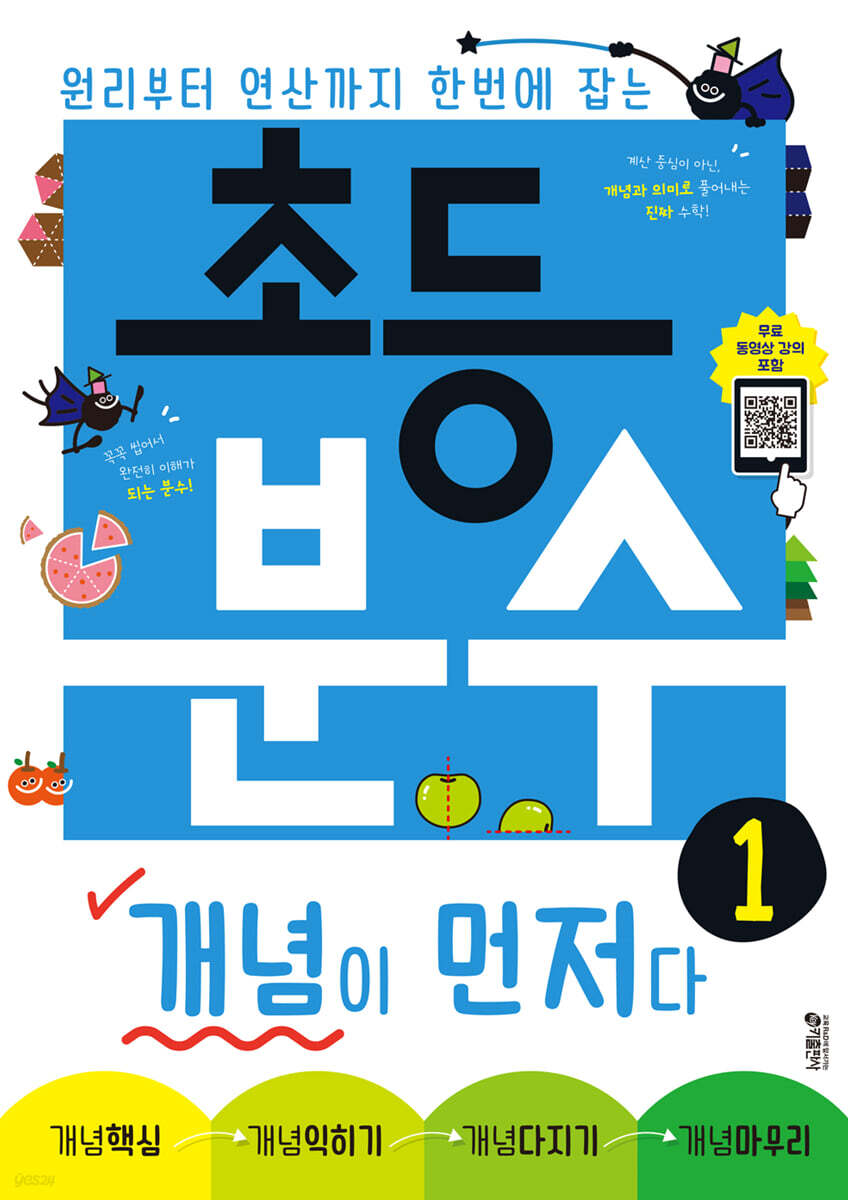
Elementary fraction concepts come first 1
 |
Description
Book Introduction
Fractions are the main culprit in causing math problems in third graders. If you don't understand and move on from fractions properly, you could end up a failure. The concept of "Elementary Fractions, Concept Comes First" was broken down into small pieces, making it impossible to completely digest. This book is structured as if a teacher is right next to you lecturing one by one, along with illustrations that allow for an intuitive understanding of fraction concepts. For any confusing parts while studying, the book even provides free lectures via QR codes, allowing students to study fractions without difficulty. |
- You can preview some of the book's contents.
Preview
index
1.
Fountain! What the hell are you?
1.
The shape of the fountain
2.
Terminology of fractions
3.
Reading fractions
4.
Divide one into equal parts
5.
Divide several into equal parts
Unit conclusion
Confirm in descriptive form
Take a break
2.
One piece? Unit fraction!
1.
unit fraction
2.
Lesson 1 Unit Fractions
3.
Expressing as 1/2
4.
Expressing as 1/3
5.
Expressing as 1/4
6.
Expressing as a unit fraction
7.
Comparing the sizes of unit fractions
Unit conclusion
Confirm in descriptive form
Take a break
3.
Let's express it as a fraction!
1.
Expanding unit fractions
2.
Meaning of fractions
3.
Displaying fractions on a number line
4.
Understanding with pictures
5.
To understand it in this way
6.
The thing called a fountain
7.
Fraction for remainder
Unit conclusion
Confirm in descriptive form
Take a break
Fountain! What the hell are you?
1.
The shape of the fountain
2.
Terminology of fractions
3.
Reading fractions
4.
Divide one into equal parts
5.
Divide several into equal parts
Unit conclusion
Confirm in descriptive form
Take a break
2.
One piece? Unit fraction!
1.
unit fraction
2.
Lesson 1 Unit Fractions
3.
Expressing as 1/2
4.
Expressing as 1/3
5.
Expressing as 1/4
6.
Expressing as a unit fraction
7.
Comparing the sizes of unit fractions
Unit conclusion
Confirm in descriptive form
Take a break
3.
Let's express it as a fraction!
1.
Expanding unit fractions
2.
Meaning of fractions
3.
Displaying fractions on a number line
4.
Understanding with pictures
5.
To understand it in this way
6.
The thing called a fountain
7.
Fraction for remainder
Unit conclusion
Confirm in descriptive form
Take a break
Detailed image
.jpg)

Publisher's Review
The main culprit behind the dropouts, the 3rd grade elementary school fraction!
If you don't understand and move on from fractions properly, you may end up a failure.
A 'completely precious fountain book' that breaks down concepts into small pieces so that you can't help but digest them completely!!!
1.
Visualize math terms to remember them for a long time!
Mathematics is a discipline of promise.
It is a study focused on concepts and processes, not simple calculations.
So, we need to know the terminology accurately, but the problem is that most mathematical terms are Chinese characters.
So, we have included the terms written in Chinese characters in the book in an easy-to-understand way and illustrated them so that you can remember them for a long time.
To avoid confusion, we explain it with pictures, and we practice it with problems so that you can internalize it completely.
You don't have to worry about fraction terminology anymore.
2.
Intuition comes first, logic comes second!
Before developing the logical content, we start with an intuitive understanding.
After learning how to distinguish between the shapes of fractions, we will begin to unravel the meaning of fractions.
First, see what half is, then practice 1/3, 1/4, … in that order, and then generalize to 1/□.
Because you first gain an intuitive understanding and then organize the concepts with logical explanations, you can naturally accept mathematical expressions and promises.
3.
You can practice changing sentences into equations!
Children who can solve problems easily when they are given a formula, but are at a loss when they are given a sentence.
But in fact, sentences and expressions are just different ways of expressing the same thing.
If you express a situation in words, it is a sentence, and if you express it mathematically, it is an equation.
English isn't the only language where sentences are broken up into pieces.
In mathematics, to change a sentence into an equation, you must read the sentence separately.
You can practice cutting sentences and replacing each part with what you want, and it provides a logical explanation of why you can make the changes.
You can practice changing sentences into formulas step by step, underlining sentences, and also marking them with parentheses.
4.
Free video lectures so you can study on your own!
From the second chapter, which begins with a full-fledged mathematical story, video lectures are included.
You can view the lecture immediately without separate registration by scanning the QR code on the page.
You can enjoy studying with the cheerful, refreshing, and exhilarating lectures of a former EBS teacher.
If you don't understand and move on from fractions properly, you may end up a failure.
A 'completely precious fountain book' that breaks down concepts into small pieces so that you can't help but digest them completely!!!
1.
Visualize math terms to remember them for a long time!
Mathematics is a discipline of promise.
It is a study focused on concepts and processes, not simple calculations.
So, we need to know the terminology accurately, but the problem is that most mathematical terms are Chinese characters.
So, we have included the terms written in Chinese characters in the book in an easy-to-understand way and illustrated them so that you can remember them for a long time.
To avoid confusion, we explain it with pictures, and we practice it with problems so that you can internalize it completely.
You don't have to worry about fraction terminology anymore.
2.
Intuition comes first, logic comes second!
Before developing the logical content, we start with an intuitive understanding.
After learning how to distinguish between the shapes of fractions, we will begin to unravel the meaning of fractions.
First, see what half is, then practice 1/3, 1/4, … in that order, and then generalize to 1/□.
Because you first gain an intuitive understanding and then organize the concepts with logical explanations, you can naturally accept mathematical expressions and promises.
3.
You can practice changing sentences into equations!
Children who can solve problems easily when they are given a formula, but are at a loss when they are given a sentence.
But in fact, sentences and expressions are just different ways of expressing the same thing.
If you express a situation in words, it is a sentence, and if you express it mathematically, it is an equation.
English isn't the only language where sentences are broken up into pieces.
In mathematics, to change a sentence into an equation, you must read the sentence separately.
You can practice cutting sentences and replacing each part with what you want, and it provides a logical explanation of why you can make the changes.
You can practice changing sentences into formulas step by step, underlining sentences, and also marking them with parentheses.
4.
Free video lectures so you can study on your own!
From the second chapter, which begins with a full-fledged mathematical story, video lectures are included.
You can view the lecture immediately without separate registration by scanning the QR code on the page.
You can enjoy studying with the cheerful, refreshing, and exhilarating lectures of a former EBS teacher.
GOODS SPECIFICS
- Date of issue: July 30, 2019
- Page count, weight, size: 168 pages | 560g | 210*297*10mm
- ISBN13: 9791189719579
- ISBN10: 1189719576
- Reference book grade: Elementary school common
- Reference book usage semester: Common semester
- Reference book difficulty level: Easy Reference book difficulty level guide
- KC Certification: Certification Type: Conformity Confirmation
You may also like
카테고리
korean


korean

![ELLE 엘르 스페셜 에디션 A형 : 12월 [2025]](http://librairie.coreenne.fr/cdn/shop/files/b8e27a3de6c9538896439686c6b0e8fb.jpg?v=1766436872&width=3840)


