

Deep Learning from Scratch 1
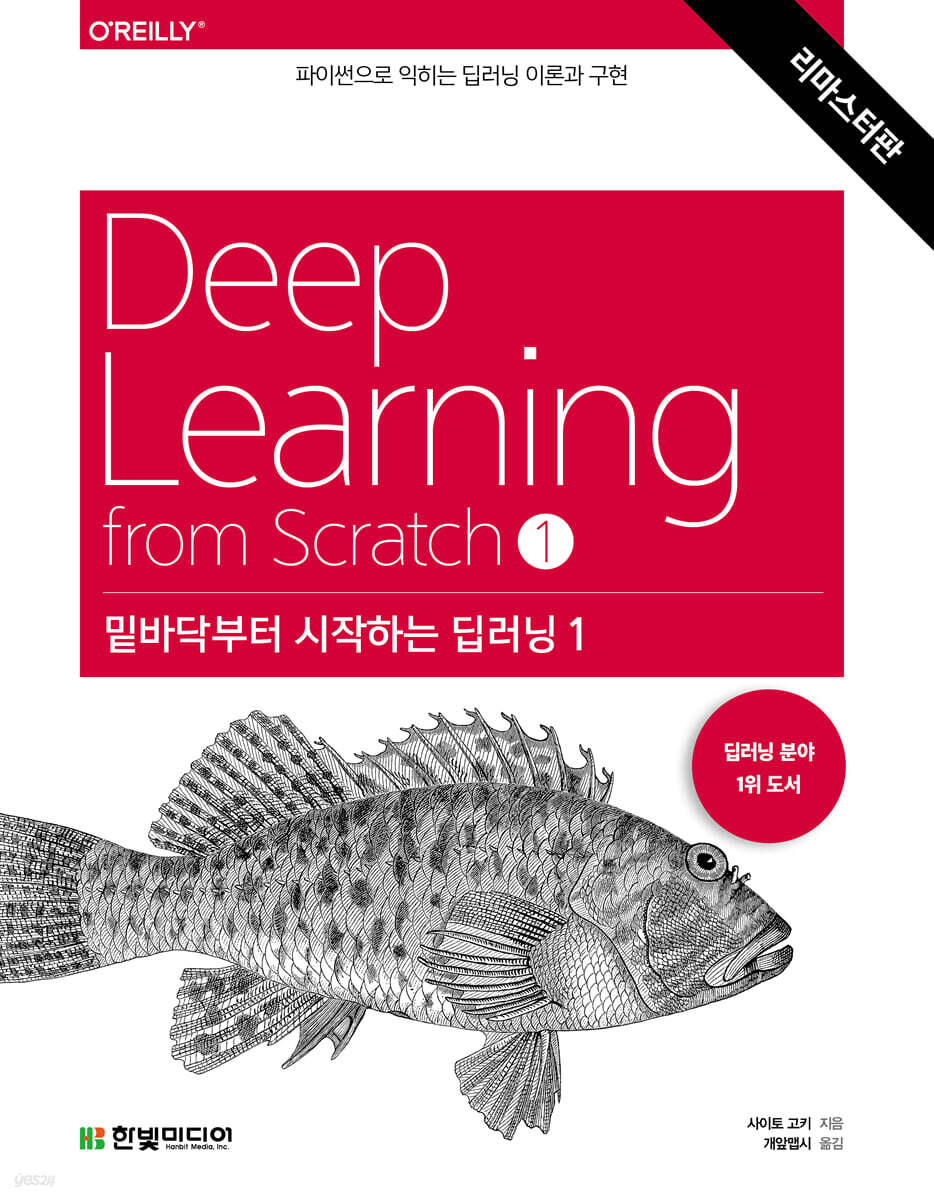 |
Description
Book Introduction
The undisputed bestseller in the deep learning field!
The easiest introduction to deep learning: understand it with your head and practice it with your hands.
This book is a friendly guide that helps you build a solid foundation step by step by implementing the core concepts of deep learning from the ground up.
It systematically explains the principles of deep learning, from the basic concepts of deep learning to convolutional neural networks (CNNs) used in image recognition, without relying on libraries or frameworks.
Additionally, complex concepts can be visually conveyed using computational graphs, making them easy for anyone to understand.
This book will serve as an excellent guide not only for beginners taking their first steps into deep learning, but also for developers and researchers who want to re-establish their fundamentals.
- You can preview some of the book's contents.
Preview
index
CHAPTER 1 Hello Python
_1.1 What is Python?
_1.2 Installing Python
_1.3 Python Interpreter
_1.4 Python script file
_1.5 NumPy
_1.6 Mattplotlip
_1.7 Summary
CHAPTER 2 Perceptron
_2.1 What is a perceptron?
_2.2 Simple logic circuit
_2.3 Implementing a Perceptron
_2.4 Limitations of the Perceptron
_2.5 If a multilayer perceptron is deployed
_2.6 From NAND to Computers
_2.7 Summary
CHAPTER 3 NEURAL NETWORKS
_3.1 From Perceptron to Neural Network
_3.2 Activation function
_3.3 Calculating multidimensional arrays
_3.4 Implementing a 3-layer neural network
_3.5 Designing the Output Layer
_3.6 Handwritten Number Recognition
_3.7 Summary
CHAPTER 4: NEURAL NETWORK LEARNING
_4.1 Learning from data!
_4.2 Loss function
_4.3 Numerical differentiation
_4.4 Slope
_4.5 Implementing the Learning Algorithm
_4.6 Summary
CHAPTER 5 Backpropagation
_5.1 Computational Graph
_5.2 Chain Law
_5.3 Backpropagation
_5.4 Implementing a Simple Hierarchy
_5.5 Implementing the Activation Function Layer
_5.6 Implementing Affine/Softmax Layers
_5.7 Implementing Backpropagation
_5.8 Summary
CHAPTER 6 Learning-Related Skills
_6.1 Parameter Update
_6.2 Initial values of weights
_6.3 Batch Normalization
_6.4 For proper learning
_6.5 Finding Appropriate Hyperparameter Values
_6.6 Summary
CHAPTER 7 Convolutional Neural Networks (CNNs)
_7.1 Overall structure
_7.2 Convolutional Layer
_7.3 Pooling layer
_7.4 Implementing a Convolution/Pooling Layer
_7.5 Implementing CNN
_7.6 Visualizing CNNs
_7.7 Representative CNNs
_7.8 Summary
CHAPTER 8 DEEP LEARNING
_8.1 Deeper
_8.2 Early History of Deep Learning
_8.3 Faster (Deep Learning Acceleration)
_8.4 Utilizing Deep Learning
_8.5 Summary
APPENDIX A Computational Graph of the Softmax-with-Loss Layer
A.1 Forward propagation
A.2 Backpropagation
A.3 Summary
Detailed image

Publisher's Review
Deep Learning: The Easiest Way to Learn Complex Concepts!
A must-read for beginners in deep learning, covering both the "why" and the "how."
It's now widely known that deep learning is at the heart of AI innovation.
However, when you actually try to learn it, you easily get frustrated when you face the wall of complex formulas and technical terms.
Haven't you had similar experiences? This book offers both the joy of understanding and the sense of accomplishment of implementation to those new to deep learning.
You will learn not only through theory, but also through hands-on implementation, starting from simple perceptrons and moving on to convolutional neural networks (CNNs) and image recognition.
As you learn by reading and modifying code line by line, deep learning will no longer feel so difficult.
This book goes beyond a simple introductory text and provides a foundation for in-depth study of deep learning technologies.
I hope that "Deep Learning from Scratch 1" will serve as a solid foundation for you to move on to the next level.
What's changed in the remastered version
In the remastered version, formats, codes, and graphs have been fully colorized, and the quality of translation and editing has been greatly improved.
We also provide Google Collaborative code so you can modify it to run anywhere and check it right in your browser, providing a better hands-on experience than the original book.
- Full colorization of formats, codes, graphs, etc. and improved editing
- Modernized some terminology and improved translations
- Modified example code to run from any location
- Google Collab code provided so you can check it directly in your browser.
Who is this book for?
We implement deep learning programs from scratch using Python, using only a minimal number of external libraries.
We'll also briefly explain how to use Python so that even those unfamiliar with it can understand it.
- Those who are interested in deep learning but don't know where to start
- Those who want to learn not only theory but also by implementing working code.
- Those who want to deeply understand the principles of deep learning without relying on libraries.
- Those who want to build a solid foundation before learning the latest deep learning technologies.
- For those who want to start with an introductory book that has been verified by the best-selling domestic book and numerous readers' favorable reviews.
Topics covered in the "Deep Learning from Scratch" series
- [Part 1] Convolutional Neural Networks and Image Processing
- [Part 2] Recurrent Neural Networks and Natural Language Processing
- [Part 3] Dynamic Computational Graphs and Deep Learning Frameworks
- [Part 4] Deep Reinforcement Learning
- [Part 5] Image Generation Model
GOODS SPECIFICS
- Date of issue: January 24, 2025
- Page count, weight, size: 312 pages | 183*235*13mm
- ISBN13: 9791169213387
- ISBN10: 1169213383
You may also like
카테고리
korean


korean


