

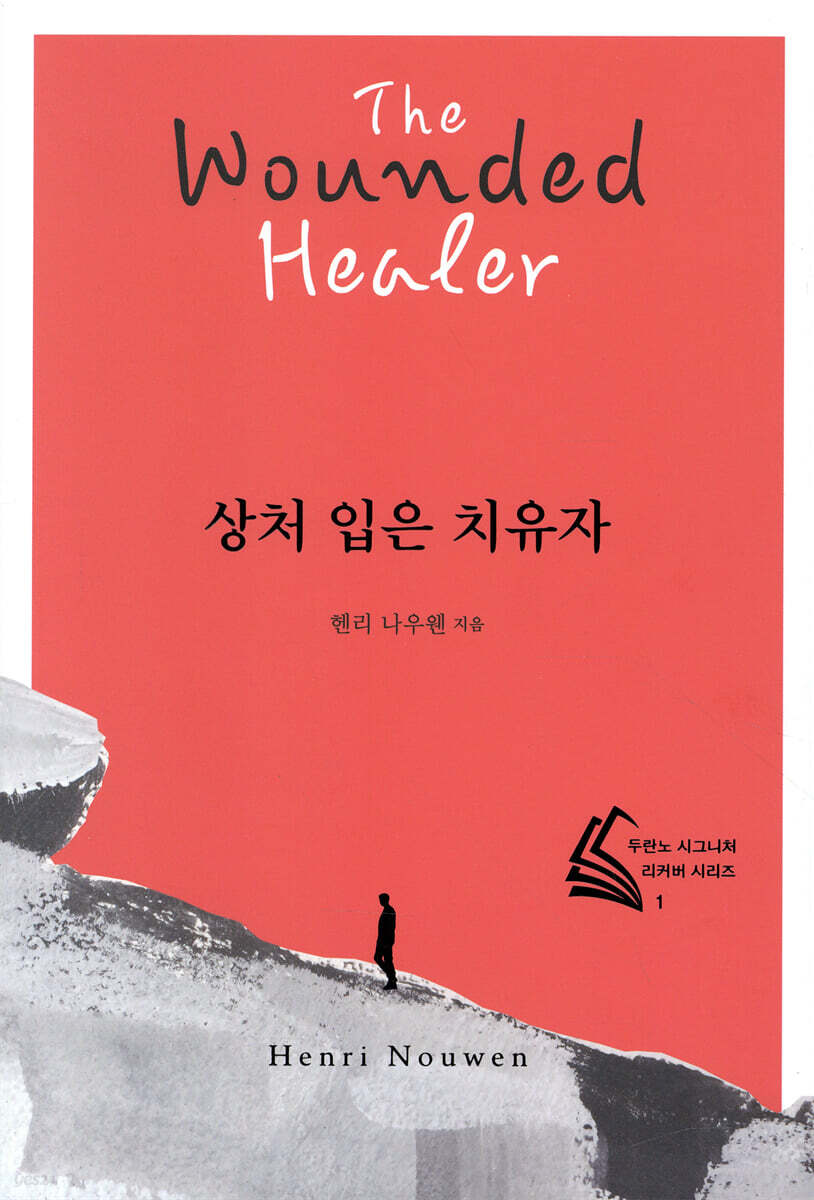
Wounded Healer
 |
Description
Book Introduction
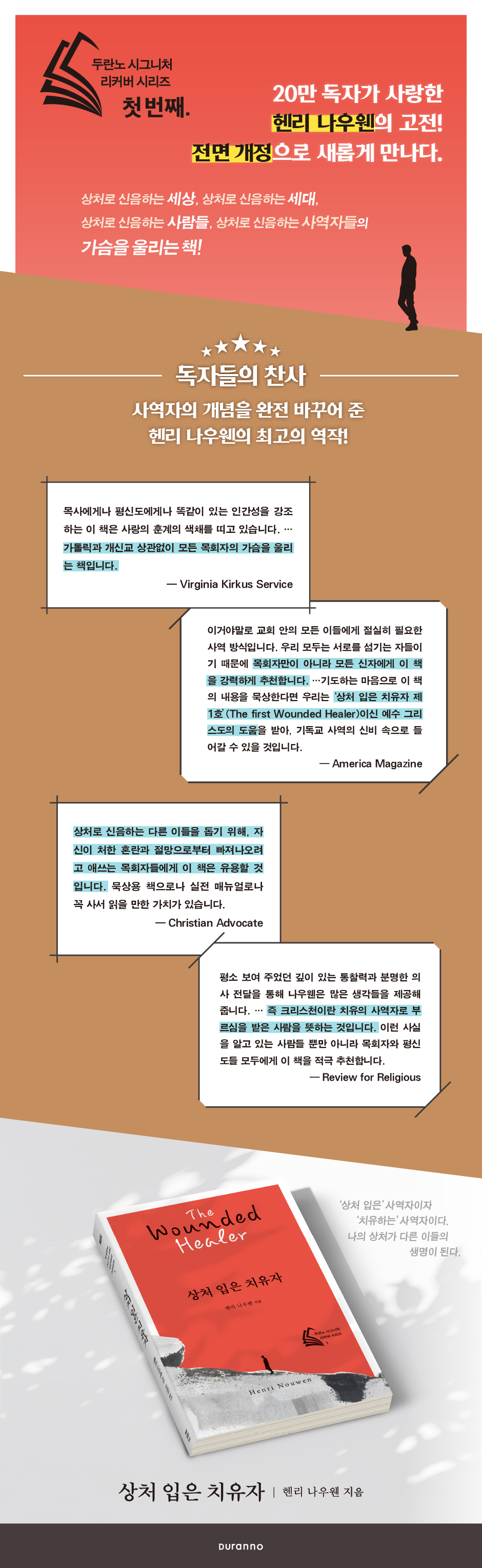
He is a 'wounded' minister and a 'healing' minister.
Ministers of this age are called to be “wounded healers” like Jesus.
They are 'wounded' ministers and 'healing' ministers like Jesus.
Just as Jesus himself became the path to new life by tearing his own body, we realize that the wounds we ourselves have suffered can become a source of life for others.
This book answers the question many ministers ask: “What does it mean to be a minister in modern society?”
It will also be an invaluable guide for all Christians on their journey of service.
Ministers of this age are called to be “wounded healers” like Jesus.
They are 'wounded' ministers and 'healing' ministers like Jesus.
Just as Jesus himself became the path to new life by tearing his own body, we realize that the wounds we ourselves have suffered can become a source of life for others.
This book answers the question many ministers ask: “What does it mean to be a minister in modern society?”
It will also be an invaluable guide for all Christians on their journey of service.
- You can preview some of the book's contents.
Preview
index
Praise for this book
In publishing the revised edition
Prologue/ Four Open Doors
_ In the face of the crisis of modern ministry
1.
Ministry in a 'Disconnected World'
- Exploring what humans truly seek
2.
Ministry for the 'Rootless Generation'
- Look into the eyes of the young people running away
3.
Ministry for the 'Hopeless'
- Makes us wait for tomorrow beyond death
4.
The Ministry of the 'Lonely Minister'
- Wounded Healer, Following Jesus
Epilogue/ Moving Forward as a True Servant
- My wounds become the life of others.
Acknowledgements
main
In publishing the revised edition
Prologue/ Four Open Doors
_ In the face of the crisis of modern ministry
1.
Ministry in a 'Disconnected World'
- Exploring what humans truly seek
2.
Ministry for the 'Rootless Generation'
- Look into the eyes of the young people running away
3.
Ministry for the 'Hopeless'
- Makes us wait for tomorrow beyond death
4.
The Ministry of the 'Lonely Minister'
- Wounded Healer, Following Jesus
Epilogue/ Moving Forward as a True Servant
- My wounds become the life of others.
Acknowledgements
main
Detailed image
Into the book
More than 30 years have passed since this important work was first published in 1972.
Yet, the fact that it remains popular to this day is clear evidence that Henri Nouwen's argument that ministry is about meeting and becoming one with those who are waiting for the good news has gained traction.
While Nouwen's writing has a timeless quality, his publishers and those associated with the Henri Nouwen Legacy Trust felt the text needed to be refined for a modern audience.
I am deeply grateful to Sean Mulrooney and Kathryn Smith for their hard work on this.
They gave careful consideration to how Nouwen would refine this book, reinterpreting it for modern readers while retaining his insights and inspiration.
While the first edition was primarily of interest to ministers, this revised edition will be an invaluable guide for all those on their journey to becoming more fully human.
---From “Publishing the Revised Edition”
It's a very old story, but it feels like a recent story.
If the pastor had turned from the Bible and looked into the eyes of the young man, he would have known that he was the Messiah.
Likewise, we must look into the eyes of the young people of this generation who are fleeing our cruelty.
If we do so, we will not be able to hand them over to the enemy, but we will be able to take them out of their hiding places and lead them back to the people to whom they belong.
When that happens, we will be free from fear.
--- p.50
If today's generation is, as Riesman says, anonymous members of a lonely crowd, then tomorrow's generation will be the children of this lonely crowd.
We are faced with a generation that has parents but no father.
Among these people, those who claim authority because they are older, more mature, smarter, or stronger are not trusted from the start.
--- p.56
But this generation, which rejects its fathers, which claims authority, which rejects the legitimacy of institutions and is afraid of them, faces a new danger.
It is to become a prisoner of oneself.
--- p.59
We looked into the eyes of the young fugitive.
He discovered that he was introverted, mentally devoid of a father figure, and obsessive.
We didn't want to hand him over to the enemy to be killed.
Instead, I wanted to take him to the heart of our village and discover in that young man the One who would save this fearful world.
To do this, we must be able to explain our inner selves well, have compassion, and have a contemplative attitude.
--- p.80
Ultimately, a person of prayer is someone who can recognize the face of the Messiah in others, reveal what is hidden, and grasp the reality of what was previously unattainable.
--- p.81
As John studied the transcripts of his conversations with Mr. Harrison, he learned that the patient's greatest concern was death.
Mr. Harrison was somewhat aware that he was standing at a crossroads between life and death.
In his brief conversation with John, Mr. Harrison expressed his fear of death three times, but John seemed to continually avoid the subject or try to conceal the painful reality.
--- p.93
The statement, “I am not ready to die,” means that Mr. Harrison is not ready to faithfully submit to the Lord.
He was not ready to give his life in faith and hope.
The pain he was experiencing at the time was rather small compared to what he thought was on the other side of life's boundaries.
Mr. Harrison feared death in a very existential way.
--- p.96
“There is nothing, there is no one.
“Only hard work awaits me.” It is not difficult for a healthy young man to understand what it means to say that no one cares whether he lives or dies.
But it is a very difficult task.
Isolation is the worst of human suffering.
--- p.98
If there is an attitude that hurts the hearts of suffering human beings, it is indifference.
People in desperate need want to be listened to, encouraged, forgiven, embraced, held, held, smiled gently, or even told that they can no longer help. Yet, ministers often don't want to get too deeply involved in their plight.
This is precisely the tragedy of Christian ministry.
--- p.116
But now it seems we need to re-establish the basic principles.
To truly help someone, you have to intervene in their situation, and to help someone, you have to fully engage with their painful situation, and in the process, you have to take the risk of being hurt, damaged, or even destroyed.
--- p.117
The Christian way of life does not eliminate loneliness, but rather protects it and cherishes it as a precious gift.
--- p.132
If a minister lives with such false expectations and illusions, he will not be able to use his loneliness as a source of human understanding.
Also, we cannot truly serve many people who do not understand their own suffering.
--- p.134
There is no minister who can save people.
I can only be a guide to those who are trembling with fear.
But paradoxically, through this guidance, the target of our desires appears for the first time.
When we recognize that pain need not be avoided and can be harnessed in our shared pursuit of life, it transforms from an expression of despair into a sign of hope.
--- p.147
If loneliness is one of the greatest wounds of a minister, hospitality can transform that wound into a source of healing.
--- p.147
We have seen that the predicament facing modern man is one of historical discontinuity, fragmented ideology, and the quest for immortality.
We also looked at mystical and revolutionary methods of transcending one's limitations.
Finally, we see that these two approaches are not contradictory, but rather two aspects of the experiential transcendence that Jesus clearly demonstrated to Christians.
(Omitted) A vision of a new world, that is what we dream of and what guides our actions.
That is what allows us to move forward, even at great risk, with the conviction that one day humanity will be free, that we will love freely.
Yet, the fact that it remains popular to this day is clear evidence that Henri Nouwen's argument that ministry is about meeting and becoming one with those who are waiting for the good news has gained traction.
While Nouwen's writing has a timeless quality, his publishers and those associated with the Henri Nouwen Legacy Trust felt the text needed to be refined for a modern audience.
I am deeply grateful to Sean Mulrooney and Kathryn Smith for their hard work on this.
They gave careful consideration to how Nouwen would refine this book, reinterpreting it for modern readers while retaining his insights and inspiration.
While the first edition was primarily of interest to ministers, this revised edition will be an invaluable guide for all those on their journey to becoming more fully human.
---From “Publishing the Revised Edition”
It's a very old story, but it feels like a recent story.
If the pastor had turned from the Bible and looked into the eyes of the young man, he would have known that he was the Messiah.
Likewise, we must look into the eyes of the young people of this generation who are fleeing our cruelty.
If we do so, we will not be able to hand them over to the enemy, but we will be able to take them out of their hiding places and lead them back to the people to whom they belong.
When that happens, we will be free from fear.
--- p.50
If today's generation is, as Riesman says, anonymous members of a lonely crowd, then tomorrow's generation will be the children of this lonely crowd.
We are faced with a generation that has parents but no father.
Among these people, those who claim authority because they are older, more mature, smarter, or stronger are not trusted from the start.
--- p.56
But this generation, which rejects its fathers, which claims authority, which rejects the legitimacy of institutions and is afraid of them, faces a new danger.
It is to become a prisoner of oneself.
--- p.59
We looked into the eyes of the young fugitive.
He discovered that he was introverted, mentally devoid of a father figure, and obsessive.
We didn't want to hand him over to the enemy to be killed.
Instead, I wanted to take him to the heart of our village and discover in that young man the One who would save this fearful world.
To do this, we must be able to explain our inner selves well, have compassion, and have a contemplative attitude.
--- p.80
Ultimately, a person of prayer is someone who can recognize the face of the Messiah in others, reveal what is hidden, and grasp the reality of what was previously unattainable.
--- p.81
As John studied the transcripts of his conversations with Mr. Harrison, he learned that the patient's greatest concern was death.
Mr. Harrison was somewhat aware that he was standing at a crossroads between life and death.
In his brief conversation with John, Mr. Harrison expressed his fear of death three times, but John seemed to continually avoid the subject or try to conceal the painful reality.
--- p.93
The statement, “I am not ready to die,” means that Mr. Harrison is not ready to faithfully submit to the Lord.
He was not ready to give his life in faith and hope.
The pain he was experiencing at the time was rather small compared to what he thought was on the other side of life's boundaries.
Mr. Harrison feared death in a very existential way.
--- p.96
“There is nothing, there is no one.
“Only hard work awaits me.” It is not difficult for a healthy young man to understand what it means to say that no one cares whether he lives or dies.
But it is a very difficult task.
Isolation is the worst of human suffering.
--- p.98
If there is an attitude that hurts the hearts of suffering human beings, it is indifference.
People in desperate need want to be listened to, encouraged, forgiven, embraced, held, held, smiled gently, or even told that they can no longer help. Yet, ministers often don't want to get too deeply involved in their plight.
This is precisely the tragedy of Christian ministry.
--- p.116
But now it seems we need to re-establish the basic principles.
To truly help someone, you have to intervene in their situation, and to help someone, you have to fully engage with their painful situation, and in the process, you have to take the risk of being hurt, damaged, or even destroyed.
--- p.117
The Christian way of life does not eliminate loneliness, but rather protects it and cherishes it as a precious gift.
--- p.132
If a minister lives with such false expectations and illusions, he will not be able to use his loneliness as a source of human understanding.
Also, we cannot truly serve many people who do not understand their own suffering.
--- p.134
There is no minister who can save people.
I can only be a guide to those who are trembling with fear.
But paradoxically, through this guidance, the target of our desires appears for the first time.
When we recognize that pain need not be avoided and can be harnessed in our shared pursuit of life, it transforms from an expression of despair into a sign of hope.
--- p.147
If loneliness is one of the greatest wounds of a minister, hospitality can transform that wound into a source of healing.
--- p.147
We have seen that the predicament facing modern man is one of historical discontinuity, fragmented ideology, and the quest for immortality.
We also looked at mystical and revolutionary methods of transcending one's limitations.
Finally, we see that these two approaches are not contradictory, but rather two aspects of the experiential transcendence that Jesus clearly demonstrated to Christians.
(Omitted) A vision of a new world, that is what we dream of and what guides our actions.
That is what allows us to move forward, even at great risk, with the conviction that one day humanity will be free, that we will love freely.
--- p.44~45
Publisher's Review
To a 'disconnected world', a 'shaky generation', and 'those who fear death'...
Nouwen divided his study into four chapters.
These four chapters are four ways to approach the problems of ministry in our time.
The first chapter deals with a suffering world.
He diagnoses the world as a 'disconnected world' and suggests the path that humans truly pursue and desire.
The second chapter deals with the suffering generation.
It talks about the path of ministry from the perspective of young people who are wavering without roots.
The third chapter deals with suffering individuals.
Serve the miserable lives that fear death and give them hope for tomorrow.
The fourth shows the example of Jesus to ministers who are trembling with the pain of loneliness.
I emphasize again that true ministry cannot be accomplished unless ministers deeply understand how the wounds inflicted through suffering can be used as a source of healing for others.
A Christian is a person called to be a minister of healing.
Nouwen tells us that becoming a minister means recognizing the suffering of the times within ourselves and using that awareness as the starting point of our service.
The calling of a minister is to realize in his heart the suffering of his time, and from that realization his ministry begins.
Whether he is trying to engage with a world in turmoil, trying to relate to his seemingly obsessive contemporaries, or trying to speak to a dying person, in all cases the way his ministry is perceived as authentic is by speaking directly of the suffering he has experienced in his own heart.
This path is not just for the clergy.
This is a calling to all Christians living in our time.
Working with those who suffer from ‘alienation,’ ‘disconnection,’ ‘loneliness,’ and ‘death’ is a calling not only for clergy but also for all Christians.
The paradox of healing seemingly fragile wounds and the advancement of the community.
It emphasizes that true healing occurs when we look at and acknowledge the seemingly weak word ‘wound.’
As Christians and ministers living on this earth, we can expect healing and growth for our community as well as our own by revealing the wounds hidden within us.
His message to Christians (ministers) who must constantly struggle with loneliness projects the image of Christ who achieved perfection through deduction.
Moreover, this book helps us feel the love of Christ that touches our weaknesses and wounds.
Henri Nouwen's masterpiece that completely changed the concept of a minister
The Wounded Healer is considered Henri Nouwen's greatest work, and it illuminates the true meaning of ministry in this age.
Redefining the minister of this age as a wounded healer, Christians can become a source of life for others through their own wounds.
Drawing on deep insight, extensive knowledge, and a wealth of case studies from experience, it offers new confidence and vision to ministers struggling to escape confusion and despair.
Nouwen divided his study into four chapters.
These four chapters are four ways to approach the problems of ministry in our time.
The first chapter deals with a suffering world.
He diagnoses the world as a 'disconnected world' and suggests the path that humans truly pursue and desire.
The second chapter deals with the suffering generation.
It talks about the path of ministry from the perspective of young people who are wavering without roots.
The third chapter deals with suffering individuals.
Serve the miserable lives that fear death and give them hope for tomorrow.
The fourth shows the example of Jesus to ministers who are trembling with the pain of loneliness.
I emphasize again that true ministry cannot be accomplished unless ministers deeply understand how the wounds inflicted through suffering can be used as a source of healing for others.
A Christian is a person called to be a minister of healing.
Nouwen tells us that becoming a minister means recognizing the suffering of the times within ourselves and using that awareness as the starting point of our service.
The calling of a minister is to realize in his heart the suffering of his time, and from that realization his ministry begins.
Whether he is trying to engage with a world in turmoil, trying to relate to his seemingly obsessive contemporaries, or trying to speak to a dying person, in all cases the way his ministry is perceived as authentic is by speaking directly of the suffering he has experienced in his own heart.
This path is not just for the clergy.
This is a calling to all Christians living in our time.
Working with those who suffer from ‘alienation,’ ‘disconnection,’ ‘loneliness,’ and ‘death’ is a calling not only for clergy but also for all Christians.
The paradox of healing seemingly fragile wounds and the advancement of the community.
It emphasizes that true healing occurs when we look at and acknowledge the seemingly weak word ‘wound.’
As Christians and ministers living on this earth, we can expect healing and growth for our community as well as our own by revealing the wounds hidden within us.
His message to Christians (ministers) who must constantly struggle with loneliness projects the image of Christ who achieved perfection through deduction.
Moreover, this book helps us feel the love of Christ that touches our weaknesses and wounds.
Henri Nouwen's masterpiece that completely changed the concept of a minister
The Wounded Healer is considered Henri Nouwen's greatest work, and it illuminates the true meaning of ministry in this age.
Redefining the minister of this age as a wounded healer, Christians can become a source of life for others through their own wounds.
Drawing on deep insight, extensive knowledge, and a wealth of case studies from experience, it offers new confidence and vision to ministers struggling to escape confusion and despair.
GOODS SPECIFICS
- Publication date: June 8, 2022
- Page count, weight, size: 156 pages | 216g | 140*206*20mm
- ISBN13: 9788953142329
- ISBN10: 8953142326
You may also like
카테고리
korean


korean

![GQ KOREA Mark (Monthly): December [2025]](http://librairie.coreenne.fr/cdn/shop/files/8ef265dbbfbf186523ed75ba7319009d.jpg?v=1765340328&width=3840)


