

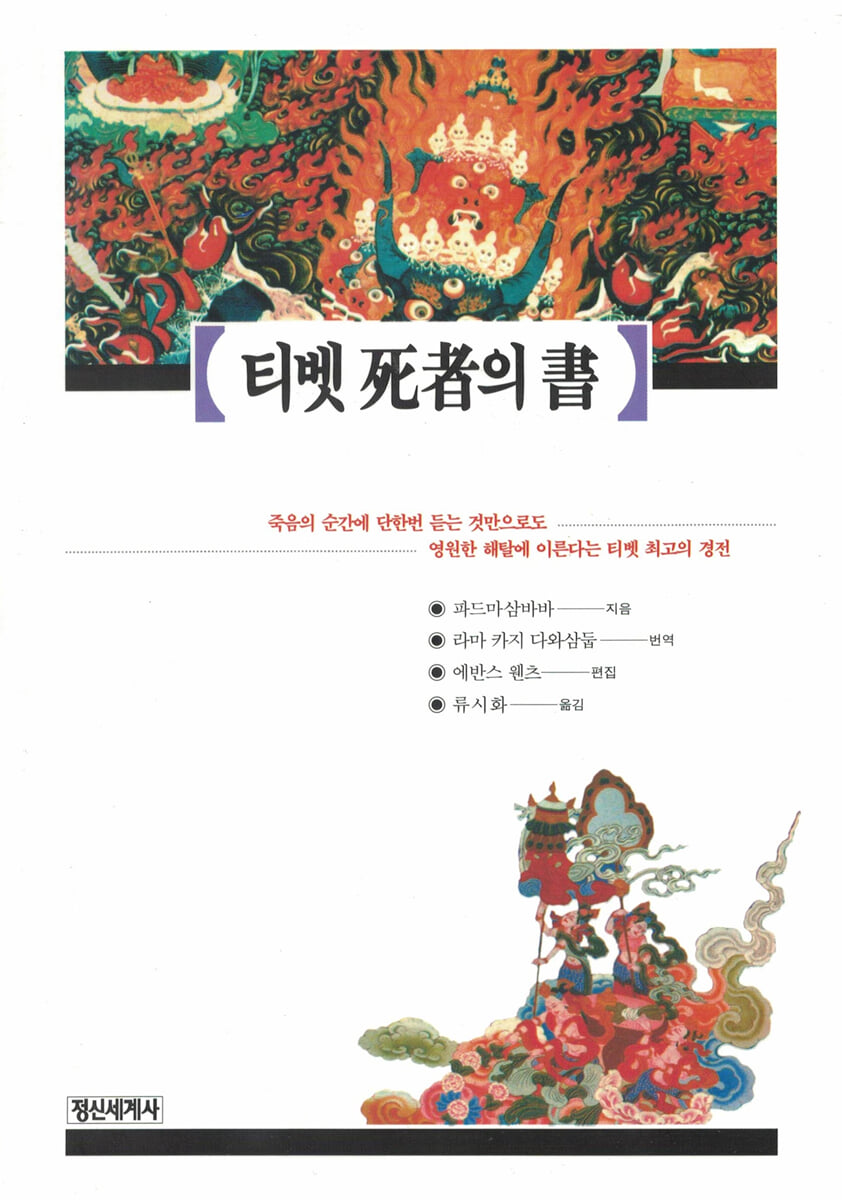
Tibetan Book of the Dead
 |
Description
Book Introduction
This is a translation of the legendary sutra, which is said to contain the teachings of Padmasambhava, a Tibetan Buddhist ascetic, that his later disciples discovered and left behind. It has been translated into Korean by poet and meditator Ryu Si-hwa, with detailed commentary, including abundant annotations covering the entire sutra and commentaries by Wentz and Jung.
- You can preview some of the book's contents.
Preview
Into the book
One clue to the power of mantras, which is discussed throughout the Tibetan Book of the Dead, can be found in ancient Greek music theory.
In other words, if you know a fundamental tone with a special property, you can use that tone to decompose that special property.
Every organism has its own unique vibrational frequency.
From grains of sand to mountains, and even planets and the sun, everything has its own unique vibrational frequency.
Knowing this frequency allows us to use it mystically to break down the organism.
In other words, if you know a fundamental tone with a special property, you can use that tone to decompose that special property.
Every organism has its own unique vibrational frequency.
From grains of sand to mountains, and even planets and the sun, everything has its own unique vibrational frequency.
Knowing this frequency allows us to use it mystically to break down the organism.
--- p.497~498
What phenomena does the soul experience at the moment of death, and how does the afterlife unfold?
What is the way to escape the shackles of reincarnation and achieve eternal liberation, and what choices are available to those who are reincarnated?
An ancient scripture, full of mysteries, provides the answer.
What phenomena does the soul experience at the moment of death, and how does the afterlife unfold?
What is the way to escape the shackles of reincarnation and achieve eternal liberation, and what choices are available to those who are reincarnated?
An ancient scripture, full of mysteries, provides the answer.
What is the way to escape the shackles of reincarnation and achieve eternal liberation, and what choices are available to those who are reincarnated?
An ancient scripture, full of mysteries, provides the answer.
What phenomena does the soul experience at the moment of death, and how does the afterlife unfold?
What is the way to escape the shackles of reincarnation and achieve eternal liberation, and what choices are available to those who are reincarnated?
An ancient scripture, full of mysteries, provides the answer.
--- p. From the preface
In terms of its contribution to the science of death, the afterlife, and reincarnation, the Tibetan Book of the Dead, originally called "Bardo Thodol - Eternal Freedom through Hearing in the Afterlife," is unique among the world's sacred texts.
As a condensed explanatory text of the doctrines of Mahayana Buddhism, this book is of immense religious, philosophical, and historical importance.
Furthermore, this scripture is based on the mystical science (Tantra) of yoga philosophy, which was a required subject at the Nalanda Buddhist University, which can be called the Oxford University of ancient India, and is the most notable literature among the Oriental books handed down to the modern times.
In terms of its contribution to the science of death, the afterlife, and reincarnation, the Tibetan Book of the Dead, originally called "Bardo Thodol - Eternal Freedom through Hearing in the Afterlife," is unique among the world's sacred texts.
As a condensed explanatory text of the doctrines of Mahayana Buddhism, this book is of immense religious, philosophical, and historical importance.
Furthermore, this scripture is based on the mystical science (Tantra) of yoga philosophy, which was a required subject at the Nalanda Buddhist University, which can be called the Oxford University of ancient India, and is the most notable literature among the Oriental books handed down to the modern times.
As a condensed explanatory text of the doctrines of Mahayana Buddhism, this book is of immense religious, philosophical, and historical importance.
Furthermore, this scripture is based on the mystical science (Tantra) of yoga philosophy, which was a required subject at the Nalanda Buddhist University, which can be called the Oxford University of ancient India, and is the most notable literature among the Oriental books handed down to the modern times.
In terms of its contribution to the science of death, the afterlife, and reincarnation, the Tibetan Book of the Dead, originally called "Bardo Thodol - Eternal Freedom through Hearing in the Afterlife," is unique among the world's sacred texts.
As a condensed explanatory text of the doctrines of Mahayana Buddhism, this book is of immense religious, philosophical, and historical importance.
Furthermore, this scripture is based on the mystical science (Tantra) of yoga philosophy, which was a required subject at the Nalanda Buddhist University, which can be called the Oxford University of ancient India, and is the most notable literature among the Oriental books handed down to the modern times.
--- p.
49
49
Human existence is no different in this respect.
Humans believe that they exist as one 'I', but in fact, such a thought is nothing more than an illusion.
says, 'You could not ask for more than to know that these illusions are shadows of your own thoughts.' Human beings are no different in this respect.
Humans believe that they exist as one 'I', but in fact, such a thought is nothing more than an illusion.
says, 'You can only hope for the best if you know that these illusions are shadows of your own thoughts.'
Humans believe that they exist as one 'I', but in fact, such a thought is nothing more than an illusion.
says, 'You could not ask for more than to know that these illusions are shadows of your own thoughts.' Human beings are no different in this respect.
Humans believe that they exist as one 'I', but in fact, such a thought is nothing more than an illusion.
says, 'You can only hope for the best if you know that these illusions are shadows of your own thoughts.'
--- p.
Oh, merciful one.
Please protect someone who has no one to protect them.
Protect him who is unprotected.
Be his strength and companion.
Protect him from the darkness of the afterlife.
Save him from the fear and dread of the kings of death.
ah.
O merciful one.
Do not delay the power of mercy and help him.
Don't let him go to a place of misery.
Do not forget your old oath.
Do not slow down the power of your mercy.
Oh, Buddhas and Bodhisattvas.
Please do not withhold your power of mercy from this person.
Hold him with the rope of your mercy.
Do not let this living being succumb to the power of evil karma.
Ah, truth, those who have realized the truth, and the seekers who follow them.
Protect this person from misfortune in the afterlife.
Oh, merciful one.
Please protect someone who has no one to protect them.
Protect him who is unprotected.
Be his strength and companion.
Protect him from the darkness of the afterlife.
Save him from the fear and dread of the kings of death.
ah.
O merciful one.
Do not delay the power of mercy and help him.
Don't let him go to a place of misery.
Do not forget your old oath.
Do not slow down the power of your mercy.
Oh, Buddhas and Bodhisattvas.
Please do not withhold your power of mercy from this person.
Hold him with the rope of your mercy.
Do not let this living being succumb to the power of evil karma.
Ah, truth, those who have realized the truth, and the seekers who follow them.
Protect this person from misfortune in the afterlife.
Please protect someone who has no one to protect them.
Protect him who is unprotected.
Be his strength and companion.
Protect him from the darkness of the afterlife.
Save him from the fear and dread of the kings of death.
ah.
O merciful one.
Do not delay the power of mercy and help him.
Don't let him go to a place of misery.
Do not forget your old oath.
Do not slow down the power of your mercy.
Oh, Buddhas and Bodhisattvas.
Please do not withhold your power of mercy from this person.
Hold him with the rope of your mercy.
Do not let this living being succumb to the power of evil karma.
Ah, truth, those who have realized the truth, and the seekers who follow them.
Protect this person from misfortune in the afterlife.
Oh, merciful one.
Please protect someone who has no one to protect them.
Protect him who is unprotected.
Be his strength and companion.
Protect him from the darkness of the afterlife.
Save him from the fear and dread of the kings of death.
ah.
O merciful one.
Do not delay the power of mercy and help him.
Don't let him go to a place of misery.
Do not forget your old oath.
Do not slow down the power of your mercy.
Oh, Buddhas and Bodhisattvas.
Please do not withhold your power of mercy from this person.
Hold him with the rope of your mercy.
Do not let this living being succumb to the power of evil karma.
Ah, truth, those who have realized the truth, and the seekers who follow them.
Protect this person from misfortune in the afterlife.
--- p.458-459
GOODS SPECIFICS
- Date of issue: August 1, 1995
- Page count, weight, size: 526 pages | 760g | 148*210*35mm
- ISBN13: 9788935700660
- ISBN10: 8935700665
You may also like
카테고리
korean


korean

![GQ KOREA Mark (Monthly): December [2025]](http://librairie.coreenne.fr/cdn/shop/files/8ef265dbbfbf186523ed75ba7319009d.jpg?v=1765340328&width=3840)


