

Put away childish things
 |
Description
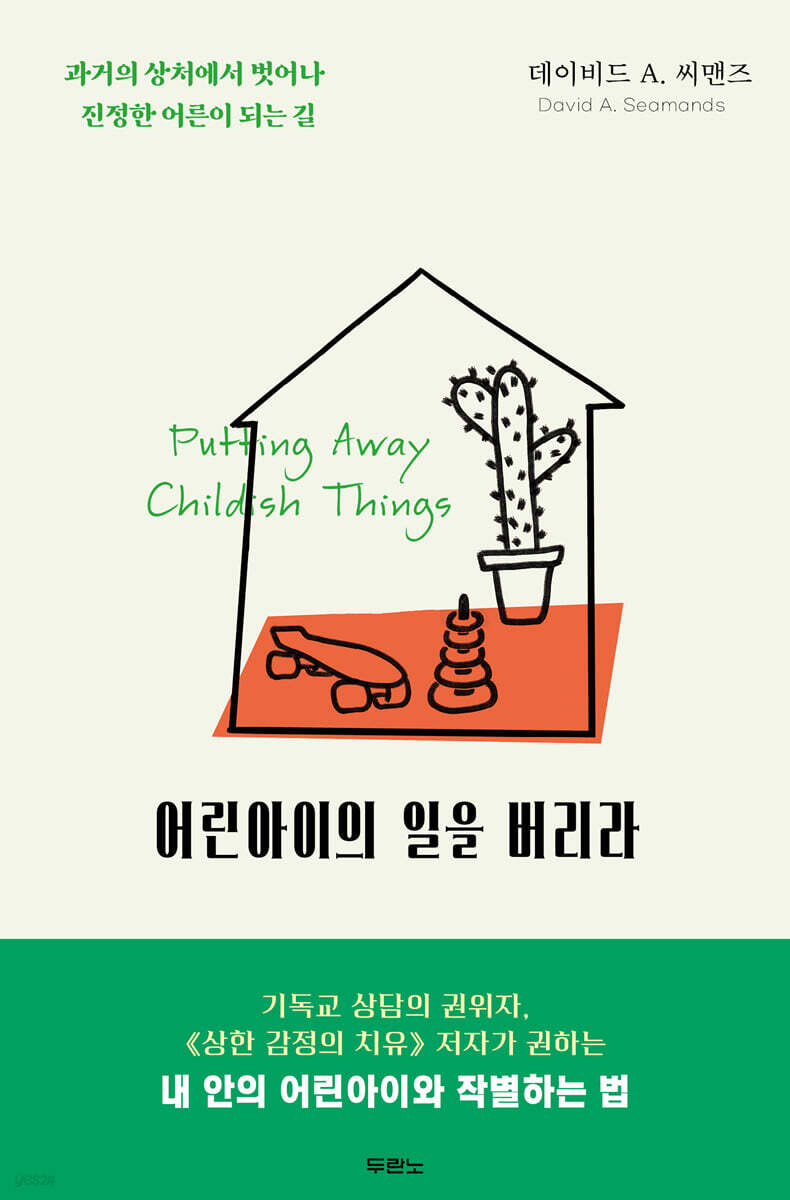
Book Introduction
There is a seven-year-old child living inside me.
The wounded ego of childhood… .
This child, sometimes angry, sometimes timid and anxious, comes back to life and dominates me whenever he gets the chance.
Sometimes our childhood experiences hinder our spiritual and mental maturity.
Because there are painful memories from childhood that need to be healed, unhealthy complexes and obsessions that need to be cut off, spoiled emotions that need to be tamed, and suppressed feelings that need to be released.
We must abandon immature ways of thinking and allow mature ways of processing emotions, proper understanding of concepts, and balanced behavior to take hold.
The ultimate goal is to mature in our relationships with ourselves, others, and God.
This book illuminates common misconceptions about God's will, love and marriage, prayer, emotions, and self-abandonment, and guides us on how to think and act as blameless and mature people of God.
I recommend this book to anyone who has decided to put away childish things (1 Corinthians 13:11) and wants to become like Christ.
The wounded ego of childhood… .
This child, sometimes angry, sometimes timid and anxious, comes back to life and dominates me whenever he gets the chance.
Sometimes our childhood experiences hinder our spiritual and mental maturity.
Because there are painful memories from childhood that need to be healed, unhealthy complexes and obsessions that need to be cut off, spoiled emotions that need to be tamed, and suppressed feelings that need to be released.
We must abandon immature ways of thinking and allow mature ways of processing emotions, proper understanding of concepts, and balanced behavior to take hold.
The ultimate goal is to mature in our relationships with ourselves, others, and God.
This book illuminates common misconceptions about God's will, love and marriage, prayer, emotions, and self-abandonment, and guides us on how to think and act as blameless and mature people of God.
I recommend this book to anyone who has decided to put away childish things (1 Corinthians 13:11) and wants to become like Christ.
- You can preview some of the book's contents.
Preview
index
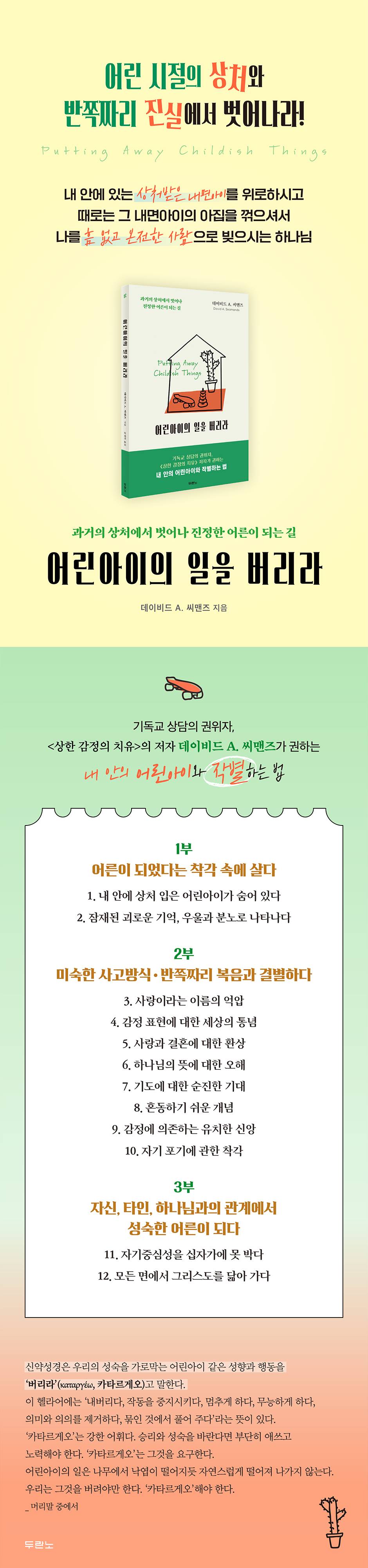
preface
Part 1: Living Under the Illusion of Being an Adult
1.
There's a wounded child hiding inside me.
2.
Potential painful memories manifest as depression and anger
Part 2: Immature Thinking and Breaking Up with a Half-Finished Gospel
3.
Oppression in the name of love
: “I need to do better.
“I’m saying this for you.”
4.
The world's common beliefs about expressing emotions
: “A strong boy doesn’t cry.”
5.
Fantasy about love and marriage
: “Love is romantic.”
6.
Misunderstanding God's will
: “Everything in the world (even evil things) is intended by God.”
7.
Naive expectations about prayer
: “If you just pray, God will answer.”
8.
A concept that is easy to confuse
: “To give me this pain… God doesn’t love me.”
9.
Childish faith that relies on emotions
: “When God leads, He always gives me a special feeling.”
10.
The illusion of self-abandonment
: “If I give God control over me, I disappear.”
Part 3: Becoming a Mature Adult in Relationships with Oneself, Others, and God
11.
Crucifying self-centeredness
12.
Becoming more like Christ in every way
Part 1: Living Under the Illusion of Being an Adult
1.
There's a wounded child hiding inside me.
2.
Potential painful memories manifest as depression and anger
Part 2: Immature Thinking and Breaking Up with a Half-Finished Gospel
3.
Oppression in the name of love
: “I need to do better.
“I’m saying this for you.”
4.
The world's common beliefs about expressing emotions
: “A strong boy doesn’t cry.”
5.
Fantasy about love and marriage
: “Love is romantic.”
6.
Misunderstanding God's will
: “Everything in the world (even evil things) is intended by God.”
7.
Naive expectations about prayer
: “If you just pray, God will answer.”
8.
A concept that is easy to confuse
: “To give me this pain… God doesn’t love me.”
9.
Childish faith that relies on emotions
: “When God leads, He always gives me a special feeling.”
10.
The illusion of self-abandonment
: “If I give God control over me, I disappear.”
Part 3: Becoming a Mature Adult in Relationships with Oneself, Others, and God
11.
Crucifying self-centeredness
12.
Becoming more like Christ in every way
Detailed image
Into the book
The inner child is most evident in the place where the child feels most comfortable: at home.
The same is true of personal contact and relationships that feel like home.
The areas where it's most difficult to live maturely are with close friends, roommates, lovers, coworkers, and family.
In such an intimate relationship, the inner child tends to take the lead.
In our everyday lives, we present a very polite and well-controlled self in public.
When around people you're not close with, you're mature, reasonable, and a pretty nice person to get along with.
But when it comes to close relationships, things change.
When you enter into a deep friendship, love, marriage, or even a very close partnership, you have no idea how quickly this little inner child takes over.
The inner child can be very unreasonable, stubborn, and demanding, or shy, fearful, and vulnerable.
--- 「1.
From "There is a wounded child hiding inside me"
Many people live with anxiety for years because of unresolved painful memories, and the burden grows heavier and heavier.
When such a person runs out of patience and energy, he or she is more likely to fall into an emotional crisis.
When we become physically exhausted, ill, or traumatized, we become weaker, and when something happens that relates to a painful event in our past, memories that we have tried to suppress for so long are awakened and activated.
When that sleeping child from the past awakens, it dominates that person's attitude, reactions, values, and overall behavior.
The dormant emotions resurface and are expressed as deep depression, anger, uncontrollable lust, inferiority complex, fear, loneliness, and feelings of rejection.
--- 「2.
From “Potential Painful Memories, Appearing as Depression and Anger”
You can't do this alone.
You need a trusted friend, pastor, or Christian counselor to help you discern whether your inner child, who you can't seem to please, is pushing you toward impossible goals, or whether it's what God and His Word truly require.
Sometimes, when such feelings are severe, it may require long-term counseling with a well-trained counselor.
But no matter what method you use, you must resolve to 'neutralize' the voice of the child inside you that constantly demands and cries out.
--- 「3.
From "Oppression in the Name of Love"
This attitude also extends to the Christian life.
We believe that a truly victorious Christian is always quiet, calm, and unperturbed.
Christians should never be sad, angry, mournful, upset, or shaken by anything, and it has been mistakenly thought that the clear evidence of a victorious Christian is the 'Great Rock Face'.
It required him to be an ascetic, expressionless, self-controlled, and emotionless.
If Jesus is our example, then the above is a terrible distortion.
Although it is presented as an ideal model, this is a distorted image.
We cannot reach this point because these unbiblical and impractical standards are false.
Yet, countless faithful Christians still struggle with unnecessary guilt as they try to reach that standard.
The saying, “Tough boys don’t cry,” is immediately followed by the saying, “Try harder.”
This creates a vicious cycle in the Christian life: desperate effort, failure, despair, repentance, then more effort, more failure, and more despair.
--- 「4.
From “The World’s Common Sense About Expressing Emotions”
Somerset Maugham's masterpiece, Of Human Bondage, is the story of a boy named Philip.
Philip, who was born with a deformed foot, limped and was very conscious of his disability.
One day Philip heard that if he prayed to God, He would grant him whatever he wanted, so he prayed that his twisted foot would be straightened by the next morning.
Philip went to bed hoping that his feet would be back to normal by morning.
When I woke up in the morning, my feet were still distorted.
Philip was heartbroken and disillusioned.
From this experience onwards, he began to lose his faith.
This kind of story is repeated countless times in the lives of adults.
I've spent a lot of time talking with people who have been shaken in their faith because God hasn't answered their prayers.
--- 「7.
From “Naive Expectations About Prayer”
Emotions are the most volatile and unreliable of the many components that make up our selves.
Emotions are mysterious and difficult to explain.
…For example, haven't you ever woken up feeling completely different than you did the night before and couldn't figure out why? That's why it's so childish to let emotions dictate our actions, especially to use them as indicators of spiritual health.
When we let our emotions control us, we quickly become filled with guilt and resentment, and when we don't have a particular experience or feeling, we begin to believe that something is wrong.
Then we start comparing ourselves, saying “what if” and wanting to be someone we are not.
--- 「9.
From “Childish Faith Dependent on Emotions”
There are strong memories from childhood and teenage years that need to be healed.
There are subtle concealments and defensive behaviors that need to be uncovered.
There are also unhealthy complexes and obsessions that need to be cut off.
There are unrealistic mottos that have been oppressing us and against which we must rebel.
There are naughty emotions that need to be tamed and repressed emotions that need to be released.
There are childish lies to be rebuked, foolish confusions to be resolved, and naive notions to be corrected.
This process requires both passive and active effort.
Negative behaviors must be abandoned (katargeo) and mature, positive emotions, understanding, concepts and actions must take hold.
Therefore, this process requires our whole personality: thoughts, emotions, will, and actions.
It demands maturity in our relationships with ourselves, with others, and with God.
Most people would agree that the biggest problem in life is themselves.
Samuel Hoffenstein said:
“My problem is that wherever I go, ‘I’ follow him around and ruin everything.”
The same is true of personal contact and relationships that feel like home.
The areas where it's most difficult to live maturely are with close friends, roommates, lovers, coworkers, and family.
In such an intimate relationship, the inner child tends to take the lead.
In our everyday lives, we present a very polite and well-controlled self in public.
When around people you're not close with, you're mature, reasonable, and a pretty nice person to get along with.
But when it comes to close relationships, things change.
When you enter into a deep friendship, love, marriage, or even a very close partnership, you have no idea how quickly this little inner child takes over.
The inner child can be very unreasonable, stubborn, and demanding, or shy, fearful, and vulnerable.
--- 「1.
From "There is a wounded child hiding inside me"
Many people live with anxiety for years because of unresolved painful memories, and the burden grows heavier and heavier.
When such a person runs out of patience and energy, he or she is more likely to fall into an emotional crisis.
When we become physically exhausted, ill, or traumatized, we become weaker, and when something happens that relates to a painful event in our past, memories that we have tried to suppress for so long are awakened and activated.
When that sleeping child from the past awakens, it dominates that person's attitude, reactions, values, and overall behavior.
The dormant emotions resurface and are expressed as deep depression, anger, uncontrollable lust, inferiority complex, fear, loneliness, and feelings of rejection.
--- 「2.
From “Potential Painful Memories, Appearing as Depression and Anger”
You can't do this alone.
You need a trusted friend, pastor, or Christian counselor to help you discern whether your inner child, who you can't seem to please, is pushing you toward impossible goals, or whether it's what God and His Word truly require.
Sometimes, when such feelings are severe, it may require long-term counseling with a well-trained counselor.
But no matter what method you use, you must resolve to 'neutralize' the voice of the child inside you that constantly demands and cries out.
--- 「3.
From "Oppression in the Name of Love"
This attitude also extends to the Christian life.
We believe that a truly victorious Christian is always quiet, calm, and unperturbed.
Christians should never be sad, angry, mournful, upset, or shaken by anything, and it has been mistakenly thought that the clear evidence of a victorious Christian is the 'Great Rock Face'.
It required him to be an ascetic, expressionless, self-controlled, and emotionless.
If Jesus is our example, then the above is a terrible distortion.
Although it is presented as an ideal model, this is a distorted image.
We cannot reach this point because these unbiblical and impractical standards are false.
Yet, countless faithful Christians still struggle with unnecessary guilt as they try to reach that standard.
The saying, “Tough boys don’t cry,” is immediately followed by the saying, “Try harder.”
This creates a vicious cycle in the Christian life: desperate effort, failure, despair, repentance, then more effort, more failure, and more despair.
--- 「4.
From “The World’s Common Sense About Expressing Emotions”
Somerset Maugham's masterpiece, Of Human Bondage, is the story of a boy named Philip.
Philip, who was born with a deformed foot, limped and was very conscious of his disability.
One day Philip heard that if he prayed to God, He would grant him whatever he wanted, so he prayed that his twisted foot would be straightened by the next morning.
Philip went to bed hoping that his feet would be back to normal by morning.
When I woke up in the morning, my feet were still distorted.
Philip was heartbroken and disillusioned.
From this experience onwards, he began to lose his faith.
This kind of story is repeated countless times in the lives of adults.
I've spent a lot of time talking with people who have been shaken in their faith because God hasn't answered their prayers.
--- 「7.
From “Naive Expectations About Prayer”
Emotions are the most volatile and unreliable of the many components that make up our selves.
Emotions are mysterious and difficult to explain.
…For example, haven't you ever woken up feeling completely different than you did the night before and couldn't figure out why? That's why it's so childish to let emotions dictate our actions, especially to use them as indicators of spiritual health.
When we let our emotions control us, we quickly become filled with guilt and resentment, and when we don't have a particular experience or feeling, we begin to believe that something is wrong.
Then we start comparing ourselves, saying “what if” and wanting to be someone we are not.
--- 「9.
From “Childish Faith Dependent on Emotions”
There are strong memories from childhood and teenage years that need to be healed.
There are subtle concealments and defensive behaviors that need to be uncovered.
There are also unhealthy complexes and obsessions that need to be cut off.
There are unrealistic mottos that have been oppressing us and against which we must rebel.
There are naughty emotions that need to be tamed and repressed emotions that need to be released.
There are childish lies to be rebuked, foolish confusions to be resolved, and naive notions to be corrected.
This process requires both passive and active effort.
Negative behaviors must be abandoned (katargeo) and mature, positive emotions, understanding, concepts and actions must take hold.
Therefore, this process requires our whole personality: thoughts, emotions, will, and actions.
It demands maturity in our relationships with ourselves, with others, and with God.
Most people would agree that the biggest problem in life is themselves.
Samuel Hoffenstein said:
“My problem is that wherever I go, ‘I’ follow him around and ruin everything.”
--- 「12.
From “Becoming Like Christ in Every Way”
From “Becoming Like Christ in Every Way”
Publisher's Review
Comfort the wounded inner child within me
Sometimes you have to break the stubbornness of that inner child.
God who makes me a perfect and flawless person
Escape from childhood wounds and half-truths
To become mature in Christ
A delicate yet stern exhortation!
“When I was a child, I spoke like a child, I thought like a child, I reasoned like a child. But when I became a man, I put away childish things” (1 Corinthians 13:11).
Although we are adults in terms of age, we are still immature in some areas mentally and spiritually.
The problem may be our wounded childhood selves that still live within us.
A childish mindset is what prevents us from growing in Christ.
How does our childhood self, our inner child, hinder our growth? How can we prevent it from taking control of our present selves in various aspects of life?
The painful memories of childhood need to be healed.
We must break free from unhealthy complexes and obsessions.
We must tame our spoiled emotions and release our suppressed ones.
We must abandon negative behavior patterns and allow mature emotional processing, sound biblical concepts, and balanced behavior patterns to take hold.
This means maturing in our relationship with ourselves, with others, and with God.
God grants us saving grace, freeing us from the oppression of our bitter past.
He awakens us from our old and wicked habits and guides us to grow into true adults.
To receive God's guidance, we must first decide to break away from our immature inner child.
David A., author of the international bestseller “Healing Hurt Feelings,”
In this book, Seaman exposes immature understandings and half-truths about God's will, love and marriage, prayer, emotions, and self-abandonment, and guides us to think and act like a blameless, mature person of God.
Sometimes you have to break the stubbornness of that inner child.
God who makes me a perfect and flawless person
Escape from childhood wounds and half-truths
To become mature in Christ
A delicate yet stern exhortation!
“When I was a child, I spoke like a child, I thought like a child, I reasoned like a child. But when I became a man, I put away childish things” (1 Corinthians 13:11).
Although we are adults in terms of age, we are still immature in some areas mentally and spiritually.
The problem may be our wounded childhood selves that still live within us.
A childish mindset is what prevents us from growing in Christ.
How does our childhood self, our inner child, hinder our growth? How can we prevent it from taking control of our present selves in various aspects of life?
The painful memories of childhood need to be healed.
We must break free from unhealthy complexes and obsessions.
We must tame our spoiled emotions and release our suppressed ones.
We must abandon negative behavior patterns and allow mature emotional processing, sound biblical concepts, and balanced behavior patterns to take hold.
This means maturing in our relationship with ourselves, with others, and with God.
God grants us saving grace, freeing us from the oppression of our bitter past.
He awakens us from our old and wicked habits and guides us to grow into true adults.
To receive God's guidance, we must first decide to break away from our immature inner child.
David A., author of the international bestseller “Healing Hurt Feelings,”
In this book, Seaman exposes immature understandings and half-truths about God's will, love and marriage, prayer, emotions, and self-abandonment, and guides us to think and act like a blameless, mature person of God.
GOODS SPECIFICS
- Date of issue: September 24, 2025
- Page count, weight, size: 200 pages | 266g | 135*205*14mm
- ISBN13: 9788953151734
- ISBN10: 8953151732
You may also like
카테고리
korean


korean

![GQ KOREA Mark (Monthly): December [2025]](http://librairie.coreenne.fr/cdn/shop/files/8ef265dbbfbf186523ed75ba7319009d.jpg?v=1765340328&width=3840)


