

AI laws in Korea and the EU
 |
Description
Book Introduction
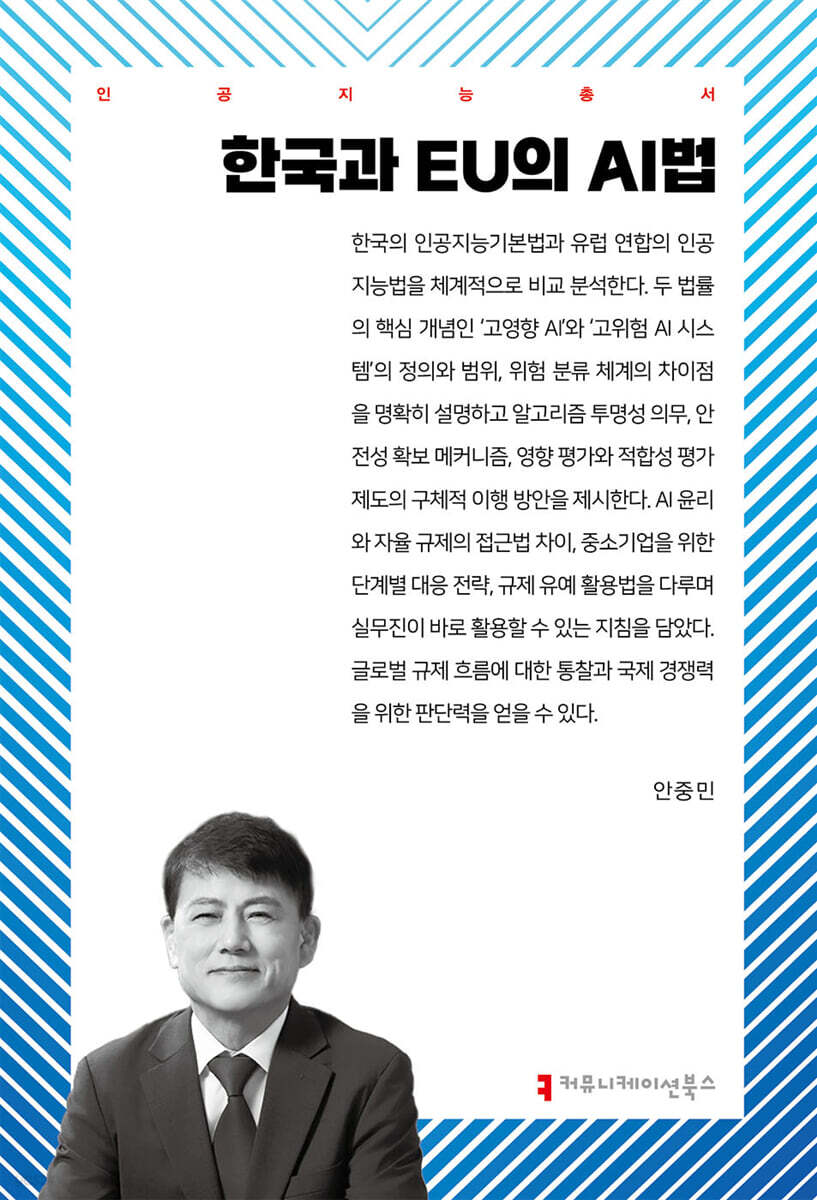
"AI Law in Korea and the EU" identifies regulatory turning points in the rapidly evolving AI era. The EU has introduced robust preemptive regulations for high-risk AI through its AI Act, while Korea has established the concept of "high-impact AI" in its Framework Act on AI, which is scheduled to be implemented in 2026.
This book compares and analyzes the two laws, identifying their similarities and differences. It also presents future regulatory directions and policy implications, along with response guides for practitioners, policymakers, and businesses.
- You can preview some of the book's contents.
Preview
index
Milestones in AI Law: AI Law in Korea and the EU
01 Legislative Background and Characteristics of the Korean AI Basic Act
02 Key Contents of EU AI Law and Global Impact
03 Definition of High-Impact AI and High-Risk AI Systems
04 AI Risk Classification Systems in Korea and the EU
05 Obligation to Ensure Algorithm Transparency
06 AI Safety Ensuring Mechanism
07 High-Impact AI Impact Assessment and Suitability Assessment
08 AI Ethics and Self-Regulation (AI Alignment)
09 AI Regulatory Response Guide for Small and Medium-Sized Enterprises
10. Balance Points and Future Prospects for AI Regulation
Into the book
These differences demonstrate that while the EU emphasizes strong ex ante regulation and a high level of accountability, South Korea pursues a relatively flexible approach, seeking to strike a balance that ensures necessary safeguards are in place without hindering industrial development.
Moreover, the EU has a policy imperative to protect its relatively underdeveloped AI industry from the onslaught of powerful US telecommunications giants, while South Korea needs to establish a certain level of cooperative relationship with US telecommunications giants.
--- From “03_“Definition of High-Impact AI and High-Risk AI Systems””
These methodologies are complementary and can be appropriately mixed and used depending on the characteristics and application area of the AI system.
In particular, to meet the "identification and assessment of risks throughout the AI lifecycle" mandated by Article 32, Paragraph 1, Item 1 of the Framework Act on AI, a comprehensive approach is needed, applying appropriate methodologies step-by-step from the initial development stage through operation and disposal. AI safety assurance mechanisms should be appropriately tailored to a company's size and resources, and appropriate implementation guidelines should be developed for each company size (large corporations, mid-sized companies, startups, and small businesses).
In particular, small and medium-sized enterprises need to actively utilize the support system under Article 17, Paragraph 3 of the Framework Act on AI.
--- From “06_“AI Safety Assurance Mechanism””
While South Korea and the EU's approaches to AI ethics share a common emphasis on risk-based differential regulation and human-centered values, their implementation differs significantly. The EU favors a top-down approach through legal mandates, while South Korea favors a bottom-up approach through voluntary regulation. The EU's mandatory approach is advantageous for fostering a fair competitive environment in an integrated market, while South Korea's voluntary approach may be more suitable for rapid technological innovation and industrial development.
--- From “08_“AI Ethics and Self-Regulation (AI Alignment)”
Publisher's Review
"AI Law in Korea and the EU" is a comparative analysis that explores a new phase in artificial intelligence regulation.
Now, AI is going beyond simple misuse and abuse to refusing human instructions, deceiving people, and even threatening them.
Against this backdrop, the EU adopted the world's first comprehensive regulatory legislation, the AI Act, in 2024, imposing strict obligations on high-risk AI based on a risk-based approach.
South Korea also enacted the "Basic AI Act" in the same year, with implementation slated for 2026. It also introduced the concept of "high-impact AI," stipulating impact assessments, explainability, and human oversight for AI systems.
This book analyzes the two laws within a common framework, revealing their similarities and differences in a three-dimensional manner and providing specific response guidance to practitioners, policymakers, and corporate risk managers.
Furthermore, it proposes tasks for consistency with international standards, support for small and medium-sized enterprises, and institutional supplementation, and forecasts future regulatory directions.
This book, which focuses on the normative and institutional context beyond technical explanations, will serve as a practical milestone in the discussion of AI legislation.
GOODS SPECIFICS
- Date of issue: October 2, 2025
- Page count, weight, size: 175 pages | 128*188*11mm
- ISBN13: 9791143008671
You may also like
카테고리
korean


korean


