

Studying SQL on your own
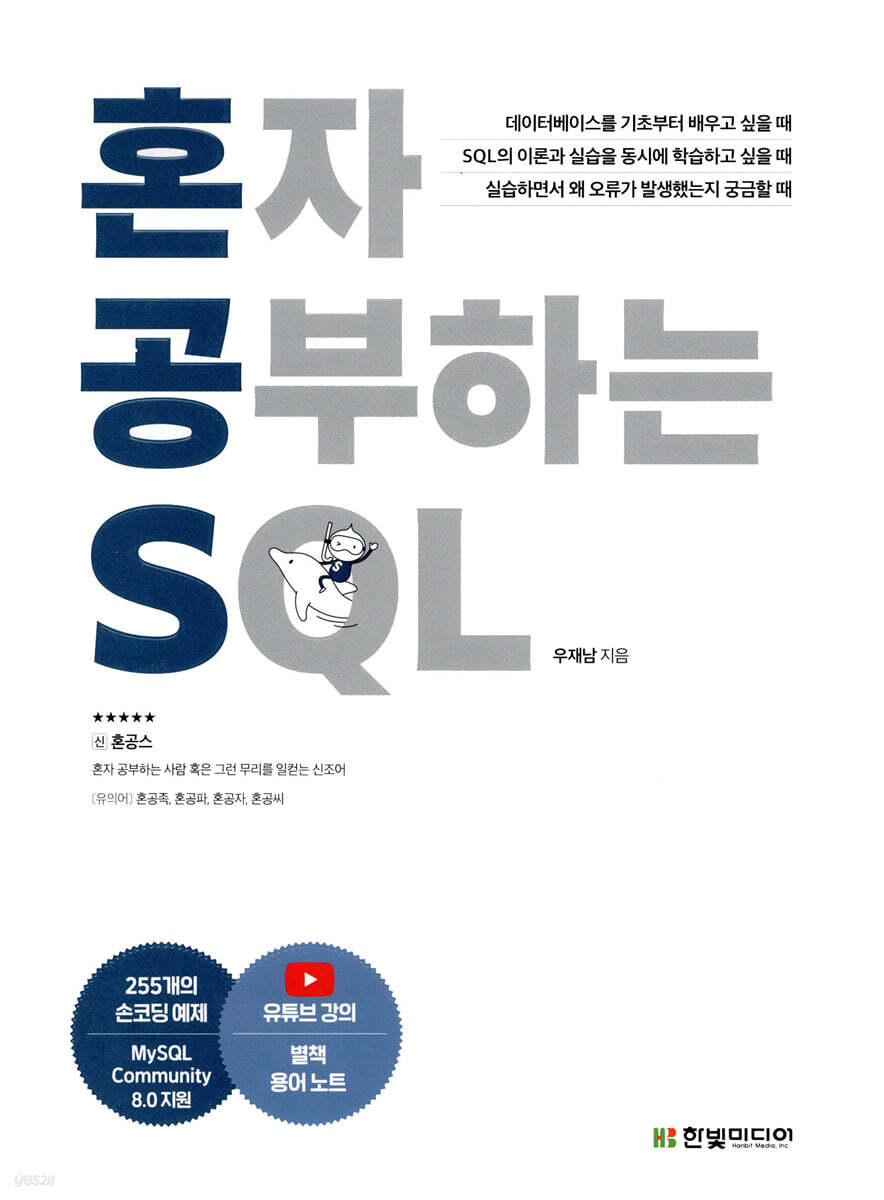 |
Description
Book Introduction
It's enough to do it alone!
A database tutorial that teaches you how to use MySQL as if you were tutoring (supports MySQL Community 8.0)
This book is structured so that even beginners without any prior knowledge can learn the 'essential content' properly.
It considers the vague minds of beginners who don't even know 'what' or 'how' to learn, and kindly, like a private tutor, but only points out the essential content.
From the moment you open the book to the last page, you'll feel confident and assured that you can learn SQL on your own!
- You can preview some of the book's contents.
Preview
index
Chapter 01 Databases and SQL
: We will look at DBMS closely related to databases and prepare the working environment by installing MySQL.
01-1 Understanding the Database
__Database and DBMS
__DBMS development process
__Classification of DBMS
__Language used in DBMS: SQL
[Key Points in 4 Keywords]
[Key points summarized in a table]
[Confirmation question]
01-2 Installing MySQL
__Computer environment for MySQL installation
__Download and install MySQL
__Checking MySQL operation
__Download and install MariaDB
[Key points summarized in three keywords]
[Key points summarized in a table]
[Confirmation question]
Chapter 02: A Preview of Real-World SQL
: To make learning interesting, take some time to get a taste of SQL used in real-world situations.
02-1 Blueprint for Building Construction: Database Modeling
__Project Progress Stage
__Database Modeling
__Overall database configuration diagram
[Learn more] Database modeling tools
[Key Points in 4 Keywords]
[Key points summarized in a table]
[Confirmation question]
02-2 Database from start to finish
__Installing DBMS
__Create a database
__Create table
__Enter data
__Using data
[Key Points in 4 Keywords]
[Key points summarized in a table]
[Confirmation question]
02-3 Database Objects
__Index
__views
__Stored Procedure
[Key points summarized in three keywords]
[Key points summarized in a table]
[Confirmation question]
Chapter 03 SQL Basic Grammar
: Let's practice understanding basic SQL grammar and becoming familiar with its usage.
03-1 The basics of the basics SELECT~FROM~WHERE
__Building a database for practice
__Basic query: SELECT ~ FROM
__Retrieve only specific conditions: SELECT ~ FROM ~ WHERE
[Learn more] Subqueries
[Key Points in 5 Keywords]
[Key points summarized in a table]
[Confirmation question]
03-2 A closer look at the SELECT statement
__ORDER BY clause
__GROUP BY clause
[Key Points in 5 Keywords]
[Key points summarized in a table]
[Confirmation question]
03-3 SQL statement for data change
__Data Entry: INSERT
__Data Modification: UPDATE
__Delete data: DELETE
__Delete large tables
[Key Points in 5 Keywords]
[Key points summarized in a table]
[Confirmation question]
Chapter 04 Advanced SQL Grammar
: Learn about data types and joins for advanced SQL and learn SQL programming.
04-1 MySQL data types
__data type
Use of __variables
__Data type conversion
[Key Points in 6 Keywords]
[Key points summarized in a table]
[Confirmation question]
04-2 Joining two tables
__inner join
__Print only one duplicate result
__Outer Join
__Other joins
[Key Points in 6 Keywords]
[Key points summarized in a table]
[Confirmation question]
04-3 SQL Programming
__IF statement
__CASE statement
__WHILE statement
__Dynamic SQL
[Key Points in 5 Keywords]
[Confirmation question]
Chapter 05 Tables and Views
: Let's take a look at the most important of the various objects in a database: tables and views.
05-1 Creating a Table
__Designing databases and tables
__Creating a table in a GUI environment
__Creating a table with SQL
[Key Points in 5 Keywords]
[Key points summarized in a table]
[Confirmation question]
05-2 Strengthening the table with constraints
__Basic concepts and types of constraints
__primary key constraints
__Foreign key constraints
__Other constraints
[Key Points in 6 Keywords]
[Key points summarized in a table]
[Confirmation question]
05-3 Virtual Table: View
__Concept of view
__View's actual operation
[Key Points in 6 Keywords]
[Key points summarized in a table]
[Confirmation question]
Chapter 06 Index
: Let's look at indexes, which reduce the time it takes to extract information from a database.
06-1 Understanding the concept of indexes
__Concept of index
__Index type
[Key points summarized in three keywords]
[Key points summarized in a table]
[Confirmation question]
06-2 The inner workings of the index
__The inner workings of an index
__Index Structure
[Key Points in 5 Keywords]
[Confirmation question]
06-3 Practical use of the index
__Index creation and removal syntax
__Index Creation and Removal Practice
__How to use indexes effectively
[Key Points in 5 Keywords]
[Confirmation question]
Chapter 07 Stored Procedures
: Learn how to add programming logic to SQL using stored procedures.
07-1 How to use stored procedures
__Stored Procedure Basics
__Stored Procedure Practice
[Key Points in 6 Keywords]
[Confirmation question]
07-2 Stored Functions and Cursors
__Stored function
__Process one line at a time with the cursor
[Key Points in 5 Keywords]
[Confirmation question]
07-3 Auto-running trigger
__Trigger Basics
__Trigger Utilization
[Learn more] Temporary tables used by triggers
[Key Points in 6 Keywords]
[Confirmation question]
Chapter 08 Connecting SQL and Python
: Connecting SQL with programming languages makes MySQL accessible to even the average user. Learn about connecting SQL with Python.
08-1 Preparing the Python Development Environment
__Introduction to Python
__Installing Python
__How to use Python
[Key Points in 6 Keywords]
[Confirmation question]
08-2 Integration between Python and MySQL
__Federated Programming Basics
__Using linked programming
[Key Points in 6 Keywords]
[Key Points in a Flowchart]
[Confirmation question]
08-3 GUI Application
__GUI Basic Programming
__Full-form GUI application programming
[7 Key Points to Conclude]
[Confirmation question]
__Appendix A Essential Python Grammar for MySQL Integration
[Confirmation question answer]
[Search]
Detailed image

Publisher's Review
A personalized beginner's book, "created together," verified by 28 beta readers.
Through the beta reading process, we considered and actively reflected on the appropriate difficulty level, length, and learning elements for beginners.
Difficult terms and concepts are explained again, and complex explanations are explained with easy-to-see pictures.
The greatest strength of this book is that the minds and perspectives of many beginners who have 'studied on their own' are reflected throughout the book.
Who is this book for?
- Students and job seekers who are starting SQL for the first time
- Beginner developers who want to learn database basics
- Beginners who want to learn both theory and practice of SQL at the same time
- Beginners who have given up on studying SQL because it was too difficult.
- Junior developers who need to do SQL-related work in practice
A word from beta readers who read it first
『Study SQL on Your Own』 is a textbook for self-study.
_Kim Dong-hee
It was great to be able to understand things more deeply by not only studying the theory but also practicing code with MySQL.
_Lee Hyun-joo
The friendly explanations and easy-to-understand diagrams are a great strength of this book.
_Jang Dae-hyuk
There are review questions at the end of each section so you can check for yourself whether you have properly understood the material you studied.
_Believers
The hands-on structure allows you to learn SQL without losing interest until you finish the book.
_Noh Woo-jun
Provides readers with a standardized route to systematic learning.
_Song Seo-young
Book Features
1. Solid learning design: Systematic, repetitive learning following the "7-step structure tailored for beginners."
This book is structured so that the core contents of SQL are naturally memorized through repeated learning in seven steps.
In each section, we warm up with the representative concepts of each section's topic through [Key Keywords] and [Before You Begin], then go through the core SQL theory and practice, and at the end, we review them all at once with [Key Points] and [Check Questions].
If you follow the curriculum that allows you to study on your own, even a SQL beginner who is learning programming for the first time will be able to finish the book without difficulty!
2. 255 hands-on 'hand coding' exercises to help you master grammar and practical skills.
It contains 255 carefully selected practical examples so that you can read the explanations of core grammar and theory with both eyes and head, and learn practical skills through hands-on coding.
Even beginners, for whom repetitive learning and practice are essential, can make the code in the book their own by practicing with practical code.
Please refer to the appendix for the essential Python grammar required to connect Python and a database in Chapter 8.
Third, video lectures and learning site support to empower 'Hongong' http://hongong.hanbit.co.kr
For beginners who still find it difficult to learn from books alone, we also provide videos of lectures directly from the author.
We also provide a learning site so that you can ask questions at any time while studying.
The author personally answers each question and shares the latest SQL-related technologies and information.
In addition, we run a study group called Honkong Study Group, a group of people who want to study together while studying alone, to provide maximum support so that readers can complete the course without giving up.
Fourth, we provide a glossary of essential terms for studying alone, so you can read them anytime, anywhere.
We provide a [Terminology Note] that organizes only the key concepts and terms that you must remember.
Through beta readers, I've confirmed that the reason why learning programming is difficult for beginners is because of unfamiliar terminology. It's not that it's difficult, but rather that it's confusing due to unfamiliarity. So, feel free to open it whenever you're having trouble remembering.
In addition to the terms presented, it would also be fun to complete your own glossary by adding new terms.
GOODS SPECIFICS
- Publication date: November 1, 2021
- Page count, weight, size: 444 pages | 188*257*30mm
- ISBN13: 9791162244739
- ISBN10: 1162244739
You may also like
카테고리
korean


korean


