

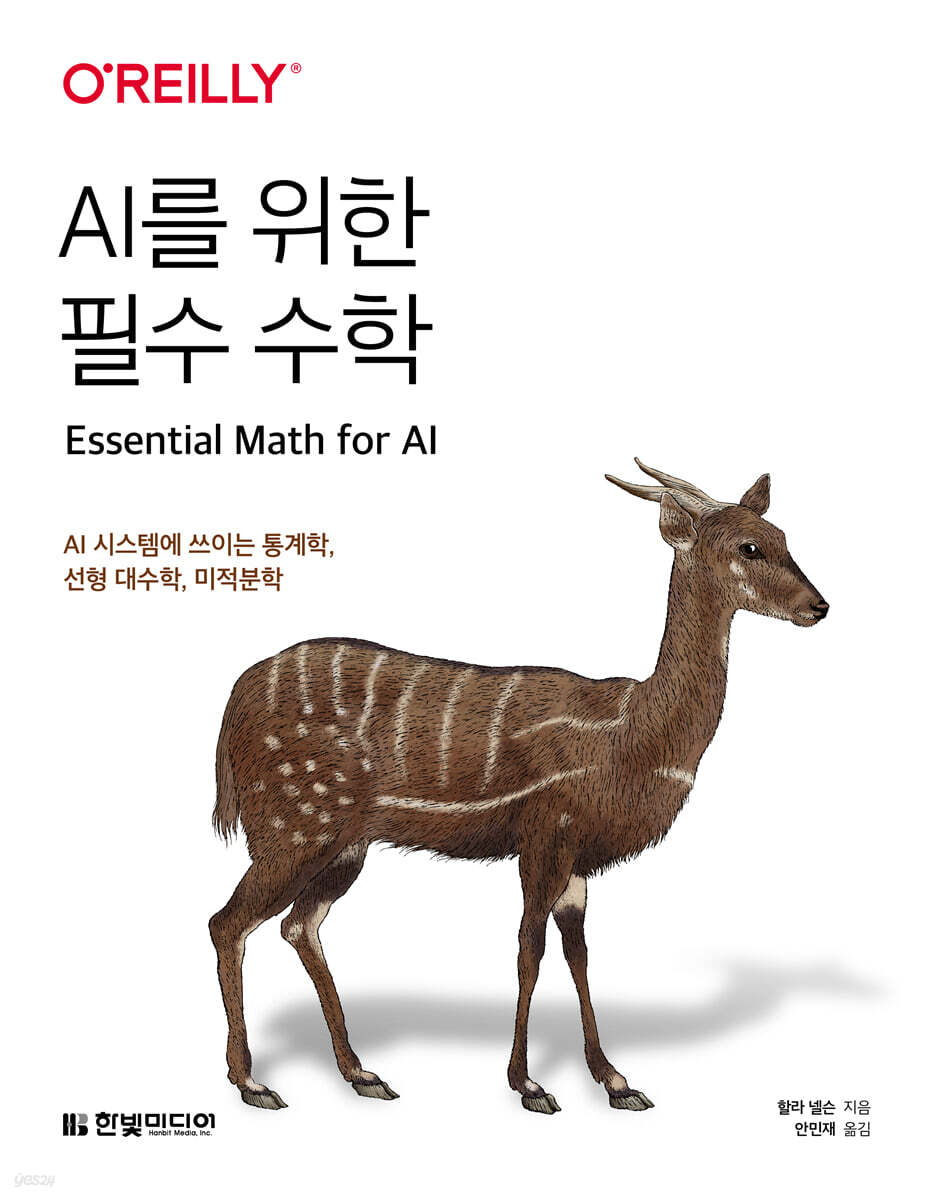
Essential Mathematics for AI
 |
Description
Book Introduction
The beginning of AI is mathematics!
A math guide that focuses on application cases, excluding theorem/proof/coding.
This book is designed for those who give up on mathematics because they are overwhelmed by complex formulas and vast amounts of data. It explains basic mathematical concepts essential for building AI systems, such as statistics, linear algebra, and calculus, in an easy-to-understand manner.
We minimize difficult theorems, proofs, and coding, and demonstrate how each concept is applied to AI applications through real-world examples.
This allows you to focus on the relationships between mathematical concepts and the big picture rather than on the mathematical details.
Additionally, it clearly explains why which mathematics is used in which part of AI, and goes beyond a simple list of theories to provide an easy-to-understand explanation of how mathematics is utilized in actual AI systems through specific examples.
This book introduces relevant mathematical concepts in core areas of AI, including the fundamental principles of machine learning algorithms, the operation of neural networks, and the mathematical foundations of natural language processing, helping readers systematically understand how AI works. This book will be a valuable resource for students, developers, and researchers interested in AI, as well as executives seeking to apply AI technology to their businesses.
A math guide that focuses on application cases, excluding theorem/proof/coding.
This book is designed for those who give up on mathematics because they are overwhelmed by complex formulas and vast amounts of data. It explains basic mathematical concepts essential for building AI systems, such as statistics, linear algebra, and calculus, in an easy-to-understand manner.
We minimize difficult theorems, proofs, and coding, and demonstrate how each concept is applied to AI applications through real-world examples.
This allows you to focus on the relationships between mathematical concepts and the big picture rather than on the mathematical details.
Additionally, it clearly explains why which mathematics is used in which part of AI, and goes beyond a simple list of theories to provide an easy-to-understand explanation of how mathematics is utilized in actual AI systems through specific examples.
This book introduces relevant mathematical concepts in core areas of AI, including the fundamental principles of machine learning algorithms, the operation of neural networks, and the mathematical foundations of natural language processing, helping readers systematically understand how AI works. This book will be a valuable resource for students, developers, and researchers interested in AI, as well as executives seeking to apply AI technology to their businesses.
- You can preview some of the book's contents.
Preview
index
Chapter 1 Why should we learn artificial intelligence mathematics?
1.1 What is artificial intelligence?
1.2 Why is artificial intelligence in the spotlight?
1.3 What can artificial intelligence do?
1.4 What are the limitations of artificial intelligence?
1.5 What happens if an AI system fails?
1.6 Where is artificial intelligence headed?
1.7 Who are the biggest contributors to artificial intelligence today?
1.8 What contributions has mathematics made to artificial intelligence?
Chapter 2 Data, Data, and More Data
2.1 Data for Artificial Intelligence
2.2 Real and simulated data
2.3 Mathematical Models: Linear and Nonlinear
2.4 Real data examples
2.5 Example simulation data
2.6 Mathematical Models: Simulation and Artificial Intelligence
2.7 Where do you get your data?
2.8 Frequently appearing terms in data distribution, probability, and statistics
2.9 Continuous and Discrete Distributions
2.10 The Power of Joint Probability Density Functions
2.11 Uniform distribution
2.12 Normal distribution
2.13 Frequently used distributions
2.14 Various meanings of distribution
2.15 A/B Testing
Chapter 3 How to Optimize Functions for Data
3.1 Useful Classical Machine Learning Models
3.2 Numerical and analytical methods
3.3 Regression: Predicting numeric values
3.4 Logistic Regression: Binary Classification
3.5 Softmax Regression: Multinomial Classification
3.6 Integrating the model into the final layer of the neural network
3.7 Popular machine learning methods and ensemble methods
3.8 Performance Evaluation of Classification Models
Chapter 4 Optimization for Neural Networks
4.1 Cerebral Cortex and Artificial Neural Networks
4.2 Training functions: fully connected neural networks, dense neural networks, and forward neural networks
4.3 Loss function
4.4 Optimization
4.5 Normalization
4.6 Hyperparameters of Machine Learning Models
4.7 Chain rule and backpropagation
4.8 Evaluating the importance of input data features
Chapter 5 Convolutional Neural Networks and Computer Vision
5.1 Convolution and Cross-Correlation
5.2 Convolution from a system design perspective
5.3 Convolution and One-Dimensional Discrete Signals
5.4 Convolution and Two-Dimensional Discrete Signals
5.5 Linear Algebra Notation
5.6 Pooling
5.7 Convolutional Neural Networks for Image Classification
Chapter 6 Singular Value Decomposition: Image Processing, Natural Language Processing, and Social Media
6.1 Matrix Decomposition
6.2 Diagonal matrices
6.3 Matrices as spatial linear transformations
6.4 Three Methods for Matrix Multiplication
6.5 large cream
6.6 Components of Singular Value Decomposition
6.7 Singular Value Decomposition vs. Eigenvalue Decomposition
6.8 Computing the singular value decomposition
6.9 Pseudoinverse matrix
6.10 Applying Singular Value Decomposition to Images
6.11 Principal Component Analysis and Dimensionality Reduction
6.12 Principal Component Analysis and Clustering
6.13 Applications in Social Media
6.14 Latent Semantic Analysis
6.15 Random Singular Value Decomposition
Chapter 7 Natural Language Processing and Financial AI: Vectorization and Time Series Analysis
7.1 Natural Language Processing Artificial Intelligence
7.2 Preparing Natural Language Data
7.3 Statistical Models and Log Functions
7.4 Zipf's Law on the Number of Words
7.5 Various vector representations of natural language documents
7.6 Cosine similarity
7.7 Natural Language Processing Applications
7.8 Transformer and Attention Models
7.9 Convolutional Neural Networks for Time Series Data
7.10 Recurrent Neural Networks for Time Series Data
7.11 Natural Language Data Examples
7.12 Financial Artificial Intelligence
Chapter 8 Probabilistic Generative Models
8.1 When are generative models useful?
8.2 General Mathematics of Generative Models
8.3 Transition from deterministic to probabilistic thinking
8.4 Maximum likelihood estimation
8.5 Explicit and implicit density models
8.6 Traceable Explicit Density: Reliable Visible Neural Networks
8.7 Explicit Density - Traceability: Variable Transformation and Nonlinear Independent Component Analysis
8.8 Explicit Density - Untraceable: Approximating Variational Autoencoders via Variational Methods
8.9 Explicit Density - Untraceable: Approximating Boltzmann Machines via Markov Chains
8.10 Implicit Density - Markov Chains: A Probabilistic Generative Model
8.11 Implicit Density - Adversarial Generative Model
8.12 Example: High-Energy Physics Using Machine Learning and Generative Neural Networks
8.13 Other Generation Models
8.14 Evolution of the generative model
8.15 Probabilistic Language Modeling
Chapter 9 Graph Models
9.1 Graphs: Nodes, Edges, and Features
9.2 Example: PageRank Algorithm
9.3 Calculating the inverse matrix using graphs
9.4 Cayley Graph Groups: Pure Algebra and Parallel Computation
9.5 Passing Messages Within a Graph
9.6 Unlimited Uses of Graphs
9.7 Random walks on graphs
9.8 Learning Node Representation
9.9 Applications of Graph Neural Networks
9.10 Dynamic Graph Model
9/11 Bayes Network
9.12 Graph Diagrams for Probabilistic Causal Modeling
9.13 A Brief History of Graph Theory
9.14 Key Considerations in Graph Theory
9.15 Graph Algorithms and Computational Aspects
Chapter 10 Operational Science
10.1 There is no free lunch
10.2 Complexity Analysis and Big O Notation
10.3 Optimization: The Core of Operational Science
10.4 Considerations on Optimization
10.5 Optimization on the Network
1.1 What is artificial intelligence?
1.2 Why is artificial intelligence in the spotlight?
1.3 What can artificial intelligence do?
1.4 What are the limitations of artificial intelligence?
1.5 What happens if an AI system fails?
1.6 Where is artificial intelligence headed?
1.7 Who are the biggest contributors to artificial intelligence today?
1.8 What contributions has mathematics made to artificial intelligence?
Chapter 2 Data, Data, and More Data
2.1 Data for Artificial Intelligence
2.2 Real and simulated data
2.3 Mathematical Models: Linear and Nonlinear
2.4 Real data examples
2.5 Example simulation data
2.6 Mathematical Models: Simulation and Artificial Intelligence
2.7 Where do you get your data?
2.8 Frequently appearing terms in data distribution, probability, and statistics
2.9 Continuous and Discrete Distributions
2.10 The Power of Joint Probability Density Functions
2.11 Uniform distribution
2.12 Normal distribution
2.13 Frequently used distributions
2.14 Various meanings of distribution
2.15 A/B Testing
Chapter 3 How to Optimize Functions for Data
3.1 Useful Classical Machine Learning Models
3.2 Numerical and analytical methods
3.3 Regression: Predicting numeric values
3.4 Logistic Regression: Binary Classification
3.5 Softmax Regression: Multinomial Classification
3.6 Integrating the model into the final layer of the neural network
3.7 Popular machine learning methods and ensemble methods
3.8 Performance Evaluation of Classification Models
Chapter 4 Optimization for Neural Networks
4.1 Cerebral Cortex and Artificial Neural Networks
4.2 Training functions: fully connected neural networks, dense neural networks, and forward neural networks
4.3 Loss function
4.4 Optimization
4.5 Normalization
4.6 Hyperparameters of Machine Learning Models
4.7 Chain rule and backpropagation
4.8 Evaluating the importance of input data features
Chapter 5 Convolutional Neural Networks and Computer Vision
5.1 Convolution and Cross-Correlation
5.2 Convolution from a system design perspective
5.3 Convolution and One-Dimensional Discrete Signals
5.4 Convolution and Two-Dimensional Discrete Signals
5.5 Linear Algebra Notation
5.6 Pooling
5.7 Convolutional Neural Networks for Image Classification
Chapter 6 Singular Value Decomposition: Image Processing, Natural Language Processing, and Social Media
6.1 Matrix Decomposition
6.2 Diagonal matrices
6.3 Matrices as spatial linear transformations
6.4 Three Methods for Matrix Multiplication
6.5 large cream
6.6 Components of Singular Value Decomposition
6.7 Singular Value Decomposition vs. Eigenvalue Decomposition
6.8 Computing the singular value decomposition
6.9 Pseudoinverse matrix
6.10 Applying Singular Value Decomposition to Images
6.11 Principal Component Analysis and Dimensionality Reduction
6.12 Principal Component Analysis and Clustering
6.13 Applications in Social Media
6.14 Latent Semantic Analysis
6.15 Random Singular Value Decomposition
Chapter 7 Natural Language Processing and Financial AI: Vectorization and Time Series Analysis
7.1 Natural Language Processing Artificial Intelligence
7.2 Preparing Natural Language Data
7.3 Statistical Models and Log Functions
7.4 Zipf's Law on the Number of Words
7.5 Various vector representations of natural language documents
7.6 Cosine similarity
7.7 Natural Language Processing Applications
7.8 Transformer and Attention Models
7.9 Convolutional Neural Networks for Time Series Data
7.10 Recurrent Neural Networks for Time Series Data
7.11 Natural Language Data Examples
7.12 Financial Artificial Intelligence
Chapter 8 Probabilistic Generative Models
8.1 When are generative models useful?
8.2 General Mathematics of Generative Models
8.3 Transition from deterministic to probabilistic thinking
8.4 Maximum likelihood estimation
8.5 Explicit and implicit density models
8.6 Traceable Explicit Density: Reliable Visible Neural Networks
8.7 Explicit Density - Traceability: Variable Transformation and Nonlinear Independent Component Analysis
8.8 Explicit Density - Untraceable: Approximating Variational Autoencoders via Variational Methods
8.9 Explicit Density - Untraceable: Approximating Boltzmann Machines via Markov Chains
8.10 Implicit Density - Markov Chains: A Probabilistic Generative Model
8.11 Implicit Density - Adversarial Generative Model
8.12 Example: High-Energy Physics Using Machine Learning and Generative Neural Networks
8.13 Other Generation Models
8.14 Evolution of the generative model
8.15 Probabilistic Language Modeling
Chapter 9 Graph Models
9.1 Graphs: Nodes, Edges, and Features
9.2 Example: PageRank Algorithm
9.3 Calculating the inverse matrix using graphs
9.4 Cayley Graph Groups: Pure Algebra and Parallel Computation
9.5 Passing Messages Within a Graph
9.6 Unlimited Uses of Graphs
9.7 Random walks on graphs
9.8 Learning Node Representation
9.9 Applications of Graph Neural Networks
9.10 Dynamic Graph Model
9/11 Bayes Network
9.12 Graph Diagrams for Probabilistic Causal Modeling
9.13 A Brief History of Graph Theory
9.14 Key Considerations in Graph Theory
9.15 Graph Algorithms and Computational Aspects
Chapter 10 Operational Science
10.1 There is no free lunch
10.2 Complexity Analysis and Big O Notation
10.3 Optimization: The Core of Operational Science
10.4 Considerations on Optimization
10.5 Optimization on the Network
Detailed image

Publisher's Review
A guide that explains essential mathematical concepts in the age of artificial intelligence in an easy and intuitive way!
"Essential Mathematics for AI" explains the mathematical principles underlying artificial intelligence and data science in a way anyone can understand.
Rather than focusing on mathematical formulas and proofs, this book covers various examples of how mathematics is actually applied in artificial intelligence projects, helping you gain an intuitive understanding.
In particular, it provides in-depth coverage of relatively underrepresented areas, including graph theory and operational science, providing ideas that can be immediately applied in practice.
This will be a useful resource not only for those planning to begin learning artificial intelligence, but also for practitioners in related fields.
"Essential Mathematics for AI" explains the mathematical principles underlying artificial intelligence and data science in a way anyone can understand.
Rather than focusing on mathematical formulas and proofs, this book covers various examples of how mathematics is actually applied in artificial intelligence projects, helping you gain an intuitive understanding.
In particular, it provides in-depth coverage of relatively underrepresented areas, including graph theory and operational science, providing ideas that can be immediately applied in practice.
This will be a useful resource not only for those planning to begin learning artificial intelligence, but also for practitioners in related fields.
GOODS SPECIFICS
- Date of issue: August 20, 2024
- Page count, weight, size: 640 pages | 1,136g | 183*235*26mm
- ISBN13: 9791169212588
- ISBN10: 1169212581
You may also like
카테고리
korean


korean

![GQ KOREA Mark (Monthly): December [2025]](http://librairie.coreenne.fr/cdn/shop/files/8ef265dbbfbf186523ed75ba7319009d.jpg?v=1765340328&width=3840)


