

People Who Leave Their Thoughts to Us: Homo Brainless
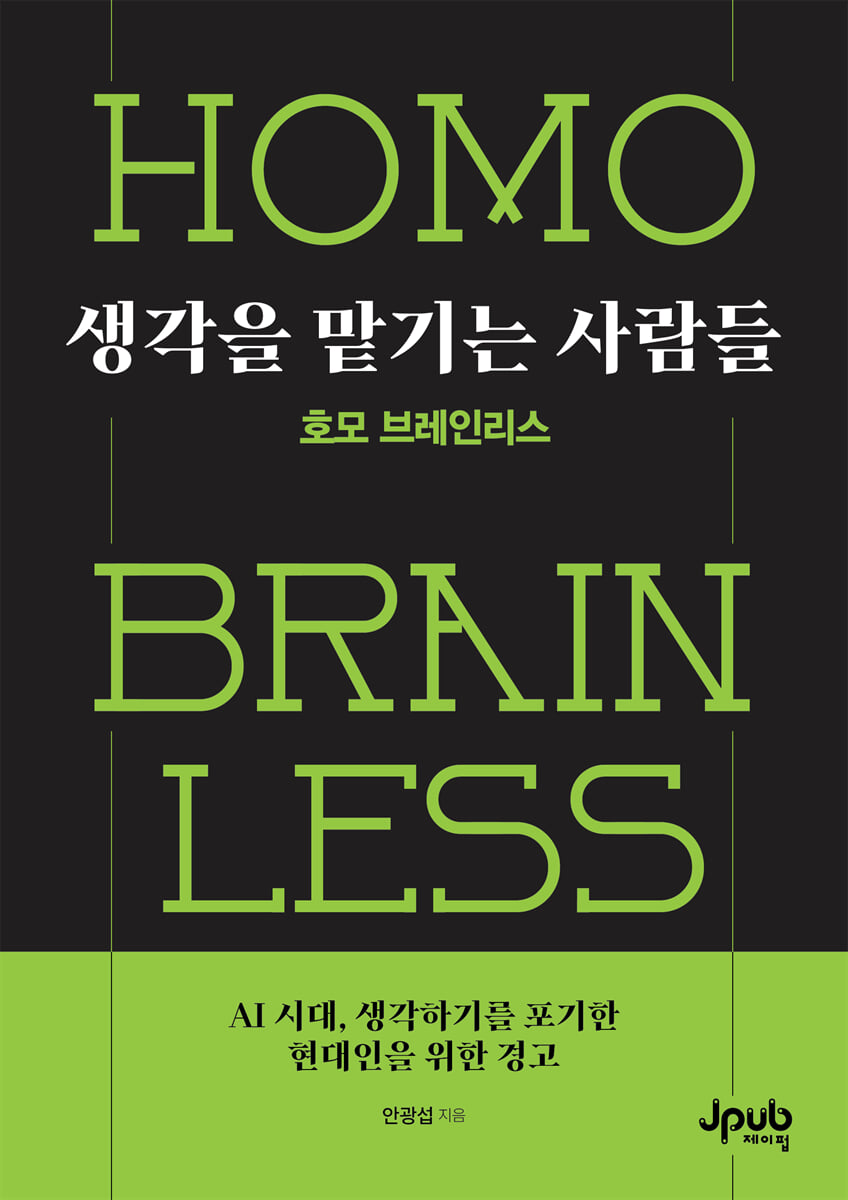 |
Description
Book Introduction
Should I think or should I fall asleep?
This book sends a powerful message to us living in the AI era: "Don't outsource your thinking."
Rather than simply teaching you how to use the latest tools, it shows you how to cultivate uniquely human strengths like questioning, critical thinking, and structured thinking, and collaborate with AI.
Drawing on the historical insight that technology has both replaced humans and ultimately expanded life, the author emphasizes that we must treat AI as our intellectual partner, as its masters rather than its slaves.
Ultimately, this book is a practical compass that guides us beyond "how to work with AI" in this chaotic era, and on how to live as masters of our own thoughts.
- You can preview some of the book's contents.
Preview
index
Recommended Articles: In the AI Era, Will You Be a Beggar or a Leader? 6
Introduction: The Age of Information Overflow 9
Prologue: 11 Concerns That Started with Vibe Coding
Why "AI Survival Strategy" and Not "Vibe Coding"
Will technology replace or complement humans?
__The Principle of Survival Discovered in Chaos
Part 1: Redesigning Your Perspective: 35 Ways of Thinking for the Surviving Few
Chapter 1: Are You a Questioner or a Beggar? 41
Chapter 2: The End of Perfectionism, the Age of Great Experimentation 50
Chapter 3: From Turing's Question to ChatGPT 57
Chapter 4: Machine Imagination: The Three Faces of AI Creativity 63
Chapter 5: Are You a Consumer of Information or a Producer of Meaning? 72
__The most important question we need to ask now
Part 2: Sharpen Your Principles: 83 Irreplaceable, Uniquely Human Capabilities
Chapter 6: The Power of Drawing the Blueprint of Thought: Structuring 92
__How AI Seduces Your System 1
__The pyramid that builds the framework of thought
__Practical prompt templates created using the pyramid principle
__How AI Mimics Human Thought
__The Tree of Thought: How AI Brainstorms
__Self-Consistency: AI Checks Its Own Calculations
The Power of Structure: Before & After (Final Edition)
__Another real-world example: solving a business problem
Chapter 7: Artificial Intelligence Reaches Humanity's Highest Knowledge 110
Chapter 8: How to Collaborate with the Smartest Fool in the World: Critical Thinking 120
Step 1: Become a "gatekeeper" who filters out lies.
Step 2: Become an "Editor" Who Judges "Good"
Chapter 9: Redefining Software 130
__A new era of electricity, a new era of operating systems
__The Evolution of the Developer: Architect and Conductor
Chapter 10: Context and Taste: The Last Piece AI Can't Imitate 141
Part 3: Build Your Own System: Workflow 153: Mastering Your Tools
Chapter 11: How the "Second Brain" Becomes the Engine of Thought 162
Chapter 12: Creating Your Own AI Collaboration Cycle to Achieve Your Goals 172
Chapter 13: Riding Technology, But Not Being a Slave to It 185
Chapter 14: The Evolution of the Tech Race: From GPUs to Talent
Chapter 15: Focus on the Unchanging Essence 211
__12 Criteria for Smart Technology Utilization
Epilogue: Living as Masters of Our Thoughts, and the Future Ahead of Us 226
Search 232
Detailed image

Into the book
Ultimately, this results-first mindset is the most crucial shift in perspective for survival in the AI era. It requires not simply consuming the results AI provides in wonder, but the ability to consciously reverse engineer them, dissecting and analyzing them, delving into their underlying principles. It also requires the application of these internalized principles to create something entirely new.
/ Depending on how quickly you understand and internalize the rules of this new game, you will either remain a simple user who 'begs' the AI for answers, or you will become a 'designer' who manipulates the AI to create what you want.
And as always, the survivors will be the latter.
--- p.39-40
Now, we can use tools like AI to experiment with building multiple service prototypes or MVPs (minimum viable products) simultaneously, all at a fraction of the cost.
The order of learning is completely reversed.
You no longer need to worry about the 'how' question.
First, you can ask AI what you want to create, and then quickly verify the result to determine why you need to create it.
And when you're finally confident that your idea is meaningful and valuable, then you can learn as much "how" as you need, as needed.
/ Perfectionism has little room to stand.
Now, a great era of experimentation opens before us.
No craftsman in this world was a craftsman from the beginning.
--- p.54
While artificial intelligence is making remarkable progress, if there's something evolution hasn't equipped us with beforehand, that could be the starting point of true leverage.
While the cost of learning what we already know is getting cheaper, the true scarcity lies in intrinsic qualities like curiosity and the motivation to explore new things.
No matter how much the cost of learning decreases, there is still psychological discomfort and challenge in embracing new concepts.
In such a situation, the internal motivation of 'I'm still curious, so I should try it' acts as the most powerful leverage.
--- p.79
When you teach AI to self-verify in this way, the accuracy of its answers improves dramatically. According to MIT research, applying self-consistency improved AI's inference accuracy by an average of 34%.
/ Just as we organize our thoughts according to the pyramid principle, AI can only think by following logical steps.
Both self-consistency and the tree of thought technique have one root: structured thinking.
/ What this tells us is clear.
The secret to prompt engineering isn't learning special techniques for AI, but rather first demonstrating a well-structured human thought process that AI would want to emulate.
--- p.104
We now have to decide which seeds to plant and which to weed out.
And we must become "gardeners of thought," pondering how to connect and arrange those seeds to produce the most abundant fruit. AI can provide excellent seeds, but the task of cultivating the garden lies solely with the gardener.
Ultimately, if we are to truly utilize this new architect and rainmaker, we must first deeply understand the workings and limitations of our own garden—our brain—and then build a systematic "garden management system" that transcends those limitations.
--- p.157
This phenomenon of 'outsourcing of thought' is becoming more common with the development of artificial intelligence.
It is about acting and making decisions based on what artificial intelligence suggests without your own judgment or consideration.
From convenient summary services to recommendation algorithms, we're increasingly handing over more choices to artificial intelligence.
As a result, the process of direct reflection itself is decreasing, and even personal judgment is deteriorating.
/ What is really needed in these times is to develop your own structural thinking skills.
It's not just about how to use tools well or how to utilize artificial intelligence.
The real key is the ability to accurately identify the fundamental problem, structure it step-by-step, and solve it yourself.
--- p.194
Publisher's Review
Will you be a slave to your tools or their master?
AI can answer questions for us, but humans must still be the ones to think.
Beyond simple usage, "Thinking: Homo Brainless" asks how we will question, structure, critique, and understand context in the age of AI.
More important than prompting skills are the ability to ask questions that penetrate the problem, the critical thinking that verifies AI answers, and the "second brain" that accumulates thoughts.
As with writing, printing, and the Internet, those who will ultimately survive this technological shock will be thinking humans.
Many books teach you how to use AI.
But this book asks:
“In the AI era, are you still the master of your thoughts?”
And the author answers:
“Don’t outsource your thinking, train your questions.
Good answers come from persistent questions, and conversations with AI ultimately depend on the skill of the questioner.
Structure your thoughts.
The ability to simply break down complex problems and connect them seamlessly is the true competitive edge in the AI era.
Critique it. Don't just accept the AI's answers; examine them in context and contrast them with other perspectives.
Write it down.
"Don't let the momentary insight slip away, but create a second brain to accumulate and recycle your thoughts." The message this book conveys is simple: the way to become smarter alongside AI is for humans to become masters of their own thoughts.
Technology is just a tool, and it is up to humans to decide how to use it.
Key Contents
- Understanding the essence of AI and redefining the role of humans
- Developing the ability to ask questions and structure thoughts to penetrate problems.
- Train yourself to be a questioner who constantly asks and criticizes.
- Validating AI through critical thinking
- Training unique human strengths to counter AI
Target audience
- Practitioners who are already using AI but want to go beyond simple use and deepen their thinking and collaboration.
- Learners who feel that prompting techniques alone are insufficient and want to develop questioning skills and critical thinking.
- Workers who do not want to lose their unique competitiveness in the face of new technological shocks.
- Creators who want to use AI as an intellectual partner, not just a tool, to achieve creative results.
- All readers who want to live as 'masters of their thoughts' even in the AI era
GOODS SPECIFICS
- Date of issue: September 18, 2025
- Page count, weight, size: 236 pages | 152*215*14mm
- ISBN13: 9791194587644
You may also like
카테고리
korean


korean


