

Java's Classics
 |
Description
Book Introduction
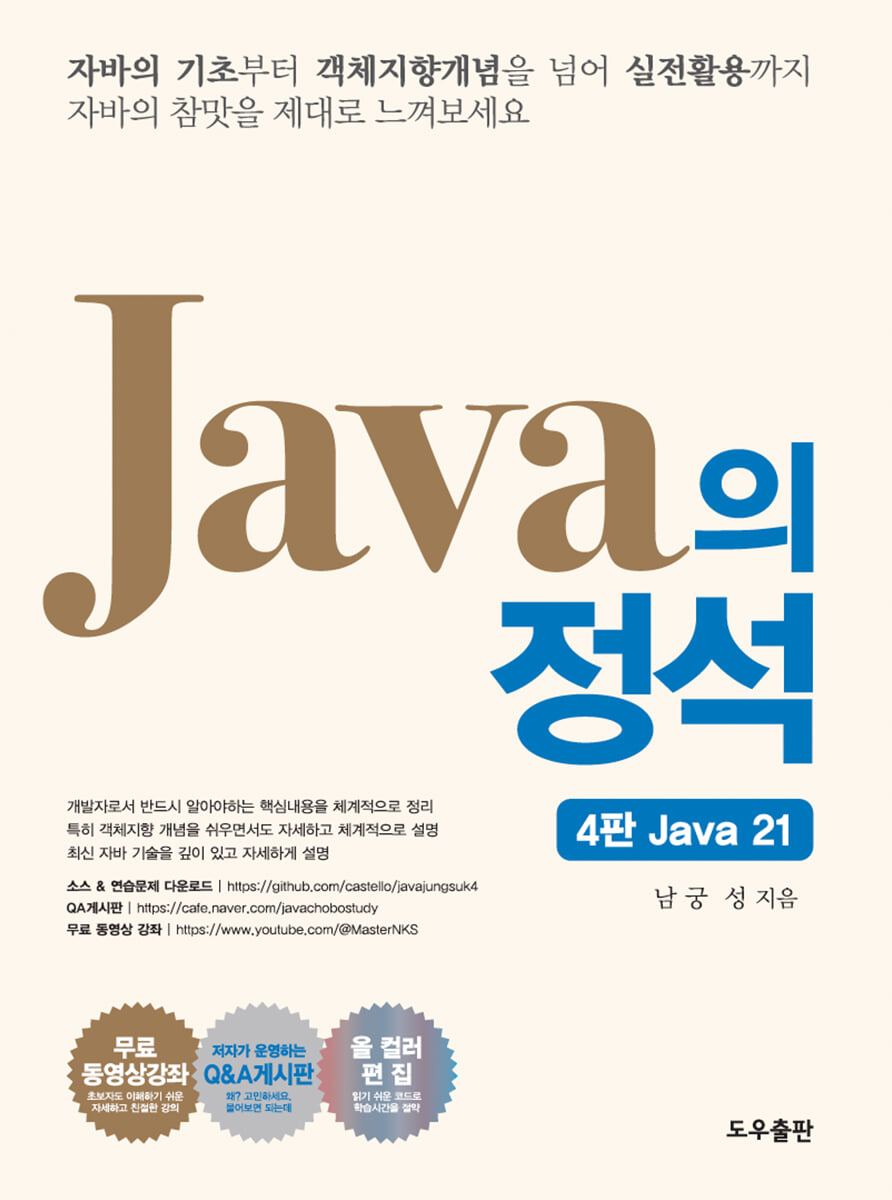
The latest edition of "Java Essentials," a long-time bestseller in the Java field since its first publication 17 years ago.
The latest features of Java are explained in detail and in depth.
The author has been personally answering questions from readers at cafes for over 20 years, and has a good understanding of the areas that beginners find difficult, which he has reflected in the book.
This book, which the author has been writing consistently for over 20 years, stands out for its depth, detail, and the author's sincerity and effort.
- You can preview some of the book's contents.
Preview
index
ch1 Before starting Java
1.
Java (Java programming language) 2
1.1 What is Java? 2
1.2 History of Java 3
1.3 Features of the Java Language 6
1.4 Java Virtual Machine (JVM) 8
2.
Setting up a Java development environment 10
2.1 Installing Java Development Kit (JDK) 10
2.2 Installing IntelliJ IDEA 20
3.
Programming in Java 28
3.1 Hello.java 28
3.2 Frequently occurring errors and solutions 31
3.3 Java Program Execution Process 32
3.4 Comment 33
3.5 How to Study with This Book 34
ch2 variable
1.
Variable 40
1.1 What is a variable? 40
1.2 Declaring and Initializing Variables 40
1.3 Variable Naming Rules 45
2.
Variable type 47
2.1 Primitive type 48
2.2 Constants and Literals 50
2.3 Formatted Output - printf() 58
2.4 Getting input from the screen - Scanner 62
3.
Base 64
3.1 Decimal and Binary 64
3.2 Bits and Bytes 65
3.3 Octal and Hexadecimal 66
3.4 Integer Base Conversion 68
3.5 Conversion of Real Numbers to Bases 70
3.6 Binary Representation of Negative Numbers - 2's Complement 72
4.
Primitive type 76
4.1 Logical Types - boolean 76
4.2 Character type - char 76
4.3 Integer types - byte, short, int, long 83
4.4 Real Numbers - float, double 89
5.
Type Conversion 95
5.1.
What is type conversion (casting)? 95
5.2 Type Conversion Method 95
5.3 Conversion between integer types 96
5.4 Type Conversion Between Real Numbers 98
5.5 Type Conversion Between Integer and Real Numbers 101
5.6 Automatic Type Conversion 103
ch3 operator
1.
Operator 108
1.1 Operators and Operands 108
1.2 Expressions and Assignment Operators 108
1.3 Types of Operators 108
1.4 Operator Precedence and Associativity Rules 110
1.5 Arithmetic Conversion (Usual Arithmetic Conversion) 113
2.
Unary Operator 115
2.1 Increment/Decrement Operator ++ -- 115
2.2 Sign Operator + - 118
3.
Arithmetic Operators 119
3.1 Arithmetic Operators + - * / 119
3.2 Remainder operator % 130
4.
Comparison Operators 131
4.1 Comparison Operators 〈 〉 〈= 〉= 131
4.2 Equality comparison operator == != 131
5.
Logical Operators 136
5.1 Logical Operators - &&, ||, ! 136
5.2 Bitwise Operators & | ^ ~ 〈〈 〉〉 143
6.
Other operators 152
6.1 Conditional Operator ?: 152
6.2 Assignment operator = op= 154
ch4 Conditional statements and loops
1.
Conditional statements - if, switch 158
1.1 if statement 158
1.2 if-else statement 162
1.3 if-else if statement 163
1.4 Nested if statements 166
1.5 switch statement 168
2.
Loops - for, while, do-while 180
2.1 for loop 180
2.2 while loop 191
2.3 do-while loop 197
2.4 break statement 199
2.5 continue statement 200
2.6 Named Loops 202
ch5 array
1.
Array 206
1.1 What is an array? 206
1.2 Declaring and Creating Arrays 206
1.3 Array length and index 208
1.4 Array Initialization 213
1.5 Copying an Array 216
1.6 Using Arrays 220
2.
String array 230
2.1 Declaration and creation of a String array 230
2.2 Initializing a String Array 230
2.3 char array and String class 233
2.4 Receiving input via the command line 236
3.
Multidimensional array 238
3.1 Declaration and indexing of two-dimensional arrays 238
3.2 Initializing a Two-Dimensional Array 238
3.3 Variable Arrays 243
3.4 Using Multidimensional Arrays 244
ch6 Object-Oriented Programming I
1.
Object-oriented languages 254
1.1 History of Object-Oriented Languages 254
1.2 Object-oriented languages 254
2.
Classes and Objects 255
2.1 Definition and Use of Classes and Objects 255
2.2 Objects and Instances 256
2.3 Object Components - Attributes and Functions 257
2.4 Creating and Using Instances 258
2.5 Object Array 264
2.6 Another definition of class 266
3.
Variables and Methods 270
3.1 Types of variables according to declaration location 270
3.2 Class Variables and Instance Variables 271
3.3 Method 273
3.4 Method Declaration and Implementation 276
3.5 Method Call 278
3.6 return statement 282
3.7 JVM Memory Structure 285
3.8 Primitive and Reference Parameters 288
3.9 Reference return type 292
3.10 Recursive Calls 294
3.11 Class Methods and Instance Methods 301
3.12 References and calls between class members and instance members 304
4.
Overloading 307
4.1 What is Overloading? 307
4.2 Conditions for Overloading 307
4.3 Example of Overloading 307
4.4 Advantages of Overloading 309
4.5 Varargs and Overloading 311
5.
Constructor 315
5.1 What is a constructor? 315
5.2 Default Constructor 316
5.3 Constructors with parameters 318
5.4 Calling another constructor from a constructor - this(), this 319
5.5 Copying instances using constructors 322
Initializing variables 324
6.1 Initializing Variables 324
6.2 Explicit Initialization 325
6.3 Initialization Block 326
6.4 Timing and order of member variable initialization 328
ch7 Object-Oriented Programming II
1.
Inheritance 334
1.1 Definition and Benefits of Inheritance 334
1.2 Relationships between classes - Inclusion relationship 340
1.3 Determining Relationships Between Classes 341
1.4 Single Inheritance 347
1.5 Object Class - The Ancestor of All Classes 349
2.
Overriding 351
2.1 What is Overriding? 351
2.2 Conditions for Overriding 352
2.3 Overloading vs.
Overriding 353
2.4 super 354
2.5 super() - Constructor of ancestor class 356
3.
package and import 360
3.1 Package 360
3.2 Package Declaration 361
3.3 Import Statement 364
3.4 Import statement declaration 364
3.5 Static import statement 366
4.
Modifier 368
4.1 What is a Controller? 368
4.2 static - common 368 of a class
4.3 final - the final, unchangeable 369
4.4 abstract - abstract, incomplete 371
4.5 Access Modifiers 372
4.6 Combination of modifiers 377
5.
Polymorphism 378
5.1 What is polymorphism? 378
5.2 Type conversion of reference variables 380
5.3 instanceof operator 386
5.4 Linking Reference Variables and Instances 394
5.5 Polymorphism of parameters 397
5.6 Handling various types of objects as arrays 400
6.
Abstract class 405
6.1 What is an abstract class? 405
6.2 Abstract Methods 405
6.3 Writing an Abstract Class 407
7.
Interface 411
7.1 What is an Interface? 411
7.2 Creating an Interface 411
7.3 Interface Inheritance 412
7.4 Implementing Interfaces 412
7.5 Multiple Inheritance Using Interfaces 415
7.6 Polymorphism Using Interfaces 417
7.7 Interface Advantages 420
7.8 Understanding Interfaces 426
7.9 Default methods, static methods, and private methods 430
8.
Inner class 434
8.1 What is an inner class? 434
8.2 Types and characteristics of inner classes 435
8.3 Declaring an Inner Class 435
8.4 Controllers and Accessibility of Inner Classes 436
8.5 Anonymous Classes 441
ch8 exception handling
1.
Exception Handling 444
1.1 Program Error 444
1.2 Hierarchy of Exception Classes 445
1.3 Exception Handling - Try-Catch Statement 446
1.4 Flow in try-catch statements 449
1.5 Exceptions and Catch Blocks 450
1.6 Raising Exceptions 454
1.7 Declaring Exceptions in Methods 457
1.8 finally block 464
1.9 Automatic Resource Recovery - try-with-resources statement 466
1.10 Creating Custom Exceptions 469
1.11 Exception Re-Throwing 472
1.12 Chained Exceptions 474
ch9 java.lang package and useful classes
1.
java.lang package 480
1.1 Object class 480
1.2 String class 494
1.3 StringBuffer and StringBuilder 508
1.4 Math Class 514
1.5 Wrapper Class 521
2.
Useful Class 526
2.1 java.util.Objects class 526
2.2 java.util.Random class 530
2.3 Regular Expression - java.util.regex 535
2.4 java.util.Scanner class 540
2.5 java.util.StringTokenizer class 543
2.6 java.math.BigInteger class 548
2.7 java.math.BigDecimal class 551
ch10 Date and Time & Format
1.
Date and time 558
1.1 Calendar and Date 558
2.
Formatting Class 570
2.1 DecimalFormat 570
2.2 SimpleDateFormat 574
2.3 ChoiceFormat 578
2.4 MessageFormat 579
3.
java.time package 582
3.1 Core Classes in the java.time Package 582
3.2 LocalDate and LocalTime 585
3.3 Instant 590
3.4 LocalDateTime and ZonedDateTime 591
3.5 TemporalAdjusters 595
3.6 Period and Duration 597
3.7 Parsing and Formatting 602
ch11 collection framework
1.
Collections Framework 608
1.1 Core Interfaces of the Collection Framework 608
1.2 ArrayList and Vector 615
1.3 LinkedList 626
1.4 Stacks and Queues 634
1.5 Iterator, ListIterator, Enumeration 644
1.6 Arrays 654
1.7 Comparator and Comparable 658
1.8 HashSet 661
1.9 TreeSet 668
1.10 HashMap and Hashtable 674
1.11 TreeMap 684
1.12 Properties 688
1.13 Collections 694
1.14 Collection Class Summary & Organization 699
ch12 Modern Java Features
1.
Generics 702
1.1 What is Generix? 702
1.2 Declaring a Generic Class 703
1.3 Creating and Using Objects of Generic Classes 706
1.4 Restricted Generic Class 709
1.5 Wild Card 711
1.6 Generic Methods 717
1.7 Type conversion of generic types 720
1.8 Removal of generic types 722
2.
Enumeration 724
2.1 What is an enumeration? 724
2.2 Definition and Use of Enumerations 725
2.3 Adding Members to an Enumeration 728
2.4 Understanding Enumerations 731
3.
Annotation 735
3.1 What are Annotations? 735
3.2 Standard Annotation 736
3.3 Meta-Annotation 744
3.4 Defining annotation types 748
4.
Record 754
4.1 What is a record? 754
4.2 Record Features 755
4.3 Nesting of records 760
4.4 Generic Record 762
4.5 Records and Annotations 764
5.
Sealed Class 766
5.1 What is the Shield Class? 766
5.2 Shield Class Constraints 767
5.3 Shield Class and Switch Type 769
6.
Module 774
6.1 What is a Module? 774
6.2 Module Descriptor - module-info.java 776
6.3 Anonymous Modules and the java.base Module 779
6.4 Transitive and Circular Dependencies 786
6.5 Compiling and Running Modules 788
6.6 Automatic Module 793
ch13 thread
1.
Thread 796
1.1 Processes and Threads 796
1.2 Implementation and Execution of Threads 798
1.3 start() and run() 802
1.4 Single-threaded and multi-threaded 806
1.5 Thread priority 812
1.6 Thread Group 815
1.7 Daemon thread 818
1.8 Thread Execution Control 822
2.
Thread Synchronization 841
2.1 Synchronization using synchronized 841
2.2 wait() and notify() 845
2.3 Synchronization using Locks and Conditions 853
2.4 volatile 860
2.5 Fork & Join Framework 862
3.
virtual thread 867
3.1 What are virtual threads? 867
3.2 Creating and Using Virtual Threads 868
3.3 Characteristics of Virtual Threads 869
3.4 Platform Threads and Virtual Threads 871
3.5 Virtual Thread State 878
3.6 Precautions when creating virtual threads 884
3.7 Continuation and StackChunk 885
4.
Executor and ExecutorService 889
4.1 Executor 889
4.2 ThreadFactory 890
4.3 ExecutorService 892
4.4 Thread Pool 898
4.5 Future903
4.6 CompletableFuture 913
ch14 Lambda and Streams
1.
Lambda expression 928
1.1 What is a Lambda Expression? 928
1.2 Writing Lambda Expressions 929
1.3 Functional Interface 931
1.4 java.util.function package 936
1.5 Function Composition and Predicate Combination 942
1.6 Method Reference 946
2.
Stream 948
2.1 What is a Stream? 948
2.2 Creating a Stream 953
2.3 Intermediate operations in streams 958
2.4 Optional〈T〉 and OptionalInt 971
2.5 Final operation of stream 976
2.6 collect() 980
2.7 Implementing a Collector 997
2.8 Stream Conversion 1000
ch15 input/output (I/O)
1.
Input/Output in Java 1004
1.1 What is input/output? 1004
1.2 Stream 1004
1.3 Byte-based streams - InputStream, OutputStream 1005
1.4 Auxiliary Stream 1007
1.5 Character-Based Streams - Reader, Writer 1008
2.
Byte-based stream 1010
2.1 InputStream and OutputStream 1010
2.2 ByteArrayInputStream and ByteArrayOutputStream 1012
2.3 FileInputStream and FileOutputStream 1016
3.
Byte-based auxiliary stream 1019
3.1 FilterInputStream and FilterOutputStream 1019
3.2 BufferedInputStream and BufferedOutputStream 1020
3.3 DataInputStream and DataOutputStream 1023
3.4 SequenceInputStream 1029
3.5 PrintStream 1031
4.
Character-based stream 1035
4.1 Reader and Writer 1035
4.2 FileReader and FileWriter 1037
4.3 PipedReader and PipedWriter 1039
4.4 StringReader and StringWriter 1041
5.
Character-based auxiliary stream 1042
5.1 BufferedReader and BufferedWriter 1042
5.2 InputStreamReader and OutputStreamWriter 1043
6.
Standard Input/Output and File 1045
6.1 Standard Input/Output - System.in, System.out, System.err 1045
6.2 Changing the target of standard input/output - setOut(), setErr(), setIn() 1047
6.3 RandomAccessFile 1049
6.4 File 1053
7.
Serialization 1072
7.1 What is Serialization? 1072
7.2 ObjectInputStream, ObjectOutputStream 1073
7.3 Creating a Serializable Class - Serializable, transient 1075
7.4 Versioning Serializable Classes 1081
ch16 networking
1.
Networking 1084
1.1 Client/Server 1084
1.2 IP address 1086
1.3 InetAddress 1087
1.4 URLs and URIs 1089
1.5 URLConnection 1092
2.
Socket Programming 1097
2.1 TCP and UDP 1097
2.2 TCP Socket Programming 1098
2.3 UDP Socket Programming 1116
Detailed image

Publisher's Review
A book that contains everything you need to know as a Java programmer.
This book is a compilation of the author's extensive practical experience, lectures, and lectures he has given while running an online cafe (Naver Cafe) for over 20 years, so it contains all the opinions and questions of members who are learning Java for the first time.
So, you could say that this book is written from the perspective of people who are starting out with Java.
This book goes beyond simply introducing Java and systematically organizes the essential knowledge that programmers need to know. By dedicating 200 pages to object-oriented concepts, it explains them from a principle-centered perspective so that you can fully understand object-oriented concepts with just this one book.
In addition, it provides a detailed introduction to Java's latest core features, virtual threads and modules, and also explains in detail the new features of Java 21, the latest LTS version of Java (as of February 2025).
In addition, it covers in detail from the basics to applications topics such as generics, annotations, and threads that are often neglected in other books.
The author himself provides continuously updated video lectures through an internet cafe and operates a Q&A board, so he is considerate in many ways to ensure that readers can sufficiently study on their own.
This is a book that thoroughly considers the reader's perspective and shows the effort and consideration put into it.
In addition, we supplemented the explanations, illustrations, and examples that were lacking in the third edition, and checked it thoroughly to the point where it was difficult to find any typos.
- Improved the deficiencies (pictures, examples, explanations, typos) of the 3rd edition of Java Essentials.
- Practice problems have been added to each chapter.
- Video lectures are provided free of charge.
- Presentation materials (ppt) and learning materials used in video lectures are provided free of charge on GitHub.
- We will provide detailed answers to your book-related questions through the Q&A board.
GOODS SPECIFICS
- Date of issue: June 30, 2025
- Page count, weight, size: 1,122 pages | 2,253g | 188*257*49mm
- ISBN13: 9788994492001
- ISBN10: 8994492003
You may also like
카테고리
korean


korean


