

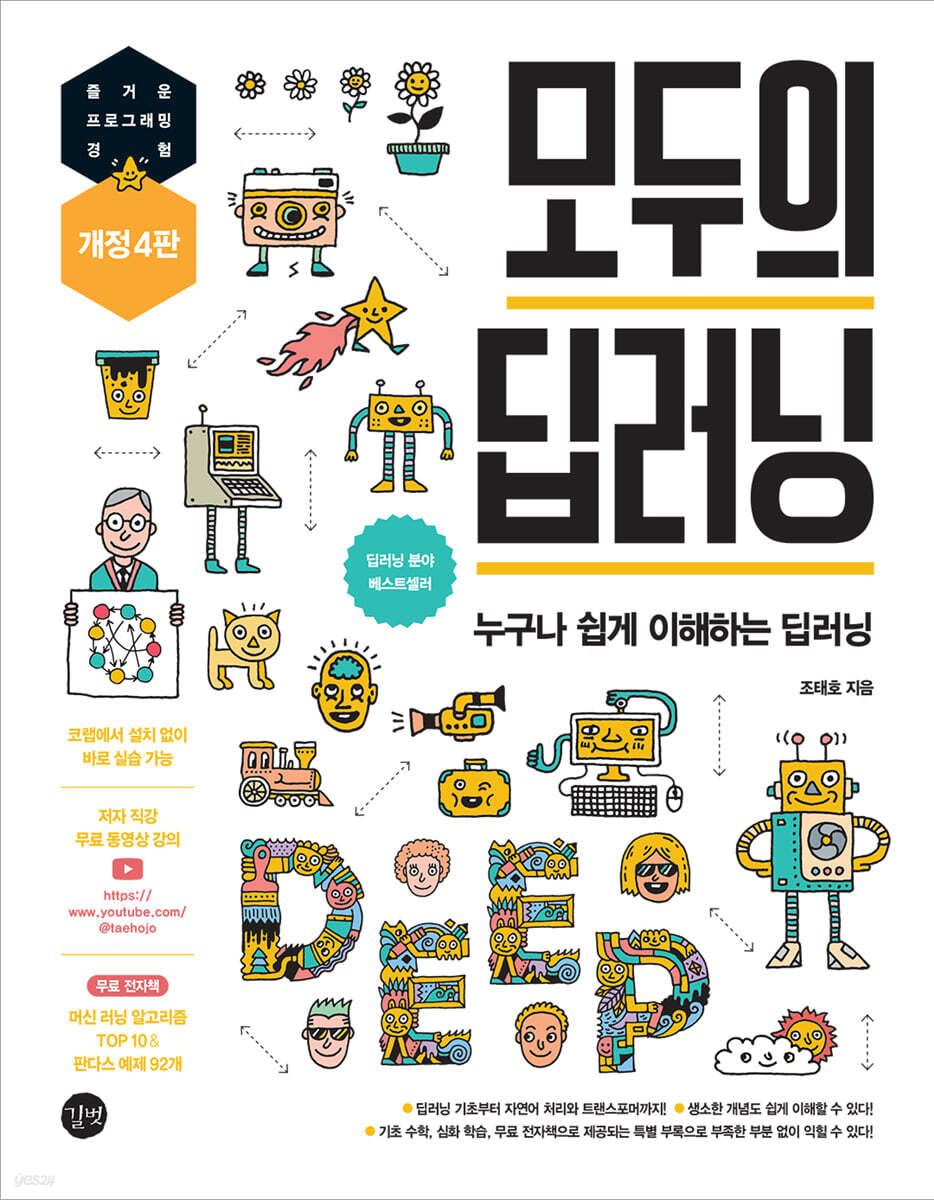
Deep Learning for Everyone
 |
Description
Book Introduction
An introductory book to deep learning that's easier for anyone to understand than anything else.
From the basics of deep learning to natural language processing and transformers, the foundation of ChatGPT!
From machine learning to ChatGPT, AI is constantly evolving, but its unchanging roots lie in deep learning.
"Deep Learning for Everyone," the textbook of choice for countless schools and educational institutions over the past eight years, minimizes reliance on complex formulas and technical terminology, offering beginners the most reliable foundational learning method with intuitive explanations and abundant examples.
In particular, it is structured so that you can learn not only deep learning theory but also practical applications through hands-on practice using libraries based on easy-to-understand and comfortable explanations that anyone can understand.
It reinforces many of the contents of the previous 3rd edition, updates the practical environment, and provides the easiest and most complete explanation of natural language processing and transformers, the core of modern AI.
Additionally, for readers who find it difficult to study on their own, we provide free video lectures, and the 'Top 10 Most Used Machine Learning Algorithms' and '92 Pandas Cheat Keys for Data Analysis', which were provided as separate appendices in the 3rd edition, are now available as free e-books in online bookstores.
If you've been frustrated while learning deep learning or are just starting out, start with this book, which is optimized for beginners.
- You can preview some of the book's contents.
Preview
index
First Yard | Warm-up Exercises for Beginning Deep Learning
Chapter 1.
Let's try deep learning!
1 | Artificial Intelligence? Machine Learning? Deep Learning?
2 | Three Things You Need to Run Deep Learning
3 | Running Google Colab
Chapter 2.
A sneak peek at the core of deep learning
1 | The Principle of Predicting the Unknown
2 | Running Deep Learning Code
3 | An Overview of Deep Learning
4 | Is this the real deep learning?
Chapter 3.
Basic Mathematics for Deep Learning
1 | Linear function, slope and y-intercept
2 | Quadratic Functions and Minimum Values
3 | Differentiation, Instantaneous Rate of Change, and Slope
4 | Partial differentiation
5 | Exponents and Exponential Functions
6 | Sigmoid function
7 | Logarithms and Logarithmic Functions
Second Yard | Basic Principles of Predictive Models
Chapter 4.
The best prediction line
1 | Definition of linear regression
2 | What is the best forecast line?
3 | Least Squares Method
4 | Least Squares Verification with Python Coding
5 | Mean square error
6 | Checking Mean Squared Error with Python Coding
Chapter 5.
Linear Regression Models: Draw First, Then Fix
1 | Overview of Gradient Descent
2 | Linear Regression with Python Coding
3 | Overview of Multiple Linear Regression
4 | Multiple Linear Regression with Python Coding
5 | Running Linear Regression and Multiple Linear Regression Models in TensorFlow
Chapter 6.
Logistic Regression Models: Determining True or False
1 | Definition of Logistic Regression
2 | Sigmoid function
3 | Error formula
4 | Logarithmic function
5 | Running a Logistic Regression Model in TensorFlow
Third Yard | The Beginning of Deep Learning: Neural Networks
Chapter 7.
Perceptrons and the Beginning of Artificial Intelligence
1 | The Perceptron, the Beginning of Artificial Intelligence
2 | The Perceptron's Challenge
3 | XOR problem
Chapter 8.
multilayer perceptron
1 | The emergence of multilayer perceptrons
2 | Design of a Multilayer Perceptron
3 | Solving the XOR Problem
4 | Solving the XOR Problem with Coding
Chapter 9.
From backpropagation to deep learning
1 | The Birth of Deep Learning: Error Backpropagation
2 | Activation Functions and Advanced Gradient Descent
3 | Advanced Gradient Descent for Speed and Accuracy
Fourth Yard | Building Deep Learning Fundamentals
Chapter 10.
Designing a Deep Learning Model
1 | Definition of the model
2 | Input layer, hidden layer, output layer
3 | Compile the model
4 | Running the Model
Chapter 11.
Handling data
1 | Deep Learning and Data
2 | Analyzing Pima Indian Data
3 | Data Exploration with Pandas
4 | Extracting Important Data
5 | Pima Indian Diabetes Prediction in Action
Chapter 12.
Solving multi-classification problems
1 | Multi-classification problem
2 | Correlation graph
3 | One-hot encoding
4 | Softmax
5 | Implementing Iris Variety Prediction
Chapter 13.
Validating model performance
1 | Verifying Data and Executing Predictions
2 | Understanding Overfitting
3 | Training and Test Sets
4 | Saving and Reusing Models
5 | k-fold cross-validation
Chapter 14.
Improving model performance
1 | Data Verification and Validation Set
2 | Updating the Model
3 | Checking for Overfitting with Graphs
4 | Automatically pause learning
Chapter 15.
Model created with actual data
1 | Understanding the Data
2 | Handling Missing Values and Categorical Variables
3 | Extracting attribute-specific relevance
4 | Housing Price Prediction Model
Fifth Yard | Leveraging Deep Learning
Chapter 16.
The flower of image recognition: convolutional neural networks (CNNs).
1 | Principles of Image Recognition
2 | Building a Deep Learning Basic Framework
3 | Convolutional Neural Network (CNN)
4 | Max Pulling, Dropout, and Platen
5 | Running a Convolutional Neural Network
Chapter 17.
Face GAN and Autoencoder: A World Without a Face
1 | Fake manufacturing plant, producer
2 | A device that determines truth or falsehood, a discriminator
3 | Running an Adversarial Neural Network
4 | Autoencoder that extracts image features
Chapter 18.
Maximizing Deep Learning Performance with Transfer Learning
1 | Building Powerful Learning Models from Small Datasets
2 | Maximizing Model Performance with Transfer Learning
Chapter 19.
Building Explainable Deep Learning Models
1 | How to Explain Deep Learning Results
2 | Explainable Deep Learning in Action
Chapter 20.
A new challenge starting with Kaggle
1 | Sign up for Kaggle and choose a competition
2 | Obtaining Data
3 | Learn
4 | Submit Results
5 | Submit your final predictions
Sixth Yard | The Foundation of ChatGPT: Natural Language Processing and Transformers
Chapter 21.
Natural language processing using deep learning
1 | Tokenization of Text
2 | One-hot encoding of words
3 | Word Embedding
4 | Read the text and predict positive or negative responses
Chapter 22.
Recurrent neural networks (RNNs) that handle sequence arrays
1 | Classifying Reuters News Categories Using LSTM
2 | Classifying Movie Reviews Using a Combination of LSTMs and CNNs
3 | Neural Networks with Attention
Chapter 23: Attention: How AI Understands Context
1 | Measuring word-to-word similarity
2 | Understanding the Relationships Between Words
3 | Modifying the Relationship Between Words
4 | How AI Understands Context
5 | Question (Query), Clue (Key), Answer (Value)
6 | Creating Attention for Transformers
Chapter 24: Making Your Own Transformer
1 | Transformer Structure and Multihead Attention
2 | Positional encoding that indicates the order of words
3 | Positive-Negative Prediction Using a Transformer Encoder
4 | Run the entire Transformer
Deep Learning 1.
Computational method of error backpropagation
1 | Update the error of the output layer
2 | Error formula
3 | Chain Rule
4 | Calculating the Chain Rule
5 | Editing Weights
6 | Correcting errors in the hidden layer
7 | Calculating the error in the hidden layer
8 | Delta
Deep Learning 2.
Neural networks coded in Python
1 | Setting Environment Variables
2 | Running a Neural Network with Python Code
Appendix A: Running Deep Learning with Anaconda on My Computer
Special Appendix (available as a free e-book)
Chapter 1.
Top 10 Most Used Machine Learning Algorithms
Chapter 2.
Pandas for Data Analysis: A Collection of 92 Examples
Detailed image

Into the book
Coding with AI without understanding it is not real coding.
Just because you get information about a good restaurant from a travel blog doesn't mean you've actually gone there and enjoyed the taste and atmosphere of the local food.
Today, we live in an age where we can create and implement so many things using AI.
But, the more important it is to properly understand how AI works and the learning process.
This book is the result of a long-term effort to provide the essential concepts and practical knowledge needed to easily and enjoyably begin learning deep learning, a core technology of AI.
We've organized the flow of development of cutting-edge AI, including ChatGPT, in a simple and systematic way, making it easy for anyone to understand the essence of deep learning.
In the first section, we'll build an execution environment for machine learning and deep learning models, learn basic concepts, and thoroughly examine the fundamental mathematical principles necessary to understand the core concepts of deep learning.
In the second section, you will learn the basic principles you need to know to understand deep learning, and in the third section, you will learn the core algorithms of deep learning, such as perceptron and backpropagation.
In the fourth section, you'll learn how to implement deep learning using real-world examples and various types of data. In the fifth section, you'll learn cutting-edge technologies essential for practical applications, such as image recognition, virtual image generation, transfer learning, explainable AI, and Kaggle competitions.
The sixth chapter, newly written for this fourth edition, provides a basic, easy-to-understand explanation of the attention and transformer techniques that made ChatGPT possible, and examines how these techniques led to the current large-scale language model boom.
Without a solid foundation, you'll feel limited when solving complex problems, and it'll be difficult to be certain which libraries to choose and how to implement them when developing AI.
Ultimately, it's crucial to solidify your fundamentals, enjoy coding, maintain a constant curiosity about AI, and continue learning.
First published in 2017, this award-winning introductory book on deep learning has been constantly revised and widely loved! We hope you achieve all your dreams with "Deep Learning for Everyone."
--- From "The Author's Note"
Publisher's Review
Everyone understands deep learning,
You can implement your own model!
Preparation | Understanding Deep Learning and Preparing for Learning
Get ready to learn by setting up a deep learning execution environment and learning basic mathematics.
You will also learn linear regression and logistic regression, which are the basic operating principles of deep learning.
Basics | Deep Learning Fundamentals
Learn the concepts of neural networks and backpropagation, essential for designing deep learning, and practice six projects to see how deep learning theory is applied to real-world projects.
Each project contains one essential technique for deep learning.
Utilization | Understand and implement key deep learning models.
Building on what you've learned so far, you'll apply CNNs, RNNs, transfer learning, and explainable AI to practical applications and tackle new challenges.
Additionally, you'll learn the fundamentals of natural language processing, specifically transformers and attention techniques, and build your own, exploring how these techniques form the basis for large-scale language models like ChatGPT.
Deep Learning | A Deep Dive into Backpropagation and Neural Networks
Special Appendix | 1) Top 10 Most Used Machine Learning Algorithms
2) 92 Pandas examples for data analysis
[Beta Tester Review]
"Deep Learning for Everyone" is back with its 4th edition after two years.
There are a variety of introductory books on deep learning on the market, but because readers vary in skill level, the level of explanation and delivery method vary from book to book.
As the title and cover of this book suggest, "Deep Learning for Everyone: Deep Learning Made Easy for Everyone," all the content is explained in an easy-to-understand manner.
Compared to the 3rd edition, the 4th edition added content that directly implements the attention mechanism and transformer, which was also explained in a way that was easier to understand than the paper, which was very helpful for understanding.
Chanseok Kang, Software Engineer, LG Electronics (Practical Environment: Colab + Local)
As someone who develops deep learning models and applies them to practical applications, this book was extremely useful for organizing and quickly reviewing basic concepts.
In particular, each concept is explained with pictures, allowing for intuitive understanding of the theory, and the practice code is well-organized, allowing for easy implementation.
It is suitable for learning the overall flow from basic neural networks to CNN, RNN, and performance evaluation metrics.
This revised edition includes enhanced content on attention and transformers, allowing you to learn cutting-edge concepts in line with the recent trend of generative AI.
Additionally, the machine learning algorithms and Pandas practice materials included in the appendix will help you gain practical experience by providing hands-on experience with technologies frequently used in the field through actual code.
This book is a great introductory text for beginners, and a practical reference for practitioners who want to organize concepts and practice code-based exercises.
Lee Hye-min, AI Research Engineer (Practical Environment: Colab)
The 4th edition of 『Deep Learning for Everyone』 is structured to help you naturally acquire machine learning and deep learning concepts through hands-on practice, along with explanations of the fundamental mathematical concepts essential to understanding machine learning.
In particular, the 4th edition has significantly added content related to natural language processing (NLP). By learning through hands-on implementation of transformer and attention techniques that reflect the latest technological trends, I was able to gain significant insights into policy analysis and administrative data utilization as a public servant.
Moreover, as understanding the workings of modern models like ChatGPT becomes increasingly important in public administration, this book was a great help in gaining practical application ideas.
With its balanced mix of theory and practice, I believe this book on deep learning is highly recommended for civil servants seeking to integrate AI technology into public administration, as well as for beginners and intermediate learners alike.
Choi Kyu-min, IT Civil Servant, Ministry of the Interior and Safety (Practical Training Environment: Colab)
By chance, I had the opportunity to read the 4th edition of the famous book, 『Deep Learning for Everyone』, before its publication.
As I read through the contents page by page, I realized that, as its reputation suggests, this book is truly the perfect introduction to deep learning.
The book's easy-to-understand explanations, which even non-majors can read, and the numerous full-color images included to aid understanding are more than enough to make studying deep learning fun for readers.
In particular, this book is characterized by its detailed practical examples based on Google Colab for each chapter, rather than simply focusing on theory, making it useful not only for understanding the content but also for acquiring practical implementation skills.
The most representative additions compared to the 3rd edition are the attention mechanism and the transformer model.
In today's era of generative AI, these are important concepts that any developer should know at least.
I think this book is filled with the author's passion to continuously reflect the latest technological trends in his books.
If you know someone who wants to start studying machine learning and deep learning but isn't sure how or where to begin, I strongly recommend this book as a starting point.
Choi Seong-wook, Samsung Electronics VD Business Division Security Lab (Practical Environment: Co-Lab)
This book provides in-depth coverage of deep learning and is packed with useful information.
The code examples were well organized and very helpful for my practice.
Additionally, the book's content reflects the latest trends, so I was able to apply it right away.
What stands out about the author's efforts is that the code explanations are clear and easy to understand.
This book will be a great guide for learning deep learning.
Kim Min-gyeom, Burnect Inc. (Practical environment: Colab)
It's been over a decade since I took a data science and machine learning course in college, and I've come across this book.
This book explains the most fundamental and essential concepts for understanding deep learning, which were learned at the time. It also introduces the development of newly developed technologies over time, using ample examples, helping learners establish a solid foundation for understanding.
Although it contains a very extensive amount of content in one volume, the explanations are never lengthy, and the sentences are refined to the extent necessary.
I also believe that this book provides appropriate direction for willing readers to study additional materials.
Honey Man_Backend Software Developer (Practice Environment: Colab)
GOODS SPECIFICS
- Date of issue: April 30, 2025
- Page count, weight, size: 460 pages | 183*235*19mm
- ISBN13: 9791140714520
You may also like
카테고리
korean


korean


