

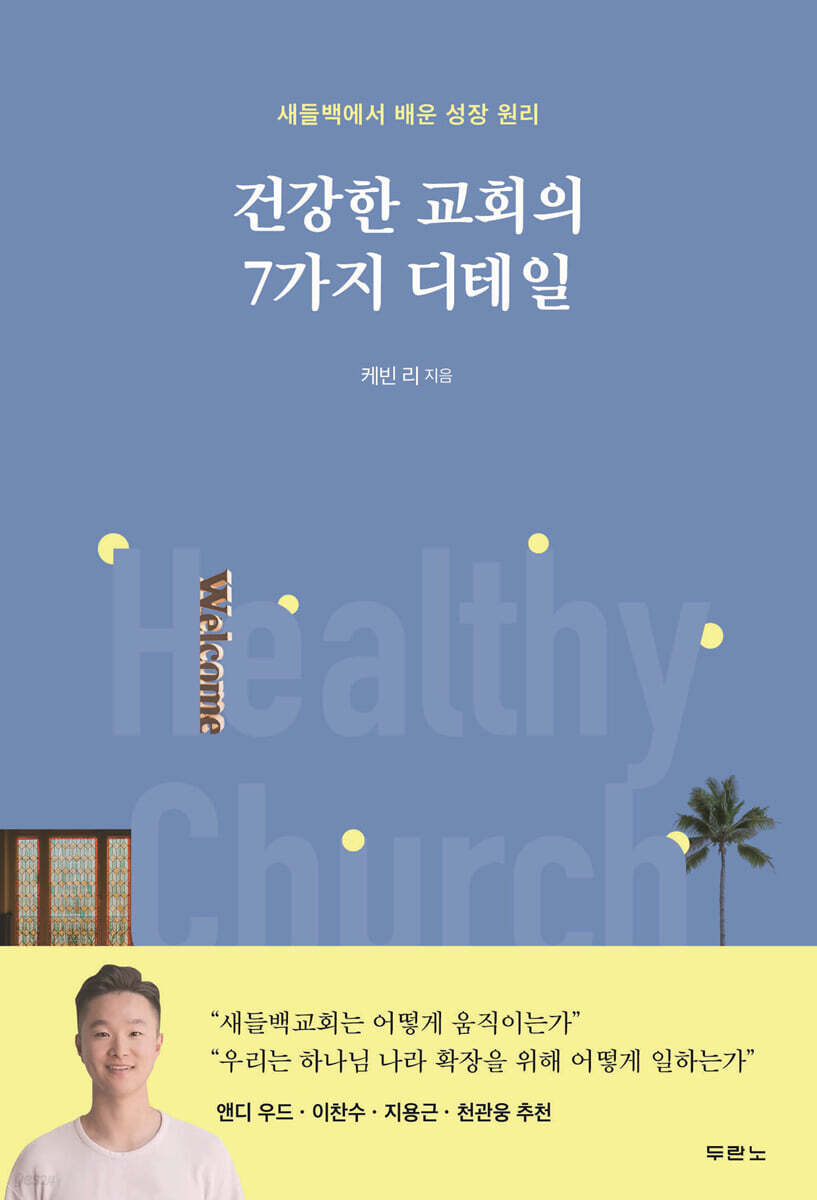
7 Details of a Healthy Church
 |
Description
Book Introduction
How Saddleback Church Operates
“How do we work to expand the kingdom of God?”
A comprehensive guide to assist churches and pastors, from the essence of a healthy church to sustainable pastoral alternatives.
This is the latest work by Pastor Kevin Lee, author of “Please Take Care of Online Ministry.”
The author, who introduced the online ministry of Saddleback Church in the United States during the pandemic and provided much-needed pastoral support to Korean churches and pastors, has now shared Saddleback Church's pastoral know-how.
The author, a 1.5 generation Korean-American, has worked in online ministry and is currently serving as an Experience Pastor at Wedeer Campus, a new church founded by the second senior pastor in 2022.
In this book, the author introduces seven principles of Saddleback's continuous growth based on pastoral insights gained from his experience at Saddleback.
This has significant implications not only for pastors in Korean churches, but also for many lay leaders concerned about healthy church communities.
Many churches minister with similar principles and standards, but ultimately, putting those values into practice requires attention to detail, the participation of pastors and believers, and the establishment of a culture. This rich collection of examples and information helps us realize this.
“How do we work to expand the kingdom of God?”
A comprehensive guide to assist churches and pastors, from the essence of a healthy church to sustainable pastoral alternatives.
This is the latest work by Pastor Kevin Lee, author of “Please Take Care of Online Ministry.”
The author, who introduced the online ministry of Saddleback Church in the United States during the pandemic and provided much-needed pastoral support to Korean churches and pastors, has now shared Saddleback Church's pastoral know-how.
The author, a 1.5 generation Korean-American, has worked in online ministry and is currently serving as an Experience Pastor at Wedeer Campus, a new church founded by the second senior pastor in 2022.
In this book, the author introduces seven principles of Saddleback's continuous growth based on pastoral insights gained from his experience at Saddleback.
This has significant implications not only for pastors in Korean churches, but also for many lay leaders concerned about healthy church communities.
Many churches minister with similar principles and standards, but ultimately, putting those values into practice requires attention to detail, the participation of pastors and believers, and the establishment of a culture. This rich collection of examples and information helps us realize this.
- You can preview some of the book's contents.
Preview
index
Recommendation | Prologue
1 How you do something is more important than what you do.
What's Your Church's Culture? | Systems vs. Culture | The 12 Commandments for Saddleback Staff | Creating a Healthy Culture | The Values of Saddleback Staff That Surprised Me the Most | Questions for Sharing
2_ A growing church does not loosen its grip on evangelism.
Existing Church Members vs. Evangelism Targets | Creating an Evangelism-Friendly Church: The Pastor's Role | Creating an Evangelism-Friendly Church: Participation of Church Members | Give People a Reason to Invite | Saddleback Church Just Keeps Trying | Questions for Sharing
3 Small groups are not optional, they are essential.
Saddleback's small group structure | All Saddleback faculty and staff participate in small groups | Three key elements of small groups that Saddleback values | If you're not participating in a small group | Don't tell people you attend our church | Questions for sharing
4. Mental health should be taken care of as much as spiritual health.
Mental illness is pain, not a negative identity | I am a child of God with workaholism and anxiety | Are you addicted to ministry? | Recovering from workaholism | Mental health as a trend in Korean churches | Starting an emotionally healthy spiritual community now | Researching emotionally healthy spirituality | Questions for sharing
5. A healthy church has happy pastors.
Churches pause during the pastors' wives' retreat | How will the pastors' wives' retreat proceed? | A church that values the opinions of ministers' families over the needs of the ministry | Couples worship together | Families fall apart, and Saddleback changes | Questions for sharing
6 For the church to grow, I must constantly grow.
Clearing Up Leadership Myths | Strengthening Whole-Church Leadership | The Most Important Thing You Can Do as a Leader: Your Voice |
Leaders Make Leaders, Not Followers | Questions for Sharing
7 For a minister, rest is more important than ministry.
Rest Enables Creative Ministry | There Are No Days Off at Saddleback Church! | What Would a Church That Helps Us Keep the Sabbath Look Like? | Three Tips for Creating a Healthy Workplace | Pastor Rick Warren's Final Advice to the Korean Church | Questions for Sharing
Epilogue | Note
1 How you do something is more important than what you do.
What's Your Church's Culture? | Systems vs. Culture | The 12 Commandments for Saddleback Staff | Creating a Healthy Culture | The Values of Saddleback Staff That Surprised Me the Most | Questions for Sharing
2_ A growing church does not loosen its grip on evangelism.
Existing Church Members vs. Evangelism Targets | Creating an Evangelism-Friendly Church: The Pastor's Role | Creating an Evangelism-Friendly Church: Participation of Church Members | Give People a Reason to Invite | Saddleback Church Just Keeps Trying | Questions for Sharing
3 Small groups are not optional, they are essential.
Saddleback's small group structure | All Saddleback faculty and staff participate in small groups | Three key elements of small groups that Saddleback values | If you're not participating in a small group | Don't tell people you attend our church | Questions for sharing
4. Mental health should be taken care of as much as spiritual health.
Mental illness is pain, not a negative identity | I am a child of God with workaholism and anxiety | Are you addicted to ministry? | Recovering from workaholism | Mental health as a trend in Korean churches | Starting an emotionally healthy spiritual community now | Researching emotionally healthy spirituality | Questions for sharing
5. A healthy church has happy pastors.
Churches pause during the pastors' wives' retreat | How will the pastors' wives' retreat proceed? | A church that values the opinions of ministers' families over the needs of the ministry | Couples worship together | Families fall apart, and Saddleback changes | Questions for sharing
6 For the church to grow, I must constantly grow.
Clearing Up Leadership Myths | Strengthening Whole-Church Leadership | The Most Important Thing You Can Do as a Leader: Your Voice |
Leaders Make Leaders, Not Followers | Questions for Sharing
7 For a minister, rest is more important than ministry.
Rest Enables Creative Ministry | There Are No Days Off at Saddleback Church! | What Would a Church That Helps Us Keep the Sabbath Look Like? | Three Tips for Creating a Healthy Workplace | Pastor Rick Warren's Final Advice to the Korean Church | Questions for Sharing
Epilogue | Note
Detailed image

Into the book
Saddleback Church focuses on forming and maintaining the culture and beliefs of its faculty and staff.
And I believe this is the secret to Saddleback Church's long and healthy growth.
One of the most important parts of becoming a Saddleback Church staff member is reading and pledging the “12 Commandments for Saddleback Staff Members” (for convenience, this book calls them “12 Commandments,” but they actually refer to twelve values).
The following 12 commandments are the attitudes that all Saddleback faculty and staff must promise and keep.
--- p.22
The reason Saddleback Church focuses on new believers rather than existing members is because they know that just as there is a virtuous cycle of growth, there is also a vicious cycle of church decline.
If we focus on meeting the needs of existing believers,
The church is focused inward (internal).
As the saying goes, "the arm bends inward," if the focus bends inward, the threshold of the church will inevitably become higher.
Conversely, as sermons become more profound, they become more difficult for non-believers to understand, and as a result, churches become more difficult places to visit.
At this time, the most toxic phenomenon to the growth and health of the church can arise in the hearts of the believers.
That is precisely what they think: 'It is difficult for our church to bring in non-believers.'
Even though the believer does not say this out loud, he or she intuitively recognizes it and stops evangelizing, which is the beginning of a vicious cycle.
--- pp.50-52
*If I had to pick just one secret to Saddleback Church's explosive growth in just 45 years and its ability to become a globally influential church, I can confidently say it's "small groups."
Of course, it is true that the church has received attention through “The Purpose Driven Life.”
But what was able to capture that great interest and the crowd of believers was neither the passionate worship service overflowing with emotion nor the active volunteer work.
The secret to Saddleback Church's healthy growth is its small group system, which helps church members connect with each other.
Pastor Rick Warren said:
“People come to church to hear the word, but they stay because of the relationships they form with the other believers.” And the church grows with the believers who remain.
No matter how active the evangelism is, no matter how good the sermons are, and no matter how many people are drawn in, if there is no small group system to connect believers, existing believers will go to other churches in search of better words.
--- pp.70-71
If you think about it, there is one more reason why workaholism is promoted in churches.
Because it can do work in the name of God.
“I have to work until my body breaks because I am doing God’s work”, “I will work hard at God’s work without rest while I am alive”, “I should sleep in heaven”, “Satan doesn’t rest, so I can’t rest either”. These are things we often hear in church.
If you've ever had these thoughts or been in a ministry environment where these words are being exchanged, you definitely need to discern whether you're addicted to work or whether you're serving in an environment that rewards workaholism.
I'm not telling you to get out of an environment that promotes workaholism right now.
If that's the case, we need to think about how we can change that culture and create a turning point that promotes change.
--- pp.104-105
The ministers of Saddleback Church also encourage their members to worship together as a couple whenever possible.
Even if you serve as a layperson, it is said, “Offer worship first, and then serve the next worship.”
However, if the minister who gives such advice is seen worshipping apart from his spouse, the authority of his words will not be easily established.
If a minister worships with his or her spouse and shows that he or she serves outside of those times, this is the greatest blessing and teaching he or she can give to the congregation.
They say that it is more effective for parents to teach their children through actions rather than through words.
The same goes for ministers.
--- p.139
There is a strange system in Saddleback Church.
It's about having one-on-one time with your senior manager once a month.
Currently, I have a one-on-one scheduled with my supervisor every first Tuesday of the month at 1:00 PM.
During this time, we share one personal issue and one ministry issue that requires senior help.
For personal issues, you can share difficulties you face at home and freely discuss your private concerns.
Any topic is fine.
It is a time when you can share your biggest concerns and interests at the time.
I believe that one-on-one time with seniors is key to Saddleback Church developing a healthy ministry culture.
It is a system that makes large organizations feel small and allows complex structures to be digested simply.
If there is something that upsets the senior pastor, you can naturally share it with him at a set time each month.
--- pp.168-169
In a ministry environment where ministers do not observe the Sabbath fully, it is extremely difficult to keep the Sabbath on one's own.
It's no different from trying to survive by swimming in the middle of a rough sea with waves crashing against you.
No matter how much an individual tries to rest, if the church keeps contacting them, it will feel more urgent than the invisible command of God.
If you don't acknowledge or respond to that message, it may seem like you're using rest as an excuse to not do your work.
Keeping the Sabbath holy is a culture that the entire church must strive to create, as the harsh gazes of fellow workers can be felt.
And I believe this is the secret to Saddleback Church's long and healthy growth.
One of the most important parts of becoming a Saddleback Church staff member is reading and pledging the “12 Commandments for Saddleback Staff Members” (for convenience, this book calls them “12 Commandments,” but they actually refer to twelve values).
The following 12 commandments are the attitudes that all Saddleback faculty and staff must promise and keep.
--- p.22
The reason Saddleback Church focuses on new believers rather than existing members is because they know that just as there is a virtuous cycle of growth, there is also a vicious cycle of church decline.
If we focus on meeting the needs of existing believers,
The church is focused inward (internal).
As the saying goes, "the arm bends inward," if the focus bends inward, the threshold of the church will inevitably become higher.
Conversely, as sermons become more profound, they become more difficult for non-believers to understand, and as a result, churches become more difficult places to visit.
At this time, the most toxic phenomenon to the growth and health of the church can arise in the hearts of the believers.
That is precisely what they think: 'It is difficult for our church to bring in non-believers.'
Even though the believer does not say this out loud, he or she intuitively recognizes it and stops evangelizing, which is the beginning of a vicious cycle.
--- pp.50-52
*If I had to pick just one secret to Saddleback Church's explosive growth in just 45 years and its ability to become a globally influential church, I can confidently say it's "small groups."
Of course, it is true that the church has received attention through “The Purpose Driven Life.”
But what was able to capture that great interest and the crowd of believers was neither the passionate worship service overflowing with emotion nor the active volunteer work.
The secret to Saddleback Church's healthy growth is its small group system, which helps church members connect with each other.
Pastor Rick Warren said:
“People come to church to hear the word, but they stay because of the relationships they form with the other believers.” And the church grows with the believers who remain.
No matter how active the evangelism is, no matter how good the sermons are, and no matter how many people are drawn in, if there is no small group system to connect believers, existing believers will go to other churches in search of better words.
--- pp.70-71
If you think about it, there is one more reason why workaholism is promoted in churches.
Because it can do work in the name of God.
“I have to work until my body breaks because I am doing God’s work”, “I will work hard at God’s work without rest while I am alive”, “I should sleep in heaven”, “Satan doesn’t rest, so I can’t rest either”. These are things we often hear in church.
If you've ever had these thoughts or been in a ministry environment where these words are being exchanged, you definitely need to discern whether you're addicted to work or whether you're serving in an environment that rewards workaholism.
I'm not telling you to get out of an environment that promotes workaholism right now.
If that's the case, we need to think about how we can change that culture and create a turning point that promotes change.
--- pp.104-105
The ministers of Saddleback Church also encourage their members to worship together as a couple whenever possible.
Even if you serve as a layperson, it is said, “Offer worship first, and then serve the next worship.”
However, if the minister who gives such advice is seen worshipping apart from his spouse, the authority of his words will not be easily established.
If a minister worships with his or her spouse and shows that he or she serves outside of those times, this is the greatest blessing and teaching he or she can give to the congregation.
They say that it is more effective for parents to teach their children through actions rather than through words.
The same goes for ministers.
--- p.139
There is a strange system in Saddleback Church.
It's about having one-on-one time with your senior manager once a month.
Currently, I have a one-on-one scheduled with my supervisor every first Tuesday of the month at 1:00 PM.
During this time, we share one personal issue and one ministry issue that requires senior help.
For personal issues, you can share difficulties you face at home and freely discuss your private concerns.
Any topic is fine.
It is a time when you can share your biggest concerns and interests at the time.
I believe that one-on-one time with seniors is key to Saddleback Church developing a healthy ministry culture.
It is a system that makes large organizations feel small and allows complex structures to be digested simply.
If there is something that upsets the senior pastor, you can naturally share it with him at a set time each month.
--- pp.168-169
In a ministry environment where ministers do not observe the Sabbath fully, it is extremely difficult to keep the Sabbath on one's own.
It's no different from trying to survive by swimming in the middle of a rough sea with waves crashing against you.
No matter how much an individual tries to rest, if the church keeps contacting them, it will feel more urgent than the invisible command of God.
If you don't acknowledge or respond to that message, it may seem like you're using rest as an excuse to not do your work.
Keeping the Sabbath holy is a culture that the entire church must strive to create, as the harsh gazes of fellow workers can be felt.
--- pp.200-201
Publisher's Review
The author points out the first detail: “How you do something is more important than what you do.”
Based on this principle, Saddleback examines and continuously upgrades the church's overall culture and structures.
Second, it suggests how important it is to create a church culture that is evangelistically friendly so that new believers can feel comfortable when they visit.
It seeks to promote the content of sermons, as well as the various systems of the church, and the participation of pastors and believers.
Thirdly, we introduce Saddleback's small group system, which can be said to mean, "Saddleback is a small group, and small groups are Saddleback."
Pastor Rick Warren and his wife, as well as the second-generation pastor and all ministers, must belong to and participate in small groups.
Although it differs from the reality of the Korean church, it provides rich information on the role and operation of small groups that go beyond affiliation and duty to promote spiritual intimacy and awakening, care, and growth, as well as the structure in which leaders produce leaders.
Fourth, the topic of “mental health of pastors,” which Korean churches should pay attention to, is explained not only by Pastor Rick Warren but also by the author’s case, explaining that the emotional health of pastors can be a turning point for church growth.
We can examine the burnout and balanced growth of pastors.
The story of 'Sammo', which is not immediately applicable to the Korean church, but is steadily increasing in application cases, is also drawing attention.
We will introduce in detail how the church cares for and creates an environment for the happiness of pastors' wives, and how pastors' spouses can check how they manage their family life.
And finally, we will address the most difficult area in the modern church, both domestically and internationally: the rest of pastors.
The seven introduced are not in any order of priority, and you can read them according to your area of interest.
Just reading the subheadings can give you ideas that you can apply to your own situation.
This is what the author calls a “checklist for a healthy pastor and a healthy church” based on his own intense experience.
The secret to thinking about what kind of ministry you want to do, forming close small groups where you can listen to each other, developing your family and ministry without separating them, and constantly bringing new believers into the church to realize the kingdom of God.
Each chapter includes sharing questions along with specific information and photographs introduced for each topic.
It is suitable for use as reading material for leadership meetings of senior pastors and associate pastors, and as a training study for lay leaders.
* For readers
- Pastors who want to create a healthy church community
- Senior pastors who are concerned about the difficulty of pastoral work
- Pastors who have temporarily left the ministry due to a pastoral slump or burnout
- Pastors seeking alternatives due to the gap between ministry and reality.
- Pastors and leaders who want to promote new changes and growth in the church
Based on this principle, Saddleback examines and continuously upgrades the church's overall culture and structures.
Second, it suggests how important it is to create a church culture that is evangelistically friendly so that new believers can feel comfortable when they visit.
It seeks to promote the content of sermons, as well as the various systems of the church, and the participation of pastors and believers.
Thirdly, we introduce Saddleback's small group system, which can be said to mean, "Saddleback is a small group, and small groups are Saddleback."
Pastor Rick Warren and his wife, as well as the second-generation pastor and all ministers, must belong to and participate in small groups.
Although it differs from the reality of the Korean church, it provides rich information on the role and operation of small groups that go beyond affiliation and duty to promote spiritual intimacy and awakening, care, and growth, as well as the structure in which leaders produce leaders.
Fourth, the topic of “mental health of pastors,” which Korean churches should pay attention to, is explained not only by Pastor Rick Warren but also by the author’s case, explaining that the emotional health of pastors can be a turning point for church growth.
We can examine the burnout and balanced growth of pastors.
The story of 'Sammo', which is not immediately applicable to the Korean church, but is steadily increasing in application cases, is also drawing attention.
We will introduce in detail how the church cares for and creates an environment for the happiness of pastors' wives, and how pastors' spouses can check how they manage their family life.
And finally, we will address the most difficult area in the modern church, both domestically and internationally: the rest of pastors.
The seven introduced are not in any order of priority, and you can read them according to your area of interest.
Just reading the subheadings can give you ideas that you can apply to your own situation.
This is what the author calls a “checklist for a healthy pastor and a healthy church” based on his own intense experience.
The secret to thinking about what kind of ministry you want to do, forming close small groups where you can listen to each other, developing your family and ministry without separating them, and constantly bringing new believers into the church to realize the kingdom of God.
Each chapter includes sharing questions along with specific information and photographs introduced for each topic.
It is suitable for use as reading material for leadership meetings of senior pastors and associate pastors, and as a training study for lay leaders.
* For readers
- Pastors who want to create a healthy church community
- Senior pastors who are concerned about the difficulty of pastoral work
- Pastors who have temporarily left the ministry due to a pastoral slump or burnout
- Pastors seeking alternatives due to the gap between ministry and reality.
- Pastors and leaders who want to promote new changes and growth in the church
GOODS SPECIFICS
- Date of issue: September 24, 2025
- Page count, weight, size: 228 pages | 312g | 128*188*20mm
- ISBN13: 9788953151628
- ISBN10: 8953151627
You may also like
카테고리
korean


korean

![GQ KOREA Mark (Monthly): December [2025]](http://librairie.coreenne.fr/cdn/shop/files/8ef265dbbfbf186523ed75ba7319009d.jpg?v=1765340328&width=3840)


