

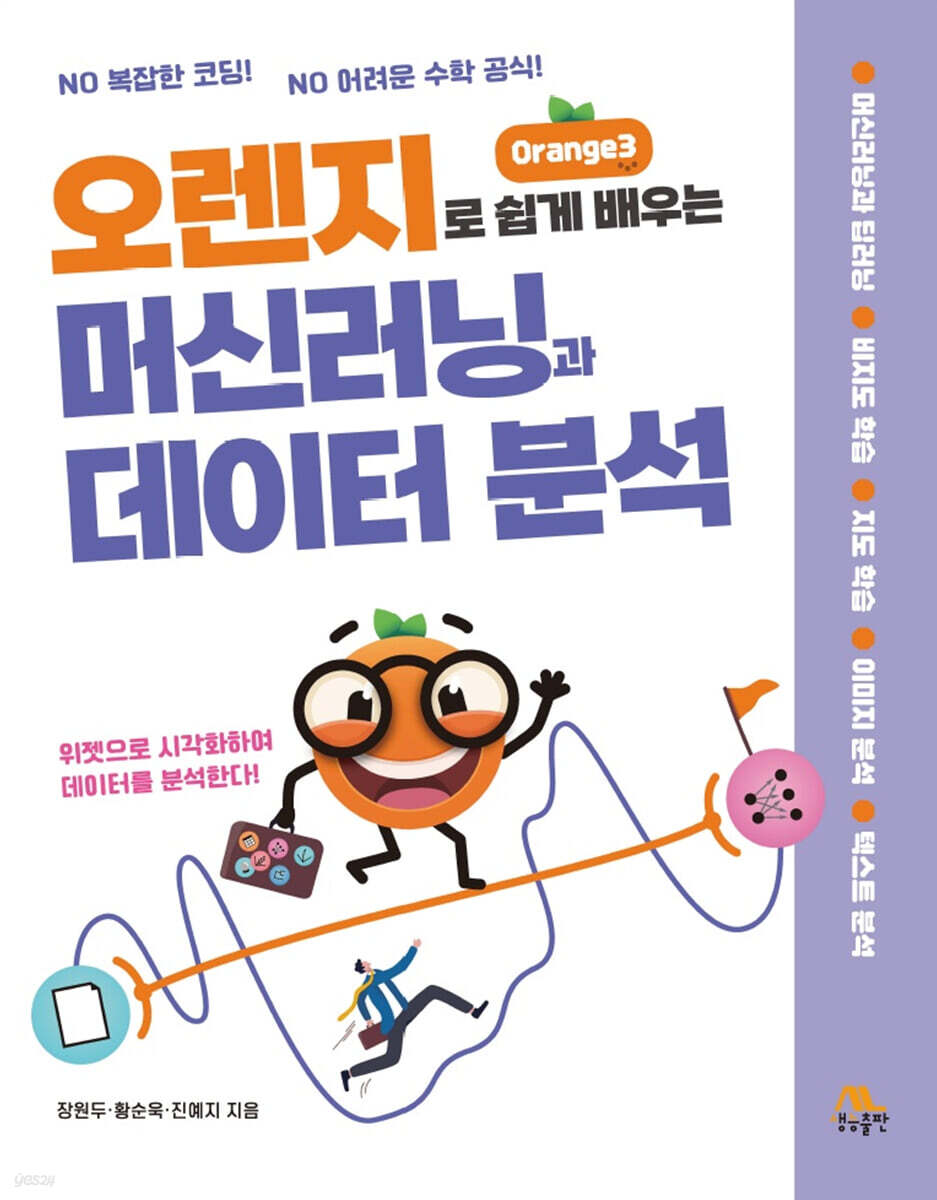
Learn machine learning and data analysis easily with Orange
 |
Description
Book Introduction
Artificial intelligence has become a very close part of our lives.
Students rely on ChatGPT for review and assignment preparation, and images and videos created with generative AI are captivating us across various media.
Many students want to create artificial intelligence models and analyze diverse data from their daily lives, but the fact that most AI models are developed in programming languages like Python often poses a significant obstacle to students' decision to learn AI.
Orange, introduced in this book, features a visual coding method that allows you to drag and drop widgets, allowing you to easily analyze data using machine learning techniques without complex text coding.
Because it internally uses the scikit-learn library, which is Python's machine learning package, it also has a very high degree of freedom compared to other data analysis software.
index
CHAPTER 01 Orange, No Coding, Machine Learning
1.1 No-Coding Data Analysis and Orange
1.2 Understanding the concept of artificial intelligence
1.3 How to install
1.4 Screen composition
1.5 Widget
Practice problems
CHAPTER 02 Orange Basics and Basic Statistical Analysis
2.1 Investigating the characteristics of each flower type (Orange's basic statistics widget)
2.2 Let's analyze the distribution of students enrolled in the course (pivot table).
Practice problems
CHAPTER 03 Data Visualization
3.1 When is the most common time for drunk driving? (Histogram)
3.2 Are there differences in the composition of wine depending on the variety? (Bar graph and Box plot)
3.3 Do abalones age? (Scatterplot and correlation coefficient)
3.4.
Analysis of Titanic survivor data (Mosaic Display)
Practice problems
CHAPTER 04 Data Preprocessing
4.1 What is the hottest city in our country? (Impute)
4.2 Let's find the area where electric vehicles are most active (Melt)
4.3 Is Voice Phishing Decreasing? (Feature Constructor)
4.4 Where do people get the most colds? (Merge Data, Concatenate)
Practice problems
CHAPTER 05 Unsupervised Learning and Data Analysis
5.1 What is unsupervised learning?
5.2 Let's find students with similar performance patterns (hierarchical clustering)
5.3 Let's group similar animals together in the zoo (K-means algorithm)
5.4 Which European ski resorts will you visit this winter? (Self-organizing map)
5.5 Finding High-Performance Companies with Financial Data (Principal Component Analysis)
Practice problems
CHAPTER 06 Supervised Learning and Data Classification
6.1 What is supervised learning?
6.2 Let's predict housing prices (regression analysis)
6.3 Can Health Checkup Data Predict Smoking Status? (Logistic Regression and Naive Bayes)
6.4 Will this funding be successful? (K-NN, Decision Tree, Random Forest)
6.5 Let's predict whether someone has heart disease (support vector machines and artificial neural networks).
Practice problems
CHAPTER 07 Deep Learning and Image Classification
7.1 Photo Data and Deep Learning
7.2 Orange and Image Data
7.3 What is this flower called? (Image embedding and convolutional neural networks)
7.4 Organizing Photos on My Computer (Images and Unsupervised Learning)
7.5 Let's classify vehicle types (Image learning application (1))
7.6 Let's classify the facial expressions of pets (Image learning application (2))
Practice problems
CHAPTER 08 Natural Language Processing
8.1 What is Natural Language Processing?
8.2 What are the most frequently used words by US presidential candidates? (Word Cloud)
8.3 Let's automatically classify spam emails (natural language processing + machine learning)
8.4 How many people like this product? (Text sentiment analysis)
8.5 What are the central keywords in today's news articles? (Co-occurrence Network)
Practice problems
CHAPTER 09 Time Series Data Analysis
9.1 What is time series data?
9.2 Let's visualize stock price information (time series data visualization)
9.3 What will be the sales volume next month? (Time Series Forecasting Model - ARIMA)
9.4 Life Expectancy and GDP by Era and Country (Visual Map)
Practice problems
Publisher's Review
However, existing Orange-related books mainly focus on learning the program's functions or only provide a few practical exercises, which can be somewhat disappointing for researchers and students pursuing machine learning and data analysis.
On the other hand, this book has the great advantage of allowing you to comprehensively learn machine learning and data analysis in a short 15-week period, even if you have no coding knowledge.
By skipping the time-consuming coding process, you can focus more on learning how to utilize machine learning models.
Through a variety of examples, you'll gain hands-on experience with key machine learning concepts and the process of analyzing data. You'll also gain the ability to quickly and easily analyze diverse data on your own.
As I write this introduction, I let my imagination run wild about what the coding tools of the future will look like.
In an era where many things are increasingly automated, won't there come a day when text-based coding is considered a relic of the past? I hope this book will make machine learning and data analysis more accessible to students from a variety of fields.
Features of this book
· Intuitive analysis through visual coding: Instead of the commonly used text coding, we used a visual coding technique that involves dragging and dropping icons, making it easy to analyze data and utilize artificial intelligence.
· Easily configure various types of machine learning models: You can configure new AI models simply by adding and connecting widgets, so you can study various AI models and apply them to various problems in a short period of time.
· Easy explanation of basic artificial intelligence concepts through pictures: Complex artificial intelligence concepts are explained in an easy and concise manner through pictures, allowing for intuitive understanding of the basic knowledge required for data analysis, etc.
· Explanation of artificial intelligence techniques through [Learn More]: Complex artificial intelligence theories are explained concisely on one page with illustrations, enabling a conceptual understanding of artificial intelligence theories.
· Various data analysis practices based on actual data: This course is designed to help you improve your data analysis skills by bringing in and analyzing various real-world data, such as the status of drunk driving crackdowns and changes in global life expectancy.
· Practice Problems: Practice problems are provided to help you check your understanding of artificial intelligence theory and the practical knowledge required for data analysis.
We also present new data to which you can apply the learned artificial intelligence technology, so that you can apply what you have learned on your own.
GOODS SPECIFICS
- Date of issue: February 14, 2024
- Page count, weight, size: 396 pages | 190*240*30mm
- ISBN13: 9791192932514
- ISBN10: 119293251X
You may also like
카테고리
korean


korean


