

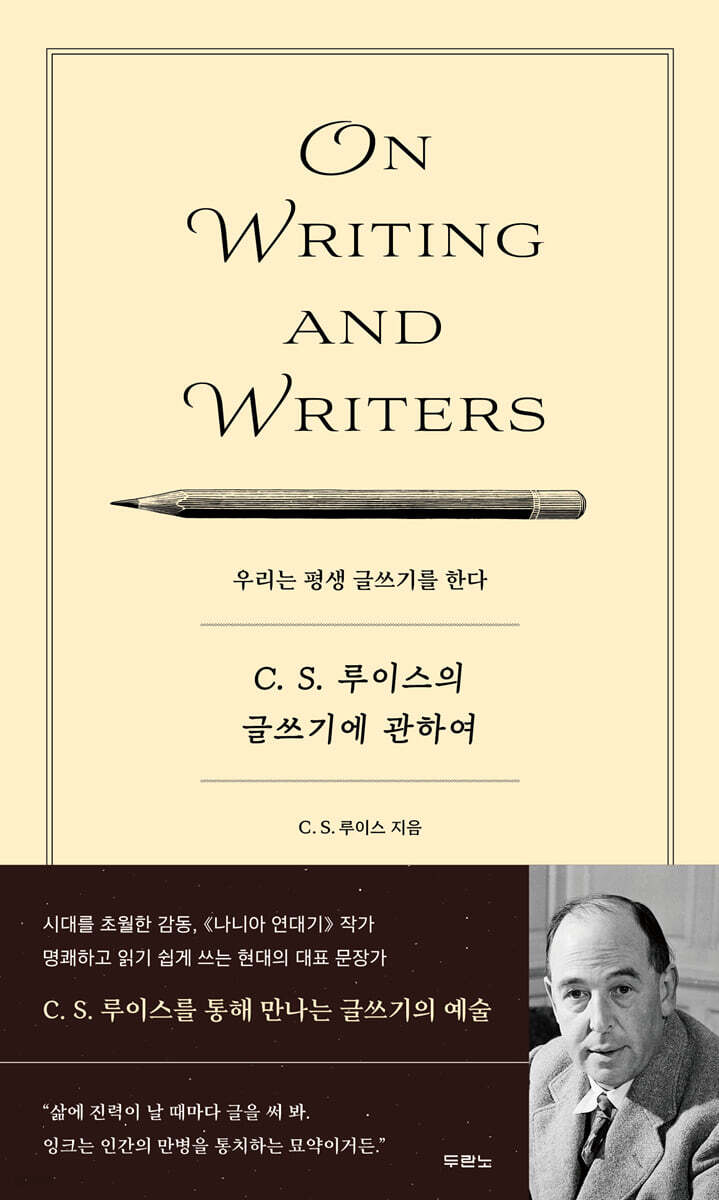
On CS Lewis's Writing
 |
Description
Book Introduction
Timeless inspiration, author of The Chronicles of Narnia
A representative modern writer who writes clearly and easily readably
C.
The Art of Writing Through S. Lewis
The author of the children's fantasy novel "The Chronicles of Narnia," which has sold over 100 million copies worldwide, as well as masterpieces such as "The Screwtape Letters" and "Mere Christianity," which have influenced countless lives and become classics, and a respected professor and scholar who taught English literature at Oxford and Cambridge for a long time, and is praised as the greatest Christian apologist of the 20th century, C.
S. Lewis.
We have carefully selected about 100 of his advice and opinions on “writing and writers” from various letters, books, and essays he wrote throughout his life.
I love reading,
Knowing the amazing power of writing,
To all who aspire to write well
This book contains Lewis's writing philosophy and techniques, recognized for his insight, imagination, and writing prowess across a variety of genres, including science fiction, literary criticism, theology, memoir, and poetry.
"How do writers begin to write?", "Why do we write?", "How can we write better?", "What constitutes bad writing?", "How can we write persuasively?", "What should we be careful of when criticizing?", "What mistakes are common when writing?", etc. Practical and profound concerns are presented in every line and space of the text.
A representative modern writer who writes clearly and easily readably
C.
The Art of Writing Through S. Lewis
The author of the children's fantasy novel "The Chronicles of Narnia," which has sold over 100 million copies worldwide, as well as masterpieces such as "The Screwtape Letters" and "Mere Christianity," which have influenced countless lives and become classics, and a respected professor and scholar who taught English literature at Oxford and Cambridge for a long time, and is praised as the greatest Christian apologist of the 20th century, C.
S. Lewis.
We have carefully selected about 100 of his advice and opinions on “writing and writers” from various letters, books, and essays he wrote throughout his life.
I love reading,
Knowing the amazing power of writing,
To all who aspire to write well
This book contains Lewis's writing philosophy and techniques, recognized for his insight, imagination, and writing prowess across a variety of genres, including science fiction, literary criticism, theology, memoir, and poetry.
"How do writers begin to write?", "Why do we write?", "How can we write better?", "What constitutes bad writing?", "How can we write persuasively?", "What should we be careful of when criticizing?", "What mistakes are common when writing?", etc. Practical and profound concerns are presented in every line and space of the text.
- You can preview some of the book's contents.
Preview
index
The editor's writing.
The world of writing that Lewis invites you to
Part 1.
Breathe life into the letters and lines
- If you want to write well
- The pain and joy of putting thoughts into words
Part 2.
A deeper level of writing, into that wondrous adventure.
- Writing a novel
- Writing poetry
- Writing for children
- Writing science fiction
- Christian writing
- Write persuasively
- Lewis's view on other writers
Entry
supplement.
Authors featured in this book
The world of writing that Lewis invites you to
Part 1.
Breathe life into the letters and lines
- If you want to write well
- The pain and joy of putting thoughts into words
Part 2.
A deeper level of writing, into that wondrous adventure.
- Writing a novel
- Writing poetry
- Writing for children
- Writing science fiction
- Christian writing
- Write persuasively
- Lewis's view on other writers
Entry
supplement.
Authors featured in this book
Detailed image
Into the book
4.
When you write, don't just use adjectives to describe how you want your readers to feel about the subject you're describing.
Instead of simply saying something is “terrible,” describe it so that we can feel its horror.
Instead of just saying "it's fun," I want you to read the description you wrote and make the word "it's fun" burst out of our mouths.
So, words like scary, strange, ugly, or noble are all the same as saying to the reader, “Please do my work for me.”
5.
Don't use words that are too grandiose for the topic.
For example, if you want to say “very,” you shouldn’t write “infinitely.”
Otherwise, when you want to talk about something truly infinite, there are no words left.
--- p.15
3.
Always write with your ears, not with your eyes.
The same goes for reading.
You should listen to every sentence you write as if you were reading it or making a presentation.
If it doesn't sound good, rewrite it.
8.
Whatever word you use, make sure you know its meaning.
--- p.16~17
It takes practice, practice, and more practice.
As long as we write consistently and as well as we can, it doesn't matter what we write at our age (at least in my opinion).
I feel like I've made a lot of progress every time I put effort into writing a page, whether it's poetry or prose.
Even if you throw that manuscript into the fire after a while.
--- p.27
Here are some of the shortcomings that stand out to me in the critiques of today's undergraduates:
1.
When it comes to negative criticism, there is a note of ill will in their tone.
The intention is to hurt the author rather than inform the reader.
Originally, negative criticism was meant to diagnose and explain the flaws of a work, not to insult the work.
2.
Even though the work has been around for several generations, they are too quick to advocate or accept radical reinterpretations of the work.
Clearly, there must have been some evaluation of such a reinterpretation, but that part is ignored.
--- p.31
I have only ever seen one student submit someone else's work as if it were his own.
I told that student.
I'm not a detective, let alone a nurse or a medalist, so I have no intention of monitoring such childish tactics.
I told him to clean things up, but he voluntarily left school the next week, and I never saw him again.
I think you should roughly announce the criteria related to this.
… … How can a free man, who tries to write a thesis on his own, do so more than a galley [a type of ship used in the Mediterranean in ancient and medieval times.
I find it truly absurd that one could prefer the slave labor of copying and writing, as if one were a slave to the editor.
--- p.33
When I say I write “for children,” I mean that I leave out elements that children might not like or understand, not that I write it deliberately to be below adult standards.
Of course, I could be mistaken, but if I follow this principle, I can at least avoid the attitude of trying to teach.
I didn't write with a specific target audience in mind.
My theory is that if a book is only for children, it's not worth reading at all, even when they're young. My work can be judged either guilty or innocent by this standard.
I hoped that my story would help overcome the various oppressions that had been instilled in the child's mind.
But the same oppression can exist in the minds of adults, and perhaps be overcome in the same ways.
Fairy tales are a form that captures the world of fantasy, and people of all ages may or may not read fairy tales.
If the author can effectively utilize the characteristics of a fairy tale and properly connect with the reader, the power of the fairy tale will be the same regardless of the age at which the reader is read.
In other words, fairy tales generalize without losing specificity, vividly present a broader range of experiences than abstract concepts or individual events, and eliminate all irrelevant parts.
The best fairy tales can do more than that.
It can give us the opportunity to experience something for the first time in our lives.
It's not about "commenting on life," it's about broadening life.
--- p.44~45
For me, the process of writing a story is much closer to birdwatching than speaking or building a building.
First of all, several images come to mind.
Some of them have similar tastes and smells, so they group together.
If you observe silently, things will gradually come together on their own.
If you're really lucky (and I never have been), the whole thing will fall into place and the story will be complete without the writer having to do anything.
But usually (and in my experience always) there are gaps.
So in the end, the writer has to make it up to some extent.
The writer must find reasons why characters must act in different ways in different places.
I don't know if this is the best way to write a story, let alone the conventional way.
It's the only way I know.
The image always comes first.
--- p.95-96
Chris Neville's She Knew He Was Coming is the worst case scenario.
The clichéd themes of a sentimental brothel and a kind-hearted prostitute are acceptable, even if they're melodramatic, but is there a reason the setting has to be Mars? In any work of art, every subject must be used according to its intended purpose.
If you introduce a theme into a symphony, you must achieve something with it; if you write a poem in a particular meter, you must make use of the unique characteristics of that meter; if you write a historical novel, the period must fit the purpose.
Any element that is not beneficial to the work is actually detrimental.
I can't afford to waste it like that (in a good ink painting, white space is as essential to the overall composition as the lines.
(The only cases where the margins are just blank are children's drawings).
If the “unique characteristics of Mars” are not going to be fully utilized, then there is no reason to use Mars as a setting for the story, right?
--- p.109
You must be especially careful when criticizing areas you don't like, and above all, you should not criticize areas you dislike at all.
… (omitted)… I dare to advise anyone who wants to be a critic to set the same principles for yourself.
If you find yourself reacting with aversion, even disgust, to all books of a certain type or to a certain situation, this is a red flag.
I'm convinced that being good at giving negative criticism is the most difficult thing we can do.
I would encourage everyone to start on the most favorable terms.
In other words, you should critique the author only after you thoroughly understand what he or she is trying to say, truly like him or her, and have enjoyed reading many of his or her good works.
Then, we can properly point out the writer's mistakes and perhaps even reveal the reasons for the mistakes.
But if you really react with, "Ugh! I hate books like this," you won't be able to diagnose the book's real flaws.
We may try to hide our feelings, but ultimately we'll just throw analysis aside and spit out a jumble of emotional clichés like "messy," "frivolous," "pseudo," "sloppy," and "rash."
If you really know what the problem is, you don't need any of these words.
--- p.128~130
You must translate all of your theology into everyday language.
It's a hassle and you'll run out of things to say after 30 minutes, but it's absolutely necessary.
It also helps me immensely with my own thinking.
If you can't put your thoughts into words that anyone can understand, then your thinking is confused.
If you want to test whether you really know what you're saying, you have to be able to translate it that way.
--- p.135
Overall, of all the poetry I've ever read, Dante's is by far the best.
Yet, when the brilliance of his poetry reaches its highest peak, Dante seems to be doing little.
… … In short, the highest state of poetry in the art of poetry is ultimately a kind of retreat.
To get there, the entire world seen through the poet's eyes must enter deep into his mind.
Then all the poet has to do now is get out of the way.
If you stay still, waves will crash in, mountains will sway their leaves, light will shine brightly, and celestial bodies will rotate on their own.
All of these are not just materials needed to write poetry, but are already poetry in themselves.
I dare confess that after Dante, even Shakespeare seems to me a little artificial.
Shakespeare almost seems to be “just making it up,” but you don’t get that feeling with Dante.
Even people who no longer read Dante's poetry would agree.
When you write, don't just use adjectives to describe how you want your readers to feel about the subject you're describing.
Instead of simply saying something is “terrible,” describe it so that we can feel its horror.
Instead of just saying "it's fun," I want you to read the description you wrote and make the word "it's fun" burst out of our mouths.
So, words like scary, strange, ugly, or noble are all the same as saying to the reader, “Please do my work for me.”
5.
Don't use words that are too grandiose for the topic.
For example, if you want to say “very,” you shouldn’t write “infinitely.”
Otherwise, when you want to talk about something truly infinite, there are no words left.
--- p.15
3.
Always write with your ears, not with your eyes.
The same goes for reading.
You should listen to every sentence you write as if you were reading it or making a presentation.
If it doesn't sound good, rewrite it.
8.
Whatever word you use, make sure you know its meaning.
--- p.16~17
It takes practice, practice, and more practice.
As long as we write consistently and as well as we can, it doesn't matter what we write at our age (at least in my opinion).
I feel like I've made a lot of progress every time I put effort into writing a page, whether it's poetry or prose.
Even if you throw that manuscript into the fire after a while.
--- p.27
Here are some of the shortcomings that stand out to me in the critiques of today's undergraduates:
1.
When it comes to negative criticism, there is a note of ill will in their tone.
The intention is to hurt the author rather than inform the reader.
Originally, negative criticism was meant to diagnose and explain the flaws of a work, not to insult the work.
2.
Even though the work has been around for several generations, they are too quick to advocate or accept radical reinterpretations of the work.
Clearly, there must have been some evaluation of such a reinterpretation, but that part is ignored.
--- p.31
I have only ever seen one student submit someone else's work as if it were his own.
I told that student.
I'm not a detective, let alone a nurse or a medalist, so I have no intention of monitoring such childish tactics.
I told him to clean things up, but he voluntarily left school the next week, and I never saw him again.
I think you should roughly announce the criteria related to this.
… … How can a free man, who tries to write a thesis on his own, do so more than a galley [a type of ship used in the Mediterranean in ancient and medieval times.
I find it truly absurd that one could prefer the slave labor of copying and writing, as if one were a slave to the editor.
--- p.33
When I say I write “for children,” I mean that I leave out elements that children might not like or understand, not that I write it deliberately to be below adult standards.
Of course, I could be mistaken, but if I follow this principle, I can at least avoid the attitude of trying to teach.
I didn't write with a specific target audience in mind.
My theory is that if a book is only for children, it's not worth reading at all, even when they're young. My work can be judged either guilty or innocent by this standard.
I hoped that my story would help overcome the various oppressions that had been instilled in the child's mind.
But the same oppression can exist in the minds of adults, and perhaps be overcome in the same ways.
Fairy tales are a form that captures the world of fantasy, and people of all ages may or may not read fairy tales.
If the author can effectively utilize the characteristics of a fairy tale and properly connect with the reader, the power of the fairy tale will be the same regardless of the age at which the reader is read.
In other words, fairy tales generalize without losing specificity, vividly present a broader range of experiences than abstract concepts or individual events, and eliminate all irrelevant parts.
The best fairy tales can do more than that.
It can give us the opportunity to experience something for the first time in our lives.
It's not about "commenting on life," it's about broadening life.
--- p.44~45
For me, the process of writing a story is much closer to birdwatching than speaking or building a building.
First of all, several images come to mind.
Some of them have similar tastes and smells, so they group together.
If you observe silently, things will gradually come together on their own.
If you're really lucky (and I never have been), the whole thing will fall into place and the story will be complete without the writer having to do anything.
But usually (and in my experience always) there are gaps.
So in the end, the writer has to make it up to some extent.
The writer must find reasons why characters must act in different ways in different places.
I don't know if this is the best way to write a story, let alone the conventional way.
It's the only way I know.
The image always comes first.
--- p.95-96
Chris Neville's She Knew He Was Coming is the worst case scenario.
The clichéd themes of a sentimental brothel and a kind-hearted prostitute are acceptable, even if they're melodramatic, but is there a reason the setting has to be Mars? In any work of art, every subject must be used according to its intended purpose.
If you introduce a theme into a symphony, you must achieve something with it; if you write a poem in a particular meter, you must make use of the unique characteristics of that meter; if you write a historical novel, the period must fit the purpose.
Any element that is not beneficial to the work is actually detrimental.
I can't afford to waste it like that (in a good ink painting, white space is as essential to the overall composition as the lines.
(The only cases where the margins are just blank are children's drawings).
If the “unique characteristics of Mars” are not going to be fully utilized, then there is no reason to use Mars as a setting for the story, right?
--- p.109
You must be especially careful when criticizing areas you don't like, and above all, you should not criticize areas you dislike at all.
… (omitted)… I dare to advise anyone who wants to be a critic to set the same principles for yourself.
If you find yourself reacting with aversion, even disgust, to all books of a certain type or to a certain situation, this is a red flag.
I'm convinced that being good at giving negative criticism is the most difficult thing we can do.
I would encourage everyone to start on the most favorable terms.
In other words, you should critique the author only after you thoroughly understand what he or she is trying to say, truly like him or her, and have enjoyed reading many of his or her good works.
Then, we can properly point out the writer's mistakes and perhaps even reveal the reasons for the mistakes.
But if you really react with, "Ugh! I hate books like this," you won't be able to diagnose the book's real flaws.
We may try to hide our feelings, but ultimately we'll just throw analysis aside and spit out a jumble of emotional clichés like "messy," "frivolous," "pseudo," "sloppy," and "rash."
If you really know what the problem is, you don't need any of these words.
--- p.128~130
You must translate all of your theology into everyday language.
It's a hassle and you'll run out of things to say after 30 minutes, but it's absolutely necessary.
It also helps me immensely with my own thinking.
If you can't put your thoughts into words that anyone can understand, then your thinking is confused.
If you want to test whether you really know what you're saying, you have to be able to translate it that way.
--- p.135
Overall, of all the poetry I've ever read, Dante's is by far the best.
Yet, when the brilliance of his poetry reaches its highest peak, Dante seems to be doing little.
… … In short, the highest state of poetry in the art of poetry is ultimately a kind of retreat.
To get there, the entire world seen through the poet's eyes must enter deep into his mind.
Then all the poet has to do now is get out of the way.
If you stay still, waves will crash in, mountains will sway their leaves, light will shine brightly, and celestial bodies will rotate on their own.
All of these are not just materials needed to write poetry, but are already poetry in themselves.
I dare confess that after Dante, even Shakespeare seems to me a little artificial.
Shakespeare almost seems to be “just making it up,” but you don’t get that feeling with Dante.
Even people who no longer read Dante's poetry would agree.
--- p.150~151
Publisher's Review
A delicate sentence that moves the heart, an exquisite harmony of imagination and logic,
About a beautiful story that captures the truth of life!
From diaries, letters, book reviews, reports, and literary writing on social media
Now wake up your dead sentence!
This book focuses primarily on literary and imaginative writing, so it will be a rich source of inspiration for professional writers, aspiring writers, and avid readers alike.
Above all, whether voluntarily or involuntarily, whether the writing is short or long, and whatever the writing tool, modern people spend their entire lives writing.
The messages contained in this book are absolutely beneficial and applicable to all of our everyday writing.
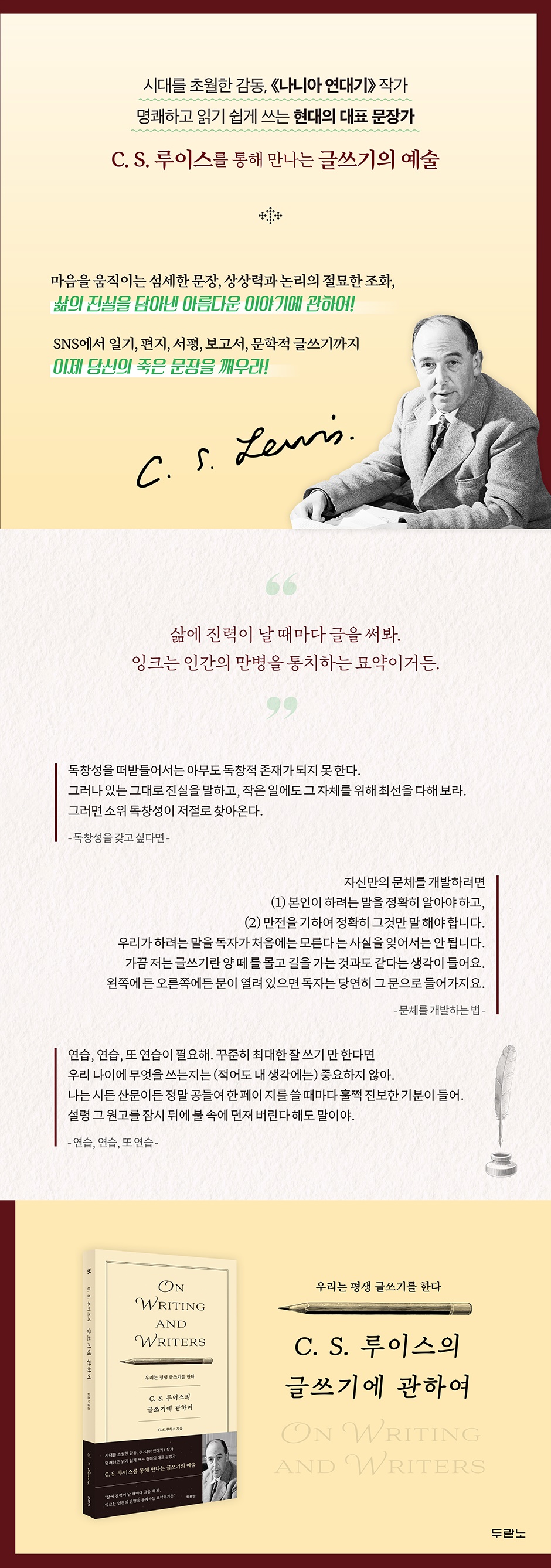
“Whenever you feel tired in life, try writing.
“Ink is the panacea for all human ills.” This is part of a letter Lewis sent to his close friend Arthur Greaves.
I hope that modern people, physically and mentally exhausted, will begin to write in their own way through this book, and that this will lead to progress in writing.
Furthermore, I hope you will experience the unexpected pleasure of stepping into the world of works by various authors whom you briefly encounter through Lewis's eyes in the book!
About a beautiful story that captures the truth of life!
From diaries, letters, book reviews, reports, and literary writing on social media
Now wake up your dead sentence!
This book focuses primarily on literary and imaginative writing, so it will be a rich source of inspiration for professional writers, aspiring writers, and avid readers alike.
Above all, whether voluntarily or involuntarily, whether the writing is short or long, and whatever the writing tool, modern people spend their entire lives writing.
The messages contained in this book are absolutely beneficial and applicable to all of our everyday writing.
“Whenever you feel tired in life, try writing.
“Ink is the panacea for all human ills.” This is part of a letter Lewis sent to his close friend Arthur Greaves.
I hope that modern people, physically and mentally exhausted, will begin to write in their own way through this book, and that this will lead to progress in writing.
Furthermore, I hope you will experience the unexpected pleasure of stepping into the world of works by various authors whom you briefly encounter through Lewis's eyes in the book!
GOODS SPECIFICS
- Date of issue: May 7, 2025
- Page count, weight, size: 236 pages | 262g | 120*200*20mm
- ISBN13: 9788953150812
- ISBN10: 8953150817
You may also like
카테고리
korean


korean

![GQ KOREA Mark (Monthly): December [2025]](http://librairie.coreenne.fr/cdn/shop/files/8ef265dbbfbf186523ed75ba7319009d.jpg?v=1765340328&width=3840)


