

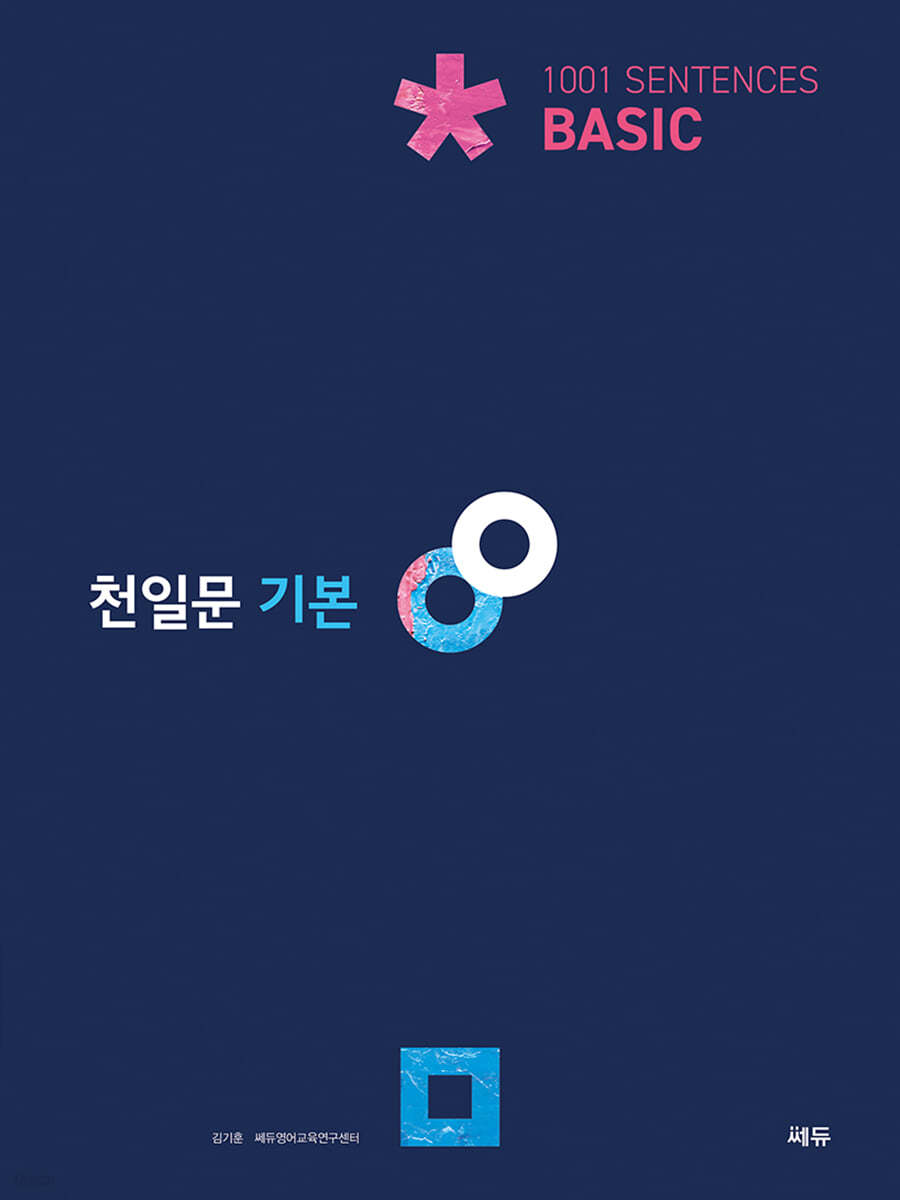
Basic 1001 Sentences
 |
Description
Book Introduction
From basic sentences to difficult sentences for the CSAT, learn all English sentences with Thousand Character Classic! The Thousand Character Classic is characterized by learning English structure by reading representative phrases separately, and it allows for quick direct reading and accurate sentence interpretation. 『Thousand Character Classic Basics』 was created for students who want to learn systematic grammar concepts. It consists of a total of 1,001 sentences and covers all types of sentences that appear on the CSAT. Because it provides full sentence reading and syntactic analysis, you can systematically learn the basics on your own. It reflects the latest trends in past exam questions from the College Scholastic Ability Test (CSAT), the Evaluation Institute, etc., and also includes problems related to grammar, writing, and sentence transitions. |
- You can preview some of the book's contents.
Preview
index
PART 1 Sentence Structure
CHAPTER 01 Basic Structure of Verbs and Sentences
Unit 01 SV
Unit 02 SVA
Further Study Nouns that function as adverbs
Unit 03 SVC
Further Study Adjectives (Phrases) that modify nouns
Unit 04 SVO/SVOA
Unit 05 SVOO
Unit 06 SVOC
Unit 07 Verbs and sentence patterns to watch out for
CHAPTER 02 Understanding the Subject
Unit 08 Noun Phrase Subject
Unit 09 Noun Clause Subject Ⅰ
Unit 10 Noun Clause Subject II
Unit 11 Subject it
Unit 12 Semantic Subject of the Infinitive
Unit 13 Semantic Subjects of Gerunds
Further Study When the semantic subject is not indicated separately
Unit 14 Sentences with it as the subject
CHAPTER 03 Understanding Objects
Unit 15 Infinitive/Gerund Objects I
Unit 16: Infinitive/Gerund Objects II
Unit 17 Noun Clause Object
Unit 18 Reflexive Pronoun Objects
Unit 19 Objects of Prepositions
Further Study: Objects of Prepositions to Watch Out for
Unit 20 Object it
CHAPTER 04 Understanding Bohr
Unit 21 Various Nominative Complements
Unit 22: To-Infinitive Object Complement
Further Study Objects and Objective Complements to-v/v/v-ing
Unit 23 Infinitive (v) Object Complement
Unit 24 Present Participle (v-ing) Object Complement
Unit 25 Past Participle (pp) Objective Complement
Unit 26 have+object+pp
PART 2 Understanding Predicates
CHAPTER 05 Verb Tenses
Unit 27: The Different Meanings of the Present Tense
Unit 28 Expressions for the future
Unit 29 Present Perfect Tense/Present Perfect Continuous Tense
Further Study Understanding the Present Perfect
Unit 30 Past Perfect/Future Perfect
Unit 31 Perfect tense of infinitives/gerunds
CHAPTER 06 Auxiliary Verbs that Add Meaning to Verbs
Unit 32 Ability/Permission
Unit 33 Advice/Necessity
Unit 34 Possibilities/Speculations about the Present or Future
Further Study should and ought to
Unit 35 Possibilities/Speculations/Regrets about the Past
Unit 36 Special uses of should
Unit 37 Frequently Seen Auxiliary Verb Expressions
CHAPTER 07 Verb Tenses
Unit 38 Passive voice in sentence patterns 3 and 4
Unit 39 Passive Voice in 5 Sentence Patterns
Further Study Idiomatic Expressions of the Passive Voice
Unit 40 Passive Voice Combined with Auxiliary Verbs/Tenses
Unit 41 Passive Voice: Things to Note About Form
Unit 42 Imperative/Interrogative Passive Voice
Unit 43 Passive form of infinitive/gerund
CHAPTER 08 CONDITIONAL MOVEMENT
Unit 44 if+subjunctive past
Unit 45 if+should/were to
Unit 46 if+subjunctive past perfect/mixed subjunctive
Unit 47 if omitted inversion structure
Unit 48 S+wish+subjunctive
Unit 49 as if + conditional
Unit 50 Expressions leading to the conditional mood
PART 3 Understanding Modifiers
CHAPTER 09 Modifiers: to-infinitive/participle
Unit 51 Adjectival Modification of the Infinitive
Unit 52 Adjectival Modifiers of Participles (v-ing/pp)
Unit 53 Adjectival Modification of Emotional Participles (v-ing/pp)
Unit 54 Adverbial Modification of the Infinitive I
Unit 55 Adverbial Modification of the Infinitive II
Unit 56 Key phrases made with the to-infinitive
CHAPTER 10 Participle Phrases
Unit 57: The Meaning of Participle Phrases
Unit 58 Participle phrase forms to watch out for
Unit 59 Semantic Subjects of Participle Phrases to Watch Out for
PART 4 Sentence Expansion
CHAPTER 11 Coordinate Clauses and Parallel Structures
Unit 60 Coordinating Conjunctions and/but/or/for/nor/yet
Unit 61 Parallel Structure
Unit 62 both A and B etc.
Unit 63 Expressions made by one/another/the other
Further Study Comma(,)/Colon(:)/Dash(―)/Parentheses( )/Semicolon(;)
CHAPTER 12 Relative Clauses
Unit 64 Nominative/Possessive Relative Pronouns
Unit 65 Objective Relative Pronouns
Unit 66 Relative Adverbs
Further Study Distinction between Relative Pronouns and Relative Adverbs
Unit 67 Relatives and Omissions
Unit 68 Relative clauses separated from antecedents
Unit 69 Relative Pronouns that Lead Noun Clauses: what
Unit 70 Complex relative pronouns leading noun clauses
Unit 71 Relative Clauses that Supplement the Antecedent I
Unit 72 Relative clauses that supplement the antecedent II
Further Study: Understanding Relative Clauses with Additional Explanation
CHAPTER 13 ADVERBAL CLAUSES
Unit 73 Adverbial clauses expressing time I
Unit 74 Adverbial clauses expressing time II
Unit 75 Adverbial clauses expressing reasons/causes
Unit 76 Adverbial clauses expressing conditions
Unit 77 Adverbial clauses expressing concession/contrastⅠ
Further Study even though vs.
even if
Unit 78 Adverbial clauses expressing concession/contrast II
Unit 79 Adverbial clauses expressing purpose/result
Unit 80 Adverbial clauses expressing aspect
Further Study: The various meanings of as and its use as a conjunction (preposition + noun + that)
PART 5 KEY SYNTAX
CHAPTER 14 Verb Phrases with Prepositional Phrases
Unit 81 Verbs A from B
Unit 82 Verbs A for B
Unit 83 Verbs A as B
Unit 84 Verbs A of B
Unit 85 Verbs A to B
Unit 86 Verbs A with B
CHAPTER 15 Comparative Phrases
Unit 87: Basic Grammar I
Unit 88: Basic Phrase II
Unit 89 Comparative Phrases I
Unit 90 Comparative Phrases II
Unit 91: Easily Confusing Comparative Phrases I
Unit 92: Easily Confusing Comparative Phrases II
Unit 93 Superlative Phrases
Further Study Idiomatic Expressions Using the Original/Comparative/Superlative Degrees
CHAPTER 16 Special Syntax
Unit 94 Inversion Sentences
Unit 95 Emphasis
Unit 96: Elliptic Phrases
Unit 97 Common Sentences
Unit 98: Parentheses
Unit 99 Appositive Phrases
Unit 100 Negative Sentences
Further Study Phrases meaning negation
Unit 101 Phrases that require the subject to be interpreted as an adverb
Appendix | MUST-KNOW Terms & Concepts
CHAPTER 01 Basic Structure of Verbs and Sentences
Unit 01 SV
Unit 02 SVA
Further Study Nouns that function as adverbs
Unit 03 SVC
Further Study Adjectives (Phrases) that modify nouns
Unit 04 SVO/SVOA
Unit 05 SVOO
Unit 06 SVOC
Unit 07 Verbs and sentence patterns to watch out for
CHAPTER 02 Understanding the Subject
Unit 08 Noun Phrase Subject
Unit 09 Noun Clause Subject Ⅰ
Unit 10 Noun Clause Subject II
Unit 11 Subject it
Unit 12 Semantic Subject of the Infinitive
Unit 13 Semantic Subjects of Gerunds
Further Study When the semantic subject is not indicated separately
Unit 14 Sentences with it as the subject
CHAPTER 03 Understanding Objects
Unit 15 Infinitive/Gerund Objects I
Unit 16: Infinitive/Gerund Objects II
Unit 17 Noun Clause Object
Unit 18 Reflexive Pronoun Objects
Unit 19 Objects of Prepositions
Further Study: Objects of Prepositions to Watch Out for
Unit 20 Object it
CHAPTER 04 Understanding Bohr
Unit 21 Various Nominative Complements
Unit 22: To-Infinitive Object Complement
Further Study Objects and Objective Complements to-v/v/v-ing
Unit 23 Infinitive (v) Object Complement
Unit 24 Present Participle (v-ing) Object Complement
Unit 25 Past Participle (pp) Objective Complement
Unit 26 have+object+pp
PART 2 Understanding Predicates
CHAPTER 05 Verb Tenses
Unit 27: The Different Meanings of the Present Tense
Unit 28 Expressions for the future
Unit 29 Present Perfect Tense/Present Perfect Continuous Tense
Further Study Understanding the Present Perfect
Unit 30 Past Perfect/Future Perfect
Unit 31 Perfect tense of infinitives/gerunds
CHAPTER 06 Auxiliary Verbs that Add Meaning to Verbs
Unit 32 Ability/Permission
Unit 33 Advice/Necessity
Unit 34 Possibilities/Speculations about the Present or Future
Further Study should and ought to
Unit 35 Possibilities/Speculations/Regrets about the Past
Unit 36 Special uses of should
Unit 37 Frequently Seen Auxiliary Verb Expressions
CHAPTER 07 Verb Tenses
Unit 38 Passive voice in sentence patterns 3 and 4
Unit 39 Passive Voice in 5 Sentence Patterns
Further Study Idiomatic Expressions of the Passive Voice
Unit 40 Passive Voice Combined with Auxiliary Verbs/Tenses
Unit 41 Passive Voice: Things to Note About Form
Unit 42 Imperative/Interrogative Passive Voice
Unit 43 Passive form of infinitive/gerund
CHAPTER 08 CONDITIONAL MOVEMENT
Unit 44 if+subjunctive past
Unit 45 if+should/were to
Unit 46 if+subjunctive past perfect/mixed subjunctive
Unit 47 if omitted inversion structure
Unit 48 S+wish+subjunctive
Unit 49 as if + conditional
Unit 50 Expressions leading to the conditional mood
PART 3 Understanding Modifiers
CHAPTER 09 Modifiers: to-infinitive/participle
Unit 51 Adjectival Modification of the Infinitive
Unit 52 Adjectival Modifiers of Participles (v-ing/pp)
Unit 53 Adjectival Modification of Emotional Participles (v-ing/pp)
Unit 54 Adverbial Modification of the Infinitive I
Unit 55 Adverbial Modification of the Infinitive II
Unit 56 Key phrases made with the to-infinitive
CHAPTER 10 Participle Phrases
Unit 57: The Meaning of Participle Phrases
Unit 58 Participle phrase forms to watch out for
Unit 59 Semantic Subjects of Participle Phrases to Watch Out for
PART 4 Sentence Expansion
CHAPTER 11 Coordinate Clauses and Parallel Structures
Unit 60 Coordinating Conjunctions and/but/or/for/nor/yet
Unit 61 Parallel Structure
Unit 62 both A and B etc.
Unit 63 Expressions made by one/another/the other
Further Study Comma(,)/Colon(:)/Dash(―)/Parentheses( )/Semicolon(;)
CHAPTER 12 Relative Clauses
Unit 64 Nominative/Possessive Relative Pronouns
Unit 65 Objective Relative Pronouns
Unit 66 Relative Adverbs
Further Study Distinction between Relative Pronouns and Relative Adverbs
Unit 67 Relatives and Omissions
Unit 68 Relative clauses separated from antecedents
Unit 69 Relative Pronouns that Lead Noun Clauses: what
Unit 70 Complex relative pronouns leading noun clauses
Unit 71 Relative Clauses that Supplement the Antecedent I
Unit 72 Relative clauses that supplement the antecedent II
Further Study: Understanding Relative Clauses with Additional Explanation
CHAPTER 13 ADVERBAL CLAUSES
Unit 73 Adverbial clauses expressing time I
Unit 74 Adverbial clauses expressing time II
Unit 75 Adverbial clauses expressing reasons/causes
Unit 76 Adverbial clauses expressing conditions
Unit 77 Adverbial clauses expressing concession/contrastⅠ
Further Study even though vs.
even if
Unit 78 Adverbial clauses expressing concession/contrast II
Unit 79 Adverbial clauses expressing purpose/result
Unit 80 Adverbial clauses expressing aspect
Further Study: The various meanings of as and its use as a conjunction (preposition + noun + that)
PART 5 KEY SYNTAX
CHAPTER 14 Verb Phrases with Prepositional Phrases
Unit 81 Verbs A from B
Unit 82 Verbs A for B
Unit 83 Verbs A as B
Unit 84 Verbs A of B
Unit 85 Verbs A to B
Unit 86 Verbs A with B
CHAPTER 15 Comparative Phrases
Unit 87: Basic Grammar I
Unit 88: Basic Phrase II
Unit 89 Comparative Phrases I
Unit 90 Comparative Phrases II
Unit 91: Easily Confusing Comparative Phrases I
Unit 92: Easily Confusing Comparative Phrases II
Unit 93 Superlative Phrases
Further Study Idiomatic Expressions Using the Original/Comparative/Superlative Degrees
CHAPTER 16 Special Syntax
Unit 94 Inversion Sentences
Unit 95 Emphasis
Unit 96: Elliptic Phrases
Unit 97 Common Sentences
Unit 98: Parentheses
Unit 99 Appositive Phrases
Unit 100 Negative Sentences
Further Study Phrases meaning negation
Unit 101 Phrases that require the subject to be interpreted as an adverb
Appendix | MUST-KNOW Terms & Concepts
Detailed image
.jpg)
Publisher's Review
▶ From basic sentences to high-level sentences for the CSAT, learn all English sentences with Thousand Character Classic!
▶Cumulative sales of the Thousand Character Classic series exceed 4.3 million copies.
▶Yes24 Online Bookstore's #1 Bestseller
The Thousand Character Classic series, which first appeared in 2004, became the number one bestseller in Korean literature, with cumulative sales exceeding 4.3 million copies.
The Thousand-Yil Classic, which has established itself as Korea's best English textbook, has been reborn in a new way to suit learning trends.
The Thousand-Yil Classic is characterized by learning English structure by reading representative phrases separately, and it allows for quick direct reading and accurate sentence interpretation.
〈Thousand Character Classic Basics〉 was created for students who want to learn systematic grammar concepts.
It consists of a total of 1,001 sentences and covers all types of sentences that appear on the CSAT.
Because it provides full sentence reading and syntactic analysis, you can systematically learn the basics on your own.
It reflects the latest trends in past exam questions from the College Scholastic Ability Test (CSAT), the Evaluation Institute, etc., and also includes problems related to grammar, writing, and sentence transitions.
The 'Thousand Character Classic Basic Practice Book (Training Book),' sold separately, provides various types of problems for grammar application training and internal exam preparation.
If you want to build a solid foundation for advanced reading comprehension, I highly recommend reviewing the 'Thousand Character Classic Basic Problem Book (Training Book)'.
Not only the college entrance exam and school report card, but also important phrases that frequently appear in exams such as the official English exam and civil service exam can be learned through the Thousand-Yi Classic.
I hope you get good results on any test you take with the Thousand Character Classic.
1) Includes all types of sentences that appear on the CSAT
2) Systematic grammar learning to establish basic grammar concepts
3) Completely understand the system of English sentence structure and rules through 1,001 sentences.
▶Cumulative sales of the Thousand Character Classic series exceed 4.3 million copies.
▶Yes24 Online Bookstore's #1 Bestseller
The Thousand Character Classic series, which first appeared in 2004, became the number one bestseller in Korean literature, with cumulative sales exceeding 4.3 million copies.
The Thousand-Yil Classic, which has established itself as Korea's best English textbook, has been reborn in a new way to suit learning trends.
The Thousand-Yil Classic is characterized by learning English structure by reading representative phrases separately, and it allows for quick direct reading and accurate sentence interpretation.
〈Thousand Character Classic Basics〉 was created for students who want to learn systematic grammar concepts.
It consists of a total of 1,001 sentences and covers all types of sentences that appear on the CSAT.
Because it provides full sentence reading and syntactic analysis, you can systematically learn the basics on your own.
It reflects the latest trends in past exam questions from the College Scholastic Ability Test (CSAT), the Evaluation Institute, etc., and also includes problems related to grammar, writing, and sentence transitions.
The 'Thousand Character Classic Basic Practice Book (Training Book),' sold separately, provides various types of problems for grammar application training and internal exam preparation.
If you want to build a solid foundation for advanced reading comprehension, I highly recommend reviewing the 'Thousand Character Classic Basic Problem Book (Training Book)'.
Not only the college entrance exam and school report card, but also important phrases that frequently appear in exams such as the official English exam and civil service exam can be learned through the Thousand-Yi Classic.
I hope you get good results on any test you take with the Thousand Character Classic.
1) Includes all types of sentences that appear on the CSAT
2) Systematic grammar learning to establish basic grammar concepts
3) Completely understand the system of English sentence structure and rules through 1,001 sentences.
GOODS SPECIFICS
- Publication date: October 18, 2021
- Page count, weight, size: 412 pages | 1,027g | 210*280*21mm
- ISBN13: 9788968062285
- ISBN10: 8968062285
- Reference book for use in: 1st year of high school
You may also like
카테고리
korean


korean

![GQ KOREA Mark (Monthly): December [2025]](http://librairie.coreenne.fr/cdn/shop/files/8ef265dbbfbf186523ed75ba7319009d.jpg?v=1765340328&width=3840)


