

Grammar End START
 |
Description
Book Introduction
The beginning and the end of grammar is sedu!
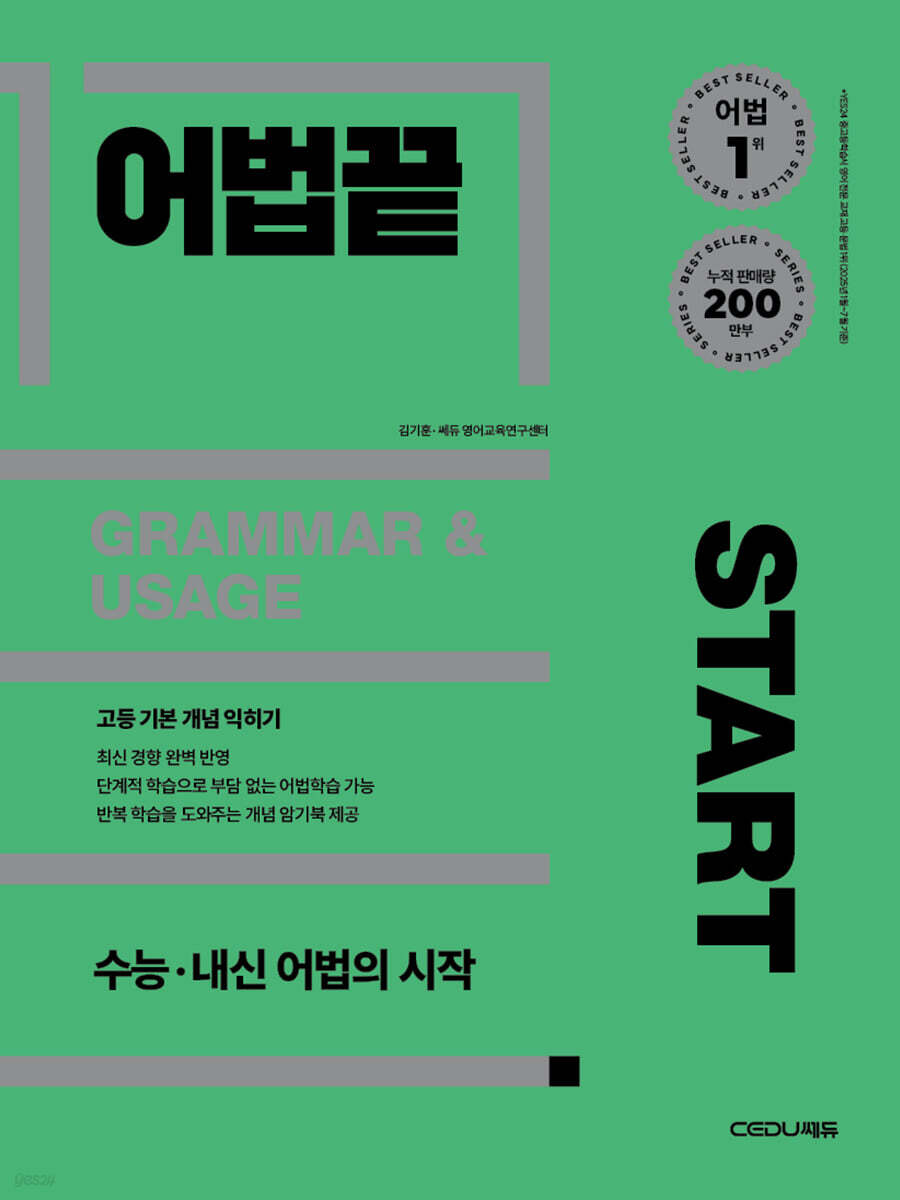
This is the latest revised edition of "Grammar End START," which presents different approaches depending on the type of grammar problem, and allows you to learn 23 key grammar points by analyzing 31 years of past grammar questions.
You can easily learn each key grammar point with the 'square grammar' and apply it to the 'underline grammar' through step-by-step learning.
Additionally, in line with recent trends, we provide additional sample problems for underlining in the 'square grammar' section.
You can check your skills with the Overall Exercise consisting of real-life grammar problems, and a portable concept memorization book is provided for convenient, repetitive study.
The "Grammar End Series" reflects all 31 years of past college entrance exam and mock exam questions and summarizes frequently appearing grammar points.
In order to accurately understand the intent of the test, only the necessary grammar explanations are provided, and optimal examples with high completeness are included.
For learners who need to apply more grammar, we recommend studying “Grammar End START” and “Grammar End START Skill Building” in parallel, completing grammar concepts with “Grammar End ESSENTIAL,” and then finishing with “Grammar End Practice Test.”
1) Grammar End START: The beginning of grammar for the CSAT and school exams
Learn 23 key grammar points by analyzing 31 years of past grammar questions.
Step-by-step grammar learning is possible without burden, and a concept memorization book is provided.
2) Grammar End START Building Skills: Application of Grammar for College Scholastic Ability Test and Internal Exams
Linked to the same table of contents as the customized review textbook of Grammar End START
Review and organize key grammar points with a large number of grammar problems, including 15 mock exams.
3) Grammar End ESSENTIAL: The end of grammar for the CSAT and school exams
A summary of the grammar concepts used in the CSAT, understanding the intentions and solution strategies of past exam questions.
Includes essay questions for the internal exam, and a concept memorization book is also provided.
4) Grammar Final Practice Test: CSAT Grammar Final Review
Analysis of the latest exam trends and summary of frequently appearing and key grammar.
Includes 288 high-quality, practice-based questions
This is the latest revised edition of "Grammar End START," which presents different approaches depending on the type of grammar problem, and allows you to learn 23 key grammar points by analyzing 31 years of past grammar questions.
You can easily learn each key grammar point with the 'square grammar' and apply it to the 'underline grammar' through step-by-step learning.
Additionally, in line with recent trends, we provide additional sample problems for underlining in the 'square grammar' section.
You can check your skills with the Overall Exercise consisting of real-life grammar problems, and a portable concept memorization book is provided for convenient, repetitive study.
The "Grammar End Series" reflects all 31 years of past college entrance exam and mock exam questions and summarizes frequently appearing grammar points.
In order to accurately understand the intent of the test, only the necessary grammar explanations are provided, and optimal examples with high completeness are included.
For learners who need to apply more grammar, we recommend studying “Grammar End START” and “Grammar End START Skill Building” in parallel, completing grammar concepts with “Grammar End ESSENTIAL,” and then finishing with “Grammar End Practice Test.”
1) Grammar End START: The beginning of grammar for the CSAT and school exams
Learn 23 key grammar points by analyzing 31 years of past grammar questions.
Step-by-step grammar learning is possible without burden, and a concept memorization book is provided.
2) Grammar End START Building Skills: Application of Grammar for College Scholastic Ability Test and Internal Exams
Linked to the same table of contents as the customized review textbook of Grammar End START
Review and organize key grammar points with a large number of grammar problems, including 15 mock exams.
3) Grammar End ESSENTIAL: The end of grammar for the CSAT and school exams
A summary of the grammar concepts used in the CSAT, understanding the intentions and solution strategies of past exam questions.
Includes essay questions for the internal exam, and a concept memorization book is also provided.
4) Grammar Final Practice Test: CSAT Grammar Final Review
Analysis of the latest exam trends and summary of frequently appearing and key grammar.
Includes 288 high-quality, practice-based questions
- You can preview some of the book's contents.
Preview
index
〈Appendix〉 Essential terms and grammar basics for learning grammar
PART 1 Square Grammar
UNIT 01 Subject-Verb Agreement
Point 01 Distinguish between subjects and modifiers!
CASE 1 Subject + (preposition + noun) + verb
CASE 2 Subject + (v-ing ~) + verb / Subject + (to-v ~) + verb
CASE 3 Subject + (pp~) + Verb
CASE 4 Subject + [relative clause ~] + verb / Subject + (adjective (phrase) ~) + verb
CASE 5 Subject + Insertion + Verb
Point Exercise
Point 02 Find the antecedent of the verb in the nominative relative clause!
CASE 1 Antecedent + Relative Pronoun + Verb
CASE 2 Antecedent + Modifier + Relative Pronoun + Verb
Point Exercise
Point 03 Be careful with sentences where the subject comes after the verb!
CASE 1 Adverb (phrase) + verb + subject
CASE 2 Negative (phrase) + (auxiliary) verb + subject
CASE 3 There + Verb + Subject
Point Exercise
Point 04 Pay attention to the subject form!
CASE 1 v-ing phrase, to-v phrase, noun clause subject + singular verb
CASE 2 each, every + singular verb / both ~ + plural verb
CASE 3 the adjective + plural verb
CASE 4 Partial expression + of + noun (N)
Point Exercise
UNIT Exercise
UNIT 02 Noun/Pronoun Agreement
Point 05 Pay attention to the form of pronouns!
CASE 1 Noun-Pronoun Number Agreement
CASE 2 Personal Pronouns vs.
possessive pronoun
CASE 3 Personal Pronouns vs.
reflexive pronoun
Point Exercise
Point 06 Distinguish modifiers according to the type of noun!
CASE 1 Modifiers vs. countable nouns
Modifiers of uncountable nouns
CASE 2 Common modifiers (phrases) of countable [uncountable] nouns
Point Exercise
UNIT Exercise
Overall Exercise 1
UNIT 03 Verb Tense
Point 07 Find the adverb to distinguish between simple past and present perfect!
CASE 1 Simple Past vs.
Present Perfect (Continued)
Point Exercise
Point 08 Be careful with adverbial clauses that use the present tense to indicate the future!
CASE 1 Adverbial clauses indicating time
CASE 2 Adverbial clause expressing condition
Point Exercise
UNIT Exercise
UNIT 04 Auxiliary Verbs and Motives
Point 09 Be careful about the time and meaning of auxiliary verb + have pp!
CASE 1 "Auxiliary Verb + Infinitive" vs.
"auxiliary verb + have pp"
CASE 2 Differences in meaning between auxiliary verbs in "auxiliary verb + have pp"
Point Exercise
Point 10 The key to conditional sentences is tense!
CASE 1 Past vs. Subjunctive
past perfect conditional
CASE 2 Special conditional using should in that clause
Point Exercise
UNIT Exercise
Overall Exercise 2
UNIT 05 Active vs. Negative Voice
passive
Point 11: Understand the semantic relationship between the verb tense and the subject!
CASE 1 Active vs. Negative Voice
passive
CASE 2 "Passive + Noun" Structure
CASE 3 Active vs. Inactive Voice in Relative Pronoun Clauses
passive
CASE 4 be used to-v vs.
be used to v-ing
Point Exercise
Point 12: Find the tense of the infinitive/gerund from the subject in terms of meaning!
CASE 1: Form of to-infinitive
CASE 2 The tense of gerunds
Point Exercise
UNIT Exercise
UNIT 06 Active vs. passive participles
passivity
Point 13: Understand the semantic relationship with the modified noun!
CASE 1 Active (v-ing) vs.
Manual (pp)
Point Exercise
Point 14 Find the subject of the participle phrase!
CASE 1 Active (v-ing) vs.
Manual (pp)
CASE 2 with+(pronoun)+participle
Point Exercise
Point 15 Find the semantic subject of the emotional verb!
CASE 1 Active (v-ing) vs.
Manual (pp)
Point Exercise
UNIT Exercise
Overall Exercise 3
UNIT 07 Verbs and Quasi-Verbs
Point 16: Find the verb first!
CASE 1 Verb vs. adverb in a sentence
verbal
CASE 2 do vs.
be
Point Exercise
Point 17: Know the object form of each verb!
CASE 1 Object of the verb: to-infinitive or gerund
CASE 2 Verb object: Both to-infinitive and gerund are possible
CASE 3: Objects and True Objects
Point Exercise
Point 18: Consider the verb and object at the same time for the objective complement!
CASE 1 Active relationship vs. objective case complement
passive relationship
Point Exercise
UNIT Exercise
UNIT 08 Parallel Structure and Comparative Syntax
Point 19: Coordinate conjunction + square asks about parallel structure!
CASE 1 Parallel structure connected by the conjunctions and, or, and but
Point Exercise
Point 20 Pay attention to the meaning and expression of each type of comparative sentence!
CASE 1 Original vs.
Comparative vs.
very
CASE 2 as adjective/adverb as
CASE 3 Parallel structure of comparison target
Point Exercise
UNIT Exercise
Overall Exercise 4
UNIT 09 Distinction in Use I
Point 21 Distinguish between the roles of adjectives and adverbs!
CASE 1 Adjective vs. Noun
adverb
CASE 2 Adverbs that require attention in meaning and usage
CASE 3 Verbs that take adjectives as their object
Point Exercise
Point 22 Don't confuse prepositions with conjunctions!
CASE 1 Prepositional and Conjunctional Positions
CASE 2 to v-ing vs.
to-v
CASE 3 like vs.
alike
Point Exercise
UNIT Exercise
UNIT 10 Distinction in Use II
Point 23 Distinguish the roles of conjunctions, relative pronouns, and relative adverbs!
CASE 1 that vs.
what Ⅰ- When both lead noun clauses
CASE 2 that vs.
what Ⅱ - when that is a relative pronoun
CASE 3 Supplementary explanatory relative clauses
CASE 4 Distinguishing between the case and antecedent of relative pronouns
CASE 5 Relative Pronouns vs.
pronoun
CASE 6 Relative Pronouns vs.
Relative adverb/preposition + relative pronoun
UNIT Exercise
Overall Exercise 5
PART 2 Underlining Grammar
UNIT 01 Underlining Verbs
Point 01 Subject-verb agreement
Point 02 Tense
Point 03 Auxiliary verbs and modalities
Point 04 Tae
Point 05 Parallel Structure
UNIT Exercise
UNIT 02 Underlining Nouns/Pronouns
Point 01 Pronoun Agreement
Point 02 Number agreement between nouns and modifiers
UNIT Exercise
Overall Exercise 1
UNIT 03 Underlining Adjectives/Adverbs
Point 01 Distinguishing between adjective and adverb positions
Point 02 Comparative Modifier Adverb
UNIT Exercise
UNIT 04 Underlining Comparative Phrases
Point 01 Distinguishing between the original, comparative, and superlative forms
Point 02 Parallel structure of comparison targets
Point 03 Comparative Idiomatic Expressions
UNIT Exercise
Overall Exercise 2
UNIT 05 v-ing/pp
underscore
Point 01 Distinguishing between active and passive
Point 02 Verb position vs.
Verb position
Point 03 Parallel Structure
Point 04 v-ing used as a main element of a sentence
Point 05 v-ing/pp
Frequently used expressions
UNIT Exercise
UNIT 06 Underlining the Infinitive
Point 01 Infinitive used as an objective complement
Point 02 Verb object: to-infinitive
Point 03: To-infinitive leading to a true object / true object
Point 04 The role of the to-infinitive / Expressions related to the to-infinitive
UNIT Exercise
Overall Exercise 3
UNIT 07 Prepositions/Conjunctions Underline
Point 01 Distinguishing between prepositions and conjunctions
Point 02 Prepositions and conjunctions to watch out for
UNIT Exercise
UNIT 08 wh-/that underline
Point 01 wh-
Point 02 that
UNIT Exercise
Overall Exercise 4
PART 1 Square Grammar
UNIT 01 Subject-Verb Agreement
Point 01 Distinguish between subjects and modifiers!
CASE 1 Subject + (preposition + noun) + verb
CASE 2 Subject + (v-ing ~) + verb / Subject + (to-v ~) + verb
CASE 3 Subject + (pp~) + Verb
CASE 4 Subject + [relative clause ~] + verb / Subject + (adjective (phrase) ~) + verb
CASE 5 Subject + Insertion + Verb
Point Exercise
Point 02 Find the antecedent of the verb in the nominative relative clause!
CASE 1 Antecedent + Relative Pronoun + Verb
CASE 2 Antecedent + Modifier + Relative Pronoun + Verb
Point Exercise
Point 03 Be careful with sentences where the subject comes after the verb!
CASE 1 Adverb (phrase) + verb + subject
CASE 2 Negative (phrase) + (auxiliary) verb + subject
CASE 3 There + Verb + Subject
Point Exercise
Point 04 Pay attention to the subject form!
CASE 1 v-ing phrase, to-v phrase, noun clause subject + singular verb
CASE 2 each, every + singular verb / both ~ + plural verb
CASE 3 the adjective + plural verb
CASE 4 Partial expression + of + noun (N)
Point Exercise
UNIT Exercise
UNIT 02 Noun/Pronoun Agreement
Point 05 Pay attention to the form of pronouns!
CASE 1 Noun-Pronoun Number Agreement
CASE 2 Personal Pronouns vs.
possessive pronoun
CASE 3 Personal Pronouns vs.
reflexive pronoun
Point Exercise
Point 06 Distinguish modifiers according to the type of noun!
CASE 1 Modifiers vs. countable nouns
Modifiers of uncountable nouns
CASE 2 Common modifiers (phrases) of countable [uncountable] nouns
Point Exercise
UNIT Exercise
Overall Exercise 1
UNIT 03 Verb Tense
Point 07 Find the adverb to distinguish between simple past and present perfect!
CASE 1 Simple Past vs.
Present Perfect (Continued)
Point Exercise
Point 08 Be careful with adverbial clauses that use the present tense to indicate the future!
CASE 1 Adverbial clauses indicating time
CASE 2 Adverbial clause expressing condition
Point Exercise
UNIT Exercise
UNIT 04 Auxiliary Verbs and Motives
Point 09 Be careful about the time and meaning of auxiliary verb + have pp!
CASE 1 "Auxiliary Verb + Infinitive" vs.
"auxiliary verb + have pp"
CASE 2 Differences in meaning between auxiliary verbs in "auxiliary verb + have pp"
Point Exercise
Point 10 The key to conditional sentences is tense!
CASE 1 Past vs. Subjunctive
past perfect conditional
CASE 2 Special conditional using should in that clause
Point Exercise
UNIT Exercise
Overall Exercise 2
UNIT 05 Active vs. Negative Voice
passive
Point 11: Understand the semantic relationship between the verb tense and the subject!
CASE 1 Active vs. Negative Voice
passive
CASE 2 "Passive + Noun" Structure
CASE 3 Active vs. Inactive Voice in Relative Pronoun Clauses
passive
CASE 4 be used to-v vs.
be used to v-ing
Point Exercise
Point 12: Find the tense of the infinitive/gerund from the subject in terms of meaning!
CASE 1: Form of to-infinitive
CASE 2 The tense of gerunds
Point Exercise
UNIT Exercise
UNIT 06 Active vs. passive participles
passivity
Point 13: Understand the semantic relationship with the modified noun!
CASE 1 Active (v-ing) vs.
Manual (pp)
Point Exercise
Point 14 Find the subject of the participle phrase!
CASE 1 Active (v-ing) vs.
Manual (pp)
CASE 2 with+(pronoun)+participle
Point Exercise
Point 15 Find the semantic subject of the emotional verb!
CASE 1 Active (v-ing) vs.
Manual (pp)
Point Exercise
UNIT Exercise
Overall Exercise 3
UNIT 07 Verbs and Quasi-Verbs
Point 16: Find the verb first!
CASE 1 Verb vs. adverb in a sentence
verbal
CASE 2 do vs.
be
Point Exercise
Point 17: Know the object form of each verb!
CASE 1 Object of the verb: to-infinitive or gerund
CASE 2 Verb object: Both to-infinitive and gerund are possible
CASE 3: Objects and True Objects
Point Exercise
Point 18: Consider the verb and object at the same time for the objective complement!
CASE 1 Active relationship vs. objective case complement
passive relationship
Point Exercise
UNIT Exercise
UNIT 08 Parallel Structure and Comparative Syntax
Point 19: Coordinate conjunction + square asks about parallel structure!
CASE 1 Parallel structure connected by the conjunctions and, or, and but
Point Exercise
Point 20 Pay attention to the meaning and expression of each type of comparative sentence!
CASE 1 Original vs.
Comparative vs.
very
CASE 2 as adjective/adverb as
CASE 3 Parallel structure of comparison target
Point Exercise
UNIT Exercise
Overall Exercise 4
UNIT 09 Distinction in Use I
Point 21 Distinguish between the roles of adjectives and adverbs!
CASE 1 Adjective vs. Noun
adverb
CASE 2 Adverbs that require attention in meaning and usage
CASE 3 Verbs that take adjectives as their object
Point Exercise
Point 22 Don't confuse prepositions with conjunctions!
CASE 1 Prepositional and Conjunctional Positions
CASE 2 to v-ing vs.
to-v
CASE 3 like vs.
alike
Point Exercise
UNIT Exercise
UNIT 10 Distinction in Use II
Point 23 Distinguish the roles of conjunctions, relative pronouns, and relative adverbs!
CASE 1 that vs.
what Ⅰ- When both lead noun clauses
CASE 2 that vs.
what Ⅱ - when that is a relative pronoun
CASE 3 Supplementary explanatory relative clauses
CASE 4 Distinguishing between the case and antecedent of relative pronouns
CASE 5 Relative Pronouns vs.
pronoun
CASE 6 Relative Pronouns vs.
Relative adverb/preposition + relative pronoun
UNIT Exercise
Overall Exercise 5
PART 2 Underlining Grammar
UNIT 01 Underlining Verbs
Point 01 Subject-verb agreement
Point 02 Tense
Point 03 Auxiliary verbs and modalities
Point 04 Tae
Point 05 Parallel Structure
UNIT Exercise
UNIT 02 Underlining Nouns/Pronouns
Point 01 Pronoun Agreement
Point 02 Number agreement between nouns and modifiers
UNIT Exercise
Overall Exercise 1
UNIT 03 Underlining Adjectives/Adverbs
Point 01 Distinguishing between adjective and adverb positions
Point 02 Comparative Modifier Adverb
UNIT Exercise
UNIT 04 Underlining Comparative Phrases
Point 01 Distinguishing between the original, comparative, and superlative forms
Point 02 Parallel structure of comparison targets
Point 03 Comparative Idiomatic Expressions
UNIT Exercise
Overall Exercise 2
UNIT 05 v-ing/pp
underscore
Point 01 Distinguishing between active and passive
Point 02 Verb position vs.
Verb position
Point 03 Parallel Structure
Point 04 v-ing used as a main element of a sentence
Point 05 v-ing/pp
Frequently used expressions
UNIT Exercise
UNIT 06 Underlining the Infinitive
Point 01 Infinitive used as an objective complement
Point 02 Verb object: to-infinitive
Point 03: To-infinitive leading to a true object / true object
Point 04 The role of the to-infinitive / Expressions related to the to-infinitive
UNIT Exercise
Overall Exercise 3
UNIT 07 Prepositions/Conjunctions Underline
Point 01 Distinguishing between prepositions and conjunctions
Point 02 Prepositions and conjunctions to watch out for
UNIT Exercise
UNIT 08 wh-/that underline
Point 01 wh-
Point 02 that
UNIT Exercise
Overall Exercise 4
Detailed image

Publisher's Review
1.
Perfectly reflecting the latest trends
2.
Learn grammar without pressure through step-by-step learning of square grammar → underlining grammar.
3.
Provides a concept memorization book to help with repetitive learning
Perfectly reflecting the latest trends
2.
Learn grammar without pressure through step-by-step learning of square grammar → underlining grammar.
3.
Provides a concept memorization book to help with repetitive learning
GOODS SPECIFICS
- Date of issue: September 22, 2025
- Page count, weight, size: 308 pages | 210*280*30mm
- ISBN13: 9788968065859
- ISBN10: 8968065853
You may also like
카테고리
korean


korean

![GQ KOREA Mark (Monthly): December [2025]](http://librairie.coreenne.fr/cdn/shop/files/8ef265dbbfbf186523ed75ba7319009d.jpg?v=1765340328&width=3840)


