

Understanding ChatGPT Structure and Technology through Pictures
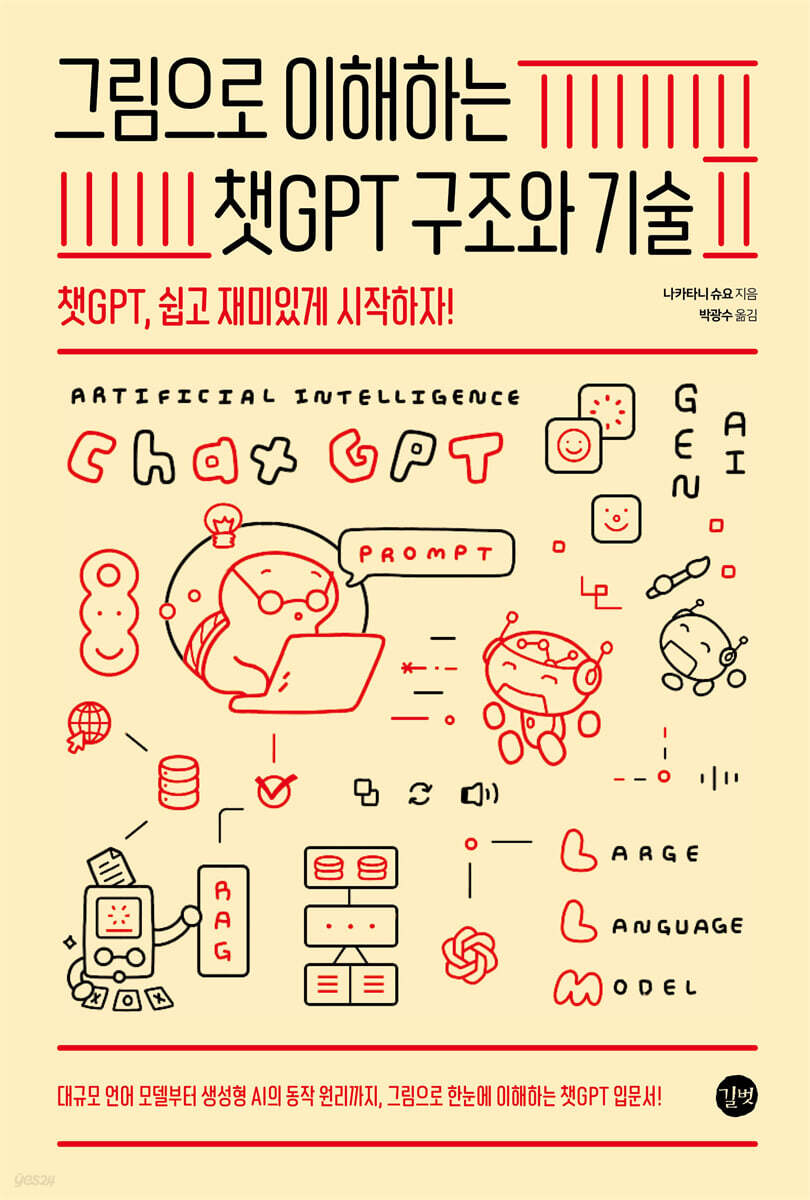 |
Description
Book Introduction
How does ChatGPT come up with answers?
Understanding the structure and principles of artificial intelligence through pictures!
It's hard to find someone who doesn't use generative AI, including ChatGPT, as it's become a natural part of our lives.
However, the pace of technological change is just as rapid, with new features and models constantly emerging.
If you have a deep understanding of the structure and principles, you can respond reliably and without panic even when new versions appear and usage methods change.
This book systematically explains the key technologies and principles that form the foundation of generative AI. It covers AI technology comprehensively, allowing readers to understand the mechanisms behind ChatGPT.
A major advantage is that it clearly presents complex concepts in 213 figures and 17 tables.
If you're using generative AI in your work or need to integrate it with other technologies, I highly recommend this book!
- You can preview some of the book's contents.
Preview
index
Chapter 1 Chat GPT
1.1 What is ChatGPT?
__1.1.1 Start ChatGPT
__1.1.2 ChatGPT Usage Cases
1.2 Convenient Chat GPT Features
__1.2.1 Editing and Manipulating Chat Responses
__1.2.2 Chat history and sharing
1.3 Prompt Engineering
__1.3.1 Prompts and Contexts
__1.3.2 Prompt Engineering
1.4 ChatGPT Engine (Large-Scale Language Model)
__1.4.1 GPT-4 and GPT-3.5
__1.4.2 Web search integration feature
__1.4.3 Multimodal feature (chat using images)
__1.4.4 Code Interpreter (automatic program execution)
1.5 GPTs (AI customization capabilities)
__1.5.1 GPTs
__1.5.2 GPT Builder
1.6 AI chat services other than ChatGPT
__1.6.1 Google Gemini
__1.6.2 Microsoft Copilot
__1.6.3 Antropic Cloud
1.7 Things to keep in mind when using AI chat
__1.7.1 Randomness exists
__1.7.2 Possible errors
__1.7.3 Prohibited Acts
__1.7.4 Handling input data
__1.7.5 Precautions when using GPTs
Chapter 2 Artificial Intelligence
2.1 AI (Artificial Intelligence)
__2.1.1 What is artificial intelligence?
2.2 History of AI
__2.2.1 History of AI Research
2.3 Generative AI and General Artificial Intelligence
__2.3.1 Generative AI
__2.3.2 General Artificial Intelligence (AGI)
Chapter 3 Machine Learning and Deep Learning
3.1 Machine Learning
__3.1.1 Machine learning ≠ Machines learning on their own
__3.1.2 Types of machine learning
__3.1.3 Inference and Learning
__3.1.4 Optimization
__3.1.5 Generalization and Overfitting
3.2 Neural Networks
__3.2.1 What is a neural network?
__3.2.2 Neural network structure
3.3 Training of Neural Networks
__3.3.1 Learning using gradient descent
__3.3.2 Error backpropagation
3.4 Normalization
__3.4.1 Dropout
__3.4.2 Batch Normalization
__3.4.3 Residual Neural Network
3.5 How to handle numbers on a computer
__3.5.1 Representing integers and decimals in binary
__3.5.2 Floating point numbers
__3.5.3 Representative formats of floating-point numbers
__3.5.4 Precision and dynamic range of floating-point numbers
3.6 Quantization
__3.6.1 Relationship between model size and GPU VRAM
__3.6.2 Quantization
3.7 Deep Learning with GPUs
__3.7.1 How to make calculations faster
__3.7.2 GPU vs CPU
__3.7.3 The Birth of GPUs and General-Purpose Computing
__3.7.4 GPU and NPU specialized for deep learning
__3.7.5 Software Support for GPU/NPU
Chapter 4 Natural Language Processing
4.1 Natural Language Processing
__4.1.1 Natural Language Processing Before Deep Learning
__4.1.2 Natural Language Processing and Deep Learning
4.2 Characters and Character Codes
__4.2.1 Character Code
__4.2.2 Unicode
4.3 Words and Tokens
__4.3.1 Splitting sentences into computer-processable parts
__4.3.2 Word and character-based segmentation
__4.3.3 Subword
4.4 Tokenizer
__4.4.1 Tokenizer Learning
__4.4.2 Trade-off between vocabulary size and token count
4.5 Word2Vec
__4.5.1 How to deal with 'concepts'
__4.5.2 Vector representation of words using Word2Vec
__4.5.3 How Word2Vec Understands Word Meaning
4.6 Embedding vector
__4.6.1 Token vectors do not represent 'meaning'
__4.6.2 Embedding vector
__4.6.3 Various embedding vectors
Chapter 5 Large-Scale Language Models
5.1 Language Model
__5.1.1 What is a model?
__5.1.2 What is a language model?
5.2 Large-scale language models
__5.2.1 Large-Scale Language Models and 'General Language Ability'
5.3 Versatility and underlying models of neural networks
__5.3.1 Feature extraction using neural networks
__5.3.2 based model
__5.3.3 How accuracy is improved with a model based on this
5.4 Scaling Laws and Emergence
__5.4.1 Scaling Laws and Emergence
__5.4.2 Number of parameters in large-scale language models
5.5 How language models generate text
__5.5.1 Text generation from language models
__5.5.2 Autoregressive language model
__5.5.3 Greed Law
5.6 Text Generation Strategies
__5.6.1 Random Sampling and Softmax Function
__5.6.2 The Role of 'Temperature'
__5.6.3 Tree diagram of word generation
__5.6.4 Beam Search
5.7 AI Chat Using Language Models
__5.7.1 AI Chat Using Sentence Generation
__5.7.2 Problems with AI Chat Using Large-Scale Language Models
5.8 Local LLM
__5.8.1 What is a local LLM?
__5.8.2 Local LLM Environment
__5.8.3 Inference process using local LLM
5.9 Licensing Large-Scale Language Models
__5.9.1 Local LLM Ecosystem
__5.9.2 Software License
__5.9.3 License Types for Large-Scale Language Models
5.10 Evaluation of Large-Scale Language Models
__5.10.1 Evaluation Methods for Large-Scale Language Models
__5.10.2 Leaderboard
5.11 Training Large-Scale Language Models: Pretraining
__5.11.1 Pre-training and base models
__5.11.2 Self-Directed Learning
__5.11.3 Additional Learning of the Base Model
__5.11.4 Training data for pre-learning
5.12 Training Large-Scale Language Models: Fine-Tuning
__5.12.1 Fine Tuning
__5.12.2 Fine Tuning Method
__5.12.3 RLHF
__5.12.4 LoRA
5.13 Learning in Context
__5.13.1 Learning in Context
Chapter 6 Transformers
6.1 Recurrent Neural Networks (RNNs)
__6.1.1 Dimension of a vector
__6.1.2 Recurrent Neural Networks
__6.1.3 RNN as a Language Model
__6.1.4 Long-distance dependencies and LSTMs
__6.1.5 Encoder-Decoder
6.2 Attention Mechanism
__6.2.1 Human Cognition and Attention Mechanisms
__6.2.2 Fundamentals of the Attention Mechanism
__6.2.3 Encoder-Decoder and Attention Mechanism
6.3 Calculation of the attention mechanism
__6.3.1 Calculating the attention mechanism
__6.3.2 Why the attention mechanism works well
6.4 Transformer
__6.4.1 Basic configuration of a transformer
__6.4.2 Positional Encoding
__6.4.3 Multihead attention mechanism
6.5 BERT
__6.5.1 BERT Features
__6.5.2 BERT Pre-training
6.6 GPT
__6.6.1 Basic Structure of the GPT Model
__6.6.2 Mixture of Experts
Chapter 7: AI Development Using APIs
7.1 Using the OpenAI API
__7.1.1 OpenAI API
__7.1.2 Precautions when using the OpenAI API
7.2 Text Generation API (Completion API, etc.)
__7.2.1 Types of text generation APIs
7.3 OpenAI API Fees
__7.3.1 Tokens for the OpenAI API
__7.3.2 Types and rates of text generation models
__7.3.3 OpenAI tokenizer library tiktoken
__7.3.4 Differences in the number of tokens by language
7.4 Parameters specified in the text generation API
__7.4.1 Parameters of the Text Generation API
7.5 Integrating the Text Generation API with External Tools: Function Calling
__7.5.1 Function Calling
__7.5.2 Langchain Library
__7.5.3 Function Calling as a Machine-Readable Tool
7.6 Embedding Vector Generation API and Specification Violation Checking API
__7.6.1 Embedding Vector Generation API
__7.6.2 Model types of the embedding vector generation API
__7.6.3 Terms Violation Check (Moderation) API
7.7 Large-scale language model API services other than OpenAI
__7.7.1 Microsoft Azure OpenAI API
__7.7.2 Google, Vertex AI
__7.7.3 Amazon, Bedrock
7.8 RAG
__7.8.1 Developing AI Applications Using External Knowledge
__7.8.2 RAG
Chapter 8: The Impact of Large-Scale Language Models
8.1 Risks and Security of Generative AI
__8.1.1 The negative impact of generative AI
__8.1.2 Exploitation of Generative AI
__8.1.3 The Risk of Generative AI Producing Inappropriate Output
__8.1.4 Service Attacks Using Generative AI
__8.1.5 Countermeasures and Guidelines
8.2 AI Bias and Alignment
__8.2.1 The Impact of Bias in Training Data on AI 3
__8.2.2 How to Control AI Bias
8.3 Hallucinations
__8.3.1 AI makes mistakes
__8.3.2 The identity of hallucination
__8.3.3 Countermeasures against hallucinations
__8.3.4 Can hallucinations be eliminated?
8.4 Democratization of AI
__8.4.1 Democratization of AI Utilization
__8.4.2 Democratizing AI Development
__8.4.3 Big Tech's Computing Resources
8.5 Multilingual Support for Large-Scale Language Models
__8.5.1 In how many languages is ChatGPT available?
__8.5.2 Language gaps in large-scale language models
__8.5.3 Large-Scale Language Models and Their Relationship to Cognition and Culture
8.6 AI and Philosophy
__8.6.1 What is intelligence and what is language?
__8.6.2 Chinese Room
Detailed image

Into the book
The strengths of the LLM shine even brighter in the field of coding.
Thanks to the GitHub Copiler I'm currently using, LLM's support has become so essential that it's hard to imagine my entire process, from ideation to code writing and final review, without it. LLM is no longer just a tool; it's a core engine that dramatically improves my work productivity.
This book delves deeply into ChatGPT and its underlying technologies at the heart of this innovation, offering readers incredible insights.
-Park Gwang-su
--- From the "Translator's Preface"
Publisher's Review
How does ChatGPT work?
ChatGPT's structure and principles are easy and quick to understand!
While most books utilize generative AI, there are limitations to its application and utilization without understanding the essence of the technology.
Usage methods change quickly and the tools themselves evolve rapidly.
However, if you deeply understand the structure and principles, you can respond reliably without being flustered even when new versions appear and usage methods change.
Therefore, if you want to better utilize AI and apply it to various fields, it is essential to understand the principles of AI.
This book covers the structure and principles of large-scale language models (LLMs), a core technology that enables ChatGPT's high versatility.
This systematically explains the key concepts and mechanisms that form the basis of generative AI, including neural networks, quantization-based models, transformers, scaling laws, RAGs, and fine-tuning.
We also examine a wide range of factors, from factors that enhance AI performance and accuracy to its applicability and future prospects.
This book is highly recommended for readers who are using generative AI in their work or need to integrate it with other technologies.
GOODS SPECIFICS
- Date of issue: November 5, 2025
- Page count, weight, size: 360 pages | 152*225*15mm
- ISBN13: 9791140716340
You may also like
카테고리
korean


korean


