

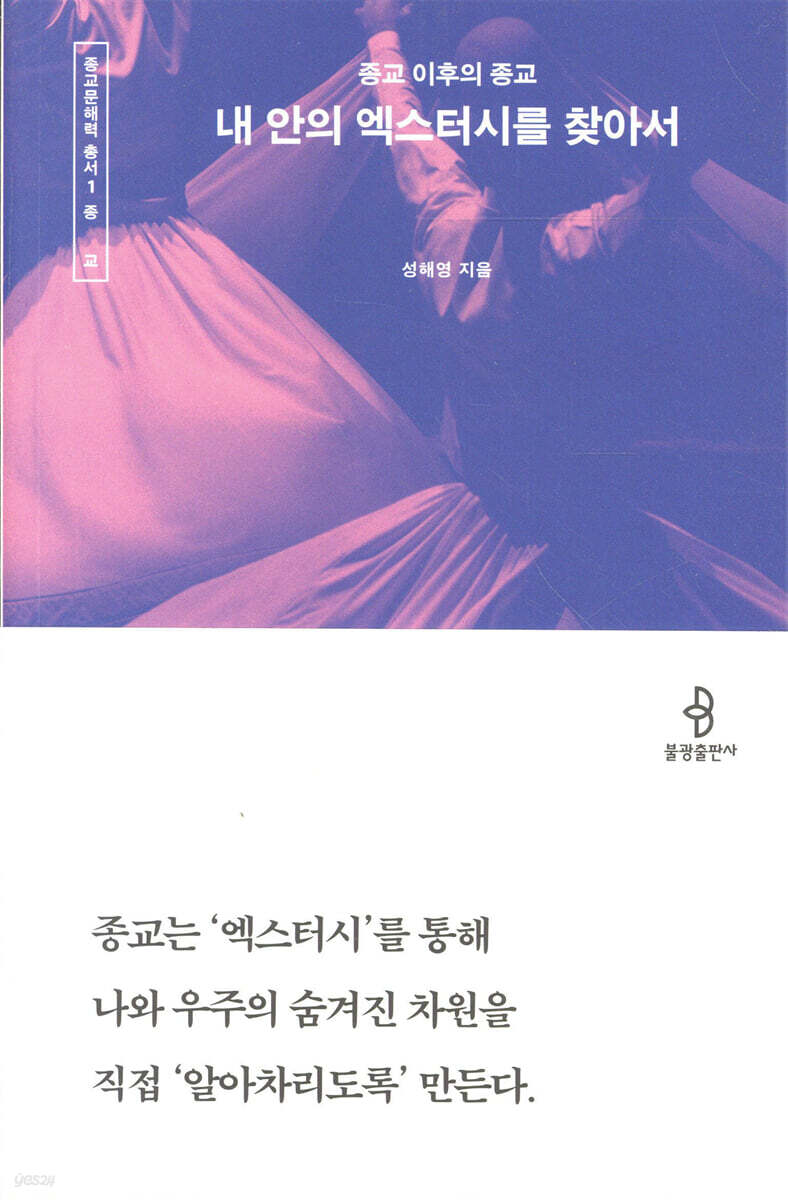
Finding the ecstasy within me
 |
Description
Book Introduction
The most beloved in the history of human intelligence Core messages of world religions! The first book in the Religious Literacy Series In Search of Ecstasy Within Me “The religion I knew until yesterday is dead!” From Plato's Eros to the 'Religion of No Religion' Exploring the Religious Journey of Ecstasy What is religion? Is it a business selling peace in the afterlife, like heaven or paradise? Or, as Marx put it, "Religion is the opium of the people," is it merely a temporary solace, not true happiness or liberation from suffering? If so, is religion an unnecessary phenomenon for us? This book offers the most appropriate answers to these questions. The author, a professor of religious studies at Seoul National University, approaches the definition of religion, worldview, various religious phenomena in modern society, three consolations of religion, and religion beyond religion through the lens of 'ecstasy' in his explanation of the past, present, and future of religion. In particular, the meaning and value of religion are explored in 'ecstasy', which is derived from the ancient Greek word (ekstasis) meaning 'standing (stasi) outside (eks)'. This is to delve into the religious world's claim that there is 'something' behind everyday life that we are still unaware of, using 'ecstasy', a core concept in the comparative study of religious psychology and mysticism. Through this, the author seeks answers to various questions, such as whether the experience of 'standing (stasi) outside (eks) myself' is actually possible, what would happen if I stood outside myself, and whether I could still be called 'me' if I left myself. This book opens our eyes to a different perspective on religion than we have known so far. The author rejects commonly associated religious search terms such as prayer, faith, offerings, and alms. Instead, we discover the meaning and value of religion through words that are rarely associated with religion. The paradox of exploring the allure of religion with new concepts and words such as Plato's philosophy of Eros and mysticism, ecstasy interpreted as ecstasy, religion of no religion, and SBNR (Spiritual But Not Religious) that pursues a spiritual life without believing in religion stimulates our intellectual desires. "Finding the Ecstasy Within Me" is the first book in the "Religious Literacy Series" that looks at religion from the perspective of "understanding" rather than "faith" and aims to increase religious sensitivity. As a must-read introductory book for those living in a society where numerous religions, including Buddhism, Christianity, Islam, and Won Buddhism, coexist, this book will serve as an excellent guide for those seeking the meaning of religion. |
- You can preview some of the book's contents.
Preview
index
Publisher's Note: Now is Religious Literacy
Introduction_Religion and Ecstasy
_Why religion 'now'?
Chapter 1: A Society Concerned About Religion
What is religion?
Worldview and Religion
The Role and Meaning of Religion
Chapter 2 Modern Society and Religion
Secularization and de-religionization
Criticism of various religions
The need for a sense of balance
Chapter 3: The Comfort and Ecstasy of Religion
The Three Comforts of Religion
What is the invisible dimension?
Ecstasy, the event that takes me away
Chapter 4: Finding the 'Transcendence' Within Me
Religion and Religious Experience
What is mysticism?
Secular mysticism
Chapter 5: Religion of No Religion
Religion beyond religion
Healing and healing for modern people
Are humans still religious?
Chapter 6: How to Believe in Religion?
Balance and Harmony: The Wisdom of Accounting and the Truth, Goodness, and Beauty
Change and Development: From Surface to Deep
Integration of Opposites and Acceptance of Paradox
Outgoing Writing_Dreaming of a Religion of Joy and Happiness
Introduction_Religion and Ecstasy
_Why religion 'now'?
Chapter 1: A Society Concerned About Religion
What is religion?
Worldview and Religion
The Role and Meaning of Religion
Chapter 2 Modern Society and Religion
Secularization and de-religionization
Criticism of various religions
The need for a sense of balance
Chapter 3: The Comfort and Ecstasy of Religion
The Three Comforts of Religion
What is the invisible dimension?
Ecstasy, the event that takes me away
Chapter 4: Finding the 'Transcendence' Within Me
Religion and Religious Experience
What is mysticism?
Secular mysticism
Chapter 5: Religion of No Religion
Religion beyond religion
Healing and healing for modern people
Are humans still religious?
Chapter 6: How to Believe in Religion?
Balance and Harmony: The Wisdom of Accounting and the Truth, Goodness, and Beauty
Change and Development: From Surface to Deep
Integration of Opposites and Acceptance of Paradox
Outgoing Writing_Dreaming of a Religion of Joy and Happiness
Detailed image

Into the book
In short, religion is 'an attempt to find answers to the ultimate questions of life that humans cannot help but ask in a relationship with an invisible dimension.'
--- p.45
Fish are born in water, live in it, and die in it, so they cannot sense the existence of water.
Before you come out of the water, you can't even feel that you've 'lived underwater'.
To perceive water, one must 'come out of it (eks) and stand (stasi)'.
That is, ecstasy is needed.
--- p.48
The fundamental principle of meditation is to focus your consciousness, stop all thought processes, and move into the state of "watching consciousness" itself.
In times like these, aspects of existence that were previously unknown in everyday life are revealed and recognized.
So meditation is directly connected to ecstasy, which means 'standing outside of myself'.
--- p.59~60
Economic prosperity, increased political rights, and rising educational standards grant members of a community the freedom to choose their religion, even the right to not practice it.
As a result, the critical view of religion has become stronger than ever.
Religion not only lost its former superior status, but for the first time it was charged with actively promoting its own meaning and value.
--- p.73
If Jesus and Buddha had not lived their sublime teachings, there would be no Christianity and Buddhism as we know them.
So, the ultimate criterion for judging a religion should not be its ideal teachings, but rather how much each individual puts them into practice in their lives.
--- p.99
Religion has a real and individual impact on the lives of those who embrace it, and in this process, it can work both positively and negatively.
It is what makes our lives happy or unhappy.
Ultimately, the standard for determining whether a religion is true is not the religion's ideal teachings, but the individual who interprets and practices them.
Especially the practical consequences it has on individual lives.
--- p.103
Plato's Eros is the fundamental force that leads to sexual union and union with the ultimate being.
So Eros is religious, or more precisely, mystical.
So, it is difficult to view Plato as a philosopher who simply emphasized cool reason.
His philosophy is full of colorful elements such as ‘the reception of Eros’, ‘divine madness’, ‘the vision of beauty itself’, and ‘ecstasy’.
--- p.146
They try to implement their religiosity directly outside the confines of religion.
The expression 'believing without belonging' succinctly summarizes this characteristic.
In our case, we call those who do not go to church, but consider themselves Christians, ‘Canaan’ believers.
It is a clever reversal of the expression 'not going out', and it is a phenomenon that can be understood in the same context.
--- p.192
Spirituality, while not confined to institutional religion, has come to mean an attitude of acceptance that one is part of something greater than the material realm.
It also encompasses the individual's desire and effort to restore the relationship with it.
It is similar to existing religions in that it acknowledges something beyond the phenomenal world, but it differs significantly in that it does not belong to a specific religion.
The expression 'spiritual but not religious (SBNR)' also means embracing a religious or metaphysical worldview, but staying outside the confines of institutional religion.
--- p.193
Meditation is an opportunity to recognize our greater identity by intuiting the unmanifested dimensions of ourselves and our entire being.
The same goes for various spiritual pursuits that seek to restore connection with something greater and confirm wholeness.
All of these movements are an individual's attempt to find a greater self-identity.
--- p.212
On a metaphorical level, modern society is also experiencing ‘collective ecstasy’.
Because all sectors of society are experiencing fundamental changes and expansions in their identities.
The paradigms of all areas, such as marriage, family, career, politics, and economics, are shaken to their core.
Religion is no exception.
Religion and religious worldview, religion and mysticism, religiosity and spirituality have become separated.
--- p.214
How can we discover our religious identity? Above all, I believe we must pay greater attention to recent changes themselves.
Because the signs and characteristics of newness are already included there.
For example, the distinct characteristic of restoring a relationship with a larger dimension outside of religion.
It is especially important what this flow aims to achieve.
The goal is none other than the happiness of life.
--- p.217
All religions constantly assert that there is still something we do not know.
When I recognize my ignorance and open myself to the possibility of knowing, the unknown dimension is revealed.
That's when I finally experience the ecstasy of standing outside of myself.
For this case, we must allow the unknown to be revealed.
Ecstasy also reveals to us an expanded identity we never knew existed, as well as the wonders that come with it.
--- p.262
If religion is to remain with us, the religions of the past must die.
Paradoxical expressions such as 'the religion of no religion' and 'the religion that goes beyond religion' imply that a new religion is born in the very place where the old religion died, just like the 'phoenix'.
As death is expressed, a thorough escape from the past is necessary.
Just as a caterpillar can become a beautiful butterfly only after it sheds its cocoon.
--- p.45
Fish are born in water, live in it, and die in it, so they cannot sense the existence of water.
Before you come out of the water, you can't even feel that you've 'lived underwater'.
To perceive water, one must 'come out of it (eks) and stand (stasi)'.
That is, ecstasy is needed.
--- p.48
The fundamental principle of meditation is to focus your consciousness, stop all thought processes, and move into the state of "watching consciousness" itself.
In times like these, aspects of existence that were previously unknown in everyday life are revealed and recognized.
So meditation is directly connected to ecstasy, which means 'standing outside of myself'.
--- p.59~60
Economic prosperity, increased political rights, and rising educational standards grant members of a community the freedom to choose their religion, even the right to not practice it.
As a result, the critical view of religion has become stronger than ever.
Religion not only lost its former superior status, but for the first time it was charged with actively promoting its own meaning and value.
--- p.73
If Jesus and Buddha had not lived their sublime teachings, there would be no Christianity and Buddhism as we know them.
So, the ultimate criterion for judging a religion should not be its ideal teachings, but rather how much each individual puts them into practice in their lives.
--- p.99
Religion has a real and individual impact on the lives of those who embrace it, and in this process, it can work both positively and negatively.
It is what makes our lives happy or unhappy.
Ultimately, the standard for determining whether a religion is true is not the religion's ideal teachings, but the individual who interprets and practices them.
Especially the practical consequences it has on individual lives.
--- p.103
Plato's Eros is the fundamental force that leads to sexual union and union with the ultimate being.
So Eros is religious, or more precisely, mystical.
So, it is difficult to view Plato as a philosopher who simply emphasized cool reason.
His philosophy is full of colorful elements such as ‘the reception of Eros’, ‘divine madness’, ‘the vision of beauty itself’, and ‘ecstasy’.
--- p.146
They try to implement their religiosity directly outside the confines of religion.
The expression 'believing without belonging' succinctly summarizes this characteristic.
In our case, we call those who do not go to church, but consider themselves Christians, ‘Canaan’ believers.
It is a clever reversal of the expression 'not going out', and it is a phenomenon that can be understood in the same context.
--- p.192
Spirituality, while not confined to institutional religion, has come to mean an attitude of acceptance that one is part of something greater than the material realm.
It also encompasses the individual's desire and effort to restore the relationship with it.
It is similar to existing religions in that it acknowledges something beyond the phenomenal world, but it differs significantly in that it does not belong to a specific religion.
The expression 'spiritual but not religious (SBNR)' also means embracing a religious or metaphysical worldview, but staying outside the confines of institutional religion.
--- p.193
Meditation is an opportunity to recognize our greater identity by intuiting the unmanifested dimensions of ourselves and our entire being.
The same goes for various spiritual pursuits that seek to restore connection with something greater and confirm wholeness.
All of these movements are an individual's attempt to find a greater self-identity.
--- p.212
On a metaphorical level, modern society is also experiencing ‘collective ecstasy’.
Because all sectors of society are experiencing fundamental changes and expansions in their identities.
The paradigms of all areas, such as marriage, family, career, politics, and economics, are shaken to their core.
Religion is no exception.
Religion and religious worldview, religion and mysticism, religiosity and spirituality have become separated.
--- p.214
How can we discover our religious identity? Above all, I believe we must pay greater attention to recent changes themselves.
Because the signs and characteristics of newness are already included there.
For example, the distinct characteristic of restoring a relationship with a larger dimension outside of religion.
It is especially important what this flow aims to achieve.
The goal is none other than the happiness of life.
--- p.217
All religions constantly assert that there is still something we do not know.
When I recognize my ignorance and open myself to the possibility of knowing, the unknown dimension is revealed.
That's when I finally experience the ecstasy of standing outside of myself.
For this case, we must allow the unknown to be revealed.
Ecstasy also reveals to us an expanded identity we never knew existed, as well as the wonders that come with it.
--- p.262
If religion is to remain with us, the religions of the past must die.
Paradoxical expressions such as 'the religion of no religion' and 'the religion that goes beyond religion' imply that a new religion is born in the very place where the old religion died, just like the 'phoenix'.
As death is expressed, a thorough escape from the past is necessary.
Just as a caterpillar can become a beautiful butterfly only after it sheds its cocoon.
--- p.263
Publisher's Review
◆ A perspective that empathizes with others: 'Religious Literacy Series' ◆
Literacy, which is used in many areas of society, is the ability to understand and utilize the meaning of words beyond the ability to know them.
Religious literacy is the ability to reinterpret and communicate religion from the perspective of "rational understanding" rather than "blind faith." The power of critical reflection and exploration in religious literacy provides a direction for choosing the right religion and practicing righteous faith.
Especially for us who live in a multi-religious and multi-cultural society, it is a force that increases ‘religious sensitivity’ to understand other religions and worldviews.
The 'Religious Literacy Series', published by Mind Lab with support from the Plato Academy Foundation, is an introductory series that fosters religious sensitivity through religious literacy.
In five books, including 『In Search of Ecstasy Within Me』(Religion), 『The Sufferings and Enlightenment of Life』(Buddhism), 『Who Is Jesus to Us Now?』(Christianity), 『An Apology for Islam』(Islam), and 『The Path to Mental Enlightenment Revealed by Sotaesan』(Won Buddhism), the core messages of the world's religions, which have been loved for the longest time in human intellectual history, are approached from a humanities perspective.
The 'Religious Literacy Series' focuses on the lives of the founders of each religion, including Buddha, Jesus, Muhammad, and Sotaesan, and provides a fresh interpretation of the fundamental questions of life they pondered and the answers to them.
And for us living in an era of post-religionism, climate change, pandemics, and the AI revolution, it shows us the meaning and value of religion, and the direction of a perspective that empathizes with differences.
I don't believe in religion,
Why do humans who have been to the moon still believe in religion?
"Finding the Ecstasy Within Me" is the first book in the "Religious Literacy Series," which aims to cultivate religious sensitivity by looking at religion from the perspective of "understanding" rather than "faith."
With AI emerging that can answer any question and humanity having already walked the moon, why do we still believe in religion? Is religion truly a phenomenon unrelated to our lives? Is religion still necessary in this day and age? Readers who have ever asked themselves these questions will find the wisest answers in this book.
ecstasy,
Revealing a dimension you never knew existed!
Religious studies is an academic discipline that compares and studies religious phenomena from a critical perspective.
Trying to better understand human existence and culture.
It studies why people believe in religion, what religion is, what elements it consists of, and what parts religions have in common and what parts are different from each other.
So, religious studies discovers the diverse and different faces of religion from the perspective of ‘understanding’ rather than ‘belief.’
Professor Seong Hae-young of Seoul National University's Department of Religious Studies, author of "In Search of Ecstasy Within Me," defines religion as "an attempt to find answers to the ultimate questions of life that humans cannot help but ask, in a relationship with an invisible dimension."
In order to approach the meaning and value of religion, I recommend taking a step back from familiarity.
We should ask ourselves, "Is that all there is to the worldview and values we've built throughout our lives?" and question the religious community's assertion that "there is something beyond the everyday, and that this unseen dimension is more important than the present."
The key word the author uses to verify the claims of the religious world is ecstasy, which is translated as ecstasy.
“Religion allows us to ‘see’ through ecstasy hidden dimensions of existence that we were unaware of.
Seeing broadens my perception of myself and the world.
Events that confirm my greater identity give me a sense of freedom and liberation.
Also, as it is translated as ‘ecstasy,’ ecstasy also tells us about the ultimate joy that resides within.” The author believes that ecstasy may be an opportunity to confirm the religious world’s claim that ‘there is an invisible dimension.’
Ecstasy creates a rift in the familiar world of everyday life and reveals a dimension we never knew existed.
It is said that it also changes the perception of oneself and the entire existence, allowing one to recognize new aspects and expand one's worldview.
“The worldview is like a ‘colored contact lens’ that is attached to the eyes from birth, making it difficult to recognize its existence.
It's a lens that you can't tell until you take it off because it was there from the beginning.
Fish are born in water, live in it, and die in it, so they cannot sense the existence of water.
Before you come out of the water, you can't even feel that you've 'lived underwater'.
To perceive water, one must 'come out of it (eks) and stand (stasi)'.
That is, ecstasy is needed.”
Why religion now?
Find happiness through a deep understanding of religion and humanity!
The emergence of 'rational reason' eliminated the place for religion.
This is because reason has taken the place of religion in many areas such as politics, education, economics, and science, which religion had been in charge of for a very long time.
Moreover, as individuals who have emerged as the main characters of their lives are granted the freedom and right to choose religion, religion is often viewed as only a temporary comfort.
Does religion have a role today? If so, what is it?
The author cautiously speculates on the role of religion in the expressions 'spiritual but not religious (SBNR)' and 'spirituality', which cross religious boundaries.
There are many people who seek meaning in life through experiences such as temple stays, pilgrimages to Santiago, and meditation classes at universities, regardless of religion.
The author sees these phenomena as attempts to fulfill something religious outside of traditional religion, although some interpret them as efforts at healing and remediation.
What is certain is that modern people, regardless of their religious background or beliefs, are actively seeking healing of mind and body and personal happiness by utilizing religious spaces and religious practices.
“There has recently been a tendency for the concepts of ‘mind,’ ‘religious experience,’ ‘mysticism,’ and ‘psychology’ to converge into the phenomenon of secular mysticism.
In this process, secular mysticism also encounters paradoxical expressions such as “the religion of non-religion” and “spiritual but not religious.”
In this way, the phenomenon of an individual's (religious) experience intersecting with psychology through the 'human mind' leads to attempts to pursue 'healing' and 'cure'.
“It is because we make personal happiness the ultimate goal of our encounters.” The author subtly suggests that religion is not a temporary comfort, but the oldest and most proven shortcut to finding human happiness.
If you need a deeper understanding of religion and humanity and want to open the door to happiness, 『Finding Ecstasy Within Me』 will be the key.
Literacy, which is used in many areas of society, is the ability to understand and utilize the meaning of words beyond the ability to know them.
Religious literacy is the ability to reinterpret and communicate religion from the perspective of "rational understanding" rather than "blind faith." The power of critical reflection and exploration in religious literacy provides a direction for choosing the right religion and practicing righteous faith.
Especially for us who live in a multi-religious and multi-cultural society, it is a force that increases ‘religious sensitivity’ to understand other religions and worldviews.
The 'Religious Literacy Series', published by Mind Lab with support from the Plato Academy Foundation, is an introductory series that fosters religious sensitivity through religious literacy.
In five books, including 『In Search of Ecstasy Within Me』(Religion), 『The Sufferings and Enlightenment of Life』(Buddhism), 『Who Is Jesus to Us Now?』(Christianity), 『An Apology for Islam』(Islam), and 『The Path to Mental Enlightenment Revealed by Sotaesan』(Won Buddhism), the core messages of the world's religions, which have been loved for the longest time in human intellectual history, are approached from a humanities perspective.
The 'Religious Literacy Series' focuses on the lives of the founders of each religion, including Buddha, Jesus, Muhammad, and Sotaesan, and provides a fresh interpretation of the fundamental questions of life they pondered and the answers to them.
And for us living in an era of post-religionism, climate change, pandemics, and the AI revolution, it shows us the meaning and value of religion, and the direction of a perspective that empathizes with differences.
I don't believe in religion,
Why do humans who have been to the moon still believe in religion?
"Finding the Ecstasy Within Me" is the first book in the "Religious Literacy Series," which aims to cultivate religious sensitivity by looking at religion from the perspective of "understanding" rather than "faith."
With AI emerging that can answer any question and humanity having already walked the moon, why do we still believe in religion? Is religion truly a phenomenon unrelated to our lives? Is religion still necessary in this day and age? Readers who have ever asked themselves these questions will find the wisest answers in this book.
ecstasy,
Revealing a dimension you never knew existed!
Religious studies is an academic discipline that compares and studies religious phenomena from a critical perspective.
Trying to better understand human existence and culture.
It studies why people believe in religion, what religion is, what elements it consists of, and what parts religions have in common and what parts are different from each other.
So, religious studies discovers the diverse and different faces of religion from the perspective of ‘understanding’ rather than ‘belief.’
Professor Seong Hae-young of Seoul National University's Department of Religious Studies, author of "In Search of Ecstasy Within Me," defines religion as "an attempt to find answers to the ultimate questions of life that humans cannot help but ask, in a relationship with an invisible dimension."
In order to approach the meaning and value of religion, I recommend taking a step back from familiarity.
We should ask ourselves, "Is that all there is to the worldview and values we've built throughout our lives?" and question the religious community's assertion that "there is something beyond the everyday, and that this unseen dimension is more important than the present."
The key word the author uses to verify the claims of the religious world is ecstasy, which is translated as ecstasy.
“Religion allows us to ‘see’ through ecstasy hidden dimensions of existence that we were unaware of.
Seeing broadens my perception of myself and the world.
Events that confirm my greater identity give me a sense of freedom and liberation.
Also, as it is translated as ‘ecstasy,’ ecstasy also tells us about the ultimate joy that resides within.” The author believes that ecstasy may be an opportunity to confirm the religious world’s claim that ‘there is an invisible dimension.’
Ecstasy creates a rift in the familiar world of everyday life and reveals a dimension we never knew existed.
It is said that it also changes the perception of oneself and the entire existence, allowing one to recognize new aspects and expand one's worldview.
“The worldview is like a ‘colored contact lens’ that is attached to the eyes from birth, making it difficult to recognize its existence.
It's a lens that you can't tell until you take it off because it was there from the beginning.
Fish are born in water, live in it, and die in it, so they cannot sense the existence of water.
Before you come out of the water, you can't even feel that you've 'lived underwater'.
To perceive water, one must 'come out of it (eks) and stand (stasi)'.
That is, ecstasy is needed.”
Why religion now?
Find happiness through a deep understanding of religion and humanity!
The emergence of 'rational reason' eliminated the place for religion.
This is because reason has taken the place of religion in many areas such as politics, education, economics, and science, which religion had been in charge of for a very long time.
Moreover, as individuals who have emerged as the main characters of their lives are granted the freedom and right to choose religion, religion is often viewed as only a temporary comfort.
Does religion have a role today? If so, what is it?
The author cautiously speculates on the role of religion in the expressions 'spiritual but not religious (SBNR)' and 'spirituality', which cross religious boundaries.
There are many people who seek meaning in life through experiences such as temple stays, pilgrimages to Santiago, and meditation classes at universities, regardless of religion.
The author sees these phenomena as attempts to fulfill something religious outside of traditional religion, although some interpret them as efforts at healing and remediation.
What is certain is that modern people, regardless of their religious background or beliefs, are actively seeking healing of mind and body and personal happiness by utilizing religious spaces and religious practices.
“There has recently been a tendency for the concepts of ‘mind,’ ‘religious experience,’ ‘mysticism,’ and ‘psychology’ to converge into the phenomenon of secular mysticism.
In this process, secular mysticism also encounters paradoxical expressions such as “the religion of non-religion” and “spiritual but not religious.”
In this way, the phenomenon of an individual's (religious) experience intersecting with psychology through the 'human mind' leads to attempts to pursue 'healing' and 'cure'.
“It is because we make personal happiness the ultimate goal of our encounters.” The author subtly suggests that religion is not a temporary comfort, but the oldest and most proven shortcut to finding human happiness.
If you need a deeper understanding of religion and humanity and want to open the door to happiness, 『Finding Ecstasy Within Me』 will be the key.
GOODS SPECIFICS
- Date of issue: March 8, 2024
- Page count, weight, size: 272 pages | 328g | 130*200*20mm
- ISBN13: 9791193454589
- ISBN10: 1193454581
You may also like
카테고리
korean


korean

![GQ KOREA Mark (Monthly): December [2025]](http://librairie.coreenne.fr/cdn/shop/files/8ef265dbbfbf186523ed75ba7319009d.jpg?v=1765340328&width=3840)


