

Apostle Paul
 |
Description
Book Introduction
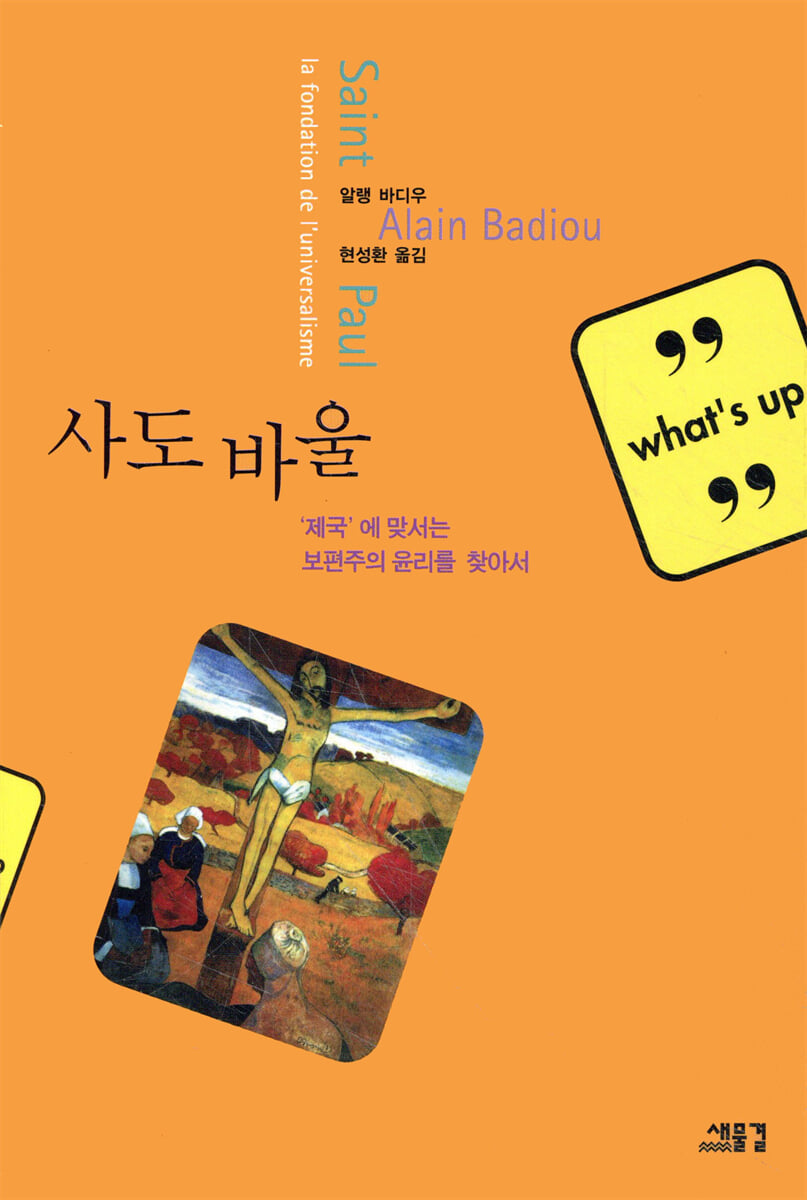
『The Apostle Paul』 is a book written by Alain Badiou, a professor of philosophy at the University of Paris 8, in which he looks back on Paul, who was a thinker, poet, and fighter.
The author is not fundamentally interested in linking Paul to religion.
He shows how Paul's general conception of rupture and subversion and the notion of thought=practice as the subjective materiality of such rupture are fully humanly combined.
He portrays this combined uniqueness of Paul as a new fighter who will follow in the footsteps of the fighter established by Lenin and the Bolsheviks in the early 20th century.
The author is not fundamentally interested in linking Paul to religion.
He shows how Paul's general conception of rupture and subversion and the notion of thought=practice as the subjective materiality of such rupture are fully humanly combined.
He portrays this combined uniqueness of Paul as a new fighter who will follow in the footsteps of the fighter established by Lenin and the Bolsheviks in the early 20th century.
- You can preview some of the book's contents.
Preview
index
Publishing the What's up series
introduction
1 Paul, our contemporary
2 Who is Paul?
3 Texts and Contexts
4 Theory of Discourses
Division of the five subjects
6 The Dialectics of Death and Resurrection
7 Paul Against the Law
8 Love as a Universal Power
9 Hope
10 Universality and the Crossing of Differences
11 In conclusion
introduction
1 Paul, our contemporary
2 Who is Paul?
3 Texts and Contexts
4 Theory of Discourses
Division of the five subjects
6 The Dialectics of Death and Resurrection
7 Paul Against the Law
8 Love as a Universal Power
9 Hope
10 Universality and the Crossing of Differences
11 In conclusion
Publisher's Review
Religious conflicts are met with 'terrorism' and 'war'
In a post-modern world where truth has lost its universality and everything has become relative, Alain Badiou, a philosopher of anti-philosophy who represents the Western left-wing intellect, sets out to find faith, hope, and love for our time through Paul, the apostle of Jesus.
? Such a strange encounter: a representative of anti-philosophy based on Lacan and Maoism, meeting the apostle Paul of Christ in an age of pessimism and despair after postmodernism.
Postmodern deconstructive philosophy seemed to promise us a brave new world until the 9/11 attacks.
However, the post-postmodern real world has quickly become a dystopia where jihad and the war on terrorism are fought on a global scale, and extreme relativism about the universality of truth runs rampant.
Religion has ceased to be a religion of love, and politics has become based on fear and surveillance, as symbolized by fingerprint searches at airports and surveillance cameras placed everywhere on the streets.
In these times, the philosophy that must contemplate this reality has ended up committing suicide through postmodernism, symbolized by the “end of the subject” and the “death of the grand narrative.”
In our age, where anti-philosophy and pessimism are rampant, Alain Badiou, a philosopher of the 'event' who has consistently argued that truth is only systematic by confronting the new subject, 'deconstructionism', along with anti-philosophy from early on, meets Paul in this book, and the way he does so is as ingenious as it is full of analogies to our times.
The Roman Empire is analogous to today's United States.
And Christianity, which was to swallow up the Roman Empire with its 'spirit' (Hegel once called it the greatest mystery in world history), was sprouting its first faith on the outskirts of the empire, but it was unable to overcome the wall of the Twelve Apostles who were trying to base themselves on the Jewish community.
And on this earth, the Greek 'philosophers' believed that they could survive in this world with philosophical wisdom, but it was only 'wisdom' for philosophy that was completely confined to the Greek world.
At this time, Saul, who was out to persecute Christians, met Jesus on his way to Damascus and became Paul.
In this way, Badiou summons the Apostle Paul, a figure from 2,000 years ago, to our time.
The resurrected apostle Paul,
Reject all particularism and pseudo-universality and fight for true universality.
So why the Apostle Paul? As Pier Paolo Pasolini's posthumous screenplay, presented in Chapter 3 of this book, demonstrates, in a sense, Paul is so closely contemporary with us. Furthermore, his very purpose was to break away from particularism and abstract universality (whether legal or economic), and explore the conditions of universal individuality.
In short, Paul resolutely rejected national generality, such as the Roman Empire's legal system, ideological generality, such as Greek philosophical and spiritual discourse, and communitarianism and particularism, represented by Jewish legalism, and pursued universal individuality.
As we see in the passage “there is neither Jew nor Greek, there is neither slave nor free, there is neither male nor female” (Galatians 3:28), for Paul (and for Badiou) truth is something that is “offered and spoken to all,” and “no conditions of attribution can limit this offering and speaking.”
In this sense, for Alain Badiou, the Apostle Paul is not a figure confined to the religion called Christianity.
In other words, Badiou does not read Paul from the level of religion.
For him, Paul is “an anti-philosophical theorist of universality,” an activist, fighter, and organizer who fights for the realization of universalism (Badiou compares Paul “to Lenin, who made the ambiguous Marx Christ”).
For example, the conflict that Paul had with the "historical" apostles (who had personally accompanied Christ) in Jerusalem over the issue of ritual (whether Jewish rituals such as circumcision should be performed on Gentiles who had become Christians) while traveling around and building a religious organization that included both Jews and Gentiles was, in Badiou's view, a struggle between Paul's universalism and the particularism (Jewish communitarianism) of the historical apostles.
Under this premise, Alain Badiou reinterprets the thoughts of the Apostle Paul and the biblical passages attributed to him from his own unique perspective.
First, he points out that Paul barely mentions anything about the actions or teachings of Jesus that are mentioned in the Gospels, and argues that the only thing that matters to Paul is that 'Christ was crucified, died, and rose again.'
But here death and resurrection are interpreted as not being biological events at all.
“For to be carnally minded is death.
As can be seen from the passage, “The mind set on the Spirit is life” (Romans 8:6), the death that Paul speaks of is one thought and one of the two paths of a divided subject.
Therefore, death is not a fate but a choice, and there is no 'being-toward-death', but only the path to death (which enters into the divisive constitution of every subject).
In this context, resurrection also becomes a victory over death, a “killing of death,” and the event of the “resurrection of Christ” universally presents the possibility of that victory.
In this way, concepts such as sin, the law, and Jesus Christ as the 'Son' are elaborately reinterpreted, and three very famous words - faith, hope, and love - are renamed and given new meaning as assurance, certainty, and love (as a universal force).
Through this, readers encounter a new face of Paul, a Paul who speaks to our society, who sheds tears, threatens, forgives, attacks, and gently embraces us all (whether believers or not) and for all of us.
In the ‘one’ truth (and monotheism), ‘one’ means ‘no exceptions’ and ‘for all’.
And through these encounters, we gain a clue to how to navigate this era, where the search for universal truth is abandoned in the name of tolerance for differences, and only the abstract universality of capital dominates the world.
In a post-modern world where truth has lost its universality and everything has become relative, Alain Badiou, a philosopher of anti-philosophy who represents the Western left-wing intellect, sets out to find faith, hope, and love for our time through Paul, the apostle of Jesus.
? Such a strange encounter: a representative of anti-philosophy based on Lacan and Maoism, meeting the apostle Paul of Christ in an age of pessimism and despair after postmodernism.
Postmodern deconstructive philosophy seemed to promise us a brave new world until the 9/11 attacks.
However, the post-postmodern real world has quickly become a dystopia where jihad and the war on terrorism are fought on a global scale, and extreme relativism about the universality of truth runs rampant.
Religion has ceased to be a religion of love, and politics has become based on fear and surveillance, as symbolized by fingerprint searches at airports and surveillance cameras placed everywhere on the streets.
In these times, the philosophy that must contemplate this reality has ended up committing suicide through postmodernism, symbolized by the “end of the subject” and the “death of the grand narrative.”
In our age, where anti-philosophy and pessimism are rampant, Alain Badiou, a philosopher of the 'event' who has consistently argued that truth is only systematic by confronting the new subject, 'deconstructionism', along with anti-philosophy from early on, meets Paul in this book, and the way he does so is as ingenious as it is full of analogies to our times.
The Roman Empire is analogous to today's United States.
And Christianity, which was to swallow up the Roman Empire with its 'spirit' (Hegel once called it the greatest mystery in world history), was sprouting its first faith on the outskirts of the empire, but it was unable to overcome the wall of the Twelve Apostles who were trying to base themselves on the Jewish community.
And on this earth, the Greek 'philosophers' believed that they could survive in this world with philosophical wisdom, but it was only 'wisdom' for philosophy that was completely confined to the Greek world.
At this time, Saul, who was out to persecute Christians, met Jesus on his way to Damascus and became Paul.
In this way, Badiou summons the Apostle Paul, a figure from 2,000 years ago, to our time.
The resurrected apostle Paul,
Reject all particularism and pseudo-universality and fight for true universality.
So why the Apostle Paul? As Pier Paolo Pasolini's posthumous screenplay, presented in Chapter 3 of this book, demonstrates, in a sense, Paul is so closely contemporary with us. Furthermore, his very purpose was to break away from particularism and abstract universality (whether legal or economic), and explore the conditions of universal individuality.
In short, Paul resolutely rejected national generality, such as the Roman Empire's legal system, ideological generality, such as Greek philosophical and spiritual discourse, and communitarianism and particularism, represented by Jewish legalism, and pursued universal individuality.
As we see in the passage “there is neither Jew nor Greek, there is neither slave nor free, there is neither male nor female” (Galatians 3:28), for Paul (and for Badiou) truth is something that is “offered and spoken to all,” and “no conditions of attribution can limit this offering and speaking.”
In this sense, for Alain Badiou, the Apostle Paul is not a figure confined to the religion called Christianity.
In other words, Badiou does not read Paul from the level of religion.
For him, Paul is “an anti-philosophical theorist of universality,” an activist, fighter, and organizer who fights for the realization of universalism (Badiou compares Paul “to Lenin, who made the ambiguous Marx Christ”).
For example, the conflict that Paul had with the "historical" apostles (who had personally accompanied Christ) in Jerusalem over the issue of ritual (whether Jewish rituals such as circumcision should be performed on Gentiles who had become Christians) while traveling around and building a religious organization that included both Jews and Gentiles was, in Badiou's view, a struggle between Paul's universalism and the particularism (Jewish communitarianism) of the historical apostles.
Under this premise, Alain Badiou reinterprets the thoughts of the Apostle Paul and the biblical passages attributed to him from his own unique perspective.
First, he points out that Paul barely mentions anything about the actions or teachings of Jesus that are mentioned in the Gospels, and argues that the only thing that matters to Paul is that 'Christ was crucified, died, and rose again.'
But here death and resurrection are interpreted as not being biological events at all.
“For to be carnally minded is death.
As can be seen from the passage, “The mind set on the Spirit is life” (Romans 8:6), the death that Paul speaks of is one thought and one of the two paths of a divided subject.
Therefore, death is not a fate but a choice, and there is no 'being-toward-death', but only the path to death (which enters into the divisive constitution of every subject).
In this context, resurrection also becomes a victory over death, a “killing of death,” and the event of the “resurrection of Christ” universally presents the possibility of that victory.
In this way, concepts such as sin, the law, and Jesus Christ as the 'Son' are elaborately reinterpreted, and three very famous words - faith, hope, and love - are renamed and given new meaning as assurance, certainty, and love (as a universal force).
Through this, readers encounter a new face of Paul, a Paul who speaks to our society, who sheds tears, threatens, forgives, attacks, and gently embraces us all (whether believers or not) and for all of us.
In the ‘one’ truth (and monotheism), ‘one’ means ‘no exceptions’ and ‘for all’.
And through these encounters, we gain a clue to how to navigate this era, where the search for universal truth is abandoned in the name of tolerance for differences, and only the abstract universality of capital dominates the world.
GOODS SPECIFICS
- Date of issue: January 21, 2008
- Format: Hardcover book binding method guide
- Page count, weight, size: 214 pages | 320g | 130*195*20mm
- ISBN13: 9788955592306
- ISBN10: 8955592302
You may also like
카테고리
korean


korean

![GQ KOREA Mark (Monthly): December [2025]](http://librairie.coreenne.fr/cdn/shop/files/8ef265dbbfbf186523ed75ba7319009d.jpg?v=1765340328&width=3840)


