

The Bible and Poverty
 |
Description
Book Introduction
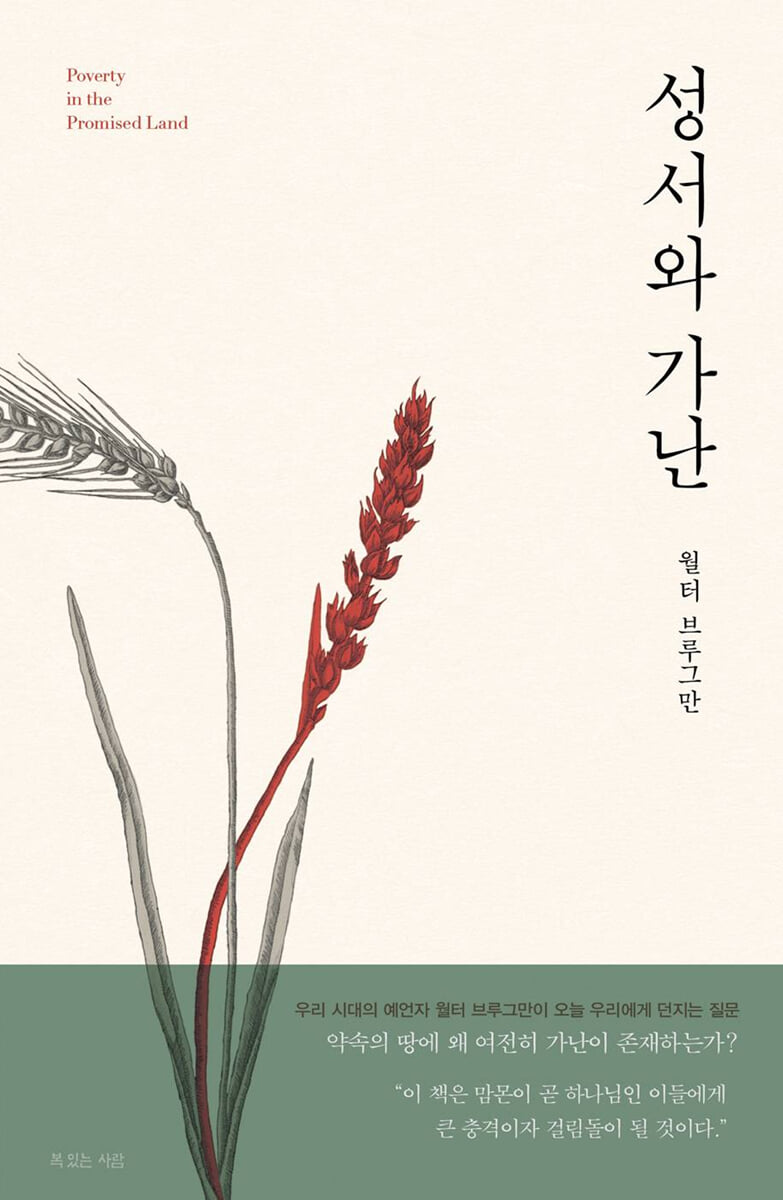
Walter Brueggemann, a prophet of our time, asks us today: Why does poverty still exist in the Promised Land?
“This book will be a great shock and stumbling block to those for whom Mammon is God.”
Poverty is often attributed to individual incompetence or laziness.
However, author Walter Brueggemann says poverty is a product of an unjust economic structure created by humans.
Throughout his lifelong theological journey, he has confronted distorted views of poverty and the structural injustices that underlie them.
The fruit of that intense thinking and practice is this book, “The Bible and Poverty.”
In this book, Brueggemann responds as a biblical scholar to Pulitzer Prize-winning sociologist Matthew Desmond's landmark work, The American Poverty Project.
While Desmond exposed the vicious cycle of inequality and poverty deeply rooted in American society, Brueggemann adds to this the biblical testimony of God's economic order and vision of Jubilee.
In the Exodus, the distribution of manna, and the warnings of the prophets, he reads God's dream of a world where everyone enjoys their share without being deprived.
For Brueggemann, poverty is not a matter of charity but of justice, and the poor are not objects of charity but neighbors with whom we share our lives.
He proclaims an economy of love that chooses sharing over ownership, solidarity over competition, and unfolds a vision of a community that supports one another and heals wounds.
This book sets us before that vision.
For those who refuse to be numb to the poverty created, who resonate with the suffering of their neighbors, and who overcome the world with love, this book is a prophetic invitation and a bold blueprint for the kingdom of God.
“This book will be a great shock and stumbling block to those for whom Mammon is God.”
Poverty is often attributed to individual incompetence or laziness.
However, author Walter Brueggemann says poverty is a product of an unjust economic structure created by humans.
Throughout his lifelong theological journey, he has confronted distorted views of poverty and the structural injustices that underlie them.
The fruit of that intense thinking and practice is this book, “The Bible and Poverty.”
In this book, Brueggemann responds as a biblical scholar to Pulitzer Prize-winning sociologist Matthew Desmond's landmark work, The American Poverty Project.
While Desmond exposed the vicious cycle of inequality and poverty deeply rooted in American society, Brueggemann adds to this the biblical testimony of God's economic order and vision of Jubilee.
In the Exodus, the distribution of manna, and the warnings of the prophets, he reads God's dream of a world where everyone enjoys their share without being deprived.
For Brueggemann, poverty is not a matter of charity but of justice, and the poor are not objects of charity but neighbors with whom we share our lives.
He proclaims an economy of love that chooses sharing over ownership, solidarity over competition, and unfolds a vision of a community that supports one another and heals wounds.
This book sets us before that vision.
For those who refuse to be numb to the poverty created, who resonate with the suffering of their neighbors, and who overcome the world with love, this book is a prophetic invitation and a bold blueprint for the kingdom of God.
- You can preview some of the book's contents.
Preview
index
Recommended Preface
Introduction
Chapter 1: Theft
Chapter 2: Swallowing
Chapter 3: Laziness
Chapter 4: The Riches of Individuals and the Meanness of the Public
Chapter 5: Shortages due to separation
Chapter 6: Giving Up
Chapter 7: Covetousness
Conclusion: The Promised Land Where Poverty Flows
Translator's Note
Introduction
Chapter 1: Theft
Chapter 2: Swallowing
Chapter 3: Laziness
Chapter 4: The Riches of Individuals and the Meanness of the Public
Chapter 5: Shortages due to separation
Chapter 6: Giving Up
Chapter 7: Covetousness
Conclusion: The Promised Land Where Poverty Flows
Translator's Note
Into the book
No one has influenced my theological imagination as deeply as Walter Brueggemann.
He is a legend.
He may be the most insightful person of the past century, or perhaps even the past millennium.
But this book is more special.
In this book, you will find not only Brueggemann's brilliant interpretation but also profound social analysis from Pulitzer Prize-winning author Matthew Desmond, author of Poverty, by America.
This book is the greatest literary cocktail God has ever created.
--- p.9 From the “Recommended Preface”
The early Christians witnessed God's abundant economy clearly demonstrated at the first Pentecost, as they shared all their possessions and shared with those in need.
Even the Acts of the Apostles makes this bold declaration:
“There was no needy person among them” (Acts 4:34a).
The early church ended poverty.
We too can end poverty.
The declaration was a bold one, based on faith.
In the next chapter, Brueggemann addresses this declaration, drawing on the work of Matthew Desmond.
Nelson Mandela famously remarked:
“A task always seems impossible until it is accomplished.” At the beginning of every social movement that changed the world, many people said, “That’s impossible!”
Then, when the movement actually happened, people said, “It’s inevitable.”
But history doesn't just happen, it's made by someone.
This book is a bold invitation to participate in making poverty history.
--- p.12 From the “Recommended Preface”
If we follow Jesus, we must have ‘compassion.’
Compassion is the core of the gospel and leads us to justice.
Martin Luther King Jr. said this:
“We are all called to be good Samaritans, to rescue our neighbors from the ditches on the road to Jericho.” But after you have rescued so many people from the ditches, you start saying, “We need to reconsider the road to Jericho.”
The late Archbishop Desmond Mpilo Tutu said:
“It’s time for us to stop pulling people out of the river.
“Now we must go upstream and find out why they are drowning,” said Dietrich Bonhoeffer, who was executed for opposing the Nazis.
“We must not only bandage the wounds of the victims crushed by the wheel of injustice, but also stop the wheel itself.”
--- p.16 From the “Recommended Preface”
This book serves as a wake-up call to a church that has, over the past 20 years, been obscuring itself with all sorts of activities and forms, including missionary-oriented language and missionary programs.
Church attendance continues to decline, and our children are turning away from the church.
Churches are increasingly becoming churches for older people only.
But as always, Brueggemann offers a biblical perspective and solutions.
The solution is not in some distant place beyond our reach if we are God's people who worship the God of the Bible.
If we, like God's people who were taken captive to Babylon, share Shalom with those around us, Shalom will return to us on the last day.
Where there is shalom among our neighbors, there will be plenty of food, drink, shelter, and friendship.
But that only happens when we constantly share shalom with our neighbors.
He is a legend.
He may be the most insightful person of the past century, or perhaps even the past millennium.
But this book is more special.
In this book, you will find not only Brueggemann's brilliant interpretation but also profound social analysis from Pulitzer Prize-winning author Matthew Desmond, author of Poverty, by America.
This book is the greatest literary cocktail God has ever created.
--- p.9 From the “Recommended Preface”
The early Christians witnessed God's abundant economy clearly demonstrated at the first Pentecost, as they shared all their possessions and shared with those in need.
Even the Acts of the Apostles makes this bold declaration:
“There was no needy person among them” (Acts 4:34a).
The early church ended poverty.
We too can end poverty.
The declaration was a bold one, based on faith.
In the next chapter, Brueggemann addresses this declaration, drawing on the work of Matthew Desmond.
Nelson Mandela famously remarked:
“A task always seems impossible until it is accomplished.” At the beginning of every social movement that changed the world, many people said, “That’s impossible!”
Then, when the movement actually happened, people said, “It’s inevitable.”
But history doesn't just happen, it's made by someone.
This book is a bold invitation to participate in making poverty history.
--- p.12 From the “Recommended Preface”
If we follow Jesus, we must have ‘compassion.’
Compassion is the core of the gospel and leads us to justice.
Martin Luther King Jr. said this:
“We are all called to be good Samaritans, to rescue our neighbors from the ditches on the road to Jericho.” But after you have rescued so many people from the ditches, you start saying, “We need to reconsider the road to Jericho.”
The late Archbishop Desmond Mpilo Tutu said:
“It’s time for us to stop pulling people out of the river.
“Now we must go upstream and find out why they are drowning,” said Dietrich Bonhoeffer, who was executed for opposing the Nazis.
“We must not only bandage the wounds of the victims crushed by the wheel of injustice, but also stop the wheel itself.”
--- p.16 From the “Recommended Preface”
This book serves as a wake-up call to a church that has, over the past 20 years, been obscuring itself with all sorts of activities and forms, including missionary-oriented language and missionary programs.
Church attendance continues to decline, and our children are turning away from the church.
Churches are increasingly becoming churches for older people only.
But as always, Brueggemann offers a biblical perspective and solutions.
The solution is not in some distant place beyond our reach if we are God's people who worship the God of the Bible.
If we, like God's people who were taken captive to Babylon, share Shalom with those around us, Shalom will return to us on the last day.
Where there is shalom among our neighbors, there will be plenty of food, drink, shelter, and friendship.
But that only happens when we constantly share shalom with our neighbors.
--- p.31 From the “Introductory Note”
Publisher's Review
characteristic
- The first book published after Walter Brueggemann's death.
- An Old Testament scholar's response to the social analysis of Pulitzer Prize-winning sociologist Matthew Desmond.
- A vivid description of how personal salvation and social transformation, love of God and love of neighbor, become one.
Target audience
- Those interested in the core ideas and life of Old Testament scholar Walter Brueggemann
- Those who seek unity between faith and life or social spirituality
Recommendation
Brueggemann completely changed the course of biblical studies.
He opened up a new way of reading the Old Testament,
It clearly reveals God's vision for a just world contained within it.
_N.
T. Wright, Senior Fellow, Wycliffe Hall, University of Oxford
We will never have someone like Brueggemann again.
Don't hesitate, open this book and read it!
_Brent A.
Strawn, Professor of Old Testament Studies at Duke University
No one has influenced my theological imagination as deeply as Brueggemann.
He is a legend.
But this book is more special.
It deals with economics, poverty, and structural injustice, but at the same time it deals with Jesus and the gospel.
Walter, thank you.
You are a precious gift to this world, and this book is one such gift.
Shane Clareborn, Director of Christian Community Development Association and Founder of Simple Way
Brueggemann's theological journey has had a profound impact on my life.
He has served both academia and the church throughout his life.
I am deeply grateful for his dedication.
Nijay Gupta, Professor of New Testament, Northern Theological Seminary
- The first book published after Walter Brueggemann's death.
- An Old Testament scholar's response to the social analysis of Pulitzer Prize-winning sociologist Matthew Desmond.
- A vivid description of how personal salvation and social transformation, love of God and love of neighbor, become one.
Target audience
- Those interested in the core ideas and life of Old Testament scholar Walter Brueggemann
- Those who seek unity between faith and life or social spirituality
Recommendation
Brueggemann completely changed the course of biblical studies.
He opened up a new way of reading the Old Testament,
It clearly reveals God's vision for a just world contained within it.
_N.
T. Wright, Senior Fellow, Wycliffe Hall, University of Oxford
We will never have someone like Brueggemann again.
Don't hesitate, open this book and read it!
_Brent A.
Strawn, Professor of Old Testament Studies at Duke University
No one has influenced my theological imagination as deeply as Brueggemann.
He is a legend.
But this book is more special.
It deals with economics, poverty, and structural injustice, but at the same time it deals with Jesus and the gospel.
Walter, thank you.
You are a precious gift to this world, and this book is one such gift.
Shane Clareborn, Director of Christian Community Development Association and Founder of Simple Way
Brueggemann's theological journey has had a profound impact on my life.
He has served both academia and the church throughout his life.
I am deeply grateful for his dedication.
Nijay Gupta, Professor of New Testament, Northern Theological Seminary
GOODS SPECIFICS
- Date of issue: September 2, 2025
- Page count, weight, size: 194 pages | 282g | 141*213*11mm
- ISBN13: 9791170832843
- ISBN10: 1170832849
You may also like
카테고리
korean


korean

![GQ KOREA Mark (Monthly): December [2025]](http://librairie.coreenne.fr/cdn/shop/files/8ef265dbbfbf186523ed75ba7319009d.jpg?v=1765340328&width=3840)


