

The way we live
 |
Description
Book Introduction
The way we live
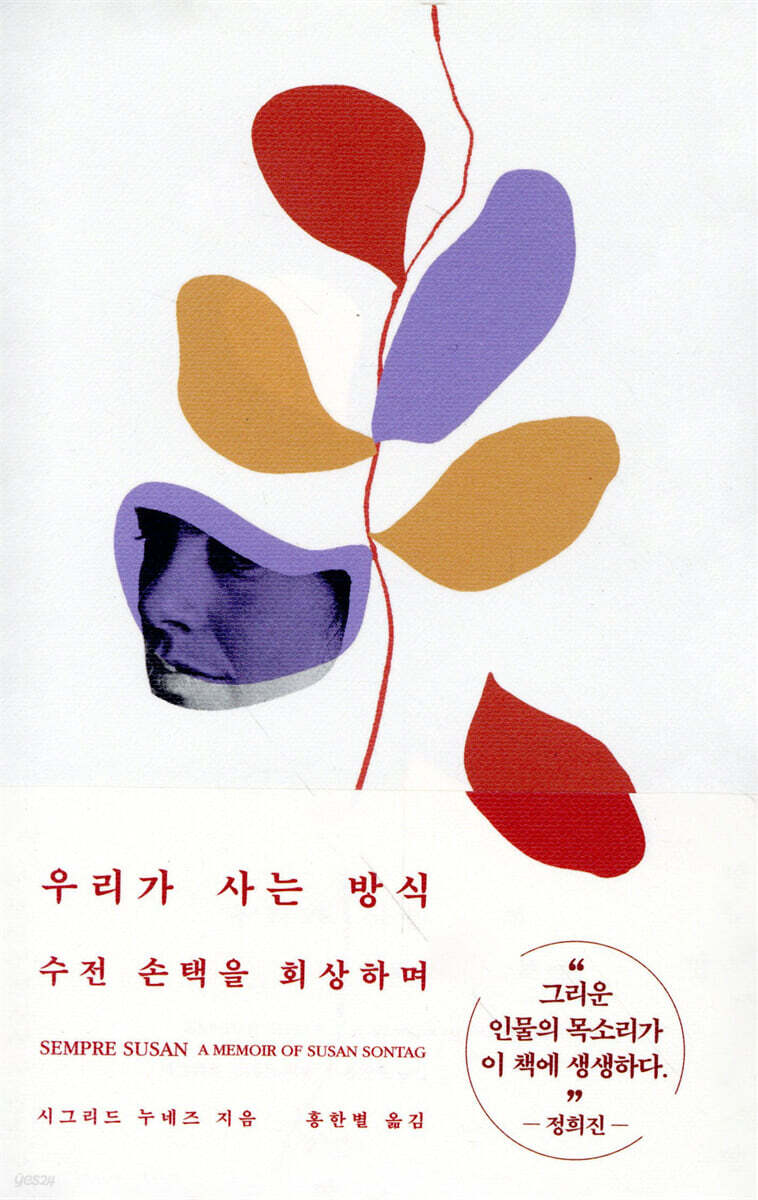
This is a 2011 book by American novelist Sigrid Nunes, a memoir about Susan Sontag, a representative intellectual of 20th-century America.
In this book, Nunez portrays with painful honesty the ways of life of an extraordinary man who has been a guiding light in his own life.
This book is a record of respect, gratitude, longing, and sadness for people and times that are now gone.
Nunez met Sontag, then 43, in 1976, when she was 25 years old.
I was just finishing my MFA at Columbia University and was about to become a writer.
Already a legend, known for her polemical essays, dazzling intellect, and cutting-edge style, Sontag introduced Nunez to her son, the writer David Leaf, and the two began dating.
Nunez soon moves into the apartment where Leaf and Sontag live and begins living together.
Sontag's influence on Nunez, who later became a prominent writer, was profound.
Nunez is grateful to have had an example from someone who was “serious and had the highest level of exaltation about the calling of being a writer.”
Although they lived together for only about two years, the teachings Sontag left behind never left Nunez for the rest of his life.
In this book, Nunez lets us hear Sontag's voices, which still resonate.
Sontag sharply captures and shows the heated atmosphere created by publishing a book, giving a lecture, or simply appearing at a certain place.
Published more than six years after Sontag's death, this book is a surprisingly truthful portrait of a colossal man who lived a life of flamboyant intellectualism.
- You can preview some of the book's contents.
Preview
Detailed image

Into the book
One day, I was having lunch at a restaurant with Susan, and I realized it was time to go back to work, so I jumped up and Susan laughed and said,
“Sit down! You don’t have to fit in exactly.
“Don’t be so mean.” “Mean” was one of Susan’s favorite words.
---p.5
Susan often said that she remembered her childhood as a dull time and that she just waited for it to end.
I've always wondered about that (how can you say that childhood, even if it wasn't happy, was a 'complete waste of time'?).
---p.16
Susan refused to be 'ashamed' of losing her breasts and lifted her shirt to show the incision scar.
“Isn’t it amazing? I thought it would be hideous, but it’s actually the same as if it was just deleted.” It really was.
Susan was not afraid to show her breasts to men, especially those she met for the first time.
I thought it was natural for everyone to be curious and that anyone should be able to watch it without flinching.
---p.45
Susan often felt that people exaggerated or overreacted to physical and emotional pain.
It was understandable that he would have such an attitude, having had cancer himself and having bravely overcome surgery and chemotherapy.
After looking at me, he gave me a simple diagnosis.
“You’re having a nervous breakdown.” Susan was concerned when she saw David’s ex-girlfriend suffering from severe menstrual cramps.
“David, you shouldn’t think that all women are like that.”
---p.51
There were times when I couldn't quite understand Susan's passion.
As I sat in the cinema, sharing a large chocolate bar with Susan, I couldn't figure out why I wanted to see the old Katharine Hepburn movie again, showing simultaneously, and having seen both of them over twenty times.
---p.65
Of all the books Susan recommended to me, I haven't read a single one that I regretted.
When we last met, W.
I praised G. Sebald's "The Immigrants" to the point of being speechless.
This book has become one of my favorites and has had a huge impact on me.
It was also from Susan that I first heard the name Sebalt.
---p.67
When I started submitting short stories to literary magazines, Susan told me that it was my fault that my stories were being rejected.
“You really seem to want to publish the article.” It was a truly discouraging tone.
One time, he said this in front of people.
“Other people are also announcing empty promises.
“Is there any reason why you can’t do it?”
---p.71
Fornes and Susan were lovers from 1959 to 1963.
Fornes came and greeted us, then Susan said to Fornes:
“Tell Sigrid what I was like when we first met.
“Come on, come on!” “That was stupid,” said Fornes.
Susan laughed, then stopped laughing and said to me.
“What I was trying to say is that there is hope for you too.”
---p.79
Normally, if someone takes themselves too seriously, it can seem ridiculous and sometimes inappropriate, but Susan never admitted that she could do that.
Susan was determined to take herself very seriously and told anyone who didn't like that to get lost, and she was always frustrated that others didn't take her seriously enough.
---p.85
Because of Susan, I read the book at a very fast pace.
Also, because of Susan, I wrote my name on every book I could get my hands on.
I cut out articles from newspapers and magazines and made scrapbooks.
Like Susan, I always had a pencil in my hand (never a pen) and underlined things in my books.
---p.94
“A writer’s standards can never be too high.” “There’s absolutely no need to worry about being obsessive.
I like obsessive people.
“Obsessive people make great art.”
---p.95
Susan had to do nothing else for quite a long time to get to work.
I took Dexedrine (a stimulant) and worked without rest.
I never left my apartment and rarely left my desk.
We fell asleep to the sound of Susan's typewriter and woke up to the sound of the typewriter.
---p.98
What were all these rumors about Susan? Were they true? Was she really a monster, as people said? I was astonished to learn how many negative things people were saying about her.
But I could never know whether Susan knew these rumors were going around (if she was aware of how far the rumors of her inappropriate relationship with her son had spread, she never told me).
---p.112
I felt that Susan had more enemies than anyone I had ever met.
Moreover, as is often the case in influential circles, Susan had enemies among her friends.
---p.113
Susan said she didn't go to the hospital even once between the day she found out she was pregnant and the day her labor started.
“I didn’t know you were leaving.” I’m someone who reads at least one book a day because of my endless curiosity, but I haven’t read a single book about pregnancy or parenting.
---p.115
Susan thought I was a hopeless lover.
He also called me a cocktease, not in a scolding way, but in a way that showed sympathy.
“I’ve always been called that too.”
---p.119
Susan felt that everything she had done in her life had been, above all, to win David's love and respect.
As if David were the parent and he was the child.
---p.127
Susan's sadness was tinged with dark anger.
He responded by kicking and screaming.
They won't catch me! When the world was not to her liking, Susan whipped herself wildly.
I wanted to hurt someone.
Among the people close to Susan, there was at least one punching bag who would beat her over and over again.
---p.130
Susan was willing to do anything.
I had to do everything.
But there were times when it seemed like forced enthusiasm.
Sometimes when I look at Susan, I feel like she wants to feel something ten times more intensely than she actually feels.
I wanted to be ten times happier, ten times sadder, and ten times more stimulated by whatever I was interested in at the time.
---p.147
How many hours have we spent sitting like this, smoking cigarettes and talking?
I still can't figure out how someone who is busier and more productive than anyone I know always finds time to have such long conversations.
“Sit down! You don’t have to fit in exactly.
“Don’t be so mean.” “Mean” was one of Susan’s favorite words.
---p.5
Susan often said that she remembered her childhood as a dull time and that she just waited for it to end.
I've always wondered about that (how can you say that childhood, even if it wasn't happy, was a 'complete waste of time'?).
---p.16
Susan refused to be 'ashamed' of losing her breasts and lifted her shirt to show the incision scar.
“Isn’t it amazing? I thought it would be hideous, but it’s actually the same as if it was just deleted.” It really was.
Susan was not afraid to show her breasts to men, especially those she met for the first time.
I thought it was natural for everyone to be curious and that anyone should be able to watch it without flinching.
---p.45
Susan often felt that people exaggerated or overreacted to physical and emotional pain.
It was understandable that he would have such an attitude, having had cancer himself and having bravely overcome surgery and chemotherapy.
After looking at me, he gave me a simple diagnosis.
“You’re having a nervous breakdown.” Susan was concerned when she saw David’s ex-girlfriend suffering from severe menstrual cramps.
“David, you shouldn’t think that all women are like that.”
---p.51
There were times when I couldn't quite understand Susan's passion.
As I sat in the cinema, sharing a large chocolate bar with Susan, I couldn't figure out why I wanted to see the old Katharine Hepburn movie again, showing simultaneously, and having seen both of them over twenty times.
---p.65
Of all the books Susan recommended to me, I haven't read a single one that I regretted.
When we last met, W.
I praised G. Sebald's "The Immigrants" to the point of being speechless.
This book has become one of my favorites and has had a huge impact on me.
It was also from Susan that I first heard the name Sebalt.
---p.67
When I started submitting short stories to literary magazines, Susan told me that it was my fault that my stories were being rejected.
“You really seem to want to publish the article.” It was a truly discouraging tone.
One time, he said this in front of people.
“Other people are also announcing empty promises.
“Is there any reason why you can’t do it?”
---p.71
Fornes and Susan were lovers from 1959 to 1963.
Fornes came and greeted us, then Susan said to Fornes:
“Tell Sigrid what I was like when we first met.
“Come on, come on!” “That was stupid,” said Fornes.
Susan laughed, then stopped laughing and said to me.
“What I was trying to say is that there is hope for you too.”
---p.79
Normally, if someone takes themselves too seriously, it can seem ridiculous and sometimes inappropriate, but Susan never admitted that she could do that.
Susan was determined to take herself very seriously and told anyone who didn't like that to get lost, and she was always frustrated that others didn't take her seriously enough.
---p.85
Because of Susan, I read the book at a very fast pace.
Also, because of Susan, I wrote my name on every book I could get my hands on.
I cut out articles from newspapers and magazines and made scrapbooks.
Like Susan, I always had a pencil in my hand (never a pen) and underlined things in my books.
---p.94
“A writer’s standards can never be too high.” “There’s absolutely no need to worry about being obsessive.
I like obsessive people.
“Obsessive people make great art.”
---p.95
Susan had to do nothing else for quite a long time to get to work.
I took Dexedrine (a stimulant) and worked without rest.
I never left my apartment and rarely left my desk.
We fell asleep to the sound of Susan's typewriter and woke up to the sound of the typewriter.
---p.98
What were all these rumors about Susan? Were they true? Was she really a monster, as people said? I was astonished to learn how many negative things people were saying about her.
But I could never know whether Susan knew these rumors were going around (if she was aware of how far the rumors of her inappropriate relationship with her son had spread, she never told me).
---p.112
I felt that Susan had more enemies than anyone I had ever met.
Moreover, as is often the case in influential circles, Susan had enemies among her friends.
---p.113
Susan said she didn't go to the hospital even once between the day she found out she was pregnant and the day her labor started.
“I didn’t know you were leaving.” I’m someone who reads at least one book a day because of my endless curiosity, but I haven’t read a single book about pregnancy or parenting.
---p.115
Susan thought I was a hopeless lover.
He also called me a cocktease, not in a scolding way, but in a way that showed sympathy.
“I’ve always been called that too.”
---p.119
Susan felt that everything she had done in her life had been, above all, to win David's love and respect.
As if David were the parent and he was the child.
---p.127
Susan's sadness was tinged with dark anger.
He responded by kicking and screaming.
They won't catch me! When the world was not to her liking, Susan whipped herself wildly.
I wanted to hurt someone.
Among the people close to Susan, there was at least one punching bag who would beat her over and over again.
---p.130
Susan was willing to do anything.
I had to do everything.
But there were times when it seemed like forced enthusiasm.
Sometimes when I look at Susan, I feel like she wants to feel something ten times more intensely than she actually feels.
I wanted to be ten times happier, ten times sadder, and ten times more stimulated by whatever I was interested in at the time.
---p.147
How many hours have we spent sitting like this, smoking cigarettes and talking?
I still can't figure out how someone who is busier and more productive than anyone I know always finds time to have such long conversations.
---p.154
Publisher's Review
Living as a writer
This book illuminates Sontag's life as a writer in many ways.
As Nunez recalls, for Sontag, “there could be no nobler pursuit, no greater adventure, no more rewarding challenge” than being a writer. Even though she was already a legendary writer in her mid-forties, Sontag was always eager to learn and spared no effort in writing well.
“It is said that to write a 20-page piece, you have to read enough books to fill an entire shelf, spend months writing and rewriting, and use up an entire stack of typed paper before you can finally complete it.
“This was normal for serious writers.”
Son Taek enjoyed talking to people.
He participated in all kinds of performances and events, and was also a movie buff who went to the cinema whenever he had the chance.
On the one hand, Sontag believed that 'a serious writer can also be a voracious reader', and he read more than one book a day.
I took stimulants and wrote all night, and whenever I had the chance, I circulated the manuscript to get feedback and refine it.
All of this was Sontag's life as a writer.
As a “natural mentor,” Sontag viewed teaching others as both a moral duty and a source of endless joy, and so he taught Nunez what he believed a writer should do.
Of course, Nunez wanted to be a writer like Sontag.
So I read whatever book Son Taek recommended.
I organized the books, clipped articles, and underlined them in pencil, just like Sontag did.
However, Son Taek could not live the 'writer's life' he wanted.
After all, it was Son Taek's life.
Nunez had to find her own way.
To do that, I had to break up with Son Taek.
In this book, Nunez introduces the life of the writer Sontag taught her.
These are pieces of advice that Nunez has treasured throughout his life.
Anyone who dreams of becoming a writer will learn a lesson.
The Path of a Female Artist
As this book vividly depicts, Sontag also influenced female artists of her time, including Nunez, by thinking and acting in a way that was different from that of other female writers.
Son Taek was a wife, a mother, and a woman, but at the same time, she lived a life that was not bound by gender.
I believed that anything a male artist could achieve, a female artist could do, and I lived that way.
As Nunez recalls, Sontag's life was admirable but not glamorous.
Son Taek lived more seriously and fiercely than anyone else, but he did not receive the respect he deserved.
People often laughed at Sontag's unusual life, even if not openly.
Sontag showed how far a female artist could push the boundaries of her life's battles.
It was a life that was difficult to imitate.
It was a life that seemed like war.
But within the realm Sontag had pioneered, Nunez felt comfortable.
Because Sontag would be her light wherever she went, she gained the confidence to pursue her own path without fear of getting lost.
Life is disappointing,
Nunez poignantly testifies that behind the glamorous intellectual life, Sontag's life was far from happy.
Even such a great person suffers because his own achievements are so insignificant.
We suffer from unsustainable intimate relationships.
Instead of recognition and respect, you are plagued by all kinds of malicious rumors and speculation.
Outside the spotlight, Sontag's life appears painful and disappointing.
In many episodes of the book, Sontag appears insensitive to pain, whether physical or mental.
It seems like you think you should be able to be indifferent and nonchalant about it.
Treat your own pain as well as the pain of others with a similar attitude.
Sometimes, it seems like the closer you are to someone, the more you enjoy spewing harsh words and hurting them.
In Nunez's view, Sontag knew better than anyone that life was painful and disappointing.
I think I believed that it was natural, that it had to be that way.
The pain did not make Sontag despair.
Because Son Taek had a mission to pursue.
This is probably the best thing Nunez learned from Sontag.
Life can be disappointing, but if there are values worth pursuing, "there is hope." In this book, Nunez shares Sontag's teachings that helped her find hope.
I firmly believe that the life of this extraordinary man, who seemed invincible, will surely become a source of hope for many more people.
This book illuminates Sontag's life as a writer in many ways.
As Nunez recalls, for Sontag, “there could be no nobler pursuit, no greater adventure, no more rewarding challenge” than being a writer. Even though she was already a legendary writer in her mid-forties, Sontag was always eager to learn and spared no effort in writing well.
“It is said that to write a 20-page piece, you have to read enough books to fill an entire shelf, spend months writing and rewriting, and use up an entire stack of typed paper before you can finally complete it.
“This was normal for serious writers.”
Son Taek enjoyed talking to people.
He participated in all kinds of performances and events, and was also a movie buff who went to the cinema whenever he had the chance.
On the one hand, Sontag believed that 'a serious writer can also be a voracious reader', and he read more than one book a day.
I took stimulants and wrote all night, and whenever I had the chance, I circulated the manuscript to get feedback and refine it.
All of this was Sontag's life as a writer.
As a “natural mentor,” Sontag viewed teaching others as both a moral duty and a source of endless joy, and so he taught Nunez what he believed a writer should do.
Of course, Nunez wanted to be a writer like Sontag.
So I read whatever book Son Taek recommended.
I organized the books, clipped articles, and underlined them in pencil, just like Sontag did.
However, Son Taek could not live the 'writer's life' he wanted.
After all, it was Son Taek's life.
Nunez had to find her own way.
To do that, I had to break up with Son Taek.
In this book, Nunez introduces the life of the writer Sontag taught her.
These are pieces of advice that Nunez has treasured throughout his life.
Anyone who dreams of becoming a writer will learn a lesson.
The Path of a Female Artist
As this book vividly depicts, Sontag also influenced female artists of her time, including Nunez, by thinking and acting in a way that was different from that of other female writers.
Son Taek was a wife, a mother, and a woman, but at the same time, she lived a life that was not bound by gender.
I believed that anything a male artist could achieve, a female artist could do, and I lived that way.
As Nunez recalls, Sontag's life was admirable but not glamorous.
Son Taek lived more seriously and fiercely than anyone else, but he did not receive the respect he deserved.
People often laughed at Sontag's unusual life, even if not openly.
Sontag showed how far a female artist could push the boundaries of her life's battles.
It was a life that was difficult to imitate.
It was a life that seemed like war.
But within the realm Sontag had pioneered, Nunez felt comfortable.
Because Sontag would be her light wherever she went, she gained the confidence to pursue her own path without fear of getting lost.
Life is disappointing,
Nunez poignantly testifies that behind the glamorous intellectual life, Sontag's life was far from happy.
Even such a great person suffers because his own achievements are so insignificant.
We suffer from unsustainable intimate relationships.
Instead of recognition and respect, you are plagued by all kinds of malicious rumors and speculation.
Outside the spotlight, Sontag's life appears painful and disappointing.
In many episodes of the book, Sontag appears insensitive to pain, whether physical or mental.
It seems like you think you should be able to be indifferent and nonchalant about it.
Treat your own pain as well as the pain of others with a similar attitude.
Sometimes, it seems like the closer you are to someone, the more you enjoy spewing harsh words and hurting them.
In Nunez's view, Sontag knew better than anyone that life was painful and disappointing.
I think I believed that it was natural, that it had to be that way.
The pain did not make Sontag despair.
Because Son Taek had a mission to pursue.
This is probably the best thing Nunez learned from Sontag.
Life can be disappointing, but if there are values worth pursuing, "there is hope." In this book, Nunez shares Sontag's teachings that helped her find hope.
I firmly believe that the life of this extraordinary man, who seemed invincible, will surely become a source of hope for many more people.
GOODS SPECIFICS
- Date of issue: May 30, 2021
- Page count, weight, size: 160 pages | 216g | 120*188*20mm
- ISBN13: 9791196999254
- ISBN10: 1196999252
You may also like
카테고리
korean


korean

![GQ KOREA Mark (Monthly): December [2025]](http://librairie.coreenne.fr/cdn/shop/files/8ef265dbbfbf186523ed75ba7319009d.jpg?v=1765340328&width=3840)


