

intrinsic intelligence
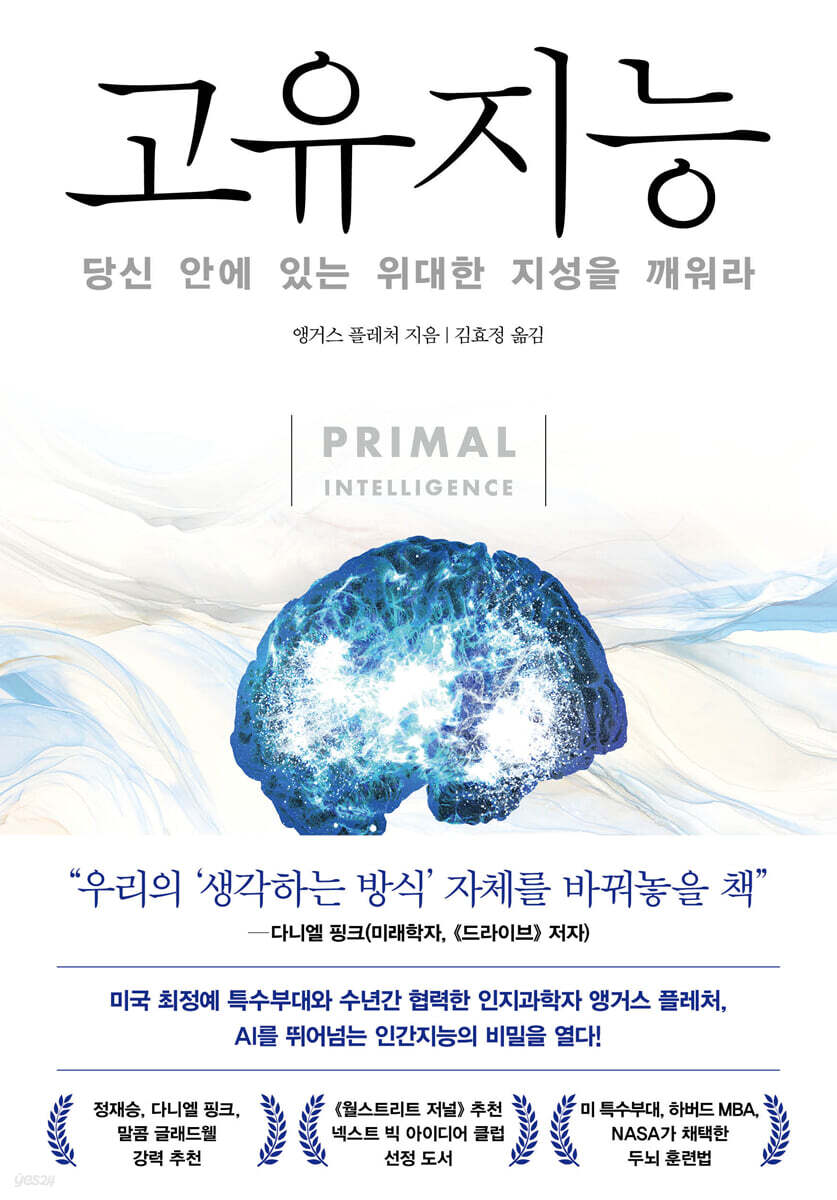 |
Description
Book Introduction
- A word from MD
-
Human abilities that cannot be replaced by AIIn an era where AI is overwhelming humans in the simple listing of knowledge,
There is no need to worry.
Because life is not simple, it is complicated.
Intuition, imagination, emotions, and common sense are special weapons that only humans possess to solve life's problems.
November 28, 2025. Min-gyu Son, Humanities PD
“A book that will change the very way we think.” - Daniel Pink (futurist, author of Drive)
"This book is a kind of manifesto on the nature of human thought." - Jaeseung Jeong (Professor of Brain and Cognitive Sciences, KAIST)
Angus Fletcher, a cognitive scientist who has worked with America's elite special forces for many years,
Unlock the secrets of unique intelligence that surpasses AI!
We live in the most information-rich era in human history.
Find the information you want instantly with your smartphone, and use AI to analyze vast amounts of data to make the most rational choice.
But the more answers there are, the more blurred the direction becomes, and the more sophisticated the analysis, the more difficult the decision becomes.
The first to spot this contradiction were the US Army Special Forces.
Although the recruits had high IQs and excellent analytical skills, they hesitated and were easily swayed in their judgment when faced with real-world situations with many variables.
“They are good at solving math problems, but they can’t solve life problems,” one commander said.
As knowledge-centered education becomes more and more prevalent, it becomes increasingly apparent that it cannot overcome uncertainty and confusion.
Accordingly, cognitive scientist Professor Angus Fletcher, together with the U.S. Army Special Operations Command, is developing training to restore 'Primal Intelligence', the original decision-making ability that humans have used since primitive times.
As a result, special forces soldiers demonstrated more agile and effective judgment in time-pressured, chaotic, and crisis situations.
The study has since demonstrated superior outcomes across innovation, resilience, decision-making, communication, and leadership in surgeons, fighter pilots, NASA astronauts, business leaders, teachers, and children.
For his contributions, Professor Angus Fletcher was awarded the Distinguished Service Medal in 2023 by the U.S. Army, with the distinction of “groundbreaking.”
Based on this empirical research, "Innate Intelligence" reveals for the first time how to awaken four essential human abilities in the AI era: intuition, imagination, emotion, and common sense.
Now, reactivate the inherent intelligence that lies dormant within you.
Direction is more important than the answer.
Native intelligence will be your compass to navigate an uncertain world.
"This book is a kind of manifesto on the nature of human thought." - Jaeseung Jeong (Professor of Brain and Cognitive Sciences, KAIST)
Angus Fletcher, a cognitive scientist who has worked with America's elite special forces for many years,
Unlock the secrets of unique intelligence that surpasses AI!
We live in the most information-rich era in human history.
Find the information you want instantly with your smartphone, and use AI to analyze vast amounts of data to make the most rational choice.
But the more answers there are, the more blurred the direction becomes, and the more sophisticated the analysis, the more difficult the decision becomes.
The first to spot this contradiction were the US Army Special Forces.
Although the recruits had high IQs and excellent analytical skills, they hesitated and were easily swayed in their judgment when faced with real-world situations with many variables.
“They are good at solving math problems, but they can’t solve life problems,” one commander said.
As knowledge-centered education becomes more and more prevalent, it becomes increasingly apparent that it cannot overcome uncertainty and confusion.
Accordingly, cognitive scientist Professor Angus Fletcher, together with the U.S. Army Special Operations Command, is developing training to restore 'Primal Intelligence', the original decision-making ability that humans have used since primitive times.
As a result, special forces soldiers demonstrated more agile and effective judgment in time-pressured, chaotic, and crisis situations.
The study has since demonstrated superior outcomes across innovation, resilience, decision-making, communication, and leadership in surgeons, fighter pilots, NASA astronauts, business leaders, teachers, and children.
For his contributions, Professor Angus Fletcher was awarded the Distinguished Service Medal in 2023 by the U.S. Army, with the distinction of “groundbreaking.”
Based on this empirical research, "Innate Intelligence" reveals for the first time how to awaken four essential human abilities in the AI era: intuition, imagination, emotion, and common sense.
Now, reactivate the inherent intelligence that lies dormant within you.
Direction is more important than the answer.
Native intelligence will be your compass to navigate an uncertain world.
- You can preview some of the book's contents.
Preview
index
Praise for this book
Introduction: Can Humans Surpass Artificial Intelligence?
Prologue: Awaken Your Lost Nature and the Power of Your Sleeping Brain
Part 1: Turn on the switch of the sleeping brain
: Four Unique Human Powers That AI Cannot Realize
Chapter 1 [Intuition] An Eye for Exceptions
: Discover new rules like Vincent van Gogh and Marie Curie.
Intuition begins in the cracks of the rules | Find the rule in the noise | The truth is always hidden in the exception | See everything anew, like a child | Rediscover intuition in stories | Stop judging and start asking questions
Chapter 2 [Imagination] The Power to See What Doesn't Exist
: Create the future like Beethoven and special agents.
The moment you see the invisible, the future opens up. | Stories are the beginning of all imagination. | The moment you connect 'why' and 'what if,' possibilities become infinite. | A good plan emerges from an infinite path that leads to a single summit. | Compose like Beethoven, act like an agent. | Design your life as a work of art.
Chapter 3 [Emotions] A Compass That Never Loses Direction
: Evaluate yourself like Antigone and Singleton.
Fear is your brain's warning that you have no plan | Anger is a warning signal that you only have one plan | Sadness and shame are traffic lights that guide you to wise action | The moment you are laughed at for being foolish, there is your true self | Discover your true purpose in life from unexpected gratitude | Your emotions tell you where to go
Chapter 4 [Common Sense] Wisdom that Guides Decisions
: Master the moment like Benjamin Franklin and the stock market investors.
Common sense is the uniquely human ability to know that "I don't know." | Learn common sense from contradictory maxims like Benjamin Franklin. | The real reason why doctors without common sense got a zero. | Anxiety is not an enemy, but a smart helper. | The art of distinguishing between past worries and future anxieties. | Warren Buffett's secret to turning his fear of public speaking into investment success. | Why James Simons chose anxiety over math. | Intuition → imagination → emotion → common sense, the cycle of unique intelligence.
Part 2: The Art of Turning Uncertainty into Opportunity
: 6 Strategies Beyond the Battlefield, Stage, and Conference Room
Chapter 5 [Innovation] The Courage to Welcome the Unfamiliar
: Reinvent the board like Einstein and Steve Jobs
Turn exceptions into new rules like Einstein | The secrets of the reality distortion field that Steve Jobs learned from King Lear | Don't avoid conflict, use it as fuel for innovation | How Darwin discovered the theory of evolution from finches | The wisdom of 'eating your enemy' learned from school bullying | The secret weapon of the human team that beats AI every time | Clausewitz's experiment with collective intelligence that defeated Napoleon
Chapter 6 [Resilience] The Power to Overcome a Crisis
: Develop anti-vulnerability like clinic patients and third-year students.
The Secret of Anti-Vulnerability Hidden in Special Agents Without PTSD | The Power of the Final Story That Kicked You Out of Dissociation | The Miracle of a Reversal of Fortune's Wonders in Your Brain | From True Negativity Comes True Positive | Why "I Can Succeed" Is More Powerful Than "I Will Succeed" | Why Successful Alumni Assert "School is the Problem" | 3 Training Methods Even an 8-Year-Old Can Follow | How to Survive When Plans A, B…Z Fail
Chapter 7 [Decision Making] Insights that Move First
: Throw a gamble like George Washington and the astronauts.
Why simulations fail even when they're perfect | The real reason George Marshall fired decorated generals | Get off the beaten path and search for clues in the dark | George Washington's Law: Be bolder when things are uncertain | Develop new plans for new situations | Armstrong's life-or-death decision one second before the moon landing | Go where experts can't tell you it can't be done
Chapter 8 [Communication] Language that Moves the Heart
: Answer the 'why' like Maya Angelou and Lincoln.
Start in the middle and awaken your brain's storytelling | Focus on exceptions, not universals | The power of mystery that Lincoln learned from Macbeth | How to captivate hearts with imagination, not fear | Start at the end and let them imagine the middle | The secret to authenticity discovered in a Vietnamese village
Chapter 9 [Coaching] How to Unleash Your Potential
: Develop talent like Champion and William Osler.
Even experts grow when they entrust their flying skills to newcomers | The real reason improv experts work with newcomers | The achievements of liberation proven by history
Chapter 10 [Leadership] The Power of Believing in the Future
: Lead with confidence like Wayne Gretzky and Nikola Tesla.
Managers are born, but leaders are born | Leave the crowd behind and find your inner compass | Only those who walk alone become leaders | Forecasting is not calculation, but creative guesswork | The fatal mistake leaders make when they miss opportunities | How MBAs kill leadership | How Tesla surpassed Edison | The victory no one knows is the real victory
Part 3: Opening the Secret Vault of Innate Intelligence
: The Archetypes of Intelligence Unraveled by Evolution, Brain Science, and Storytelling
Chapter 11 [Motto] The History of Human Intelligence
: From the Biological Big Bang to Shakespeare
The Origins of Two Intelligences: The Biological Big Bang | Motto: The Illogical Brain Machine Operating on Synapses | The Power of Story: How Story Thinking Changes the Brain | The Secrets of Human Intellectual History Through Shakespeare | The Moment Programmers Began to Rule the World with Logic | Verification of Innate Intelligence with Special Agents
Chapter 12 [Story Thinking] The Essence of Human Thought
: The ultimate way to think that moves the brain
Meeting Shakespeare at Yale | Project Narrative: Where Theory Becomes Reality | Shakespeare's Secrets for CEOs | A Fateful Encounter with Special Forces
Appendix 1: Intrinsic Intelligence Self-Assessment Quiz
Appendix 2: Guide to Intrinsic Intelligence Attributes
Acknowledgements
Further Reading
Introduction: Can Humans Surpass Artificial Intelligence?
Prologue: Awaken Your Lost Nature and the Power of Your Sleeping Brain
Part 1: Turn on the switch of the sleeping brain
: Four Unique Human Powers That AI Cannot Realize
Chapter 1 [Intuition] An Eye for Exceptions
: Discover new rules like Vincent van Gogh and Marie Curie.
Intuition begins in the cracks of the rules | Find the rule in the noise | The truth is always hidden in the exception | See everything anew, like a child | Rediscover intuition in stories | Stop judging and start asking questions
Chapter 2 [Imagination] The Power to See What Doesn't Exist
: Create the future like Beethoven and special agents.
The moment you see the invisible, the future opens up. | Stories are the beginning of all imagination. | The moment you connect 'why' and 'what if,' possibilities become infinite. | A good plan emerges from an infinite path that leads to a single summit. | Compose like Beethoven, act like an agent. | Design your life as a work of art.
Chapter 3 [Emotions] A Compass That Never Loses Direction
: Evaluate yourself like Antigone and Singleton.
Fear is your brain's warning that you have no plan | Anger is a warning signal that you only have one plan | Sadness and shame are traffic lights that guide you to wise action | The moment you are laughed at for being foolish, there is your true self | Discover your true purpose in life from unexpected gratitude | Your emotions tell you where to go
Chapter 4 [Common Sense] Wisdom that Guides Decisions
: Master the moment like Benjamin Franklin and the stock market investors.
Common sense is the uniquely human ability to know that "I don't know." | Learn common sense from contradictory maxims like Benjamin Franklin. | The real reason why doctors without common sense got a zero. | Anxiety is not an enemy, but a smart helper. | The art of distinguishing between past worries and future anxieties. | Warren Buffett's secret to turning his fear of public speaking into investment success. | Why James Simons chose anxiety over math. | Intuition → imagination → emotion → common sense, the cycle of unique intelligence.
Part 2: The Art of Turning Uncertainty into Opportunity
: 6 Strategies Beyond the Battlefield, Stage, and Conference Room
Chapter 5 [Innovation] The Courage to Welcome the Unfamiliar
: Reinvent the board like Einstein and Steve Jobs
Turn exceptions into new rules like Einstein | The secrets of the reality distortion field that Steve Jobs learned from King Lear | Don't avoid conflict, use it as fuel for innovation | How Darwin discovered the theory of evolution from finches | The wisdom of 'eating your enemy' learned from school bullying | The secret weapon of the human team that beats AI every time | Clausewitz's experiment with collective intelligence that defeated Napoleon
Chapter 6 [Resilience] The Power to Overcome a Crisis
: Develop anti-vulnerability like clinic patients and third-year students.
The Secret of Anti-Vulnerability Hidden in Special Agents Without PTSD | The Power of the Final Story That Kicked You Out of Dissociation | The Miracle of a Reversal of Fortune's Wonders in Your Brain | From True Negativity Comes True Positive | Why "I Can Succeed" Is More Powerful Than "I Will Succeed" | Why Successful Alumni Assert "School is the Problem" | 3 Training Methods Even an 8-Year-Old Can Follow | How to Survive When Plans A, B…Z Fail
Chapter 7 [Decision Making] Insights that Move First
: Throw a gamble like George Washington and the astronauts.
Why simulations fail even when they're perfect | The real reason George Marshall fired decorated generals | Get off the beaten path and search for clues in the dark | George Washington's Law: Be bolder when things are uncertain | Develop new plans for new situations | Armstrong's life-or-death decision one second before the moon landing | Go where experts can't tell you it can't be done
Chapter 8 [Communication] Language that Moves the Heart
: Answer the 'why' like Maya Angelou and Lincoln.
Start in the middle and awaken your brain's storytelling | Focus on exceptions, not universals | The power of mystery that Lincoln learned from Macbeth | How to captivate hearts with imagination, not fear | Start at the end and let them imagine the middle | The secret to authenticity discovered in a Vietnamese village
Chapter 9 [Coaching] How to Unleash Your Potential
: Develop talent like Champion and William Osler.
Even experts grow when they entrust their flying skills to newcomers | The real reason improv experts work with newcomers | The achievements of liberation proven by history
Chapter 10 [Leadership] The Power of Believing in the Future
: Lead with confidence like Wayne Gretzky and Nikola Tesla.
Managers are born, but leaders are born | Leave the crowd behind and find your inner compass | Only those who walk alone become leaders | Forecasting is not calculation, but creative guesswork | The fatal mistake leaders make when they miss opportunities | How MBAs kill leadership | How Tesla surpassed Edison | The victory no one knows is the real victory
Part 3: Opening the Secret Vault of Innate Intelligence
: The Archetypes of Intelligence Unraveled by Evolution, Brain Science, and Storytelling
Chapter 11 [Motto] The History of Human Intelligence
: From the Biological Big Bang to Shakespeare
The Origins of Two Intelligences: The Biological Big Bang | Motto: The Illogical Brain Machine Operating on Synapses | The Power of Story: How Story Thinking Changes the Brain | The Secrets of Human Intellectual History Through Shakespeare | The Moment Programmers Began to Rule the World with Logic | Verification of Innate Intelligence with Special Agents
Chapter 12 [Story Thinking] The Essence of Human Thought
: The ultimate way to think that moves the brain
Meeting Shakespeare at Yale | Project Narrative: Where Theory Becomes Reality | Shakespeare's Secrets for CEOs | A Fateful Encounter with Special Forces
Appendix 1: Intrinsic Intelligence Self-Assessment Quiz
Appendix 2: Guide to Intrinsic Intelligence Attributes
Acknowledgements
Further Reading
Detailed image

Into the book
Our brains have non-random, illogical intelligence.
This intelligence evolved millions of years before the data-dependent circuitry of AI, giving our primitive ancestors the ability to survive in an unknown world.
At first, this ability was simply accepted as a way of life.
But as our ancestors reflected on themselves, they immediately began to use this intelligence to explore their own intelligence, and as a result, they discovered that intelligence has four distinct abilities: intuition, imagination, emotion, and common sense.
- Intuition recognizes the hidden rules of the world.
- Imagination imagines a future that does not exist.
- Emotions determine the path an individual will take in his or her development.
- Common sense allows us to make wise decisions in uncertainty.
These four unique abilities enable humans to act wisely even with little information.
Of course, this doesn't mean that humans always act wisely.
But the very fact that AI can "act intelligently" is what allows it to thrive even in situations where it fails. AI can reason logically and generate random ideas.
However, common sense and imagination are not mechanically generated, so when data is insufficient or scarce, they perform worse than the human brain.
So computer thinking fails in innovation, leadership, and most aspects of daily life.
These realistic limitations of logic show why today's education system is failing.
This is because they only train students to think like computers and do things that computers are good at, but they fail to cultivate the innate wisdom of humans that AI cannot imitate.
Ultimately, future generations could become second-rate algorithms with less practical intelligence than even primitive humans.
--- From "Prologue_Lost Nature, Awaken the Dormant Abilities of the Brain"
Spy hunters gave me this advice:
“If you can’t see the exception, treat ‘everything’ as an exception.”
“Treat everything as an exception?” I asked, just to be sure.
"you're right.
“Just like how I saw the world when I was young.”
I couldn't remember how I saw the world when I was young.
But I knew how my children saw the world.
I once took my six-month-old daughter out to the backyard for a picnic.
I prepared a sandwich and lemonade for myself, and also packed a jar of carrot puree and a plastic spoon for my daughter.
He opened the bottle and offered his daughter a spoonful.
The daughter was slurping down a carrot when she dropped her spoon on the grass.
“It’s okay!” I said cheerfully, taking a clean spoon out of the container.
“Dad prepared something else!”
The daughter looked at the new spoon in the carrot jar suspiciously.
Even though I held out the spoon, he didn't put anything in his mouth.
He just held the handle tightly in his chubby fist and looked at it carefully.
Then suddenly she burst into tears and whined.
I looked at my daughter in confusion.
Then slowly I realized.
My daughter was upset that I gave her a new spoon.
The old spoon was good.
And he thought I had tricked him and taken his spoon away.
To prove my innocence, I held up an old spoon and a new spoon side by side and showed that they were interchangeable.
But the proof failed.
It wasn't the same spoon for my daughter.
My daughter continued to whine until she got her spoon back.
At that moment, I thought my daughter was foolish.
But as I realized through the special forces agents, I was the fool.
I had forgotten the truth of life that even my daughter knows.
There is nothing in this world that is the same.
Every picnic, every person is unique.
Even mass-produced plastic products made in factories can have different meanings in certain situations.
How did my daughter know this? Did she learn it? Did she suddenly wake up one day, lying in her cradle? No.
My daughter learned through the power of her unconscious brain, her deep biological instincts.
It was tacit knowledge that was acquired naturally.
It was not a deliberate decision, but an instinctive act of thinking that everything I saw was special.
As time goes by, we lose this default setting.
As we age, we structure our routines around patterns and principles, prioritizing efficiency over discovery.
Ultimately, our brains have a default setting to 'assume we've seen it before'.
This means replacing slow exploration with quick judgment, the opposite of what we were born with.
--- From "Chapter 1 [Intuition] The Eye that Captures Exceptions"
At the request of the Army Special Forces, I developed an alternative to emotional intelligence.
This method, which is more biological than logical, is based on brain connections that link emotions and stories.
Because of that connection, when the narratives of movies and novels touch our emotions, we experience a variety of emotions that are difficult to express in words, such as joy or sadness.
For a long time I had this question.
Why are emotions and stories so intertwined in our minds? Then, I met a special agent named Lucy Gray.
He was working as a singleton.
Singleton is sent into enemy territory alone, without a team or support personnel.
Because they perform their duties alone, singletons must be thorough in their self-evaluation.
You need to know when your plan is successful and when you need to change it.
Confidence should not be too much or too little.
You must evaluate yourself fairly and clearly and accurately assess your abilities each time.
Otherwise, the operation may fail and you may lose your life.
“How do you do that?” asked Gray.
Since he is such a systematic person, I assumed he would check everything about himself, from his task completion rate to his heart rate.
“I do it all by feeling,” Gray replied immediately.
“You mean a feeling?”
“Yes, I feel that way.”
Gray's self-evaluation was emotional.
If things felt smooth, I continued, and if something felt wrong, I adjusted.
To Gray, emotions were like a mysterious sense that gave him a deeper understanding of reality.
But in studying Gray and other singletons, I found a biological explanation for their seemingly supernatural ability to self-evaluate.
Emotions tracked the narrative of their mental lives, signaling that they needed to change direction when the narrative strayed from its most effective form.
--- From "Chapter 3 [Emotions] A Compass That Never Loses Direction"
Like Van Gogh, Steve Jobs encountered Shakespeare outside the classroom.
I didn't read Shakespeare for a test, I read it out of pure curiosity.
So rather than feeling a sense of kinship with King Lear, I ended up having the eyes of a child.
The result of Jobs's gaze was what his Apple colleagues called a "reality distortion field."
Within that distortion field, Jobs put aside the old rules of life and pushed for exceptions.
Until that becomes the new rule.
There are countless examples of Jobs creating new rules.
There's also a story told by engineers in Cupertino.
In 2005, Jobs collaborated with Motorola to launch the Rocker.
The Rocker was a stick-shaped phone that could download 100 songs from iTunes.
But the rocker failed miserably.
It sold very little and underperformed expectations.
It was just an old-fashioned cell phone that played a limited music list with crappy earphones.
Looking at sales performance alone, this project should have been abandoned.
But Jobs did the opposite.
The focus was on the originality of the rocker.
While competitors scoffed at the idea of a jukebox phone, Jobs pushed Apple forward, eventually creating the iPhone.
Isaacson saw Jobs as a tweaker because Jobs recognized the exceptional potential of certain devices.
He found in those devices a peculiarity similar to that seen in King Lear.
Just as Shakespeare pushed King Lear's individuality to its limit, Jobs rejected common compromises and made each device more unique, maximizing exceptionality.
--- From "Chapter 5 [Innovation] The Courage to Welcome the Unfamiliar"
You were a leader from birth.
I know this fact.
Because you know who you were in the beginning, hundreds of thousands of years ago.
Your tribe consisted of only about fifteen people, most of them children.
At thirty, you became the oldest elder.
When famine struck, you were tasked with leading your tribe through the winter cold to new hunting grounds.
You are now a descendant of countless generations who have passed this test.
So you too can pass this test.
But because he still doesn't know his own nature, he keeps failing.
All your life you have been taught that you need education.
The word 'education' comes from the Latin word meaning 'to lead'.
That means you are the person you should follow.
Education is a modern way.
Never in history have humans spent so much time in classrooms trying to pass school exams rather than survival tests.
School teaches you that your mind is full of irrational things.
Irrational thinking takes many forms, including emotions, prejudices, and ignorance of facts.
Since humans are born irrational, there is a limit to how much schools can do to correct you.
Yet, out of fear and shame, you comply with the correction, hoping that it will make you a better person.
But the more you want to be corrected, the deeper your distrust of your own nature becomes.
We give up our ability to evaluate ourselves and rely on institutional evaluations, losing our inner direction.
As you approach graduation, you hear that the highest purpose in human life is to become a leader.
These words resonate deep within your soul.
So you imagine yourself leading a team.
Maybe it's a company or a country.
But when it comes time to take the lead, you hesitate.
Because they are so ingrained in the habits of followers, it is awkward for them to lead as leaders.
If you are conscious of others and doubt yourself, those around you will notice it and will not trust your abilities.
You keep giving empty commands, but most of them are ignored.
Finally, you step back and are glad to be free from the constant torment of self-doubt.
And it's a relief to see the person who took your place shaken just as much.
This intelligence evolved millions of years before the data-dependent circuitry of AI, giving our primitive ancestors the ability to survive in an unknown world.
At first, this ability was simply accepted as a way of life.
But as our ancestors reflected on themselves, they immediately began to use this intelligence to explore their own intelligence, and as a result, they discovered that intelligence has four distinct abilities: intuition, imagination, emotion, and common sense.
- Intuition recognizes the hidden rules of the world.
- Imagination imagines a future that does not exist.
- Emotions determine the path an individual will take in his or her development.
- Common sense allows us to make wise decisions in uncertainty.
These four unique abilities enable humans to act wisely even with little information.
Of course, this doesn't mean that humans always act wisely.
But the very fact that AI can "act intelligently" is what allows it to thrive even in situations where it fails. AI can reason logically and generate random ideas.
However, common sense and imagination are not mechanically generated, so when data is insufficient or scarce, they perform worse than the human brain.
So computer thinking fails in innovation, leadership, and most aspects of daily life.
These realistic limitations of logic show why today's education system is failing.
This is because they only train students to think like computers and do things that computers are good at, but they fail to cultivate the innate wisdom of humans that AI cannot imitate.
Ultimately, future generations could become second-rate algorithms with less practical intelligence than even primitive humans.
--- From "Prologue_Lost Nature, Awaken the Dormant Abilities of the Brain"
Spy hunters gave me this advice:
“If you can’t see the exception, treat ‘everything’ as an exception.”
“Treat everything as an exception?” I asked, just to be sure.
"you're right.
“Just like how I saw the world when I was young.”
I couldn't remember how I saw the world when I was young.
But I knew how my children saw the world.
I once took my six-month-old daughter out to the backyard for a picnic.
I prepared a sandwich and lemonade for myself, and also packed a jar of carrot puree and a plastic spoon for my daughter.
He opened the bottle and offered his daughter a spoonful.
The daughter was slurping down a carrot when she dropped her spoon on the grass.
“It’s okay!” I said cheerfully, taking a clean spoon out of the container.
“Dad prepared something else!”
The daughter looked at the new spoon in the carrot jar suspiciously.
Even though I held out the spoon, he didn't put anything in his mouth.
He just held the handle tightly in his chubby fist and looked at it carefully.
Then suddenly she burst into tears and whined.
I looked at my daughter in confusion.
Then slowly I realized.
My daughter was upset that I gave her a new spoon.
The old spoon was good.
And he thought I had tricked him and taken his spoon away.
To prove my innocence, I held up an old spoon and a new spoon side by side and showed that they were interchangeable.
But the proof failed.
It wasn't the same spoon for my daughter.
My daughter continued to whine until she got her spoon back.
At that moment, I thought my daughter was foolish.
But as I realized through the special forces agents, I was the fool.
I had forgotten the truth of life that even my daughter knows.
There is nothing in this world that is the same.
Every picnic, every person is unique.
Even mass-produced plastic products made in factories can have different meanings in certain situations.
How did my daughter know this? Did she learn it? Did she suddenly wake up one day, lying in her cradle? No.
My daughter learned through the power of her unconscious brain, her deep biological instincts.
It was tacit knowledge that was acquired naturally.
It was not a deliberate decision, but an instinctive act of thinking that everything I saw was special.
As time goes by, we lose this default setting.
As we age, we structure our routines around patterns and principles, prioritizing efficiency over discovery.
Ultimately, our brains have a default setting to 'assume we've seen it before'.
This means replacing slow exploration with quick judgment, the opposite of what we were born with.
--- From "Chapter 1 [Intuition] The Eye that Captures Exceptions"
At the request of the Army Special Forces, I developed an alternative to emotional intelligence.
This method, which is more biological than logical, is based on brain connections that link emotions and stories.
Because of that connection, when the narratives of movies and novels touch our emotions, we experience a variety of emotions that are difficult to express in words, such as joy or sadness.
For a long time I had this question.
Why are emotions and stories so intertwined in our minds? Then, I met a special agent named Lucy Gray.
He was working as a singleton.
Singleton is sent into enemy territory alone, without a team or support personnel.
Because they perform their duties alone, singletons must be thorough in their self-evaluation.
You need to know when your plan is successful and when you need to change it.
Confidence should not be too much or too little.
You must evaluate yourself fairly and clearly and accurately assess your abilities each time.
Otherwise, the operation may fail and you may lose your life.
“How do you do that?” asked Gray.
Since he is such a systematic person, I assumed he would check everything about himself, from his task completion rate to his heart rate.
“I do it all by feeling,” Gray replied immediately.
“You mean a feeling?”
“Yes, I feel that way.”
Gray's self-evaluation was emotional.
If things felt smooth, I continued, and if something felt wrong, I adjusted.
To Gray, emotions were like a mysterious sense that gave him a deeper understanding of reality.
But in studying Gray and other singletons, I found a biological explanation for their seemingly supernatural ability to self-evaluate.
Emotions tracked the narrative of their mental lives, signaling that they needed to change direction when the narrative strayed from its most effective form.
--- From "Chapter 3 [Emotions] A Compass That Never Loses Direction"
Like Van Gogh, Steve Jobs encountered Shakespeare outside the classroom.
I didn't read Shakespeare for a test, I read it out of pure curiosity.
So rather than feeling a sense of kinship with King Lear, I ended up having the eyes of a child.
The result of Jobs's gaze was what his Apple colleagues called a "reality distortion field."
Within that distortion field, Jobs put aside the old rules of life and pushed for exceptions.
Until that becomes the new rule.
There are countless examples of Jobs creating new rules.
There's also a story told by engineers in Cupertino.
In 2005, Jobs collaborated with Motorola to launch the Rocker.
The Rocker was a stick-shaped phone that could download 100 songs from iTunes.
But the rocker failed miserably.
It sold very little and underperformed expectations.
It was just an old-fashioned cell phone that played a limited music list with crappy earphones.
Looking at sales performance alone, this project should have been abandoned.
But Jobs did the opposite.
The focus was on the originality of the rocker.
While competitors scoffed at the idea of a jukebox phone, Jobs pushed Apple forward, eventually creating the iPhone.
Isaacson saw Jobs as a tweaker because Jobs recognized the exceptional potential of certain devices.
He found in those devices a peculiarity similar to that seen in King Lear.
Just as Shakespeare pushed King Lear's individuality to its limit, Jobs rejected common compromises and made each device more unique, maximizing exceptionality.
--- From "Chapter 5 [Innovation] The Courage to Welcome the Unfamiliar"
You were a leader from birth.
I know this fact.
Because you know who you were in the beginning, hundreds of thousands of years ago.
Your tribe consisted of only about fifteen people, most of them children.
At thirty, you became the oldest elder.
When famine struck, you were tasked with leading your tribe through the winter cold to new hunting grounds.
You are now a descendant of countless generations who have passed this test.
So you too can pass this test.
But because he still doesn't know his own nature, he keeps failing.
All your life you have been taught that you need education.
The word 'education' comes from the Latin word meaning 'to lead'.
That means you are the person you should follow.
Education is a modern way.
Never in history have humans spent so much time in classrooms trying to pass school exams rather than survival tests.
School teaches you that your mind is full of irrational things.
Irrational thinking takes many forms, including emotions, prejudices, and ignorance of facts.
Since humans are born irrational, there is a limit to how much schools can do to correct you.
Yet, out of fear and shame, you comply with the correction, hoping that it will make you a better person.
But the more you want to be corrected, the deeper your distrust of your own nature becomes.
We give up our ability to evaluate ourselves and rely on institutional evaluations, losing our inner direction.
As you approach graduation, you hear that the highest purpose in human life is to become a leader.
These words resonate deep within your soul.
So you imagine yourself leading a team.
Maybe it's a company or a country.
But when it comes time to take the lead, you hesitate.
Because they are so ingrained in the habits of followers, it is awkward for them to lead as leaders.
If you are conscious of others and doubt yourself, those around you will notice it and will not trust your abilities.
You keep giving empty commands, but most of them are ignored.
Finally, you step back and are glad to be free from the constant torment of self-doubt.
And it's a relief to see the person who took your place shaken just as much.
--- From "Chapter 10 [Leadership] The Power to Believe in the Future"
Publisher's Review
★ Highly recommended by Jaeseung Jeong, Daniel Pink, and Malcolm Gladwell
★ Recommended by the Wall Street Journal · Selected for the Next Big Idea Club
★ Amazon category bestseller, national bestseller
“Awaken the great intelligence within you!”
The Innate Human Mindset That's Spotlighted by Special Forces, Harvard MBAs, and NASA
In an era where smartphones and AI provide all information instantly.
Yet we fear making decisions and lose our direction.
The US Army Special Forces were the first to face this paradox.
Although the new recruits had perfect intelligence and analytical skills, they were unable to function properly in actual combat.
The same phenomenon is repeated in university lecture halls and corporate conference rooms.
We can no longer navigate this ever-changing world with knowledge or logic alone.
So what kind of abilities should humans develop?
Cognitive scientist Angus Fletcher finds the answer in another intelligence humans have used since the beginning of time.
He collaborated with decision-making frontline organizations such as the U.S. Army Special Operations Command, NASA, and Harvard MBAs to identify human survival-oriented thinking abilities that cannot be explained by data and logic, and defined this as "Primal Intelligence."
Intrinsic intelligence is the fundamental thinking ability that humans have developed since primitive times for survival.
The problem is that modern education and organizational culture weaken this ability.
We learned how to 'get the right answer quickly', but we didn't learn how to make our own judgments when we were uncertain.
Today's world no longer waits for answers.
What is needed today is not the right answer, but the ability to sense direction.
"When machines create answers, humans create 'directions.'"
Four Uniquely Human Abilities That AI Can Never Realize
Native intelligence operates along the following four axes:
- Intuition: An eye that catches exceptions faster than AI.
- Imagination: The power to see a future that doesn't exist
- Emotions: A compass that keeps you on track in times of crisis
- Common sense: the wisdom to make wise decisions in uncertainty.
These abilities are core competencies that have led humans to survival since the primitive era, and they are uniquely human competitive advantages that AI can never achieve.
One of the clearest examples of how intrinsic intelligence operates in practice can be found in the history of art.
Vincent van Gogh did not follow the conventional color theory that was the standard of art education.
At the time, it was common sense for painters to paint based on scientifically organized color contrast rules.
But Van Gogh captured the subtle contrasts and emotional vibrations that cannot be explained by organized rules in people, objects, and space.
When painting “Starry Night,” Van Gogh boldly clashed yellow and blue, colors that were taboo in color theory.
If things were according to the rules, there should have been dissonance.
However, Van Gogh sensually expressed the unstable beauty of the sky and the shaky energy of life through the 'exceptions' of color.
The resulting work perfectly visualizes the intense emotions within humans, opening up a new world that conventional art has not been able to reach.
Van Gogh relied on intuition, a sensory judgment that cannot be explained by calculations or data.
He was a person who saw exceptions outside the pattern, not rules within the pattern.
The ability to read subtle tremors of color that no one noticed at the time and to turn exceptions outside the existing rules into opportunities is the core of unique intelligence.
Van Gogh's paintings opened up a new understanding of color and changed the direction of modern art.
This book demonstrates the power of intrinsic intelligence through various examples.
Examples include special forces agents who predicted the future and turned the situation around on an unpredictable battlefield; Marie Curie, who expanded the horizons of modern science by discovering phenomena that existing scientific theories could not explain; and Steve Jobs and Steve Wozniak, who intuited the future of life on a small computer.
“Seeing through the future, sensing opportunity,
“The Secret of People Who Make Outstanding Decisions in a Crisis”
6 Strategies for Turning Uncertainty into Opportunity
Intrinsic intelligence is powerful in many areas of life, including innovation, resilience, decision-making, communication, coaching, and leadership.
A NASA astronaut found himself in a desperate situation during a mission when multiple system alerts sounded simultaneously and manuals and data presented conflicting conclusions.
In those moments when he had neither time to perform calculations nor the luxury of receiving external direction, he made decisions based on his intuition, the sensory judgment he had cultivated through training.
That choice ultimately made the difference between life and death.
NASA subsequently drew attention to the unique human decision-making ability that cannot be explained by logic through these cases, and expanded training research to enhance situational awareness and intuitive judgment in astronaut training programs.
The core of intrinsic intelligence, the ability to choose the best direction even in the face of incomplete information, was demonstrated in actual mission situations.
Additionally, the U.S. Army has moved away from the traditional approach of teaching recruits the correct answer and having them follow it, and has adopted a new coaching approach that empowers them to make their own decisions and put them into practice.
Rather than suggesting solutions, the instructor helped students find their own direction through questions.
Surprisingly, even the newly enlisted recruits quickly improved their strategic thinking and resilience, adapting flexibly to unexpected variables.
This training model has since been expanded to corporate, medical, and educational settings, achieving significant results in the short term, including improved decision-making speed, building trust within teams, and strengthening proactive execution capabilities.
It has been proven that everyone has the ability to sense direction, even if they lack experience.
The important thing is not instructions, but opening an environment that can activate dormant intrinsic intelligence.
Intrinsic intelligence does not come from the accumulation of experience, but only comes to life when given the opportunity to try it out on one's own in real-world situations.
What is important is that at the center of these judgments and actions is a ‘story.’
The human brain is not a device that accumulates data and calculates answers, but a narrative engine that envisions scenes, interprets emotions, and predicts what will happen next.
We always ask ourselves, "What's happening now? What should happen next?"
The process of creating an answer to that question is the formation of a ‘story.’
So, awakening your own intelligence means understanding your life and circumstances as a narrative flow and beginning to design the next scene yourself.
“You are smarter than you think!”
A training method to restore human intelligence superior to AI
《Intrinsic Intelligence》 contains specific training methods to gradually awaken the four intrinsic intelligences deeply rooted in the human brain: intuition, imagination, emotion, and common sense.
These aren't complex psychological theories or abstract advice, but small, practical practices you can apply today.
For example, even in the midst of excessive data, first identifying "one strange thing" and expanding on the exceptional information, reinterpreting failure not as a "mistake" but as information needed for the next attempt, and choosing the smallest possible step forward rather than stopping in an uncertain situation.
Unique intelligence is awakened not through big decisions, but through small actions.
This practicality has led to rave reviews from world-renowned scholars.
Futurist Daniel Pink praised it as "a book that will change the very way we think," and Malcolm Gladwell praised author Angus Fletcher as "a man who has never had a normal thought." KAIST Professor Jaeseung Jeong emphasized that "this book is a manifesto on the nature of human thought."
The book ends with a self-assessment quiz to help you assess your own unique intelligence, as well as a short action guide to activating your intuition, imagination, emotions, and common sense.
Through simple exercises and checklist questions that can be used immediately in the field, it is designed to help readers naturally train their intrinsic intelligence in everyday life.
This book will be a practical and immediately useful tool for leaders and entrepreneurs who need to stay ahead of the curve in a rapidly changing environment, practitioners and researchers who don't want to miss opportunities amidst information overload, parents and educators who want to foster their children's critical thinking, and anyone facing important life choices.
Intrinsic intelligence is not a specialized skill for a specific profession, but a fundamental competency required by all humans who must survive uncertainty.
In today's world, where existing knowledge and logic are becoming ineffective, the most important role humans can play is to forge a path forward. When AI offers optimal answers from vast amounts of information, the task before us is to forge a path forward.
《Innate Intelligence》 is a switch that illuminates the path, and a new starting point for human intelligence that transforms a time of chaos into an era of possibility.
★ Recommended by the Wall Street Journal · Selected for the Next Big Idea Club
★ Amazon category bestseller, national bestseller
“Awaken the great intelligence within you!”
The Innate Human Mindset That's Spotlighted by Special Forces, Harvard MBAs, and NASA
In an era where smartphones and AI provide all information instantly.
Yet we fear making decisions and lose our direction.
The US Army Special Forces were the first to face this paradox.
Although the new recruits had perfect intelligence and analytical skills, they were unable to function properly in actual combat.
The same phenomenon is repeated in university lecture halls and corporate conference rooms.
We can no longer navigate this ever-changing world with knowledge or logic alone.
So what kind of abilities should humans develop?
Cognitive scientist Angus Fletcher finds the answer in another intelligence humans have used since the beginning of time.
He collaborated with decision-making frontline organizations such as the U.S. Army Special Operations Command, NASA, and Harvard MBAs to identify human survival-oriented thinking abilities that cannot be explained by data and logic, and defined this as "Primal Intelligence."
Intrinsic intelligence is the fundamental thinking ability that humans have developed since primitive times for survival.
The problem is that modern education and organizational culture weaken this ability.
We learned how to 'get the right answer quickly', but we didn't learn how to make our own judgments when we were uncertain.
Today's world no longer waits for answers.
What is needed today is not the right answer, but the ability to sense direction.
"When machines create answers, humans create 'directions.'"
Four Uniquely Human Abilities That AI Can Never Realize
Native intelligence operates along the following four axes:
- Intuition: An eye that catches exceptions faster than AI.
- Imagination: The power to see a future that doesn't exist
- Emotions: A compass that keeps you on track in times of crisis
- Common sense: the wisdom to make wise decisions in uncertainty.
These abilities are core competencies that have led humans to survival since the primitive era, and they are uniquely human competitive advantages that AI can never achieve.
One of the clearest examples of how intrinsic intelligence operates in practice can be found in the history of art.
Vincent van Gogh did not follow the conventional color theory that was the standard of art education.
At the time, it was common sense for painters to paint based on scientifically organized color contrast rules.
But Van Gogh captured the subtle contrasts and emotional vibrations that cannot be explained by organized rules in people, objects, and space.
When painting “Starry Night,” Van Gogh boldly clashed yellow and blue, colors that were taboo in color theory.
If things were according to the rules, there should have been dissonance.
However, Van Gogh sensually expressed the unstable beauty of the sky and the shaky energy of life through the 'exceptions' of color.
The resulting work perfectly visualizes the intense emotions within humans, opening up a new world that conventional art has not been able to reach.
Van Gogh relied on intuition, a sensory judgment that cannot be explained by calculations or data.
He was a person who saw exceptions outside the pattern, not rules within the pattern.
The ability to read subtle tremors of color that no one noticed at the time and to turn exceptions outside the existing rules into opportunities is the core of unique intelligence.
Van Gogh's paintings opened up a new understanding of color and changed the direction of modern art.
This book demonstrates the power of intrinsic intelligence through various examples.
Examples include special forces agents who predicted the future and turned the situation around on an unpredictable battlefield; Marie Curie, who expanded the horizons of modern science by discovering phenomena that existing scientific theories could not explain; and Steve Jobs and Steve Wozniak, who intuited the future of life on a small computer.
“Seeing through the future, sensing opportunity,
“The Secret of People Who Make Outstanding Decisions in a Crisis”
6 Strategies for Turning Uncertainty into Opportunity
Intrinsic intelligence is powerful in many areas of life, including innovation, resilience, decision-making, communication, coaching, and leadership.
A NASA astronaut found himself in a desperate situation during a mission when multiple system alerts sounded simultaneously and manuals and data presented conflicting conclusions.
In those moments when he had neither time to perform calculations nor the luxury of receiving external direction, he made decisions based on his intuition, the sensory judgment he had cultivated through training.
That choice ultimately made the difference between life and death.
NASA subsequently drew attention to the unique human decision-making ability that cannot be explained by logic through these cases, and expanded training research to enhance situational awareness and intuitive judgment in astronaut training programs.
The core of intrinsic intelligence, the ability to choose the best direction even in the face of incomplete information, was demonstrated in actual mission situations.
Additionally, the U.S. Army has moved away from the traditional approach of teaching recruits the correct answer and having them follow it, and has adopted a new coaching approach that empowers them to make their own decisions and put them into practice.
Rather than suggesting solutions, the instructor helped students find their own direction through questions.
Surprisingly, even the newly enlisted recruits quickly improved their strategic thinking and resilience, adapting flexibly to unexpected variables.
This training model has since been expanded to corporate, medical, and educational settings, achieving significant results in the short term, including improved decision-making speed, building trust within teams, and strengthening proactive execution capabilities.
It has been proven that everyone has the ability to sense direction, even if they lack experience.
The important thing is not instructions, but opening an environment that can activate dormant intrinsic intelligence.
Intrinsic intelligence does not come from the accumulation of experience, but only comes to life when given the opportunity to try it out on one's own in real-world situations.
What is important is that at the center of these judgments and actions is a ‘story.’
The human brain is not a device that accumulates data and calculates answers, but a narrative engine that envisions scenes, interprets emotions, and predicts what will happen next.
We always ask ourselves, "What's happening now? What should happen next?"
The process of creating an answer to that question is the formation of a ‘story.’
So, awakening your own intelligence means understanding your life and circumstances as a narrative flow and beginning to design the next scene yourself.
“You are smarter than you think!”
A training method to restore human intelligence superior to AI
《Intrinsic Intelligence》 contains specific training methods to gradually awaken the four intrinsic intelligences deeply rooted in the human brain: intuition, imagination, emotion, and common sense.
These aren't complex psychological theories or abstract advice, but small, practical practices you can apply today.
For example, even in the midst of excessive data, first identifying "one strange thing" and expanding on the exceptional information, reinterpreting failure not as a "mistake" but as information needed for the next attempt, and choosing the smallest possible step forward rather than stopping in an uncertain situation.
Unique intelligence is awakened not through big decisions, but through small actions.
This practicality has led to rave reviews from world-renowned scholars.
Futurist Daniel Pink praised it as "a book that will change the very way we think," and Malcolm Gladwell praised author Angus Fletcher as "a man who has never had a normal thought." KAIST Professor Jaeseung Jeong emphasized that "this book is a manifesto on the nature of human thought."
The book ends with a self-assessment quiz to help you assess your own unique intelligence, as well as a short action guide to activating your intuition, imagination, emotions, and common sense.
Through simple exercises and checklist questions that can be used immediately in the field, it is designed to help readers naturally train their intrinsic intelligence in everyday life.
This book will be a practical and immediately useful tool for leaders and entrepreneurs who need to stay ahead of the curve in a rapidly changing environment, practitioners and researchers who don't want to miss opportunities amidst information overload, parents and educators who want to foster their children's critical thinking, and anyone facing important life choices.
Intrinsic intelligence is not a specialized skill for a specific profession, but a fundamental competency required by all humans who must survive uncertainty.
In today's world, where existing knowledge and logic are becoming ineffective, the most important role humans can play is to forge a path forward. When AI offers optimal answers from vast amounts of information, the task before us is to forge a path forward.
《Innate Intelligence》 is a switch that illuminates the path, and a new starting point for human intelligence that transforms a time of chaos into an era of possibility.
GOODS SPECIFICS
- Date of issue: October 29, 2025
- Page count, weight, size: 392 pages | 638g | 150*215*23mm
- ISBN13: 9791168343306
- ISBN10: 1168343305
You may also like
카테고리
korean


korean

![ELLE 엘르 스페셜 에디션 A형 : 12월 [2025]](http://librairie.coreenne.fr/cdn/shop/files/b8e27a3de6c9538896439686c6b0e8fb.jpg?v=1766436872&width=3840)


