

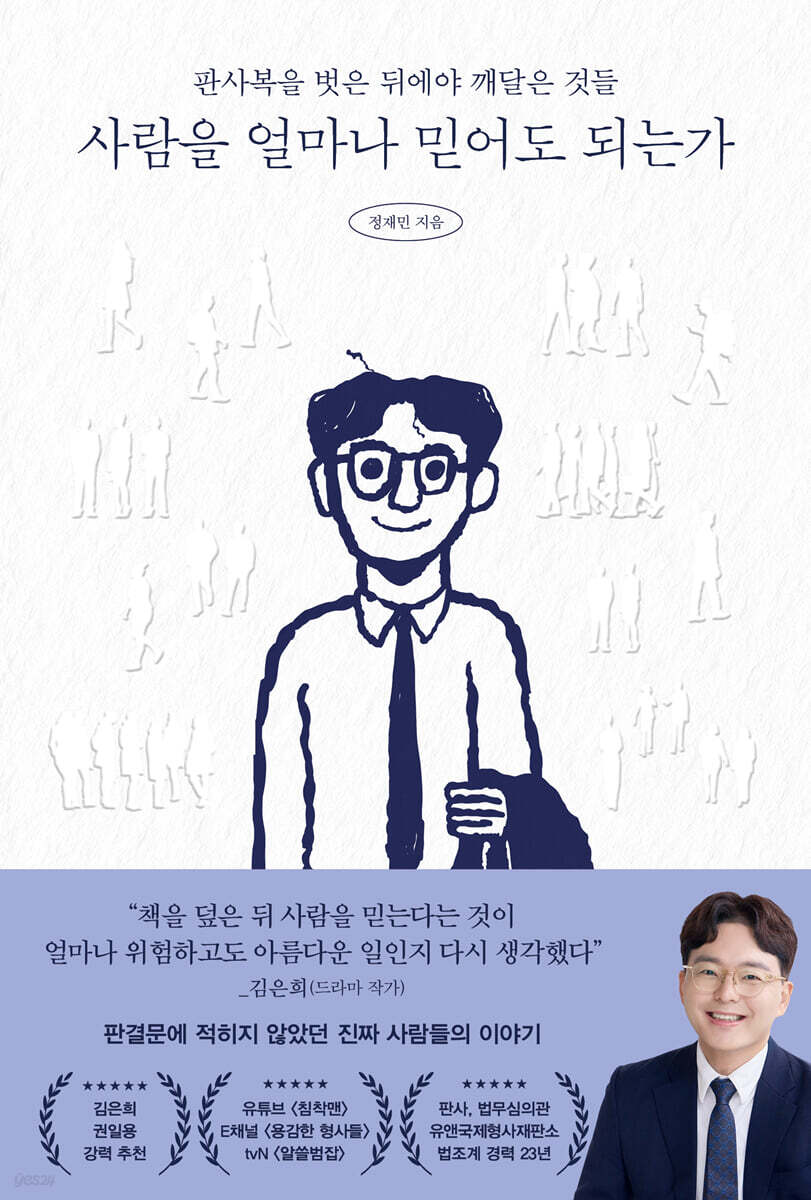
How much can you trust people?
 |
Description
Book Introduction
“What we need is not the skill of doubting, but the skill of believing wisely.”
Lawyer Jeong Jae-min, a former judge, recorded the story while going back and forth between the law office, police station, detention center, and courtroom.
Our social story
★Highly recommended by drama writer Kim Eun-hee of "Signal" and "Kingdom," and profiler Kwon Il-yong★
★New Essay by the Author of "Bohemian Rhapsody" and "Dokdo in the Hague"★
Over the past decade, fraud cases have increased by 80 percent, from 240,000 to 420,000.
In an era where fraud has surpassed theft as the number one crime, mutual suspicion and distrust have become natural.
Neither judges, lawyers, nor ordinary citizens are free from this danger.
As a lawyer, I have been defrauded, witnessed the difficulties of police investigations, met defendants in detention centers expressing their anxiety and resentment, and witnessed countless courtroom battles where suspects ultimately became accustomed to suspicion.
But this book is not simply an accusation or a cynical record.
The author emphasizes that in order to live a human life, beyond the binary choice of whether to trust others or not, we must ultimately have the courage to take the risk of "trust."
The paradox that doubt protects us, but only faith keeps us alive is the message that runs through the entire book.
Jeong Jae-min's writing is a record of events more dramatic than a courtroom drama, but it is also a record of reflection on humanity and society.
Even amidst sharp observations, he maintains a sense of humor and warmth, and ponders what we must protect in an age where distrust has become the default.
An individual's choice to trust others even at the cost of opportunity resonates even more deeply in a society dominated by distrust.
The author continues to speak to the reader.
To be happy, you have to take the risk of trust. Let's trust each other more and propose to each other more often.
Lawyer Jeong Jae-min, a former judge, recorded the story while going back and forth between the law office, police station, detention center, and courtroom.
Our social story
★Highly recommended by drama writer Kim Eun-hee of "Signal" and "Kingdom," and profiler Kwon Il-yong★
★New Essay by the Author of "Bohemian Rhapsody" and "Dokdo in the Hague"★
Over the past decade, fraud cases have increased by 80 percent, from 240,000 to 420,000.
In an era where fraud has surpassed theft as the number one crime, mutual suspicion and distrust have become natural.
Neither judges, lawyers, nor ordinary citizens are free from this danger.
As a lawyer, I have been defrauded, witnessed the difficulties of police investigations, met defendants in detention centers expressing their anxiety and resentment, and witnessed countless courtroom battles where suspects ultimately became accustomed to suspicion.
But this book is not simply an accusation or a cynical record.
The author emphasizes that in order to live a human life, beyond the binary choice of whether to trust others or not, we must ultimately have the courage to take the risk of "trust."
The paradox that doubt protects us, but only faith keeps us alive is the message that runs through the entire book.
Jeong Jae-min's writing is a record of events more dramatic than a courtroom drama, but it is also a record of reflection on humanity and society.
Even amidst sharp observations, he maintains a sense of humor and warmth, and ponders what we must protect in an age where distrust has become the default.
An individual's choice to trust others even at the cost of opportunity resonates even more deeply in a society dominated by distrust.
The author continues to speak to the reader.
To be happy, you have to take the risk of trust. Let's trust each other more and propose to each other more often.
- You can preview some of the book's contents.
Preview
index
prolog
Chapter 1.
At the Lawyer's Office_Learning the Lawyer's Law of Matchmaking
An office filled with music | From package tours to independent travel | Why I quit being a judge | A lawyer's relationship | A fraud lawyer who gets scammed | How much trust should you have in people? | Why I only take on a small number of cases | Pursuing legal battles | Like a Sherpa in the Himalayas | Like a psychoanalyst's couch | What AI can't do: give and receive trust
Chapter 2.
At the police station_Thinking of Batman
Conflicting Images of the Police | Childhood Memories of the Police | Between the Police and the Prosecutor | Why I Always Attend Police Interrogations | The Proclamation That Investigations Reveal the Truth | A World Where Fraud Runs | Falling for a Laptop Repair Scam | Why It's Difficult to Catch Fraudsters | A Time When I Naively Believed in Justice | Thinking of Batman
Chapter 3.
In the detention center_Speaking of hope behind bars
From a suspect's emergency arrest to detention | The road to the detention center | Can I get coffee after being arrested? | Inmates have parents, too | A lawyer is not a butler | When a lawyer becomes insecure | Sometimes, some people are rehabilitated | The prison of paradise
Chapter 4.
In court_while being tried
I will confirm the presence of the defense attorney | Please tell me the gist of the charges | Defendant, do you admit the charges | Please take evidence | Witnesses are also subject to distrust | Removing the MR and comparing only the lyrics | I will begin the closing argument | Beyond reasonable doubt | Standards for determining sentencing | Distrust due to the belief in preferential treatment | Feelings on the day of sentencing | The court is a world supported by the conflict between trust and distrust
Epilogue
Chapter 1.
At the Lawyer's Office_Learning the Lawyer's Law of Matchmaking
An office filled with music | From package tours to independent travel | Why I quit being a judge | A lawyer's relationship | A fraud lawyer who gets scammed | How much trust should you have in people? | Why I only take on a small number of cases | Pursuing legal battles | Like a Sherpa in the Himalayas | Like a psychoanalyst's couch | What AI can't do: give and receive trust
Chapter 2.
At the police station_Thinking of Batman
Conflicting Images of the Police | Childhood Memories of the Police | Between the Police and the Prosecutor | Why I Always Attend Police Interrogations | The Proclamation That Investigations Reveal the Truth | A World Where Fraud Runs | Falling for a Laptop Repair Scam | Why It's Difficult to Catch Fraudsters | A Time When I Naively Believed in Justice | Thinking of Batman
Chapter 3.
In the detention center_Speaking of hope behind bars
From a suspect's emergency arrest to detention | The road to the detention center | Can I get coffee after being arrested? | Inmates have parents, too | A lawyer is not a butler | When a lawyer becomes insecure | Sometimes, some people are rehabilitated | The prison of paradise
Chapter 4.
In court_while being tried
I will confirm the presence of the defense attorney | Please tell me the gist of the charges | Defendant, do you admit the charges | Please take evidence | Witnesses are also subject to distrust | Removing the MR and comparing only the lyrics | I will begin the closing argument | Beyond reasonable doubt | Standards for determining sentencing | Distrust due to the belief in preferential treatment | Feelings on the day of sentencing | The court is a world supported by the conflict between trust and distrust
Epilogue
Detailed image

Into the book
Since unhappiness also arises from relationships with others, you can prevent unhappiness at its source by not trusting others.
However, if you are always suspicious and wary of others, you will block the opportunity to give and receive love and feel happiness.
Here, the question arises as to how much we can trust people in order to live as happily as possible.
--- p.9 From "Prologue"
As a lawyer, I basically try to adopt a psychoanalyst-like attitude when listening to the perspectives of counselors or clients.
While not being ethically harsh and taking a friendly stance, he does not unconditionally take sides.
How could I possibly know all your feelings? I will listen to what you have to say without being impatient, without judging it as good or evil, and without using your misfortune as fuel for my own happiness. I will simply store it away in a drawer in my heart and listen with the intention of completely forgetting it when you feel embarrassed.
The very act of listening so carefully, of being present in a place where someone is struggling, exerts a strange power.
--- pp.89-90 From “Chapter 1: In the Lawyer’s Office - Learning the Law of Lawyers”
At some point, they started to continuously try to reach an agreement.
If the parties reach an agreement to withdraw the complaint, there is no need to proceed with a complicated investigation.
Justice can only be achieved if those who deserve to be punished are properly punished, but seeing that even investigative agencies keep resorting to tricks to get the job done easily makes me feel depressed and think that the future of our society is not bright.
--- p.154 From “Chapter 2 At the Police Station - Thinking of Batman”
Even I, a former judge, couldn't break through this wall, so what about ordinary people who have never worked in the legal profession?
There were many times in the past when I looked at criminal case records and wondered why a person was not indicted, but it was only after I became a victim of the case that I realized it vividly.
The true power of the prosecution lies in the power not to indict, which grants a pardon to the guilty, rather than the power to indict, which sends the guilty to prison.
--- p.158 From “Chapter 2 At the Police Station - Thinking of Batman”
I listened for a moment.
He spent most of the meeting explaining unnecessary facts one by one.
When the visiting time ended and the guards called him out, he continued to talk while walking out.
It was as if the exam time was over and the proctor had taken away the answer sheet, but the student was still trying to write one more character on the (actually meaningless) answer sheet.
It was because of anxiety.
The anxiety that he might be locked up in prison and never be able to get out, the anxiety that this lawyer wouldn't be able to defend him properly, that anxiety was equally strong in the father who called me every three days to check if I was doing what my son asked.
--- p.215 From “Chapter 3 In the Detention Center - Speaking of Hope Behind Iron Bars”
From the judge's point of view, it is natural that he does not trust the defendant.
This is because there is a motivation to reduce punishment even by lying.
I don't even trust lawyers.
I think he is fundamentally on the defendant's side and would lie if the defendant gave him a lot of money.
Even prosecutors don't fully trust judges.
Many prosecutors believe that judges are naive, unaware of the reality of crime and easily fooled by criminals.
Judges are the only ones who can keep prosecutors in check, so there are many prosecutors who are dissatisfied with judges and gossip about them a lot.
Even lawyers don't completely trust judges.
Although there are many judges who judge properly, there are also quite a few judges who have standards of judgment that are far from common sense or who cannot escape from preconceived notions.
With these people gathered in court for every case, checking each other to see who to trust and how much, and whether they will make any absurd remarks or judgments, the courtroom atmosphere cannot be warm and comfortable.
--- pp.343-344 From “Chapter 4 In the Court - During the Trial and Being Tried”
This is the story told by Julia Roberts in the first scene of the Bali-set film Eat, Pray, Love, which she saw in Bali.
“Once upon a time, there lived a poor man in Italy. Every day he went to church and knelt before the statues of saints and prayed, please, please, to win the lottery and become rich.
The saint, unable to bear it any longer, transformed into a human and spoke to him.
Please, please, please buy a lottery ticket and say, “Happiness comes from relationships with others who trust each other.”
A saint might say to someone who prays for happiness without anyone believing in him,
“Please, please, please trust people and tell them.” Trusting people may be the minimum lottery ticket to a happy life.
However, if you are always suspicious and wary of others, you will block the opportunity to give and receive love and feel happiness.
Here, the question arises as to how much we can trust people in order to live as happily as possible.
--- p.9 From "Prologue"
As a lawyer, I basically try to adopt a psychoanalyst-like attitude when listening to the perspectives of counselors or clients.
While not being ethically harsh and taking a friendly stance, he does not unconditionally take sides.
How could I possibly know all your feelings? I will listen to what you have to say without being impatient, without judging it as good or evil, and without using your misfortune as fuel for my own happiness. I will simply store it away in a drawer in my heart and listen with the intention of completely forgetting it when you feel embarrassed.
The very act of listening so carefully, of being present in a place where someone is struggling, exerts a strange power.
--- pp.89-90 From “Chapter 1: In the Lawyer’s Office - Learning the Law of Lawyers”
At some point, they started to continuously try to reach an agreement.
If the parties reach an agreement to withdraw the complaint, there is no need to proceed with a complicated investigation.
Justice can only be achieved if those who deserve to be punished are properly punished, but seeing that even investigative agencies keep resorting to tricks to get the job done easily makes me feel depressed and think that the future of our society is not bright.
--- p.154 From “Chapter 2 At the Police Station - Thinking of Batman”
Even I, a former judge, couldn't break through this wall, so what about ordinary people who have never worked in the legal profession?
There were many times in the past when I looked at criminal case records and wondered why a person was not indicted, but it was only after I became a victim of the case that I realized it vividly.
The true power of the prosecution lies in the power not to indict, which grants a pardon to the guilty, rather than the power to indict, which sends the guilty to prison.
--- p.158 From “Chapter 2 At the Police Station - Thinking of Batman”
I listened for a moment.
He spent most of the meeting explaining unnecessary facts one by one.
When the visiting time ended and the guards called him out, he continued to talk while walking out.
It was as if the exam time was over and the proctor had taken away the answer sheet, but the student was still trying to write one more character on the (actually meaningless) answer sheet.
It was because of anxiety.
The anxiety that he might be locked up in prison and never be able to get out, the anxiety that this lawyer wouldn't be able to defend him properly, that anxiety was equally strong in the father who called me every three days to check if I was doing what my son asked.
--- p.215 From “Chapter 3 In the Detention Center - Speaking of Hope Behind Iron Bars”
From the judge's point of view, it is natural that he does not trust the defendant.
This is because there is a motivation to reduce punishment even by lying.
I don't even trust lawyers.
I think he is fundamentally on the defendant's side and would lie if the defendant gave him a lot of money.
Even prosecutors don't fully trust judges.
Many prosecutors believe that judges are naive, unaware of the reality of crime and easily fooled by criminals.
Judges are the only ones who can keep prosecutors in check, so there are many prosecutors who are dissatisfied with judges and gossip about them a lot.
Even lawyers don't completely trust judges.
Although there are many judges who judge properly, there are also quite a few judges who have standards of judgment that are far from common sense or who cannot escape from preconceived notions.
With these people gathered in court for every case, checking each other to see who to trust and how much, and whether they will make any absurd remarks or judgments, the courtroom atmosphere cannot be warm and comfortable.
--- pp.343-344 From “Chapter 4 In the Court - During the Trial and Being Tried”
This is the story told by Julia Roberts in the first scene of the Bali-set film Eat, Pray, Love, which she saw in Bali.
“Once upon a time, there lived a poor man in Italy. Every day he went to church and knelt before the statues of saints and prayed, please, please, to win the lottery and become rich.
The saint, unable to bear it any longer, transformed into a human and spoke to him.
Please, please, please buy a lottery ticket and say, “Happiness comes from relationships with others who trust each other.”
A saint might say to someone who prays for happiness without anyone believing in him,
“Please, please, please trust people and tell them.” Trusting people may be the minimum lottery ticket to a happy life.
--- From "Epilogue" pp.353-354
Publisher's Review
“The pain of being robbed because of trust and being betrayed because of trust
“Only another faith can heal”
After a time when I firmly believed in justice
The story of becoming a lawyer who simply hopes that no one is wronged.
During his time as a judge, the author's parents were falsely diagnosed with rheumatism by a fraudulent doctor and were put on potent chemotherapy for seven years.
He sues the doctor, but the doctor is found not guilty.
The reason is that 'it is acknowledged that the suspect lied to patients about rheumatism, but since the suspect did so to enhance his reputation as a doctor, the crime of fraud, which is a property crime, does not apply.'
He felt humiliated as a member of the judicial system.
I realized that there were many hurdles to overcome even in punishing a single fraudulent doctor at a general hospital in a small provincial city.
In the 15 years since then, the author confesses that his trust in society and people has decreased significantly.
But still, he never gives up his courage to trust people, defends others, and works on the front lines of the law.
If I trust more than I do now, I will be deceived by others more often, but if I live with the door locked because I cannot trust others, my life will not get any better than it is now, and I will probably regret it at the end of my life.
He says he doesn't want to waste his life doing useless, wasteful things.
I want to meet some good people, have good conversations with acquaintances, do good things, see good scenes, maintain a good mood, and write good articles.
I hope that not only myself but everyone can live like that.
So today, we make a small effort to transform our community into a better place for each individual to live.
“To live as if you were alive, you must build relationships with others.”
Proof that my decision to believe was not wrong
Attorney Jeong Jae-min says that being a lawyer is like being a designated driver.
Because we put our customers in the backseat, drive them where they want to go, and appeal to them to trust us.
When lawyers and clients become a team, they receive a score sheet every time they visit the police, prosecutors, or courts, asking whether they are trusted or not.
Before putting the client in the back seat, the author first listens to what he has to say.
Because I don't think of it as just doing work, but rather as building a deep relationship with my clients.
When listening to a client's story, take a friendly stance, but do not unconditionally take their side.
I will listen with the mindset of, 'How could I possibly know all your feelings? I will listen willingly to what you have to say without being impatient. I will listen without judging good or evil, and I will not use your unhappiness as fuel for my happiness. I will just keep it all in a drawer in my heart and completely forget it when you feel embarrassed.'
The very act of listening so attentively, of being present in that way, exerts a strange power.
At the foundation of all this is faith.
Therefore, the author decides to believe today as well.
I am confident that the happiness and enrichment of life that comes from it will more than compensate for the pain and loss that sometimes comes from being deceived by others.
“Only another faith can heal”
After a time when I firmly believed in justice
The story of becoming a lawyer who simply hopes that no one is wronged.
During his time as a judge, the author's parents were falsely diagnosed with rheumatism by a fraudulent doctor and were put on potent chemotherapy for seven years.
He sues the doctor, but the doctor is found not guilty.
The reason is that 'it is acknowledged that the suspect lied to patients about rheumatism, but since the suspect did so to enhance his reputation as a doctor, the crime of fraud, which is a property crime, does not apply.'
He felt humiliated as a member of the judicial system.
I realized that there were many hurdles to overcome even in punishing a single fraudulent doctor at a general hospital in a small provincial city.
In the 15 years since then, the author confesses that his trust in society and people has decreased significantly.
But still, he never gives up his courage to trust people, defends others, and works on the front lines of the law.
If I trust more than I do now, I will be deceived by others more often, but if I live with the door locked because I cannot trust others, my life will not get any better than it is now, and I will probably regret it at the end of my life.
He says he doesn't want to waste his life doing useless, wasteful things.
I want to meet some good people, have good conversations with acquaintances, do good things, see good scenes, maintain a good mood, and write good articles.
I hope that not only myself but everyone can live like that.
So today, we make a small effort to transform our community into a better place for each individual to live.
“To live as if you were alive, you must build relationships with others.”
Proof that my decision to believe was not wrong
Attorney Jeong Jae-min says that being a lawyer is like being a designated driver.
Because we put our customers in the backseat, drive them where they want to go, and appeal to them to trust us.
When lawyers and clients become a team, they receive a score sheet every time they visit the police, prosecutors, or courts, asking whether they are trusted or not.
Before putting the client in the back seat, the author first listens to what he has to say.
Because I don't think of it as just doing work, but rather as building a deep relationship with my clients.
When listening to a client's story, take a friendly stance, but do not unconditionally take their side.
I will listen with the mindset of, 'How could I possibly know all your feelings? I will listen willingly to what you have to say without being impatient. I will listen without judging good or evil, and I will not use your unhappiness as fuel for my happiness. I will just keep it all in a drawer in my heart and completely forget it when you feel embarrassed.'
The very act of listening so attentively, of being present in that way, exerts a strange power.
At the foundation of all this is faith.
Therefore, the author decides to believe today as well.
I am confident that the happiness and enrichment of life that comes from it will more than compensate for the pain and loss that sometimes comes from being deceived by others.
GOODS SPECIFICS
- Date of issue: October 31, 2025
- Page count, weight, size: 356 pages | 546g | 142*210*20mm
- ISBN13: 9791169851602
- ISBN10: 1169851606
You may also like
카테고리
korean


korean

![GQ KOREA Mark (Monthly): December [2025]](http://librairie.coreenne.fr/cdn/shop/files/8ef265dbbfbf186523ed75ba7319009d.jpg?v=1765340328&width=3840)


