

The Invisible Map of Money
 |
Description
Book Introduction
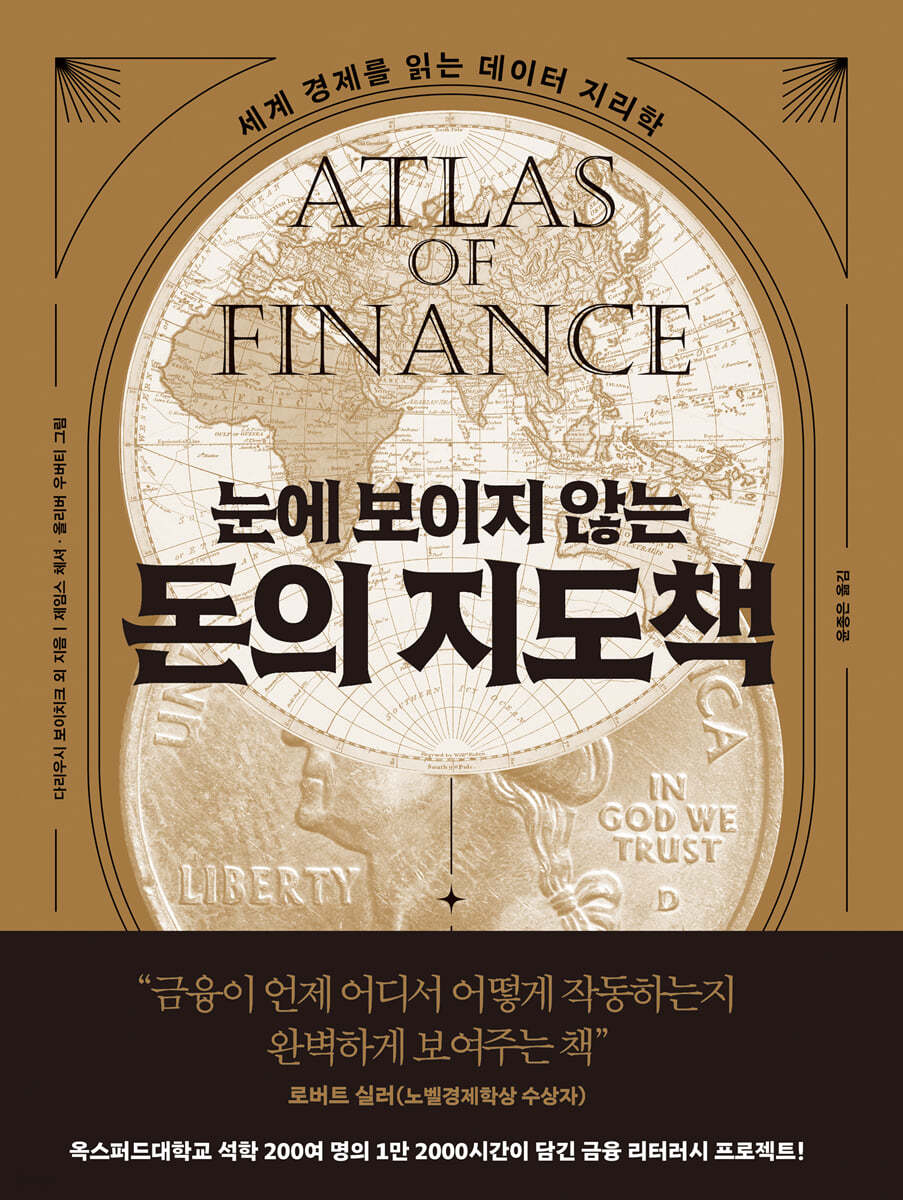
The authors of the best-selling "The Invisible Atlas," which provided geopolitical insights through the brilliant visualization of "data geography," have collaborated with a research team at Oxford University to produce a new masterpiece that captures the patterns and big data of the financial world. This time, it is “The Invisible Map of Money,” or “The Map of Money.” Oliver Uberti and James Cheshire, winners of the Royal Geographical Society's Cuthbert Peake Prize for their work revealing the truth about the world through maps and infographics, join forces with a team of 200 Oxford University researchers led by geographer Dariush Wojcik to dissect the inner workings of finance. The culmination of a massive project that took 12,000 hours, this book traces the history of finance, from the origins of currency on Sumerian clay tablets, the birth of insurance, the secrets of tax havens, the truth about carbon emissions, the emergence and volatility of cryptocurrencies like Bitcoin, and the GameStop stock price surge, revealing the truth about the global economy. This book deeply analyzes the history of finance and the nature of capital, visualizing it through maps and infographics to provide readers with new insights into macroeconomic trends. |
- You can preview some of the book's contents.
Preview
index
Introduction | Unraveling the Mysteries of Finance
Chapter 1: History and Geography
Foundations Made of Clay | The Rise of Metal Currency | Follow the Money | The Yuan and Its Ancestors | The World's Money Mountain | Who Paid for It? | Financial Geographer Adam Smith | The Ghost of Money Haunting a World of Contradictions | Is Finance a Beauty Pageant? | Made in USA
Chapter 2 Assets and Markets
A Market at a Glance | Unchanging Currency | Risks Are a Treasure | Boom Town | Infrastructure Monopoly | The Prerogatives of the Few | The Economics of Selling Out | Money on the Move | A Consistent Pattern | A Shot at Wall Street
Chapter 3 Investors and Investment
The Safest Bets | If There's Only One Free Lunch in the Financial World | Is Homeland Bias 'Rational'? | Ride-Sharing Competition | (In)Retirement Security | Pension Grinder | Who Owns the Mall? | A World Turned Upside Down | The Seed Money of the State | The World China Envisions
Chapter 4: Brokerage and Technology
People Making Money Rain | Institutions Dominating the Market | What is a SPAC? | Maritime Risk Sharing | Halley's Calculation | The Quantified Consumer | Faster, Faster | A New World Opened by Smartphones | The Future of Central Bank Digital Currency | Bitcoin, the Electric Hippo
Chapter 5 Cities and Centers
From Venice to London | The hegemony of the global economy | Where the world's money gathers | The ascending Chinese dream? | The surge of mergers | The invisible paradise | All roads lead to Bengaluru | A capital mosaic adorned by law | London's workforce | The new world conceived by fintech
Chapter 6: Bubbles and Crises
The Never-ending Financial Crisis | Theories of Instability | The Great Futures Earthquake | The Financial Crisis as Seen in the Media | The Fall of Northern Rock | How Financial Innovation Transformed the US Economy | The Eurozone Debt Crisis | Solvency Matters More Than Solidarity | Bad Lending | How to Rob a Bank
Chapter 7 Regulation and Governance
Warning Signs | (Article) Local Governance | Banks' Banks | Money Makes Law | Tax Pipes Leaking Offshore | Laundries of the World | The Giant Department Stores of the International Financial Services Industry | Assessments from a Distant Place | Changes at the Top | The Power of the People?
Chapter 8 Society and Environment
The Geography of Real Estate Inequality | Microfinance | Are You Financially Illiterate? | Weaponized Finance | Mining the Future | A Drop in the Ocean? | Alipay's Forest Tech | Burning Portfolio | Sustainable Big Picture | Where Does Money Ultimately Go?
Notes and References
Image source
Acknowledgements
About the Author
Chapter 1: History and Geography
Foundations Made of Clay | The Rise of Metal Currency | Follow the Money | The Yuan and Its Ancestors | The World's Money Mountain | Who Paid for It? | Financial Geographer Adam Smith | The Ghost of Money Haunting a World of Contradictions | Is Finance a Beauty Pageant? | Made in USA
Chapter 2 Assets and Markets
A Market at a Glance | Unchanging Currency | Risks Are a Treasure | Boom Town | Infrastructure Monopoly | The Prerogatives of the Few | The Economics of Selling Out | Money on the Move | A Consistent Pattern | A Shot at Wall Street
Chapter 3 Investors and Investment
The Safest Bets | If There's Only One Free Lunch in the Financial World | Is Homeland Bias 'Rational'? | Ride-Sharing Competition | (In)Retirement Security | Pension Grinder | Who Owns the Mall? | A World Turned Upside Down | The Seed Money of the State | The World China Envisions
Chapter 4: Brokerage and Technology
People Making Money Rain | Institutions Dominating the Market | What is a SPAC? | Maritime Risk Sharing | Halley's Calculation | The Quantified Consumer | Faster, Faster | A New World Opened by Smartphones | The Future of Central Bank Digital Currency | Bitcoin, the Electric Hippo
Chapter 5 Cities and Centers
From Venice to London | The hegemony of the global economy | Where the world's money gathers | The ascending Chinese dream? | The surge of mergers | The invisible paradise | All roads lead to Bengaluru | A capital mosaic adorned by law | London's workforce | The new world conceived by fintech
Chapter 6: Bubbles and Crises
The Never-ending Financial Crisis | Theories of Instability | The Great Futures Earthquake | The Financial Crisis as Seen in the Media | The Fall of Northern Rock | How Financial Innovation Transformed the US Economy | The Eurozone Debt Crisis | Solvency Matters More Than Solidarity | Bad Lending | How to Rob a Bank
Chapter 7 Regulation and Governance
Warning Signs | (Article) Local Governance | Banks' Banks | Money Makes Law | Tax Pipes Leaking Offshore | Laundries of the World | The Giant Department Stores of the International Financial Services Industry | Assessments from a Distant Place | Changes at the Top | The Power of the People?
Chapter 8 Society and Environment
The Geography of Real Estate Inequality | Microfinance | Are You Financially Illiterate? | Weaponized Finance | Mining the Future | A Drop in the Ocean? | Alipay's Forest Tech | Burning Portfolio | Sustainable Big Picture | Where Does Money Ultimately Go?
Notes and References
Image source
Acknowledgements
About the Author
Detailed image

Into the book
Atlases are products of their time and place.
The authors of this book are drawn from European and North American perspectives, and have been influenced by topics that have heated up the financial sector in the early 2020s, including fintech and Bitcoin.
However, we have tried to overcome such biases by paying attention to the historical and geographical diversity of the phenomena covered in the book, broadening the scope of financial topics, historical periods, and geographic scope, and utilizing a variety of map projections, colors, and visualization methods.
--- From the "Preface"
While remittances are a crucial tool in international development strategies, their geographic imbalance raises several questions.
How can we address the gap between those with access to financial services, including remittances, and those without? Is development dependent on remittances sustainable? If a country promotes remittances as a form of development, how can it support households unable to migrate? And how can those who have fled their homelands be guaranteed safety and human rights abroad? Despite these numerous problems with remittances, billions of people around the world still rely on remittance income for their livelihoods.
--- From "Chapter 2: Money for Moving"
But the performance of the U.S. stock market has left advocates of geographical diversification baffled.
Since 2009, the U.S. stock market has outperformed other markets to the point where the benefits of diversification have been overshadowed.
The US economy, capital markets, and the power of the dollar had a major impact here.
Another reason why the absolute benefits of geographical diversification are diminishing day by day is the integration of global capital markets.
As can be seen in the graph below from the left, the correlation coefficient of the stock market has increased significantly, especially among developed markets.
In the end, Mark Twain's advice wasn't wrong.
--- From "Chapter 3: If There Is Only One Free Lunch in the Financial World"
Selling shares to some investors at a price lower than the final market price during an initial public offering (IPO) may seem illegal at first glance, but it is a common practice.
This practice, known as "underpricing of IPO shares," aims to increase demand for the stock and attract public attention by raising the stock price on the first day of listing.
Royal Mail's IPO was underwritten by an investment bank underwriting team led by Goldman Sachs and UBS, who determined who would be given priority to buy shares and who would not. The IPO underwriting services market is dominated by a small number of companies, and this tendency is particularly pronounced in developing countries with smaller markets (see graph below). Therefore, large issuers like Royal Mail lack the reliance of many banks.
--- From "Chapter 4: Institutions that Dominate the Market"
While Bitcoin has made significant strides, including lower transaction costs, increased blockchain security, and increased adoption, the Bitcoin blockchain consumes an equivalent amount of energy to the entire country, such as Belgium or Chile.
This is because Bitcoin's proof-of-work algorithm, used to verify transactions, consumes a significant amount of energy.
A single Bitcoin transaction uses approximately 707.6 kilowatt-hours of electricity, which is equivalent to the electricity used by a typical American household for 24 days.
--- From "Chapter 4: Bitcoin, the Electricity-Eating Hippopotamus"
Many financial companies measured and managed financial risks and established reserves based on VaR, but they collapsed helplessly in the face of the crisis.
Thus, after the 2008 financial crisis, regulators began using a new metric called Expected Shortfall (ES) instead of VaR. ES is a metric that measures the expected loss when losses exceed VaR.
However, extreme events have the problem that it is difficult to calculate ES because the data itself is insufficient.
Ultimately, no matter what data, models, or technologies we use to manage financial risk, it is impossible to completely eliminate uncertainty.
Moreover, as the scale and complexity of international finance grows by the day, financial crises will likely have greater impacts on more regions in the future.
--- From "Chapter 7 Warning Signs"
As the impact of financial sanctions has grown due to globalization and financialization, the use of financial sanctions as a weapon has also increased explosively.
In an era of globalization, where economies are closely intertwined, excluding certain countries from major financial networks poses new challenges and enormous costs.
But at the same time, it is true that as finance becomes more technological and digitalized, it has become easier to implement, monitor, and evaluate financial sanctions.
--- From "Chapter 8: Finance as a Weapon"
A company's carbon footprint is a good starting point for decision-making, but it alone isn't enough to make sound decisions.
A company's carbon budget (the amount of carbon emissions it is allowed to emit to achieve the Paris Agreement goals) should vary depending on the region and sector it operates in.
For example, an Asian cement manufacturer might emit far more carbon per unit of revenue than a European media company, but the world can't run on media companies alone.
The authors of this book are drawn from European and North American perspectives, and have been influenced by topics that have heated up the financial sector in the early 2020s, including fintech and Bitcoin.
However, we have tried to overcome such biases by paying attention to the historical and geographical diversity of the phenomena covered in the book, broadening the scope of financial topics, historical periods, and geographic scope, and utilizing a variety of map projections, colors, and visualization methods.
--- From the "Preface"
While remittances are a crucial tool in international development strategies, their geographic imbalance raises several questions.
How can we address the gap between those with access to financial services, including remittances, and those without? Is development dependent on remittances sustainable? If a country promotes remittances as a form of development, how can it support households unable to migrate? And how can those who have fled their homelands be guaranteed safety and human rights abroad? Despite these numerous problems with remittances, billions of people around the world still rely on remittance income for their livelihoods.
--- From "Chapter 2: Money for Moving"
But the performance of the U.S. stock market has left advocates of geographical diversification baffled.
Since 2009, the U.S. stock market has outperformed other markets to the point where the benefits of diversification have been overshadowed.
The US economy, capital markets, and the power of the dollar had a major impact here.
Another reason why the absolute benefits of geographical diversification are diminishing day by day is the integration of global capital markets.
As can be seen in the graph below from the left, the correlation coefficient of the stock market has increased significantly, especially among developed markets.
In the end, Mark Twain's advice wasn't wrong.
--- From "Chapter 3: If There Is Only One Free Lunch in the Financial World"
Selling shares to some investors at a price lower than the final market price during an initial public offering (IPO) may seem illegal at first glance, but it is a common practice.
This practice, known as "underpricing of IPO shares," aims to increase demand for the stock and attract public attention by raising the stock price on the first day of listing.
Royal Mail's IPO was underwritten by an investment bank underwriting team led by Goldman Sachs and UBS, who determined who would be given priority to buy shares and who would not. The IPO underwriting services market is dominated by a small number of companies, and this tendency is particularly pronounced in developing countries with smaller markets (see graph below). Therefore, large issuers like Royal Mail lack the reliance of many banks.
--- From "Chapter 4: Institutions that Dominate the Market"
While Bitcoin has made significant strides, including lower transaction costs, increased blockchain security, and increased adoption, the Bitcoin blockchain consumes an equivalent amount of energy to the entire country, such as Belgium or Chile.
This is because Bitcoin's proof-of-work algorithm, used to verify transactions, consumes a significant amount of energy.
A single Bitcoin transaction uses approximately 707.6 kilowatt-hours of electricity, which is equivalent to the electricity used by a typical American household for 24 days.
--- From "Chapter 4: Bitcoin, the Electricity-Eating Hippopotamus"
Many financial companies measured and managed financial risks and established reserves based on VaR, but they collapsed helplessly in the face of the crisis.
Thus, after the 2008 financial crisis, regulators began using a new metric called Expected Shortfall (ES) instead of VaR. ES is a metric that measures the expected loss when losses exceed VaR.
However, extreme events have the problem that it is difficult to calculate ES because the data itself is insufficient.
Ultimately, no matter what data, models, or technologies we use to manage financial risk, it is impossible to completely eliminate uncertainty.
Moreover, as the scale and complexity of international finance grows by the day, financial crises will likely have greater impacts on more regions in the future.
--- From "Chapter 7 Warning Signs"
As the impact of financial sanctions has grown due to globalization and financialization, the use of financial sanctions as a weapon has also increased explosively.
In an era of globalization, where economies are closely intertwined, excluding certain countries from major financial networks poses new challenges and enormous costs.
But at the same time, it is true that as finance becomes more technological and digitalized, it has become easier to implement, monitor, and evaluate financial sanctions.
--- From "Chapter 8: Finance as a Weapon"
A company's carbon footprint is a good starting point for decision-making, but it alone isn't enough to make sound decisions.
A company's carbon budget (the amount of carbon emissions it is allowed to emit to achieve the Paris Agreement goals) should vary depending on the region and sector it operates in.
For example, an Asian cement manufacturer might emit far more carbon per unit of revenue than a European media company, but the world can't run on media companies alone.
--- From "Chapter 8 Burning Portfolio"
Publisher's Review
★★★ “A book that perfectly shows how, when, and where finance works.” ―Robert Shiller (Nobel Prize winner in economics)
★★★ A financial literacy project that encompasses 12,000 hours of research by over 200 Oxford University scholars!
★★★ A visual feast from the bestseller "The Invisible Map" by James Cheshire and Oliver Uberti.
The invention of money changed the course of human history.
From Sumerian clay tablets to volatile cryptocurrencies,
A dynamic spectrum that permeates the rise and fall of humanity
"The Invisible Map of Money" depicts the complex world of finance with vivid infographics and intuitive maps, making it easy for anyone to understand financial knowledge that can often seem difficult.
If you just list numbers, you can easily become tired and feel distant from life.
This book narrows that gap by depicting the thrilling history of humanity's rise and fall surrounding currency.
The journey of currency, which began on Sumerian clay tablets, transcends time and space, from the past to the present and future of mankind.
The concept of ‘reserve currency’ is naturally embodied in the transmission path of the ancient Yuan.
The frequent cargo transport accidents during the Age of Exploration provide a glimpse into the origins of the insurance industry, which still exists today.
The Monopoly game board, which depicts the distribution of international infrastructure, reveals the encroachment of national industries by large capitalists, while the Bitcoin mining volume map depicts the light and dark sides of cryptocurrency, one of today's most relevant concepts.
In this way, this book not only piques readers' interest by depicting stories closely related to our lives, but also encompasses the rampant inequality within capitalism.
From the realities of economic research to the conflict between "ants" and "institutions" and even carbon emissions maps, it presents issues that are often invisible to our eyes, offering insights that can become weapons for life.
“Ideologies may pass, but geography remains eternal.”
A visual panorama unfolds by a world-renowned cartographic duo.
A Visual Guide to Financial Geopolitics: Surviving the Storm of Capitalism
The book's greatest appeal is its unique maps and infographics.
Maps are an excellent medium for understanding the complex flow of the world at a glance, but until now, the history of finance has never been depicted on a map.
This book features brilliantly reimagined maps and infographics by James Cheshire and Oliver Uberti, winners of the Cuthbert Peak Award, the world's most prestigious award for maps.
In their previous work, "The Invisible Map," the two authors demonstrated the power that only maps and infographics can offer in reading the world's trends and uncovering hidden truths.
The two cartographers use intuitive visuals to clearly reveal the interwoven layers of finance that are often hidden from view when reading only numbers.
The Bayrings Bank bankruptcy, which served as the backdrop for the film "Gamble," is visualized as seismic waves; the truth about tax havens, previously understood abstractly, is presented as a map of islands; and the reality of today's hottest climate crisis is explained with various coordinates and infographics.
Several media outlets, including the global economic newspaper Financial Times, praised this visualization.
This book is full of useful information for everyone, from students entering capitalist society to modern people already struggling in the field and experts in the field, as Nobel Prize winner in economics Robert Shiller put it.
"The first joint research project in human history to solve a real-world problem."
Over 200 Oxford scholars and 12,000 hours of intensive training
A Great Encounter of Diverse Academics for the Future of Humanity
This book also compiles a wealth of data and includes futurological reflections.
With the common goal of dissecting the complex world of finance, a research team led by Dariush Wojcik at Oxford University was formed, bringing together leading scholars from diverse fields such as economics, geography, political science, and data science.
“Creating this book was the most labor-intensive and creative project of the authors’ lives,” says Dariusz Wojcik, who led the massive project that took 12,000 hours of work by 200 people.
Conceived about 15 years ago, the project brought together hundreds of researchers and interviewed hundreds of financial practitioners around the world to strike a balance between theory and practice.
The result of meticulously processing highly reliable data through cross-validation by numerous researchers is the "Invisible Money Map."
We humans invented a great tool called 'money', but today's humans are dominated by tools from the past.
To move forward from the past and present, we must clearly understand how the invention of money affects us and how the world uses it.
Through this book, which combines precise and expert data with brilliant visualizations, readers will gain insights into discovering a new future through the inventions we've created.
★★★ A financial literacy project that encompasses 12,000 hours of research by over 200 Oxford University scholars!
★★★ A visual feast from the bestseller "The Invisible Map" by James Cheshire and Oliver Uberti.
The invention of money changed the course of human history.
From Sumerian clay tablets to volatile cryptocurrencies,
A dynamic spectrum that permeates the rise and fall of humanity
"The Invisible Map of Money" depicts the complex world of finance with vivid infographics and intuitive maps, making it easy for anyone to understand financial knowledge that can often seem difficult.
If you just list numbers, you can easily become tired and feel distant from life.
This book narrows that gap by depicting the thrilling history of humanity's rise and fall surrounding currency.
The journey of currency, which began on Sumerian clay tablets, transcends time and space, from the past to the present and future of mankind.
The concept of ‘reserve currency’ is naturally embodied in the transmission path of the ancient Yuan.
The frequent cargo transport accidents during the Age of Exploration provide a glimpse into the origins of the insurance industry, which still exists today.
The Monopoly game board, which depicts the distribution of international infrastructure, reveals the encroachment of national industries by large capitalists, while the Bitcoin mining volume map depicts the light and dark sides of cryptocurrency, one of today's most relevant concepts.
In this way, this book not only piques readers' interest by depicting stories closely related to our lives, but also encompasses the rampant inequality within capitalism.
From the realities of economic research to the conflict between "ants" and "institutions" and even carbon emissions maps, it presents issues that are often invisible to our eyes, offering insights that can become weapons for life.
“Ideologies may pass, but geography remains eternal.”
A visual panorama unfolds by a world-renowned cartographic duo.
A Visual Guide to Financial Geopolitics: Surviving the Storm of Capitalism
The book's greatest appeal is its unique maps and infographics.
Maps are an excellent medium for understanding the complex flow of the world at a glance, but until now, the history of finance has never been depicted on a map.
This book features brilliantly reimagined maps and infographics by James Cheshire and Oliver Uberti, winners of the Cuthbert Peak Award, the world's most prestigious award for maps.
In their previous work, "The Invisible Map," the two authors demonstrated the power that only maps and infographics can offer in reading the world's trends and uncovering hidden truths.
The two cartographers use intuitive visuals to clearly reveal the interwoven layers of finance that are often hidden from view when reading only numbers.
The Bayrings Bank bankruptcy, which served as the backdrop for the film "Gamble," is visualized as seismic waves; the truth about tax havens, previously understood abstractly, is presented as a map of islands; and the reality of today's hottest climate crisis is explained with various coordinates and infographics.
Several media outlets, including the global economic newspaper Financial Times, praised this visualization.
This book is full of useful information for everyone, from students entering capitalist society to modern people already struggling in the field and experts in the field, as Nobel Prize winner in economics Robert Shiller put it.
"The first joint research project in human history to solve a real-world problem."
Over 200 Oxford scholars and 12,000 hours of intensive training
A Great Encounter of Diverse Academics for the Future of Humanity
This book also compiles a wealth of data and includes futurological reflections.
With the common goal of dissecting the complex world of finance, a research team led by Dariush Wojcik at Oxford University was formed, bringing together leading scholars from diverse fields such as economics, geography, political science, and data science.
“Creating this book was the most labor-intensive and creative project of the authors’ lives,” says Dariusz Wojcik, who led the massive project that took 12,000 hours of work by 200 people.
Conceived about 15 years ago, the project brought together hundreds of researchers and interviewed hundreds of financial practitioners around the world to strike a balance between theory and practice.
The result of meticulously processing highly reliable data through cross-validation by numerous researchers is the "Invisible Money Map."
We humans invented a great tool called 'money', but today's humans are dominated by tools from the past.
To move forward from the past and present, we must clearly understand how the invention of money affects us and how the world uses it.
Through this book, which combines precise and expert data with brilliant visualizations, readers will gain insights into discovering a new future through the inventions we've created.
GOODS SPECIFICS
- Date of issue: January 20, 2025
- Format: Hardcover book binding method guide
- Page count, weight, size: 232 pages | 702g | 190*257*22mm
- ISBN13: 9791155817346
- ISBN10: 1155817346
You may also like
카테고리
korean


korean

![GQ KOREA Mark (Monthly): December [2025]](http://librairie.coreenne.fr/cdn/shop/files/8ef265dbbfbf186523ed75ba7319009d.jpg?v=1765340328&width=3840)


