

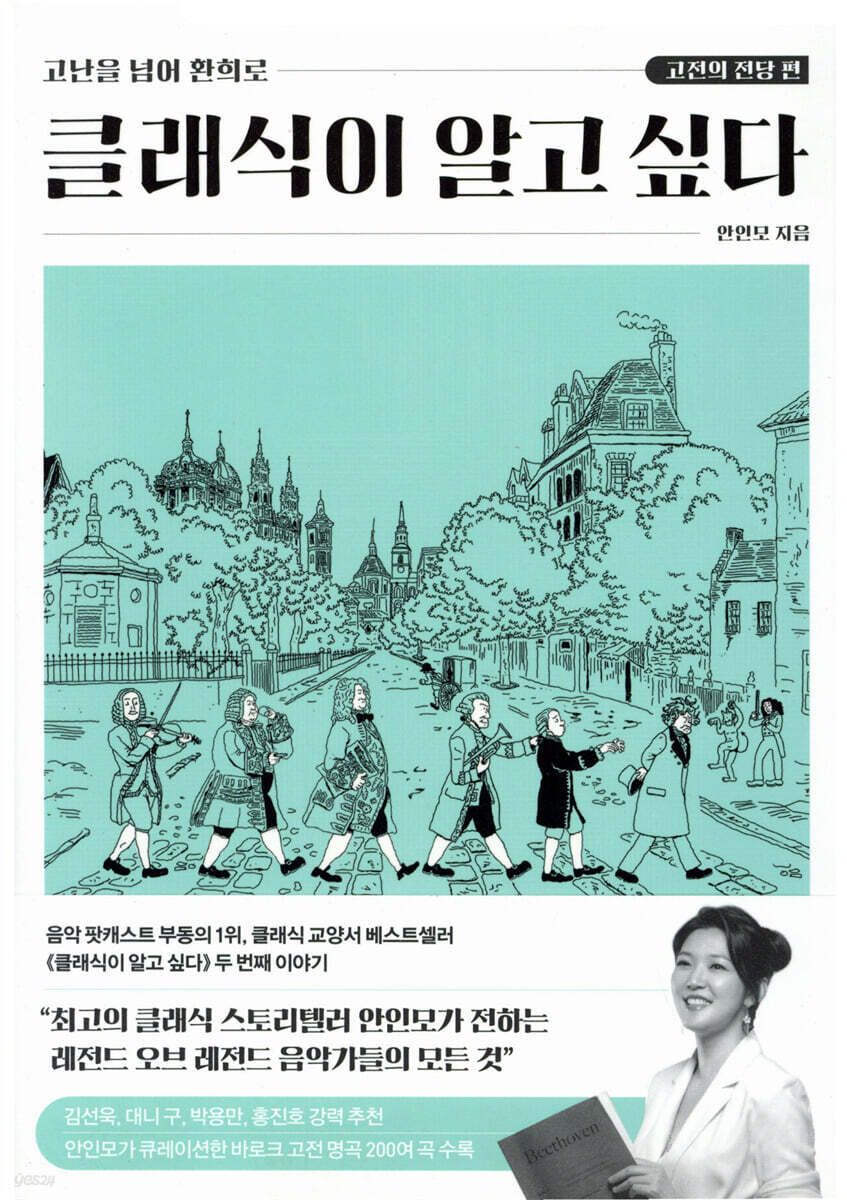
I Want to Know About Classics: The Hall of Fame
 |
Description
Book Introduction
* Highly recommended by classical music celebrities Kim Sun-wook, Danny Koo, Park Yong-man, and Hong Jin-ho * The undisputed #1 music podcast and a bestseller that has made its mark on classical education! The second installment of "I Want to Know About Classical Music," the Hall of Fame edition, is now available! The second volume of the best-selling "I Want to Know About Classical Music," which received rave reviews from both beginners and enthusiasts of classical music after its publication in 2019 and contributed to the popularization of classical music, has been published. If Volume 1, 'Romantic Salon', covered representative music and musicians of the Romantic era, Volume 2, 'Hall of Classics', covers the origins and roots of classical music and stories of Baroque classical music. Even those who are not familiar with classical music will have heard of the lives of musicians such as Vivaldi, Bach, Handel, Haydn, Mozart, Beethoven, and Paganini, along with a list of their major masterpieces and the behind-the-scenes stories of how these masterpieces were created. |
- You can preview some of the book's contents.
Preview
index
Beginning: Classics are eternal, the light and dark of legendary musicians
1.
Vivaldi, the secular priest who left behind the Four Seasons
2.
A tribute to Bach's timeless music
3.
Handel, the Messiah of Music and the Cosmopolitan
4.
Haydn, the father of music and symphony
5.
Mozart, The Angel's Magic Flute, Beloved by God
6.
The immortal Beethoven, who shook the nape of fate
extroversion.
Paganini, the violinist of Angels and Demons
Going Out: Towards a Moment of Unreachable Joy
1.
Vivaldi, the secular priest who left behind the Four Seasons
2.
A tribute to Bach's timeless music
3.
Handel, the Messiah of Music and the Cosmopolitan
4.
Haydn, the father of music and symphony
5.
Mozart, The Angel's Magic Flute, Beloved by God
6.
The immortal Beethoven, who shook the nape of fate
extroversion.
Paganini, the violinist of Angels and Demons
Going Out: Towards a Moment of Unreachable Joy
Detailed image
.jpg)
Into the book
In this episode of the Hall of Classics, we will explore the classics of classics, the classics of classics.
First, let's go back to the roots of the music we love today. Western music originated in ancient Greece and Rome, but the classical music played in concert halls today has its roots in the Baroque era.
This book talks about that very period, from the Baroque era.
---From "Starting"
Italy, violin, and concerto! Now, do these three words bring to mind "Vivaldi"? Before he was an opera composer or music director, Vivaldi was a violinist.
His natural instinct was to draw melodies over fast beats with nimble fingers and play lively dotted rhythms.
His violin concerto, composed for the schoolgirls of the Pietà, has a refined quality due to the censorship of this society, but in his later violin concertos, Vivaldi is fully felt.
The violin in the fast movement sounds like a busy and lively Vivaldi, while the violin in the slow movement sounds like he is sadly whispering a story about himself that he has never told anyone.
Sometimes it seems like we're singing together, and other times it seems like we're shouting and getting angry.
Vivaldi, who was one with the violin, would take the violin up on stage during breaks in his opera performances and show off his unique technique.
The reviews of those who saw Vivaldi's performance in person at the time were nothing short of astonishing.
---From "Vivaldi, the Secular Priest Who Left the Four Seasons Behind"
As Bach's health rapidly deteriorated, St. Thomas Church began looking for a successor in case of emergency.
Bach prepared in earnest what he would leave for his son and disciples, knowing that he might be called by God at any time.
First, he began composing music in order to pass on everything he had learned and organized about counterpoint.
Bach, who had been reading the Bible day and night by candlelight on moonlit nights his entire life, suddenly suffered from poor eyesight.
It was the result of straining my eyes by looking at sheet music my whole life.
He was operated on by British doctor Taylor, who happened to be visiting Leipzig, but his condition did not improve and he was confined to bed.
Eventually, the composing stops.
After three months of illness, Bach said this as soon as the bandages on his eyes were removed.
“Everything happened according to the Lord’s will.
“I can’t see anything!” As a result of the side effects of the surgery, Bach eventually lost his sight permanently.
Bach comforts his worried family by singing a hymn he included in his St. Matthew Passion.
---From "Bach, a tribute to timeless music"
Handel, whose eyesight had deteriorated rapidly, underwent cataract surgery, just like Bach.
Unfortunately, Handel's surgeon was the infamous British ophthalmologist Taylor, the same one who operated on Bach's eyes.
Handel reaches a point where he can no longer see anything.
From this time on, Handel lived in darkness, completely deprived of the light of the world, for about eight years.
Does Dr. Taylor even realize what he's done to the history of music? Even blind, Handel keeps his promise to the children of the Foundling Orphanage, conducting concerts every year on the organ himself.
On April 6, 1759, Handel collapsed while conducting at Covent Garden, just after finishing the last note of the final movement, the 'Amen Chorus'.
First, let's go back to the roots of the music we love today. Western music originated in ancient Greece and Rome, but the classical music played in concert halls today has its roots in the Baroque era.
This book talks about that very period, from the Baroque era.
---From "Starting"
Italy, violin, and concerto! Now, do these three words bring to mind "Vivaldi"? Before he was an opera composer or music director, Vivaldi was a violinist.
His natural instinct was to draw melodies over fast beats with nimble fingers and play lively dotted rhythms.
His violin concerto, composed for the schoolgirls of the Pietà, has a refined quality due to the censorship of this society, but in his later violin concertos, Vivaldi is fully felt.
The violin in the fast movement sounds like a busy and lively Vivaldi, while the violin in the slow movement sounds like he is sadly whispering a story about himself that he has never told anyone.
Sometimes it seems like we're singing together, and other times it seems like we're shouting and getting angry.
Vivaldi, who was one with the violin, would take the violin up on stage during breaks in his opera performances and show off his unique technique.
The reviews of those who saw Vivaldi's performance in person at the time were nothing short of astonishing.
---From "Vivaldi, the Secular Priest Who Left the Four Seasons Behind"
As Bach's health rapidly deteriorated, St. Thomas Church began looking for a successor in case of emergency.
Bach prepared in earnest what he would leave for his son and disciples, knowing that he might be called by God at any time.
First, he began composing music in order to pass on everything he had learned and organized about counterpoint.
Bach, who had been reading the Bible day and night by candlelight on moonlit nights his entire life, suddenly suffered from poor eyesight.
It was the result of straining my eyes by looking at sheet music my whole life.
He was operated on by British doctor Taylor, who happened to be visiting Leipzig, but his condition did not improve and he was confined to bed.
Eventually, the composing stops.
After three months of illness, Bach said this as soon as the bandages on his eyes were removed.
“Everything happened according to the Lord’s will.
“I can’t see anything!” As a result of the side effects of the surgery, Bach eventually lost his sight permanently.
Bach comforts his worried family by singing a hymn he included in his St. Matthew Passion.
---From "Bach, a tribute to timeless music"
Handel, whose eyesight had deteriorated rapidly, underwent cataract surgery, just like Bach.
Unfortunately, Handel's surgeon was the infamous British ophthalmologist Taylor, the same one who operated on Bach's eyes.
Handel reaches a point where he can no longer see anything.
From this time on, Handel lived in darkness, completely deprived of the light of the world, for about eight years.
Does Dr. Taylor even realize what he's done to the history of music? Even blind, Handel keeps his promise to the children of the Foundling Orphanage, conducting concerts every year on the organ himself.
On April 6, 1759, Handel collapsed while conducting at Covent Garden, just after finishing the last note of the final movement, the 'Amen Chorus'.
---From "The Messiah of Music, the Dapper Cosmopolitan Handel"
Publisher's Review
“Classics are eternal.
If there were no Baroque classics
Modern classical music would not have existed!”
Vivaldi, Bach, Handel, Haydn, Mozart, Beethoven, Paganini…
With Korea's best classic storyteller, Ahn In-mo
Time to read and listen to the origins of classical music, 'Baroque classical music'!
The success of the "I Want to Know About Classics" series by Ahn In-mo, who is considered Korea's best classical content creator and storyteller, lies in the fact that it is "the world's most entertaining and practical classical education book."
Following the first volume, 'Romantic Salon Edition', the recently published 'Hall of Classics Edition' not only vividly describes the life stories of Baroque classical musicians from the 17th and 18th centuries in the present tense, but also includes QR codes throughout the text that allow readers to immediately listen to over 200 famous pieces, giving it the unique advantage of being a 'classical entertainment book that allows reading and music appreciation at the same time'.
In addition, the 'Real-Kkok-al' corner, which organizes essential classical terminology for those new to classical music, and the 'Real-Kkae-al' corner, which contains anecdotes about musicians, are included, along with a list of key musicians and a playlist of recommended masterpieces that will allow you to have a classical conversation right away.
To commemorate the publication of Volume 2, “Hall of Classics,” enthusiastic praise is pouring in from some of the most famous classical music celebrities and opinion leaders.
The show shines with the addition of recommendations from pianist and conductor Kim Sun-wook, violinist Danny Gu, Seoul Arts Center Chairman and former Doosan Group Chairman Park Yong-man, and cellist Hong Jin-ho, a member of the band 'Hoppipolla', the first winning team of JTBC's [Super Band].
The leading figures of the K-classical craze that is creating a worldwide buzz, such as Lim Dong-hyeok, Cho Seong-jin, and Lim Yun-chan, also grew up listening to and practicing Baroque classical music.
Anyone who reads "I Want to Know Classical Music: The Hall of Classics," a book that recreates the most important and valuable Baroque classical music in art history in a friendly and popular way, will be able to become a "classical music maniac" or "someone who knows a little about classical music."
“The lives of great musicians soon became their works.”
About the Baroque Classical Masters
The culmination of the deepest and most delicate exploration!
“Beethoven’s music is too long and boring.”
“When I think of Vivaldi, the only thing I remember is “The Four Seasons.”
When you ask the public about musicians from the Baroque and Classical eras, the common response is that they are 'difficult and boring.'
Feeling regret over this, author Ahn In-mo wrote the second volume, “Hall of Classics,” to introduce the diverse charms of Baroque classical music and the musicians of the time to the public.
Vivaldi, who lived a restricted life as a priest but was honest and free in his music; Bach, who is considered the 'father of music' but actually lived a difficult and intense life due to difficult economic circumstances; Handel, a natural showman and business strategist who accurately perceived the public's tastes; Haydn, the only musician who succeeded in buying his own home in Vienna; these masters' daily lives and concerns are vividly recreated in a way that suits the sensibilities of readers living in the 21st century.
This book is significant in that it sheds light on the lives of great musicians we only encountered fragmentarily in music textbooks, from the “most humane and horizontal perspective,” including Mozart, a master of last-minute work who finished a piece 10 minutes before the deadline; Beethoven, who was sickly but had a strong mind and was more confident than anyone else; and Paganini, who is still called the “devil’s violinist” but was actually an angel of charity for the poor.
In short, this book is a compilation of the light and dark sides of the 'classic of classics, legend of legends' musicians, and their musical achievements, and it contains the behind-the-scenes stories of Baroque classical music that cannot be heard anywhere else.
If there were no Baroque classics
Modern classical music would not have existed!”
Vivaldi, Bach, Handel, Haydn, Mozart, Beethoven, Paganini…
With Korea's best classic storyteller, Ahn In-mo
Time to read and listen to the origins of classical music, 'Baroque classical music'!
The success of the "I Want to Know About Classics" series by Ahn In-mo, who is considered Korea's best classical content creator and storyteller, lies in the fact that it is "the world's most entertaining and practical classical education book."
Following the first volume, 'Romantic Salon Edition', the recently published 'Hall of Classics Edition' not only vividly describes the life stories of Baroque classical musicians from the 17th and 18th centuries in the present tense, but also includes QR codes throughout the text that allow readers to immediately listen to over 200 famous pieces, giving it the unique advantage of being a 'classical entertainment book that allows reading and music appreciation at the same time'.
In addition, the 'Real-Kkok-al' corner, which organizes essential classical terminology for those new to classical music, and the 'Real-Kkae-al' corner, which contains anecdotes about musicians, are included, along with a list of key musicians and a playlist of recommended masterpieces that will allow you to have a classical conversation right away.
To commemorate the publication of Volume 2, “Hall of Classics,” enthusiastic praise is pouring in from some of the most famous classical music celebrities and opinion leaders.
The show shines with the addition of recommendations from pianist and conductor Kim Sun-wook, violinist Danny Gu, Seoul Arts Center Chairman and former Doosan Group Chairman Park Yong-man, and cellist Hong Jin-ho, a member of the band 'Hoppipolla', the first winning team of JTBC's [Super Band].
The leading figures of the K-classical craze that is creating a worldwide buzz, such as Lim Dong-hyeok, Cho Seong-jin, and Lim Yun-chan, also grew up listening to and practicing Baroque classical music.
Anyone who reads "I Want to Know Classical Music: The Hall of Classics," a book that recreates the most important and valuable Baroque classical music in art history in a friendly and popular way, will be able to become a "classical music maniac" or "someone who knows a little about classical music."
“The lives of great musicians soon became their works.”
About the Baroque Classical Masters
The culmination of the deepest and most delicate exploration!
“Beethoven’s music is too long and boring.”
“When I think of Vivaldi, the only thing I remember is “The Four Seasons.”
When you ask the public about musicians from the Baroque and Classical eras, the common response is that they are 'difficult and boring.'
Feeling regret over this, author Ahn In-mo wrote the second volume, “Hall of Classics,” to introduce the diverse charms of Baroque classical music and the musicians of the time to the public.
Vivaldi, who lived a restricted life as a priest but was honest and free in his music; Bach, who is considered the 'father of music' but actually lived a difficult and intense life due to difficult economic circumstances; Handel, a natural showman and business strategist who accurately perceived the public's tastes; Haydn, the only musician who succeeded in buying his own home in Vienna; these masters' daily lives and concerns are vividly recreated in a way that suits the sensibilities of readers living in the 21st century.
This book is significant in that it sheds light on the lives of great musicians we only encountered fragmentarily in music textbooks, from the “most humane and horizontal perspective,” including Mozart, a master of last-minute work who finished a piece 10 minutes before the deadline; Beethoven, who was sickly but had a strong mind and was more confident than anyone else; and Paganini, who is still called the “devil’s violinist” but was actually an angel of charity for the poor.
In short, this book is a compilation of the light and dark sides of the 'classic of classics, legend of legends' musicians, and their musical achievements, and it contains the behind-the-scenes stories of Baroque classical music that cannot be heard anywhere else.
GOODS SPECIFICS
- Date of issue: August 3, 2022
- Page count, weight, size: 394 pages | 546g | 140*200*24mm
- ISBN13: 9791168123946
- ISBN10: 1168123941
You may also like
카테고리
korean


korean

![GQ KOREA Mark (Monthly): December [2025]](http://librairie.coreenne.fr/cdn/shop/files/8ef265dbbfbf186523ed75ba7319009d.jpg?v=1765340328&width=3840)


