

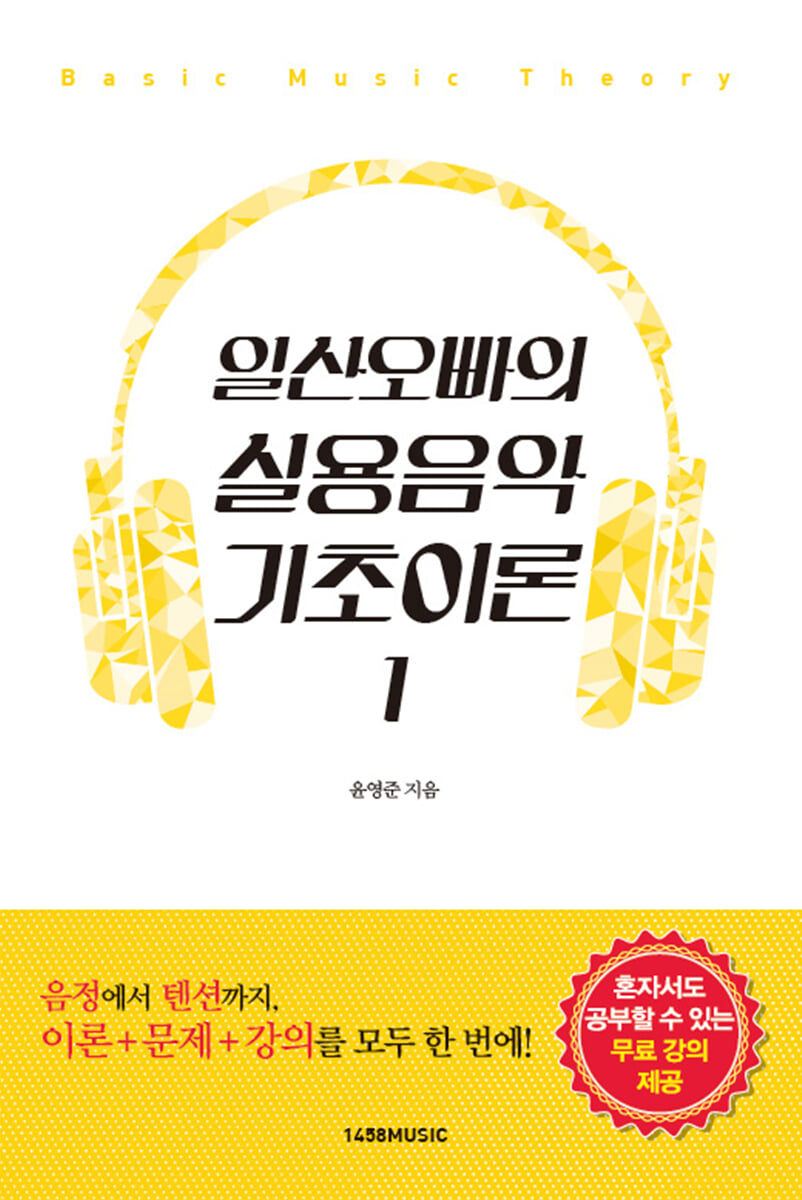
Ilsan Oppa's Practical Music Basics 1
 |
Description
Book Introduction
A practical music theory book that you can study on your own.
This book is a basic theory textbook for those who want to learn practical music.
The basic theory of practical music is explained by dividing it into units.
The content to be studied is arranged in line with the thought process that completes music theory, and is organized into small units to help you study systematically.
If you study in order, you can see the overall framework of music theory, and after each theory explanation, check problems, practice problems, and comprehensive problems are given to confirm your understanding.
The presented problems are tailored to practical music and entrance exam types, so they will be of great help to students preparing for the entrance exam.
We provide audio lectures specifically to help you understand all the theories and problems in the book.
You can listen to free lectures through a podcast hosted by the author himself.
This book is a basic theory textbook for those who want to learn practical music.
The basic theory of practical music is explained by dividing it into units.
The content to be studied is arranged in line with the thought process that completes music theory, and is organized into small units to help you study systematically.
If you study in order, you can see the overall framework of music theory, and after each theory explanation, check problems, practice problems, and comprehensive problems are given to confirm your understanding.
The presented problems are tailored to practical music and entrance exam types, so they will be of great help to students preparing for the entrance exam.
We provide audio lectures specifically to help you understand all the theories and problems in the book.
You can listen to free lectures through a podcast hosted by the author himself.
- You can preview some of the book's contents.
Preview
index
Part I.
Pitch (Lessons 1-3)
1.
Overview of pitch
2.
Semitone calculation method
3.
diatonic intervals
4.
Changes in pitch according to the occasional table
5.
chromatic intervals
6.
Interpret the pitch and complete the score
7.
double intervals
Comprehensive Problem I
Part II.
3rd chord (4th to 6th notes)
8.
Understanding 3-chord terms
9.
Four types of triads
10.
Characteristics of triads
11.
Relationship between triads
12.
Draw sheet music by looking at the 3-chord chord names
13.
Find the chord names by looking at the 3-chord score
14.
sus4 code
15.
Inversion of triads (inversion of triads)
Comprehensive Problem II
Part III.
Composition (Lectures 7-9)
16.
What is composition?
17.
Attaching a key
18.
Find the major key, tonic note, and key name by looking at the key signature
19.
Find the minor key, tonic note, and key name by looking at the key signature
20.
Find the key signature, major key, and minor key
21.
5th degree circle and two-tone pitch
22.
Relationship (incest)
23.
Transposition and key change (transposition and modulation)
Comprehensive Problem III
Part IV.
Scales (Lessons 10-11)
24.
What is a scale?
25.
Major scale
26.
minor scale
Comprehensive Problem IV
Part V.
Diatonic Chords (Lessons 12-13)
27.
What is a diatonic chord?
28.
Major diatonic chord
29.
minor diatonic chord
30.
Transpose of code
Comprehensive Problem V
Part VI.
7th chord (14-16)
31.
What is a 7th chord?
32.
Major, minor, augmented chords + 7th note
33.
diminished chord + 7th note
34.
Draw sheet music by looking at the 7th chord chord names
35.
Find the chord names by looking at the 7th chord score
36.
6 code
37.
7th chord inversion (7th chord inversion)
Comprehensive Problem VI
Part VII.
Tension Code (Lessons 17-19)
38.
What is a tension code?
39.
Available tension codes
40.
Draw tension chord name sheet music
41.
Finding Tension Chord Sheet Music Chord Names
42.
Transposition of tension code (transposition of tension code)
Comprehensive Problem VII
Part VIII.
Basic Music (20 Lessons)
43.
Staff and clef
44.
Sound name
45.
Change table and homonym
46.
negative length
47.
consecutive notes
48.
beat
49.
musical symbol
50.
Expression symbols for the order of song progression
Pitch (Lessons 1-3)
1.
Overview of pitch
2.
Semitone calculation method
3.
diatonic intervals
4.
Changes in pitch according to the occasional table
5.
chromatic intervals
6.
Interpret the pitch and complete the score
7.
double intervals
Comprehensive Problem I
Part II.
3rd chord (4th to 6th notes)
8.
Understanding 3-chord terms
9.
Four types of triads
10.
Characteristics of triads
11.
Relationship between triads
12.
Draw sheet music by looking at the 3-chord chord names
13.
Find the chord names by looking at the 3-chord score
14.
sus4 code
15.
Inversion of triads (inversion of triads)
Comprehensive Problem II
Part III.
Composition (Lectures 7-9)
16.
What is composition?
17.
Attaching a key
18.
Find the major key, tonic note, and key name by looking at the key signature
19.
Find the minor key, tonic note, and key name by looking at the key signature
20.
Find the key signature, major key, and minor key
21.
5th degree circle and two-tone pitch
22.
Relationship (incest)
23.
Transposition and key change (transposition and modulation)
Comprehensive Problem III
Part IV.
Scales (Lessons 10-11)
24.
What is a scale?
25.
Major scale
26.
minor scale
Comprehensive Problem IV
Part V.
Diatonic Chords (Lessons 12-13)
27.
What is a diatonic chord?
28.
Major diatonic chord
29.
minor diatonic chord
30.
Transpose of code
Comprehensive Problem V
Part VI.
7th chord (14-16)
31.
What is a 7th chord?
32.
Major, minor, augmented chords + 7th note
33.
diminished chord + 7th note
34.
Draw sheet music by looking at the 7th chord chord names
35.
Find the chord names by looking at the 7th chord score
36.
6 code
37.
7th chord inversion (7th chord inversion)
Comprehensive Problem VI
Part VII.
Tension Code (Lessons 17-19)
38.
What is a tension code?
39.
Available tension codes
40.
Draw tension chord name sheet music
41.
Finding Tension Chord Sheet Music Chord Names
42.
Transposition of tension code (transposition of tension code)
Comprehensive Problem VII
Part VIII.
Basic Music (20 Lessons)
43.
Staff and clef
44.
Sound name
45.
Change table and homonym
46.
negative length
47.
consecutive notes
48.
beat
49.
musical symbol
50.
Expression symbols for the order of song progression
Publisher's Review
This book explains the basic theories that anyone studying practical music must know.
The book's greatest feature is that it provides all of its content as free lectures via podcast.
The theories that were difficult to understand by just reading the explanations were accurately and repeatedly learned through lectures.
Additionally, we provide a variety of problems that match the theoretical explanations, allowing you to get a feel for how the theory is applied in practice.
Anyone can master the basic theories of practical music in a short period of time by studying 1-2 lectures per day according to the order guided in the book.
* Free lecture link address
http://www.podbbang.com/ch/9086
* Recommendation
1.
Professor Jang Gi-ho (Head of the Department of Practical Music, Seoul Institute of the Arts)
It goes without saying that the basics are important in any field.
This book emphasizes the importance of basic theory in another way.
Friendly explanations and easy-to-understand examples will guide readers comfortably into the world of fundamental music theory.
2.
Composer Kim Do-hoon, CEO of RBW, composer of "Some"
It firmly establishes the foundation of music that was like a floating cloud.
It will be a good guide for those who are starting out in music.
The book's greatest feature is that it provides all of its content as free lectures via podcast.
The theories that were difficult to understand by just reading the explanations were accurately and repeatedly learned through lectures.
Additionally, we provide a variety of problems that match the theoretical explanations, allowing you to get a feel for how the theory is applied in practice.
Anyone can master the basic theories of practical music in a short period of time by studying 1-2 lectures per day according to the order guided in the book.
* Free lecture link address
http://www.podbbang.com/ch/9086
* Recommendation
1.
Professor Jang Gi-ho (Head of the Department of Practical Music, Seoul Institute of the Arts)
It goes without saying that the basics are important in any field.
This book emphasizes the importance of basic theory in another way.
Friendly explanations and easy-to-understand examples will guide readers comfortably into the world of fundamental music theory.
2.
Composer Kim Do-hoon, CEO of RBW, composer of "Some"
It firmly establishes the foundation of music that was like a floating cloud.
It will be a good guide for those who are starting out in music.
GOODS SPECIFICS
- Date of issue: April 10, 2015
- Page count, weight, size: 288 pages | 522g | 153*224*17mm
- ISBN13: 9791195356225
- ISBN10: 1195356226
You may also like
카테고리
korean


korean

![GQ KOREA Mark (Monthly): December [2025]](http://librairie.coreenne.fr/cdn/shop/files/8ef265dbbfbf186523ed75ba7319009d.jpg?v=1765340328&width=3840)


