

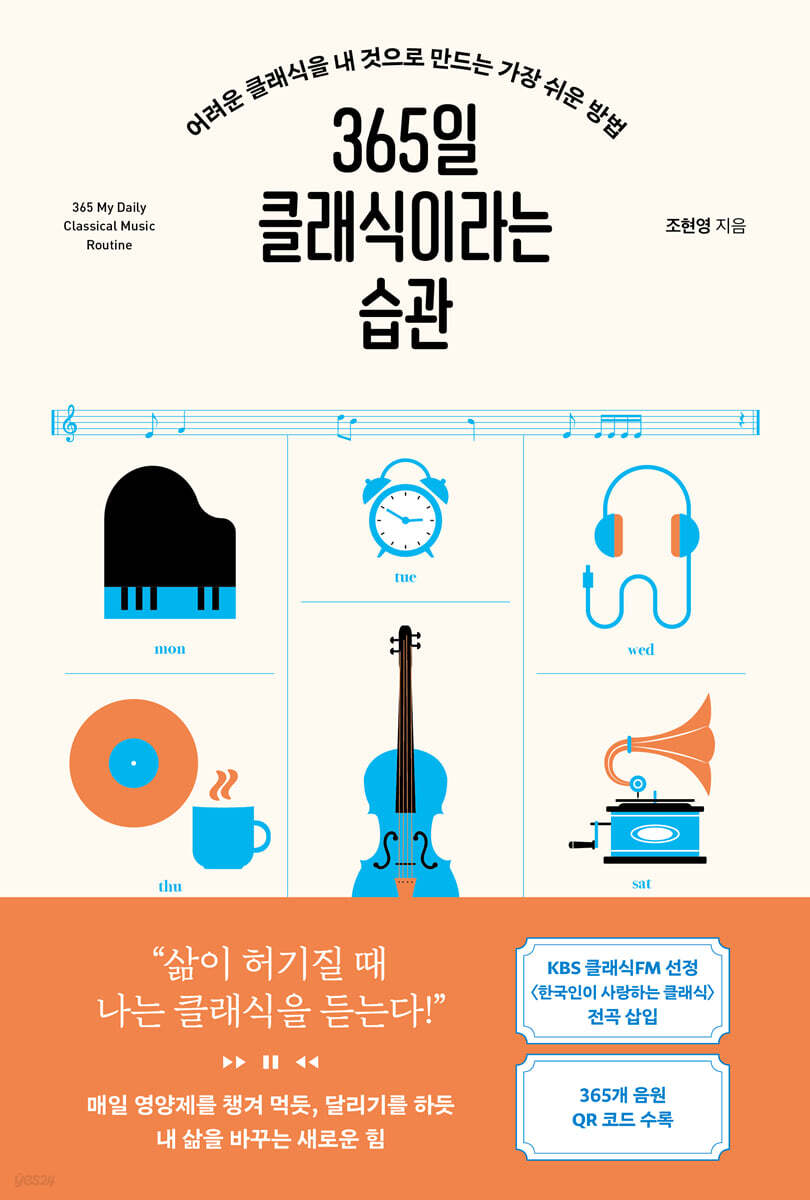
A 365-day classic habit
 |
Description
Book Introduction
“When life gets boring, I listen to classical music!”
Just like taking nutritional supplements every day, like running
A new power that changes my life
★★ All songs included in KBS Classic FM's "Classical Music Loved by Koreans"
★★ Includes 365 QR codes for music tracks that match the season and date.
Many people find classical music difficult.
Because of the length of the songs, which are usually over 10 to 20 minutes and have long titles like a code with complex numbers and alphabets, it is easy to give up before even listening.
However, classical music is more ingrained in our daily lives than we might think. It's frequently featured in TV commercials and movies, countless pop songs are composed based on classical melodies, and it's even used as cheering anthems for sports teams.
So why do people still find classical music difficult? It's because we still have fewer opportunities to experience it compared to pop music.
Just as people become more comfortable and attractive when they see each other often, classical music also becomes familiar and easier when you listen to it often.
So, the way to master the classics is simple.
You just need to start by developing the habit of listening.
The power of classics has already been widely proven in the scientific and medical fields.
It relieves anxiety and stress by increasing the happiness hormones endorphin, serotonin, oxytocin, and dopamine, and decreasing the stress hormone cortisol.
It is literally a ‘medicine for the ears.’
Now, why not add listening to classical music to your daily routine of reading for 10 minutes in the morning, stretching, napping, taking a walk, and writing in your journal?
For the author, who has been a pianist and classical lecturer for over 20 years, listening to classical music was a habit that solidified his day, like running, meditating, or taking a nutritional supplement every morning.
This book was born from the collection of short reflections I wrote down daily while listening to music. Based on the list of "Classical Music Loved by Koreans" published by KBS Classic FM, the playlist features songs familiar to Koreans. Each day, a page tells the fascinating story of each piece and its composer.
For those who want to know more about classical music but are unsure where to start, this book will be a great guide.
Just like taking nutritional supplements every day, like running
A new power that changes my life
★★ All songs included in KBS Classic FM's "Classical Music Loved by Koreans"
★★ Includes 365 QR codes for music tracks that match the season and date.
Many people find classical music difficult.
Because of the length of the songs, which are usually over 10 to 20 minutes and have long titles like a code with complex numbers and alphabets, it is easy to give up before even listening.
However, classical music is more ingrained in our daily lives than we might think. It's frequently featured in TV commercials and movies, countless pop songs are composed based on classical melodies, and it's even used as cheering anthems for sports teams.
So why do people still find classical music difficult? It's because we still have fewer opportunities to experience it compared to pop music.
Just as people become more comfortable and attractive when they see each other often, classical music also becomes familiar and easier when you listen to it often.
So, the way to master the classics is simple.
You just need to start by developing the habit of listening.
The power of classics has already been widely proven in the scientific and medical fields.
It relieves anxiety and stress by increasing the happiness hormones endorphin, serotonin, oxytocin, and dopamine, and decreasing the stress hormone cortisol.
It is literally a ‘medicine for the ears.’
Now, why not add listening to classical music to your daily routine of reading for 10 minutes in the morning, stretching, napping, taking a walk, and writing in your journal?
For the author, who has been a pianist and classical lecturer for over 20 years, listening to classical music was a habit that solidified his day, like running, meditating, or taking a nutritional supplement every morning.
This book was born from the collection of short reflections I wrote down daily while listening to music. Based on the list of "Classical Music Loved by Koreans" published by KBS Classic FM, the playlist features songs familiar to Koreans. Each day, a page tells the fascinating story of each piece and its composer.
For those who want to know more about classical music but are unsure where to start, this book will be a great guide.
- You can preview some of the book's contents.
Preview
index
How to read this book
Recommendation
Entering
january
february
March
april
May
June
July
August
September
october
November
december
Appendix 1 | KBS Classic FM's "Classical Music Loved by Koreans" Overall Rankings
Appendix 2 | Browse Works by Composer
Recommendation
Entering
january
february
March
april
May
June
July
August
September
october
November
december
Appendix 1 | KBS Classic FM's "Classical Music Loved by Koreans" Overall Rankings
Appendix 2 | Browse Works by Composer
Detailed image

Into the book
Johann Sebastian Bach (1685-1750, Germany) was a man who was associated with words like basic, fundamental, sincerity, and consistency.
Maybe that's why the first composer that comes to mind on New Year's Day is Bach.
Small, fulfilling days come together to create a month, a year, a decade.
It's great to have grand plans or ambitious goals, but as I get older, I realize that it's more valuable to find joy in everyday life and live each day to the fullest, 365 days a year.
--- From "January 1, Bach: Prelude No. 1, BWV. 846"
Although Mozart's reality was shabby, his music was never shabby.
What we should feel from Mozart's music is not the life of a genius who sailed smoothly with the wind, but his inner strength that elegantly transformed the sorrow of life.
There are times when you have to endure in silence instead of complaining or getting angry at the world.
When I listen to this song, I think of the following line from Anton Chekhov's Uncle Vanya:
--- From "February 11, Mozart: Piano Concerto No. 20 K. 466, 1st Movement"
Johann Strauss II composed mainly instrumental music that could be danced to, but this piece is not an instrumental piece but a vocal piece.
It was composed to allow the coloratura soprano, the highest voice among sopranos and a singer with brilliant technique, to fully display her skills.
It is said to have been created for the famous soprano Bianchi, who was active in Vienna in 1885.
This song requires considerable skill to control one's breathing as it has many high notes and each verse is long.
However, because the melody is simple and in a repetitive rondo form, it is easy to hum along.
Let's appreciate this song, which is spring itself, singing, "Everything is adding light with spring/ Now that hardship is over and sorrow is approaching with gentleness/ The sound of spring is heard tenderly by our side."
--- From "March 5, Johann Strauss II: 'Voices of Spring Waltz'"
Liszt composed many studies, commonly called 'études'.
Among them, the piece considered to be the most difficult is the “Transcendental Technique Etudes.”
Of the twelve pieces included in the suite, ten are titled and two (Nos. 2 and 10) are untitled.
His works are said to be difficult to play even with twenty fingers, and his close friend and composer Hector Berlioz acknowledged the difficulty of the pieces, saying:
“Liszt composed this music solely for himself, and there is not a single person in the world who can boast of being able to play it properly.”
--- From "April 26, Liszt: Mazeppa from the Transcendental Etudes"
If you are having a hard time sleeping at night, try listening to Sati's music.
There are three Gymnopedies, but the first one is the most famous.
Gymnopédie is the French spelling of the English word Gymnopaedia.
It was an annual event in ancient Sparta, and it is said that naked young men danced with a chorus and praised the gods during this festival.
Gymnos means 'naked' in ancient Greek, and paedia means 'youth, young people'.
This song is quite familiar, especially because it is often used in commercials and as psychotherapy music.
It's a comfortable music that makes you close your eyes and listen to it comfortably as the languid melody keeps repeating.
--- From "June 12, Satie: Gymnopedie No. 1"
In 1898, Mahler was elected music director of the Vienna Philharmonic Orchestra.
This piece is imbued with Mahler's ten years in Vienna and his love story with his wife.
He began composing his Symphony No. 5 in 1901, but suffered from severe intestinal bleeding and lost his health. However, he completed the symphony safely the following year and married the beautiful and talented Alma Schindler, spending a period of time going back and forth between heaven and hell.
Although he could not stop thinking about anxiety and death, he never gave up on life because of his passion for music.
--- From "July 7, Mahler: Symphony No. 5, 4th Movement"
During Mozart's time, musicians desperately needed patrons to support them financially, but Mozart suffered from extreme financial poverty after the death of his strong patron, Emperor Joseph II of Austria.
Mozart, whose debts were mounting, was asked by his friend and playwright, Emanuel Schikaneder, to compose a Singspiel (opera in German) to be performed at the theater he ran. This resulted in The Magic Flute, which is considered one of Mozart's three greatest operas along with The Marriage of Figaro and Don Giovanni.
Maybe that's why the first composer that comes to mind on New Year's Day is Bach.
Small, fulfilling days come together to create a month, a year, a decade.
It's great to have grand plans or ambitious goals, but as I get older, I realize that it's more valuable to find joy in everyday life and live each day to the fullest, 365 days a year.
--- From "January 1, Bach: Prelude No. 1, BWV. 846"
Although Mozart's reality was shabby, his music was never shabby.
What we should feel from Mozart's music is not the life of a genius who sailed smoothly with the wind, but his inner strength that elegantly transformed the sorrow of life.
There are times when you have to endure in silence instead of complaining or getting angry at the world.
When I listen to this song, I think of the following line from Anton Chekhov's Uncle Vanya:
--- From "February 11, Mozart: Piano Concerto No. 20 K. 466, 1st Movement"
Johann Strauss II composed mainly instrumental music that could be danced to, but this piece is not an instrumental piece but a vocal piece.
It was composed to allow the coloratura soprano, the highest voice among sopranos and a singer with brilliant technique, to fully display her skills.
It is said to have been created for the famous soprano Bianchi, who was active in Vienna in 1885.
This song requires considerable skill to control one's breathing as it has many high notes and each verse is long.
However, because the melody is simple and in a repetitive rondo form, it is easy to hum along.
Let's appreciate this song, which is spring itself, singing, "Everything is adding light with spring/ Now that hardship is over and sorrow is approaching with gentleness/ The sound of spring is heard tenderly by our side."
--- From "March 5, Johann Strauss II: 'Voices of Spring Waltz'"
Liszt composed many studies, commonly called 'études'.
Among them, the piece considered to be the most difficult is the “Transcendental Technique Etudes.”
Of the twelve pieces included in the suite, ten are titled and two (Nos. 2 and 10) are untitled.
His works are said to be difficult to play even with twenty fingers, and his close friend and composer Hector Berlioz acknowledged the difficulty of the pieces, saying:
“Liszt composed this music solely for himself, and there is not a single person in the world who can boast of being able to play it properly.”
--- From "April 26, Liszt: Mazeppa from the Transcendental Etudes"
If you are having a hard time sleeping at night, try listening to Sati's music.
There are three Gymnopedies, but the first one is the most famous.
Gymnopédie is the French spelling of the English word Gymnopaedia.
It was an annual event in ancient Sparta, and it is said that naked young men danced with a chorus and praised the gods during this festival.
Gymnos means 'naked' in ancient Greek, and paedia means 'youth, young people'.
This song is quite familiar, especially because it is often used in commercials and as psychotherapy music.
It's a comfortable music that makes you close your eyes and listen to it comfortably as the languid melody keeps repeating.
--- From "June 12, Satie: Gymnopedie No. 1"
In 1898, Mahler was elected music director of the Vienna Philharmonic Orchestra.
This piece is imbued with Mahler's ten years in Vienna and his love story with his wife.
He began composing his Symphony No. 5 in 1901, but suffered from severe intestinal bleeding and lost his health. However, he completed the symphony safely the following year and married the beautiful and talented Alma Schindler, spending a period of time going back and forth between heaven and hell.
Although he could not stop thinking about anxiety and death, he never gave up on life because of his passion for music.
--- From "July 7, Mahler: Symphony No. 5, 4th Movement"
During Mozart's time, musicians desperately needed patrons to support them financially, but Mozart suffered from extreme financial poverty after the death of his strong patron, Emperor Joseph II of Austria.
Mozart, whose debts were mounting, was asked by his friend and playwright, Emanuel Schikaneder, to compose a Singspiel (opera in German) to be performed at the theater he ran. This resulted in The Magic Flute, which is considered one of Mozart's three greatest operas along with The Marriage of Figaro and Don Giovanni.
--- From "November 25, Mozart: Overture to the Opera "The Magic Flute"
Publisher's Review
Classical music, what difference does it make if you listen to it every day?
The power of one classic a day that changes my life
Have you heard of the "Mozart Effect"? It's a term coined in 1993 by Francis Roscher, a psychologist at the University of California, who measured the IQ of college students while listening to Mozart's music.
The group that listened to music had an average IQ increase of 3% compared to the group that did not, a surprising reversal in the area of intelligence that is considered innate.
The power of such classics has already been widely proven in the scientific and medical fields.
It relieves anxiety and stress by increasing the happiness hormones endorphin, serotonin, oxytocin, and dopamine, and decreasing the stress hormone cortisol.
Alpha waves generated in the brain when listening to music bring stability to the mind and body and help maintain emotional balance.
Additionally, in a study of dementia patients, music therapy was found to be very effective in improving memory, emotions, and behavior.
Another study also found that classical music had a positive effect on the brain development of newborns.
Classical music is truly a 'tonic for the ears'.
“Ah, that song!”
Exciting basic knowledge for those of you who have decided to listen to some classical music.
This book contains 365 works spanning eras and genres, from familiar pieces to those new to the present, to pieces used in films and commercials. The selections are based on the list of "Classical Music Loved by Koreans" published by KBS Classic FM, focusing on creating a familiar experience that readers will instantly exclaim, "Ah, that song!"
In addition to introducing songs that suit the season, we have carefully selected songs that are related to dates, such as the year of composition and the year of the composer's birth and death.
It contains all the information to help beginners appreciate the music, such as movements, tempo, and notations, and it even adds to the enjoyment of reading by revealing the composers' lives and behind-the-scenes stories related to their compositions.
For example, if you know and listen to the story of how Elgar, an unknown composer with an uncertain future, composed "Amour Salutation" for his wife Alice, who always cheered and supported him, the violin melody will sound even sweeter.
Beethoven, who had to take 75 different medications for years, even enduring the side effects of hearing loss, wrote the Pathétique Sonata with a miserable heart, and it makes us think about where the limits of human will lie.
The anecdote about Haydn composing the symphony "Farewell" and obtaining a vacation for the orchestra members shows his wit as a skill in living life.
This is where the author's side as a classic storyteller stands out, weaving together life and classics in an exciting way.
In particular, the structure of this book is simple, introducing one song per page so that anyone can easily approach classical music and form a habit of listening to it.
No need to worry about what music to listen to today; just scan the QR code that is introduced according to the date.
219 color images that help you understand the background of the composition add to the fun of seeing as well as listening.
Beyond simple knowledge
As a classic, it serves as a tool to change your life.
What did people do for fun in the old days, before entertainment like OTT, smartphones, or computer games? Perhaps, like the movies and concerts we enjoy today, large-scale operas and orchestras were the entertainment that gave us a massive dopamine rush. While classical music includes short, sketchy pieces, most of it showcases innumerable complex emotions and grand-scale transformations.
Whether in form or origin, classical music is not a tedious area of knowledge that must be learned, but rather a tool that enriches my life.
Now, let's use classical music as a commute playlist, work songs, lullabies, and more.
The author of this book, too, would listen to the music of Mozart and Tchaikovsky whenever he felt like going on a trip somewhere, and he would vicariously experience the European atmosphere, and when he was suffering from insomnia, he would lean on Satie's "Gymnopedie."
Do you run every day? Take your morning supplements? Write a journal every night? Add listening to a piece of classical music every day to those habits.
You will have an amazing experience of how classical music will change your life.
The power of one classic a day that changes my life
Have you heard of the "Mozart Effect"? It's a term coined in 1993 by Francis Roscher, a psychologist at the University of California, who measured the IQ of college students while listening to Mozart's music.
The group that listened to music had an average IQ increase of 3% compared to the group that did not, a surprising reversal in the area of intelligence that is considered innate.
The power of such classics has already been widely proven in the scientific and medical fields.
It relieves anxiety and stress by increasing the happiness hormones endorphin, serotonin, oxytocin, and dopamine, and decreasing the stress hormone cortisol.
Alpha waves generated in the brain when listening to music bring stability to the mind and body and help maintain emotional balance.
Additionally, in a study of dementia patients, music therapy was found to be very effective in improving memory, emotions, and behavior.
Another study also found that classical music had a positive effect on the brain development of newborns.
Classical music is truly a 'tonic for the ears'.
“Ah, that song!”
Exciting basic knowledge for those of you who have decided to listen to some classical music.
This book contains 365 works spanning eras and genres, from familiar pieces to those new to the present, to pieces used in films and commercials. The selections are based on the list of "Classical Music Loved by Koreans" published by KBS Classic FM, focusing on creating a familiar experience that readers will instantly exclaim, "Ah, that song!"
In addition to introducing songs that suit the season, we have carefully selected songs that are related to dates, such as the year of composition and the year of the composer's birth and death.
It contains all the information to help beginners appreciate the music, such as movements, tempo, and notations, and it even adds to the enjoyment of reading by revealing the composers' lives and behind-the-scenes stories related to their compositions.
For example, if you know and listen to the story of how Elgar, an unknown composer with an uncertain future, composed "Amour Salutation" for his wife Alice, who always cheered and supported him, the violin melody will sound even sweeter.
Beethoven, who had to take 75 different medications for years, even enduring the side effects of hearing loss, wrote the Pathétique Sonata with a miserable heart, and it makes us think about where the limits of human will lie.
The anecdote about Haydn composing the symphony "Farewell" and obtaining a vacation for the orchestra members shows his wit as a skill in living life.
This is where the author's side as a classic storyteller stands out, weaving together life and classics in an exciting way.
In particular, the structure of this book is simple, introducing one song per page so that anyone can easily approach classical music and form a habit of listening to it.
No need to worry about what music to listen to today; just scan the QR code that is introduced according to the date.
219 color images that help you understand the background of the composition add to the fun of seeing as well as listening.
Beyond simple knowledge
As a classic, it serves as a tool to change your life.
What did people do for fun in the old days, before entertainment like OTT, smartphones, or computer games? Perhaps, like the movies and concerts we enjoy today, large-scale operas and orchestras were the entertainment that gave us a massive dopamine rush. While classical music includes short, sketchy pieces, most of it showcases innumerable complex emotions and grand-scale transformations.
Whether in form or origin, classical music is not a tedious area of knowledge that must be learned, but rather a tool that enriches my life.
Now, let's use classical music as a commute playlist, work songs, lullabies, and more.
The author of this book, too, would listen to the music of Mozart and Tchaikovsky whenever he felt like going on a trip somewhere, and he would vicariously experience the European atmosphere, and when he was suffering from insomnia, he would lean on Satie's "Gymnopedie."
Do you run every day? Take your morning supplements? Write a journal every night? Add listening to a piece of classical music every day to those habits.
You will have an amazing experience of how classical music will change your life.
GOODS SPECIFICS
- Date of issue: October 28, 2025
- Page count, weight, size: 408 pages | 152*225*30mm
- ISBN13: 9791139728415
- ISBN10: 1139728415
You may also like
카테고리
korean


korean

![GQ KOREA Mark (Monthly): December [2025]](http://librairie.coreenne.fr/cdn/shop/files/8ef265dbbfbf186523ed75ba7319009d.jpg?v=1765340328&width=3840)


