

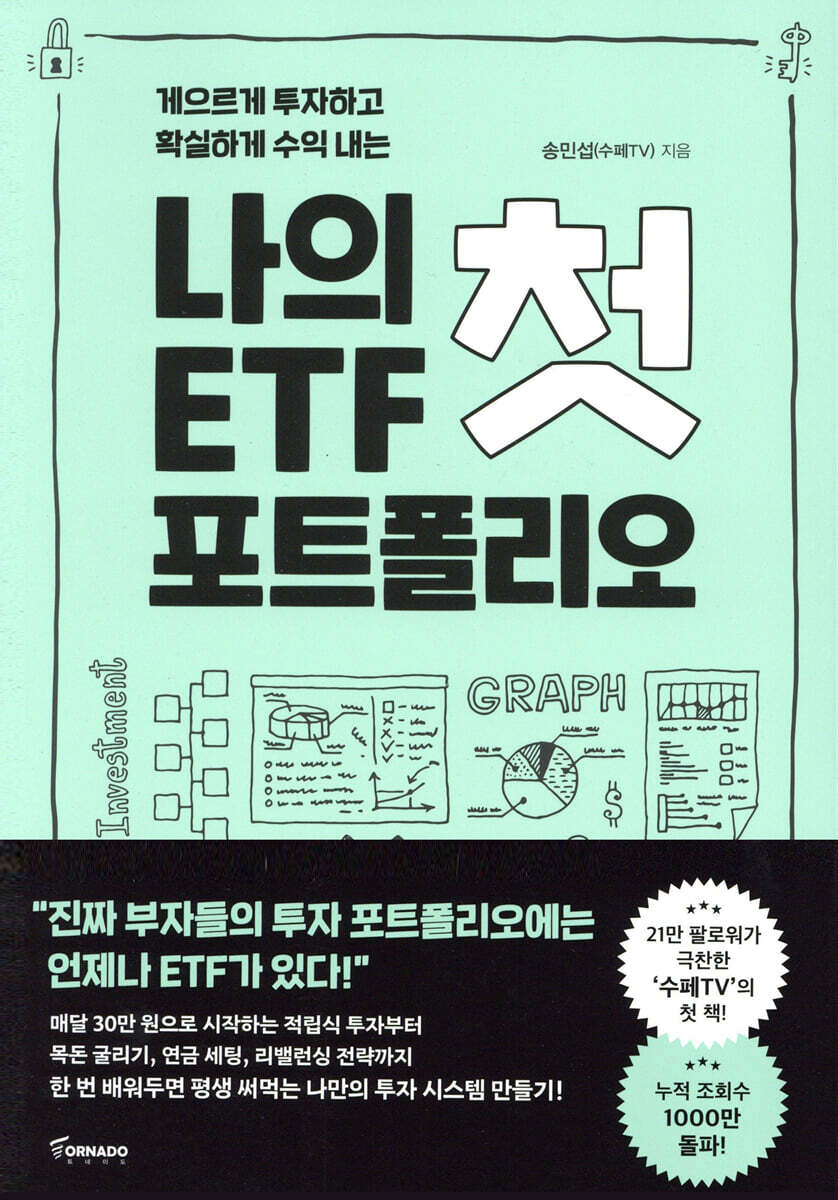
My First ETF Portfolio
 |
Description
Book Introduction
“The truly wealthy always have ETFs in their investment portfolios!” Create your own investment system that you can use for life once you learn it! As we move through this era of low interest rates, the perception that financial management is essential has become established, and interest in stock investment is hotter than ever. However, it is not uncommon to see cases where people blindly jump into a market that others say is good and end up losing money, or give up investing altogether due to stress from the complex and vast amount of information. For these novice investors, ETFs are gaining new attention as a safe and reliable investment option that guarantees returns. "My First ETF Portfolio" is the first book from the YouTube channel "Supe TV," beloved by hundreds of thousands of subscribers for its trendy analysis and authentic content. It teaches ETF investment methods that anyone can easily follow. We've compiled and analyzed the key stocks that ETF investors must know, including index-tracking ETFs, dividend ETFs, bonds, and raw material ETFs, as well as representative stocks by hot themes in the investment market, such as the metaverse, semiconductors, ESG, and cybersecurity, and promising companies to watch within them. Furthermore, we will introduce in detail the secrets to creating your own ETF investment portfolio by amount and purpose. For those who want to find a good investment that is safe and generates steady profits, we will share the investment secrets of the truly wealthy that can be used for a lifetime once you learn them. |
- You can preview some of the book's contents.
Preview
index
Prologue: I decided to invest with peace of mind.
Part 1: Getting Started with ETFs
Chapter 1: Why You Should Pay Attention to ETFs Now
Warren Buffett Loves ETFs! ┃ Direct Investing vs. ETF Investing┃ Why I, a Korean, Should Invest in US ETFs┃ Five Advantages of ETFs
Chapter 2: Basic Knowledge You Need to Know Before Investing in ETFs
Analyzing ETF Names ┃ Which ETF Management Company is Best? ┃ What if I own an ETN instead of an ETF? ┃ Everything You Need to Know About ETF Investing and Taxes!
Chapter 3: The Easiest Way to Find ETFs
How to easily find overseas ETF information ┃ Check out the ETF.com main page ┃ Five things to check when investing in ETFs ┃ How to easily find domestic ETF information
Part 2: My Own ETF Analysis
Chapter 4: The Simplest Investment Strategy: Index-Tracking ETFs
Let's take a look at ETFs in three themes ┃ The simplest ETF investment ┃ DIA, the US national index ETF ┃ What companies are noteworthy in DIA? ┃ QQQ, the US growth-focused technology ETF ┃ What companies are noteworthy in QQQ? ┃ VOO, an ETF that invests in all US stocks ┃ What companies are noteworthy in VOO? ┃ IWM, the US's hidden gem small-cap ETF ┃ What companies are noteworthy in IWM?
Chapter 5: Investing in Dividend ETFs to Prepare for Retirement
Why Invest in Dividend ETFs ┃ High-Dividend REIT ETF Right Now, VNQ ┃ Notable Companies in VNQ? ┃ Dividend Growth ETF with a Forward-Looking Vision ┃ Notable Companies in VIG ┃ Another Dividend Growth ETF, SCHD ┃ Monthly Dividend ETF Like Your Salary ┃ Global Dividend ETFs Around the World ┃ Notable Companies in VEA
Chapter 6: Bond and Gold ETFs for Those Afraid of Investing
Deposits vs. ETFs: Which is Better? ┃ Three Types of Government Bond ETFs ┃ Gold/Silver ETF Investing
Chapter 7: Investing in ETFs by Theme to Suit Your Taste
To experience the fun of investing ┃ Semiconductors, the king of the manufacturing industry ┃ What are the notable ETFs in semiconductors? ┃ The land of data, the cloud ┃ What are the notable ETFs in the cloud? ┃ Environmental protection is now a necessity, ESG ┃ What are the notable ETFs related to ESG? ┃ Another world larger than Earth, the metaverse ┃ Active ETFs investing in various innovative technologies ┃ What are the notable ETFs related to innovation? ┃ Cybersecurity, the sheriff of the online lawless zone ┃ What are the notable ETFs and companies related to cybersecurity?
Part 3: My First ETF Portfolio
Chapter 8: ETFs that are good to invest in with QQQ
Portfolio that complements weaknesses ┃ QQQ+VOO ┃ QQQ+VNQ ┃ QQQ+Theme ┃ QQQ+VEA ┃ QQQ+IEF
Chapter 9: Creating an ETF Portfolio
Two essential conditions for a portfolio ┃ Lump sum or installment plan ┃ Divide your investment into different areas ┃ Small but powerful portfolio (installment plan of 300,000 won) ┃ Retirement preparation portfolio (installment plan of 500,000 won) ┃ Healthy portfolio (installment plan of 1 million won) ┃ Concentrated investment portfolio (installment plan of 3 million won) ┃ Portfolio that protects your precious assets (over 10 million won)
Chapter 10: Starting Your Pension Savings
Should I really save for my pension? ┃ Trusts, funds, or insurance? ┃ Pension savings funds and taxes. ┃ Where should I invest my pension savings funds? ┃ Pension savings fund ETF portfolios. ┃ Pension savings fund investment weighting by age.
Chapter 11: Portfolio Rebalancing and Trading Strategies
Two Types of Rebalancing ┃ Rebalancing a 300,000 Won Portfolio ┃ When Should I Buy and Sell? ┃ Does the Chart Say It's a Downturn? ┃ Reading Candlestick Charts ┃ Four Buy Points ┃ There's a Time to Sell! ┃ You Determine Your Investment Returns!
Chapter 12: All Questions and Answers About ETFs
Still have questions? ┃ Q1. Is investing in ETFs better than investing in companies? ┃ Q2. How do I trade ETFs? ┃ Q3. What does the (H) in ETF names mean? ┃ Q4.
Can housewives, freelancers, and students save for pensions? ┃ Q5.
US ETF.
Which domestically listed US ETF is better? ┃ Q6.
Are there any tax-saving ways to invest in overseas stocks? ┃ Q7. Will ETFs also be delisted? ┃ Q8. What time is best to buy ETFs? ┃ Q9.
How much can I save for my pension? ┃ Q10.
Please tell me how to calculate capital gains tax.
┃ Q11.
Are there any stocks that will automatically invest for you if you leave them alone? ┃ Q12. If I invest in ETFs, do I not need to study companies? ┃ Q13. If you could invest in only one ETF, which would it be? ┃ Q14. Can I invest in both QQQ and SPY? ┃ Q15. How do ETFs calculate and pay out dividends? ┃ Q16. Can I invest in QQQM instead of QQQ? ┃ Q17. Is there anything I should be careful of when investing in ETFs? ┃ Q18.
When is the best time to exchange money? ┃ Q19.
Which is better to invest in, China or India? ┃ Q20.
Can I invest in Bitcoin through ETFs?
Epilogue For your healthy investment
Appendix 1. Top 100 ETF Asset Size Rankings ┃ Appendix 2.
Thematic ETF Summary ┃ Company Name, Stock Name Index ┃ Source
Part 1: Getting Started with ETFs
Chapter 1: Why You Should Pay Attention to ETFs Now
Warren Buffett Loves ETFs! ┃ Direct Investing vs. ETF Investing┃ Why I, a Korean, Should Invest in US ETFs┃ Five Advantages of ETFs
Chapter 2: Basic Knowledge You Need to Know Before Investing in ETFs
Analyzing ETF Names ┃ Which ETF Management Company is Best? ┃ What if I own an ETN instead of an ETF? ┃ Everything You Need to Know About ETF Investing and Taxes!
Chapter 3: The Easiest Way to Find ETFs
How to easily find overseas ETF information ┃ Check out the ETF.com main page ┃ Five things to check when investing in ETFs ┃ How to easily find domestic ETF information
Part 2: My Own ETF Analysis
Chapter 4: The Simplest Investment Strategy: Index-Tracking ETFs
Let's take a look at ETFs in three themes ┃ The simplest ETF investment ┃ DIA, the US national index ETF ┃ What companies are noteworthy in DIA? ┃ QQQ, the US growth-focused technology ETF ┃ What companies are noteworthy in QQQ? ┃ VOO, an ETF that invests in all US stocks ┃ What companies are noteworthy in VOO? ┃ IWM, the US's hidden gem small-cap ETF ┃ What companies are noteworthy in IWM?
Chapter 5: Investing in Dividend ETFs to Prepare for Retirement
Why Invest in Dividend ETFs ┃ High-Dividend REIT ETF Right Now, VNQ ┃ Notable Companies in VNQ? ┃ Dividend Growth ETF with a Forward-Looking Vision ┃ Notable Companies in VIG ┃ Another Dividend Growth ETF, SCHD ┃ Monthly Dividend ETF Like Your Salary ┃ Global Dividend ETFs Around the World ┃ Notable Companies in VEA
Chapter 6: Bond and Gold ETFs for Those Afraid of Investing
Deposits vs. ETFs: Which is Better? ┃ Three Types of Government Bond ETFs ┃ Gold/Silver ETF Investing
Chapter 7: Investing in ETFs by Theme to Suit Your Taste
To experience the fun of investing ┃ Semiconductors, the king of the manufacturing industry ┃ What are the notable ETFs in semiconductors? ┃ The land of data, the cloud ┃ What are the notable ETFs in the cloud? ┃ Environmental protection is now a necessity, ESG ┃ What are the notable ETFs related to ESG? ┃ Another world larger than Earth, the metaverse ┃ Active ETFs investing in various innovative technologies ┃ What are the notable ETFs related to innovation? ┃ Cybersecurity, the sheriff of the online lawless zone ┃ What are the notable ETFs and companies related to cybersecurity?
Part 3: My First ETF Portfolio
Chapter 8: ETFs that are good to invest in with QQQ
Portfolio that complements weaknesses ┃ QQQ+VOO ┃ QQQ+VNQ ┃ QQQ+Theme ┃ QQQ+VEA ┃ QQQ+IEF
Chapter 9: Creating an ETF Portfolio
Two essential conditions for a portfolio ┃ Lump sum or installment plan ┃ Divide your investment into different areas ┃ Small but powerful portfolio (installment plan of 300,000 won) ┃ Retirement preparation portfolio (installment plan of 500,000 won) ┃ Healthy portfolio (installment plan of 1 million won) ┃ Concentrated investment portfolio (installment plan of 3 million won) ┃ Portfolio that protects your precious assets (over 10 million won)
Chapter 10: Starting Your Pension Savings
Should I really save for my pension? ┃ Trusts, funds, or insurance? ┃ Pension savings funds and taxes. ┃ Where should I invest my pension savings funds? ┃ Pension savings fund ETF portfolios. ┃ Pension savings fund investment weighting by age.
Chapter 11: Portfolio Rebalancing and Trading Strategies
Two Types of Rebalancing ┃ Rebalancing a 300,000 Won Portfolio ┃ When Should I Buy and Sell? ┃ Does the Chart Say It's a Downturn? ┃ Reading Candlestick Charts ┃ Four Buy Points ┃ There's a Time to Sell! ┃ You Determine Your Investment Returns!
Chapter 12: All Questions and Answers About ETFs
Still have questions? ┃ Q1. Is investing in ETFs better than investing in companies? ┃ Q2. How do I trade ETFs? ┃ Q3. What does the (H) in ETF names mean? ┃ Q4.
Can housewives, freelancers, and students save for pensions? ┃ Q5.
US ETF.
Which domestically listed US ETF is better? ┃ Q6.
Are there any tax-saving ways to invest in overseas stocks? ┃ Q7. Will ETFs also be delisted? ┃ Q8. What time is best to buy ETFs? ┃ Q9.
How much can I save for my pension? ┃ Q10.
Please tell me how to calculate capital gains tax.
┃ Q11.
Are there any stocks that will automatically invest for you if you leave them alone? ┃ Q12. If I invest in ETFs, do I not need to study companies? ┃ Q13. If you could invest in only one ETF, which would it be? ┃ Q14. Can I invest in both QQQ and SPY? ┃ Q15. How do ETFs calculate and pay out dividends? ┃ Q16. Can I invest in QQQM instead of QQQ? ┃ Q17. Is there anything I should be careful of when investing in ETFs? ┃ Q18.
When is the best time to exchange money? ┃ Q19.
Which is better to invest in, China or India? ┃ Q20.
Can I invest in Bitcoin through ETFs?
Epilogue For your healthy investment
Appendix 1. Top 100 ETF Asset Size Rankings ┃ Appendix 2.
Thematic ETF Summary ┃ Company Name, Stock Name Index ┃ Source
Detailed image
Into the book
An ETF is a product listed on an exchange that allows index funds to be traded like regular stocks. It first appeared in 1993.
The first ETF was a product called SPY, which tracks the S&P 500 index. Simply put, it is a product that invests in the stock price index of 500 common stocks selected by Standard & Poor's.
Buffett was so positive about ETFs that he left a note in his will stating that 90% of his assets should be invested in index-tracking ETFs.
ETFs allow you to invest with peace of mind, free from the stress of worrying about a single article.
This is because they invest in entire industries or markets, not just individual stocks, and thus, they are products that look at the forest. A single ETF portfolio can include anywhere from ten to thousands of companies.
By building an investment portfolio with these ETFs, you can enjoy the benefits of diversification and make investments without losing money.
Additionally, since I don't have to react sensitively to various economic issues like economic news, FOMC meetings, and corporate earnings, I can focus more on my core business and daily life while investing.
--- 「Prologue.
From "I decided to make a comfortable investment"
Investing in an entire industry rather than a single company is less likely to fail.
It is also beneficial for risk management because it allows you to enjoy the benefits of diversification.
This can also be proven by past cases.
Looking at the world market capitalization rankings in 2000, the order was Cisco, Microsoft, Nokia, Intel, and Oracle, and in 2022, the order was Apple, Microsoft, Saudi Aramco, Google, and Amazon.
Of the top ten companies by market capitalization in the world in 2000, only Microsoft remains.
In 2000, Intel and IBM were touted as the companies that would lead the future of the computer industry.
It was difficult to choose Microsoft over these.
However, if you invest in an ETF related to this, it doesn't matter if a company on the list is delisted or its stock price falls due to poor performance. This is because the ETF periodically rebalances (rebalancing assets) to reduce the investment weighting of that company or remove it from the investment list altogether.
If you've been investing in an S&P 500 index-tracking ETF since 2000, you'll automatically have a higher weighting in Cisco in 2000 and Apple in 2022.
--- 「Chapter 1.
From “Why You Should Pay Attention to ETFs Now”
To answer the question of whether it's better to invest in individual U.S. stocks or in ETFs, let's look at an example.
When it comes to 'online shopping,' Korean companies that come to mind are Naver and Coupang, while global companies come to mind include Amazon.
Global online shopping transaction volume has been steadily increasing for several years, and the outlook for the e-commerce market is expected to remain bright.
So, it's only natural that you'd want to invest in Amazon, the current global leader in this field, right?
Let's do a quick search on Amazon to find out the stock price.
As of February 2022, that's $3,000 a week, or about 3.5 million won in Korean currency.
As of 2020, the average monthly salary of an office worker is 3.2 million won, so one share of Amazon stock is equivalent to the average salary of an average office worker.
It's more expensive than my salary.
The average monthly living expenses for a single-person household is about 1.32 million won, so after deducting living expenses, you can live there for about a week every two months.
This may be devastating news for beginners looking to start investing in US stocks.
To minimize risk, you should diversify your investments across a variety of companies, including not just Amazon, but also Apple, Microsoft, and Google. Buying just one Amazon stock every two months isn't a wise choice.
A good alternative in this case is ETF investment.
Among overseas ETFs, there's one called XLY, which also includes Amazon. As of February 2022, XLY's price is $181, or approximately 210,000 won.
It's less than a tenth of the price of a week on Amazon.
--- 「Chapter 1.
From “Why You Should Pay Attention to ETFs Now”
When it comes to investing in US stocks, most people think of IT giants like Apple, Microsoft, and Google.
These companies are actually stocks that are mainly purchased by individual investors in our country.
If you want to invest in all of these, there's no better ETF than the one I'm introducing today.
It's QQQ.
QQQ is an ETF that tracks the Nasdaq 100 index, and its exact name is 'Invesco QQQ Trust Series 1'.
This ETF is managed by Invesco. It is a product that selects the top 100 companies by market capitalization on the NASDAQ among American companies that pursue innovation and growth.
--- 「Chapter 4.
Among the simplest investment methods, index-tracking ETFs
Second, set your investment period and goals.
As I give lectures and produce videos, I receive a variety of questions related to investing.
However, in these cases, it is often difficult to answer because the questioner does not properly inform the investment period and goals.
When I'm asked, "I plan to invest 1 million won a month. How do I build a portfolio?", I respond with, "When and how will I use that money?"
In this way, investments always have a time frame and a purpose.
This way, you can draw up a clear portfolio.
For example, someone recently said to me, “I have 50 million won in cash right now.
This money will be used to purchase a house as I will be moving in a year.
“How should I invest?” he asked.
I replied, “If you can’t afford to lose even a single penny of your 50 million won in a year, I wouldn’t recommend investing.”
At the same time, I recommended the bond ETF introduced earlier in this book.
--- From "Chapter 9. Creating an ETF Portfolio"
Everyone dreams of compound interest when investing, but that effect doesn't always come through long-term investments.
To maintain your wealth, you must protect your profits and assets against the economic crisis that occurs once every ten years.
In the past, the QQQ ETF fell 75% from its peak during the tech bubble in 2000.
And it took a whopping 15 years to recover the principal.
If, instead of going all-in on a single QQQ ETF, I had invested in assets with opposing characteristics, such as gold and bonds, I could have minimized my losses and enjoyed the benefits of compound interest.
The first ETF was a product called SPY, which tracks the S&P 500 index. Simply put, it is a product that invests in the stock price index of 500 common stocks selected by Standard & Poor's.
Buffett was so positive about ETFs that he left a note in his will stating that 90% of his assets should be invested in index-tracking ETFs.
ETFs allow you to invest with peace of mind, free from the stress of worrying about a single article.
This is because they invest in entire industries or markets, not just individual stocks, and thus, they are products that look at the forest. A single ETF portfolio can include anywhere from ten to thousands of companies.
By building an investment portfolio with these ETFs, you can enjoy the benefits of diversification and make investments without losing money.
Additionally, since I don't have to react sensitively to various economic issues like economic news, FOMC meetings, and corporate earnings, I can focus more on my core business and daily life while investing.
--- 「Prologue.
From "I decided to make a comfortable investment"
Investing in an entire industry rather than a single company is less likely to fail.
It is also beneficial for risk management because it allows you to enjoy the benefits of diversification.
This can also be proven by past cases.
Looking at the world market capitalization rankings in 2000, the order was Cisco, Microsoft, Nokia, Intel, and Oracle, and in 2022, the order was Apple, Microsoft, Saudi Aramco, Google, and Amazon.
Of the top ten companies by market capitalization in the world in 2000, only Microsoft remains.
In 2000, Intel and IBM were touted as the companies that would lead the future of the computer industry.
It was difficult to choose Microsoft over these.
However, if you invest in an ETF related to this, it doesn't matter if a company on the list is delisted or its stock price falls due to poor performance. This is because the ETF periodically rebalances (rebalancing assets) to reduce the investment weighting of that company or remove it from the investment list altogether.
If you've been investing in an S&P 500 index-tracking ETF since 2000, you'll automatically have a higher weighting in Cisco in 2000 and Apple in 2022.
--- 「Chapter 1.
From “Why You Should Pay Attention to ETFs Now”
To answer the question of whether it's better to invest in individual U.S. stocks or in ETFs, let's look at an example.
When it comes to 'online shopping,' Korean companies that come to mind are Naver and Coupang, while global companies come to mind include Amazon.
Global online shopping transaction volume has been steadily increasing for several years, and the outlook for the e-commerce market is expected to remain bright.
So, it's only natural that you'd want to invest in Amazon, the current global leader in this field, right?
Let's do a quick search on Amazon to find out the stock price.
As of February 2022, that's $3,000 a week, or about 3.5 million won in Korean currency.
As of 2020, the average monthly salary of an office worker is 3.2 million won, so one share of Amazon stock is equivalent to the average salary of an average office worker.
It's more expensive than my salary.
The average monthly living expenses for a single-person household is about 1.32 million won, so after deducting living expenses, you can live there for about a week every two months.
This may be devastating news for beginners looking to start investing in US stocks.
To minimize risk, you should diversify your investments across a variety of companies, including not just Amazon, but also Apple, Microsoft, and Google. Buying just one Amazon stock every two months isn't a wise choice.
A good alternative in this case is ETF investment.
Among overseas ETFs, there's one called XLY, which also includes Amazon. As of February 2022, XLY's price is $181, or approximately 210,000 won.
It's less than a tenth of the price of a week on Amazon.
--- 「Chapter 1.
From “Why You Should Pay Attention to ETFs Now”
When it comes to investing in US stocks, most people think of IT giants like Apple, Microsoft, and Google.
These companies are actually stocks that are mainly purchased by individual investors in our country.
If you want to invest in all of these, there's no better ETF than the one I'm introducing today.
It's QQQ.
QQQ is an ETF that tracks the Nasdaq 100 index, and its exact name is 'Invesco QQQ Trust Series 1'.
This ETF is managed by Invesco. It is a product that selects the top 100 companies by market capitalization on the NASDAQ among American companies that pursue innovation and growth.
--- 「Chapter 4.
Among the simplest investment methods, index-tracking ETFs
Second, set your investment period and goals.
As I give lectures and produce videos, I receive a variety of questions related to investing.
However, in these cases, it is often difficult to answer because the questioner does not properly inform the investment period and goals.
When I'm asked, "I plan to invest 1 million won a month. How do I build a portfolio?", I respond with, "When and how will I use that money?"
In this way, investments always have a time frame and a purpose.
This way, you can draw up a clear portfolio.
For example, someone recently said to me, “I have 50 million won in cash right now.
This money will be used to purchase a house as I will be moving in a year.
“How should I invest?” he asked.
I replied, “If you can’t afford to lose even a single penny of your 50 million won in a year, I wouldn’t recommend investing.”
At the same time, I recommended the bond ETF introduced earlier in this book.
--- From "Chapter 9. Creating an ETF Portfolio"
Everyone dreams of compound interest when investing, but that effect doesn't always come through long-term investments.
To maintain your wealth, you must protect your profits and assets against the economic crisis that occurs once every ten years.
In the past, the QQQ ETF fell 75% from its peak during the tech bubble in 2000.
And it took a whopping 15 years to recover the principal.
If, instead of going all-in on a single QQQ ETF, I had invested in assets with opposing characteristics, such as gold and bonds, I could have minimized my losses and enjoyed the benefits of compound interest.
--- From "Chapter 9. Creating an ETF Portfolio"
Publisher's Review
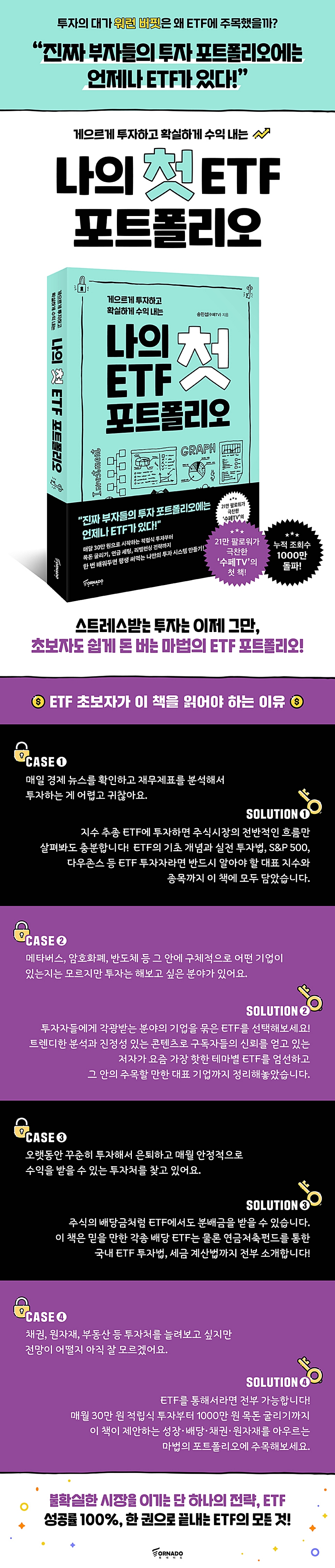
★★★ The first book from 'Supe TV', raved about by 210,000 subscribers!
★★★ Cumulative views surpass 10 million!
“The only strategy to beat the uncertain market: ETFs!”
From analysis of the hottest themes such as semiconductors, ESG, and metaverse,
Custom design encompassing growth, dividends, bonds, and raw materials
Say goodbye to stressful investing. Everything you need to know about ETFs in one book!
Warren Buffett, the investment guru, is said to have written in his will, “Invest 90% of your assets in ETFs (index funds).”
To that extent, ETFs are a safe investment that can survive in the volatile stock market and an effective investment target that truly wealthy people are paying attention to.
Unlike early 2020 and 2021, when the KOSPI index surpassed 3,000 and enjoyed a strong upward trend, issues have arisen at every turn, making it difficult to predict the future.
Perhaps for this reason, investors' interest in ETFs that guarantee stable returns is growing day by day.
In fact, the domestic ETF market, which started in 2002 with only 4 stocks and total net assets of 344.4 billion won, has grown to 526 stocks and total net assets of 70 trillion won by early 2022.
Why are investors focusing on ETFs? The biggest advantage of ETF investing is that it allows for "lazy investing."
To invest in a company, you need to understand the current state of the market the company operates in and its potential for growth.
You should also look at the company's financial statements, past sales, and net income to determine if the company is trustworthy.
In addition, you need to find the right time to invest through chart analysis.
If you enjoy this type of work, this won't be a big problem, but most beginner investors find this process tiresome and quickly give up on investing.
On the other hand, ETFs are investment products that allow you to buy and sell funds that track an index of various individual stocks like stocks.
Because you invest in the entire market rather than a specific company, there's no need to track individual stock prices, and even if a single company fails, you won't suffer a major blow, making it relatively safe. Another advantage is the ability to invest in promising stocks with small amounts.
Let's say you want to invest in the global company Amazon.
Amazon's stock price for one week is around $3,000.
When the exchange rate is 1,200 won, it is 3.6 million won.
As of 2020, the average monthly salary for office workers is about 3.2 million won, so excluding living expenses, it's hard to imagine living on that much for one week every two months.
On the other hand, ETF 'XLY', which includes Amazon among its investment companies, is at around $180.
You will be able to invest in Amazon with as little as 200,000 won.
The investment method is also simple, as unlike funds, it can be traded immediately like individual stocks.
This book is perfect for investors who want to escape the stress of worrying about a single article and invest with peace of mind. It covers everything about ETF investing, from the basic concepts of ETFs to how to obtain information and trade, to which stocks are best to choose.
For investors increasingly weary of stock investing, this book presents a new alternative: ETFs, with user-friendly explanations and abundant case studies that even beginners can easily understand.
Of course, you can start investing with 300,000 won per month,
From money management to pension setting and rebalancing strategies.
A magical ETF portfolio with a 100% success rate that even beginners can easily make money with.
If ETFs are so easy and safe to invest in, does that mean you can just buy any stock and hold it? Of course not.
For example, QQQ, an ETF favored by many domestic investors, was unable to avoid a 75% drop from its peak during the IT bubble in 2000.
It took a whopping 15 years to recover the principal.
If you don't invest in a way that suits your goals and tendencies, you may face difficulties even in a stock that others consider safe.
In other words, ETF investment also requires a strategy.
This is precisely why you should read this book.
The core of this book is to teach you how to develop your own investment strategy using ETFs.
The author suggests checking two factors before jumping into full-scale ETF investment.
The first is your investment tendency and the second is your investment purpose.
The investment approach of a 30-year-old who needs to quickly increase his assets should be different from that of a 50-year-old approaching retirement.
The investment style of someone who wants to start investing a small amount of 300,000 won per month and someone who wants to manage a lump sum of 10 million won should be different.
Although products that track indices such as the S&P 500 and the Dow Jones are representative, there are also many ETFs composed of various themes.
Therefore, through ETFs, you can expand your investment scope to include not only dividend stocks, but also semiconductors, ESG, metaverse, and other themes that are currently attracting attention in the market, as well as various assets such as real estate, bonds, and raw materials.
And since each has a very different personality, if you take advantage of these differences, you can create a magical portfolio that offsets weaknesses and maximizes gains.
This book introduces various ETFs that investors should pay attention to, categorized by keyword, and provides specific examples for each budget, offering portfolios that maximize investment efficiency and returns.
Furthermore, this book covers a wide range of ETFs, both foreign and domestic, and provides information on how to invest in pension savings funds, which are currently very popular.
It also introduces essential knowledge useful to stock investors, such as portfolio rebalancing, tax calculations, and chart analysis, thereby covering the final chapter and enabling practical investment.
Buffett once said, “The most important quality for an investor is not intelligence, but patience.”
By following the guidance in this book and building your own investment portfolio step by step, you'll soon find yourself with the investment stamina to tackle the toughest races.
★★★ Cumulative views surpass 10 million!
“The only strategy to beat the uncertain market: ETFs!”
From analysis of the hottest themes such as semiconductors, ESG, and metaverse,
Custom design encompassing growth, dividends, bonds, and raw materials
Say goodbye to stressful investing. Everything you need to know about ETFs in one book!
Warren Buffett, the investment guru, is said to have written in his will, “Invest 90% of your assets in ETFs (index funds).”
To that extent, ETFs are a safe investment that can survive in the volatile stock market and an effective investment target that truly wealthy people are paying attention to.
Unlike early 2020 and 2021, when the KOSPI index surpassed 3,000 and enjoyed a strong upward trend, issues have arisen at every turn, making it difficult to predict the future.
Perhaps for this reason, investors' interest in ETFs that guarantee stable returns is growing day by day.
In fact, the domestic ETF market, which started in 2002 with only 4 stocks and total net assets of 344.4 billion won, has grown to 526 stocks and total net assets of 70 trillion won by early 2022.
Why are investors focusing on ETFs? The biggest advantage of ETF investing is that it allows for "lazy investing."
To invest in a company, you need to understand the current state of the market the company operates in and its potential for growth.
You should also look at the company's financial statements, past sales, and net income to determine if the company is trustworthy.
In addition, you need to find the right time to invest through chart analysis.
If you enjoy this type of work, this won't be a big problem, but most beginner investors find this process tiresome and quickly give up on investing.
On the other hand, ETFs are investment products that allow you to buy and sell funds that track an index of various individual stocks like stocks.
Because you invest in the entire market rather than a specific company, there's no need to track individual stock prices, and even if a single company fails, you won't suffer a major blow, making it relatively safe. Another advantage is the ability to invest in promising stocks with small amounts.
Let's say you want to invest in the global company Amazon.
Amazon's stock price for one week is around $3,000.
When the exchange rate is 1,200 won, it is 3.6 million won.
As of 2020, the average monthly salary for office workers is about 3.2 million won, so excluding living expenses, it's hard to imagine living on that much for one week every two months.
On the other hand, ETF 'XLY', which includes Amazon among its investment companies, is at around $180.
You will be able to invest in Amazon with as little as 200,000 won.
The investment method is also simple, as unlike funds, it can be traded immediately like individual stocks.
This book is perfect for investors who want to escape the stress of worrying about a single article and invest with peace of mind. It covers everything about ETF investing, from the basic concepts of ETFs to how to obtain information and trade, to which stocks are best to choose.
For investors increasingly weary of stock investing, this book presents a new alternative: ETFs, with user-friendly explanations and abundant case studies that even beginners can easily understand.
Of course, you can start investing with 300,000 won per month,
From money management to pension setting and rebalancing strategies.
A magical ETF portfolio with a 100% success rate that even beginners can easily make money with.
If ETFs are so easy and safe to invest in, does that mean you can just buy any stock and hold it? Of course not.
For example, QQQ, an ETF favored by many domestic investors, was unable to avoid a 75% drop from its peak during the IT bubble in 2000.
It took a whopping 15 years to recover the principal.
If you don't invest in a way that suits your goals and tendencies, you may face difficulties even in a stock that others consider safe.
In other words, ETF investment also requires a strategy.
This is precisely why you should read this book.
The core of this book is to teach you how to develop your own investment strategy using ETFs.
The author suggests checking two factors before jumping into full-scale ETF investment.
The first is your investment tendency and the second is your investment purpose.
The investment approach of a 30-year-old who needs to quickly increase his assets should be different from that of a 50-year-old approaching retirement.
The investment style of someone who wants to start investing a small amount of 300,000 won per month and someone who wants to manage a lump sum of 10 million won should be different.
Although products that track indices such as the S&P 500 and the Dow Jones are representative, there are also many ETFs composed of various themes.
Therefore, through ETFs, you can expand your investment scope to include not only dividend stocks, but also semiconductors, ESG, metaverse, and other themes that are currently attracting attention in the market, as well as various assets such as real estate, bonds, and raw materials.
And since each has a very different personality, if you take advantage of these differences, you can create a magical portfolio that offsets weaknesses and maximizes gains.
This book introduces various ETFs that investors should pay attention to, categorized by keyword, and provides specific examples for each budget, offering portfolios that maximize investment efficiency and returns.
Furthermore, this book covers a wide range of ETFs, both foreign and domestic, and provides information on how to invest in pension savings funds, which are currently very popular.
It also introduces essential knowledge useful to stock investors, such as portfolio rebalancing, tax calculations, and chart analysis, thereby covering the final chapter and enabling practical investment.
Buffett once said, “The most important quality for an investor is not intelligence, but patience.”
By following the guidance in this book and building your own investment portfolio step by step, you'll soon find yourself with the investment stamina to tackle the toughest races.
GOODS SPECIFICS
- Date of issue: May 4, 2022
- Page count, weight, size: 272 pages | 500g | 152*220*20mm
- ISBN13: 9791158512415
- ISBN10: 1158512414
You may also like
카테고리
korean


korean

![ELLE 엘르 스페셜 에디션 A형 : 12월 [2025]](http://librairie.coreenne.fr/cdn/shop/files/b8e27a3de6c9538896439686c6b0e8fb.jpg?v=1766436872&width=3840)


