

2026 Global Tech Trends
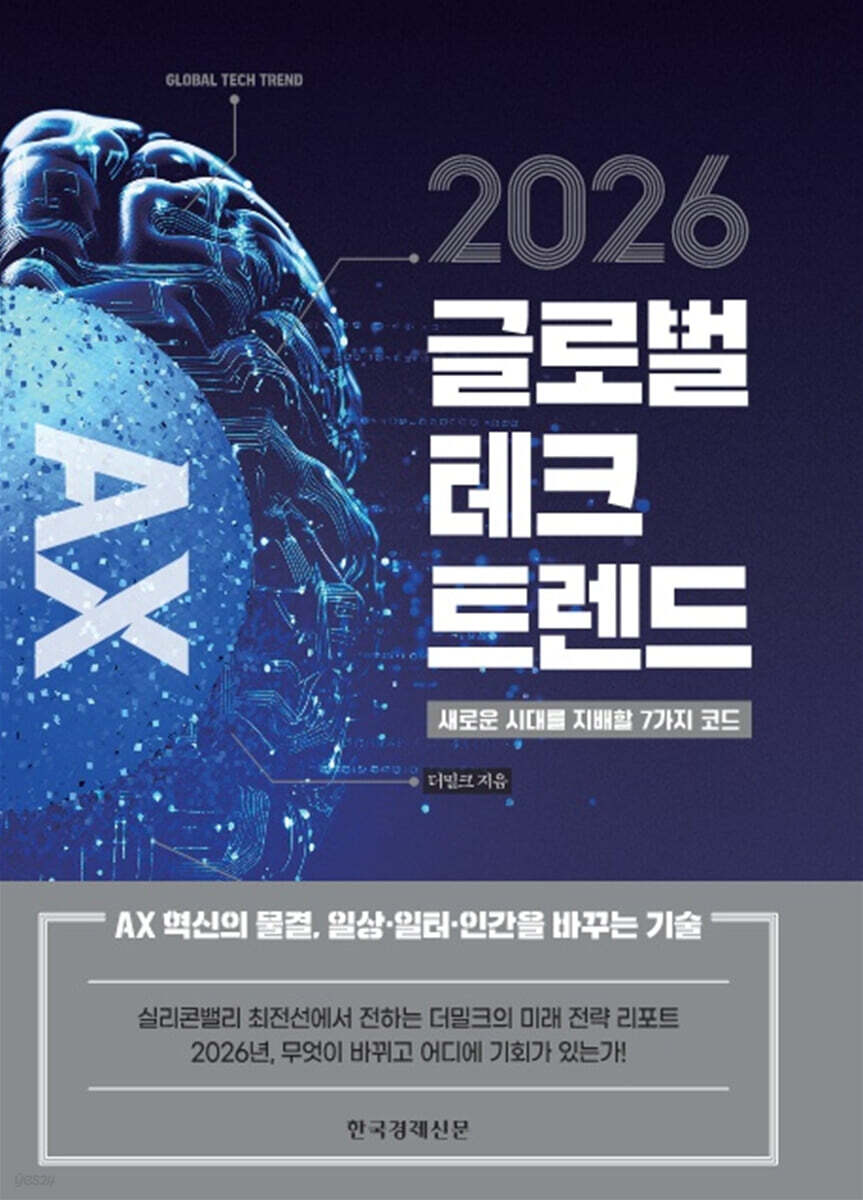 |
Description
Book Introduction
2026 is the year when AI will transform human resources, industry, and national systems.
A historic turning point that will completely reorganize!
Everything You Need to Know About the AI Renaissance and Survival Strategies in Silicon Valley
2026: What's changing and where are the opportunities?
“By 2027, the impact of superhuman AI on human society will surpass that of the Industrial Revolution.”
It may sound like a line from science fiction, but it's the core argument of "AI 2027," a specific future prediction scenario presented by researchers from OpenAI.
This book looks to 2026, the starting point of that transformation.
Last year, tech media outlet The Milk accurately predicted the three major technology trends of 2025 in its book "2025 Global Tech Trends." In this book, the company presents seven key codes that will dominate 2026.
If Leonardo da Vinci deciphered the secrets of human civilization through the codes in his paintings during the Renaissance, the codes of future civilization are now hidden in GPU clusters, data centers, and semiconductor chips.
The industrialization of superintelligence (AI OS), Magnet 10, which will lead the AI era, the intention economy that reads intentions rather than interests, the science of politics where technology dominates, the beta generation born as AI natives, the clean energy Solar Age, and even the longevity revolution in the era of healthy life expectancy.
Each code goes beyond simple trend prediction to provide a three-dimensional view of structural changes across the industry.
We've entered an era where AI executives present strategies in Samsung conference rooms, Hyundai Motor Company introduces humanoid robots to its production lines, and Hanwha Q CELLS uses AI to increase productivity by 60%.
The world is focusing its investments on AI-related industries, and the battle for AI hegemony between the US and China is becoming increasingly visible.
In times like these, this book will serve as an essential compass for anyone who needs to read the direction of change and develop a response strategy.
The future is coming faster than you think.
Depending on the choices we make at this turning point in civilization, 2026, we will either become leaders of change or remain followers.
Only the prepared will seize the opportunity.
This book is a strategy book for those people.
A historic turning point that will completely reorganize!
Everything You Need to Know About the AI Renaissance and Survival Strategies in Silicon Valley
2026: What's changing and where are the opportunities?
“By 2027, the impact of superhuman AI on human society will surpass that of the Industrial Revolution.”
It may sound like a line from science fiction, but it's the core argument of "AI 2027," a specific future prediction scenario presented by researchers from OpenAI.
This book looks to 2026, the starting point of that transformation.
Last year, tech media outlet The Milk accurately predicted the three major technology trends of 2025 in its book "2025 Global Tech Trends." In this book, the company presents seven key codes that will dominate 2026.
If Leonardo da Vinci deciphered the secrets of human civilization through the codes in his paintings during the Renaissance, the codes of future civilization are now hidden in GPU clusters, data centers, and semiconductor chips.
The industrialization of superintelligence (AI OS), Magnet 10, which will lead the AI era, the intention economy that reads intentions rather than interests, the science of politics where technology dominates, the beta generation born as AI natives, the clean energy Solar Age, and even the longevity revolution in the era of healthy life expectancy.
Each code goes beyond simple trend prediction to provide a three-dimensional view of structural changes across the industry.
We've entered an era where AI executives present strategies in Samsung conference rooms, Hyundai Motor Company introduces humanoid robots to its production lines, and Hanwha Q CELLS uses AI to increase productivity by 60%.
The world is focusing its investments on AI-related industries, and the battle for AI hegemony between the US and China is becoming increasingly visible.
In times like these, this book will serve as an essential compass for anyone who needs to read the direction of change and develop a response strategy.
The future is coming faster than you think.
Depending on the choices we make at this turning point in civilization, 2026, we will either become leaders of change or remain followers.
Only the prepared will seize the opportunity.
This book is a strategy book for those people.
- You can preview some of the book's contents.
Preview
index
Introduction - A Guide to a Future That Has Already Begun
2026 KEYWORD
PART1.
2026: A Transition to a New Stage in Human Civilization
1.
The New Da Vinci Code: A Code to Decipher a Hidden Civilization
In Search of a New Holy Grail | Code 1. AI OS, a New Operating System Created by the Industrialization of Superintelligence | Code 2. The Rise of Magnet 10, the Power Leading the AI Era | Code 3.
The Age of Agentic AI and the Fundamental Transformation of the Digital Economy | Code 4.
The dawn of an era where technology becomes military power | Code 5.
The Opening of the Second Quarter of the 21st Century and the Emergence of the Beta Generation | Code 6.
A paradigm shift in clean energy: Solar Age | Code 7.
A New Healthcare Paradigm for the Centenarian Era
2.
The future has already arrived
The AI Revolution Surpassing the Industrial Revolution | Axis 1 of Future Transformation.
Self-Evolving AI | Axis 2 of Future Transformation.
Labor Market Changes | Axis 3 of Future Transformation
The New Cold War Between the US and China | Navigating the Double-Edged Sword of the "Intelligence Age"
3.
2026: Job-Care Decoupling Arrives
The Reshaping of Work and Positions in the AI Era | Labor Market Changes in 2025
The AI Talent War Intensifies | The Future of the Job Market | How to Win the AI Talent War |
4. AI Regulation: The Tightrope Walk Between Innovation and Trust
The Age of AI Regulation is Coming | AI Regulation in the European Union | US AI Policy and Regulation | China's AI Policy | Korea's Self-Regulation and International Cooperation | 2026: Regulation and Governance at a Crossroads
PART 2. The Future of Industry Reshaping by AI
1. Three Major Battlefields of AI Semiconductors and the Future
The Global Semiconductor War | AI Semiconductor Battlefield 1.
Fabless | AI Semiconductor Battlefield 2.
Foundry | AI Semiconductor Battlefield 3.
memory
2.
Intelligent robots transform the workplace, daily life, and human identity.
Industries Transformed by Intelligent Robots | Human-Robot Collaboration | Next-Generation Robotics Technology | Social and Ethical Issues | The Future Beyond 2026 | Notable Companies
3.
A Great Transformation in Manufacturing: Ushering in the Era of Industry 6.0
AI-Powered Digital Transformation: A Crucial Strategy for Survival | 2026 Manufacturing Trends 1. The Spread of AI-Native Factories | 2026 Manufacturing Trends 2.
Accelerating Digital Twins and the Industrial Metaverse | 3 Manufacturing Trends for 2026.
Localized, Low-Carbon Supply Chains | Reshaping Manufacturing Job Structures: 2026: A New Watershed for Manufacturing
4.
Stablecoins: The Last Chance for Monetary Sovereignty
A Signal for a Restructuring of the Global Financial Order | The Convergence of AI and Stablecoins | Korea's Realities and Strategic Challenges | Global Market Trends and Outlook | Technological Challenges and Risk Factors | Outlook and Scenario Analysis for 2026 | The End of Monetary Sovereignty and the Emergence of a New Power Structure
5. AI and the longevity economy are redesigning healthcare.
Death: From Absolute Constraint to Negotiable Variable | Structural Disintegration and Restructuring of the Value Chain | The New Order and Competitive Landscape of Capital Markets | Future Outlook and Strategic Implications at the Forefront of Technological Innovation |
Reading future signals from invisible turning points
6.
The Collision of Energy and AI
The Prelude to the Power Supply Crisis | Key Outlook for 2026 1.
Surge in AI Power Demand | Key Outlook for 2026 2.
Expanding Renewable Energy and the Return of Nuclear Power | Key Outlook for 2026 3.
Accelerating US Energy Infrastructure Development | Key Outlook 4 for 2026.
The Smart Grid Gold Rush | A New Paradigm for Energy and AI | A New Phase in the Global Energy Hegemony Competition | Korea's Response Strategy
7.
Innovation and the Future of Space Tech and the Defense Industry
From the Last Supper to the First Breakfast | New Designers of the Battlefield
SpaceX and the Satellite Network Revolution | Silicon Valley Consortium Threatens Traditional Defense Companies | SpaceTech and the Future of the Defense Industry
PART3.
〈Bold〉Humans and AI: Thinking Together About the Future
1.
The Competition Between Humans and AI - Kim Dae-sik
2.
World Economic Outlook 2026 - Oh Geon-young
3.
K-Beauty: Three Trends for 2026 - Ha Hyung-seok
4. AI is not a technology, it's a civilization - Kim Mi-kyung
5.
The Age of the Greatest Battle - Song Gil-young
2026 KEYWORD
PART1.
2026: A Transition to a New Stage in Human Civilization
1.
The New Da Vinci Code: A Code to Decipher a Hidden Civilization
In Search of a New Holy Grail | Code 1. AI OS, a New Operating System Created by the Industrialization of Superintelligence | Code 2. The Rise of Magnet 10, the Power Leading the AI Era | Code 3.
The Age of Agentic AI and the Fundamental Transformation of the Digital Economy | Code 4.
The dawn of an era where technology becomes military power | Code 5.
The Opening of the Second Quarter of the 21st Century and the Emergence of the Beta Generation | Code 6.
A paradigm shift in clean energy: Solar Age | Code 7.
A New Healthcare Paradigm for the Centenarian Era
2.
The future has already arrived
The AI Revolution Surpassing the Industrial Revolution | Axis 1 of Future Transformation.
Self-Evolving AI | Axis 2 of Future Transformation.
Labor Market Changes | Axis 3 of Future Transformation
The New Cold War Between the US and China | Navigating the Double-Edged Sword of the "Intelligence Age"
3.
2026: Job-Care Decoupling Arrives
The Reshaping of Work and Positions in the AI Era | Labor Market Changes in 2025
The AI Talent War Intensifies | The Future of the Job Market | How to Win the AI Talent War |
4. AI Regulation: The Tightrope Walk Between Innovation and Trust
The Age of AI Regulation is Coming | AI Regulation in the European Union | US AI Policy and Regulation | China's AI Policy | Korea's Self-Regulation and International Cooperation | 2026: Regulation and Governance at a Crossroads
PART 2. The Future of Industry Reshaping by AI
1. Three Major Battlefields of AI Semiconductors and the Future
The Global Semiconductor War | AI Semiconductor Battlefield 1.
Fabless | AI Semiconductor Battlefield 2.
Foundry | AI Semiconductor Battlefield 3.
memory
2.
Intelligent robots transform the workplace, daily life, and human identity.
Industries Transformed by Intelligent Robots | Human-Robot Collaboration | Next-Generation Robotics Technology | Social and Ethical Issues | The Future Beyond 2026 | Notable Companies
3.
A Great Transformation in Manufacturing: Ushering in the Era of Industry 6.0
AI-Powered Digital Transformation: A Crucial Strategy for Survival | 2026 Manufacturing Trends 1. The Spread of AI-Native Factories | 2026 Manufacturing Trends 2.
Accelerating Digital Twins and the Industrial Metaverse | 3 Manufacturing Trends for 2026.
Localized, Low-Carbon Supply Chains | Reshaping Manufacturing Job Structures: 2026: A New Watershed for Manufacturing
4.
Stablecoins: The Last Chance for Monetary Sovereignty
A Signal for a Restructuring of the Global Financial Order | The Convergence of AI and Stablecoins | Korea's Realities and Strategic Challenges | Global Market Trends and Outlook | Technological Challenges and Risk Factors | Outlook and Scenario Analysis for 2026 | The End of Monetary Sovereignty and the Emergence of a New Power Structure
5. AI and the longevity economy are redesigning healthcare.
Death: From Absolute Constraint to Negotiable Variable | Structural Disintegration and Restructuring of the Value Chain | The New Order and Competitive Landscape of Capital Markets | Future Outlook and Strategic Implications at the Forefront of Technological Innovation |
Reading future signals from invisible turning points
6.
The Collision of Energy and AI
The Prelude to the Power Supply Crisis | Key Outlook for 2026 1.
Surge in AI Power Demand | Key Outlook for 2026 2.
Expanding Renewable Energy and the Return of Nuclear Power | Key Outlook for 2026 3.
Accelerating US Energy Infrastructure Development | Key Outlook 4 for 2026.
The Smart Grid Gold Rush | A New Paradigm for Energy and AI | A New Phase in the Global Energy Hegemony Competition | Korea's Response Strategy
7.
Innovation and the Future of Space Tech and the Defense Industry
From the Last Supper to the First Breakfast | New Designers of the Battlefield
SpaceX and the Satellite Network Revolution | Silicon Valley Consortium Threatens Traditional Defense Companies | SpaceTech and the Future of the Defense Industry
PART3.
〈Bold〉Humans and AI: Thinking Together About the Future
1.
The Competition Between Humans and AI - Kim Dae-sik
2.
World Economic Outlook 2026 - Oh Geon-young
3.
K-Beauty: Three Trends for 2026 - Ha Hyung-seok
4. AI is not a technology, it's a civilization - Kim Mi-kyung
5.
The Age of the Greatest Battle - Song Gil-young
Detailed image

Into the book
“My daughter lost her job because she was coding.
It's so hard to find a job these days.
I'm not sure if I should continue looking for coding work or look for another job.
“What do you think, sir?”
I realized it in that moment.
The 'AI revolution' we're talking about is no longer a future scenario.
It's already someone's job, someone's
That it is an ongoing reality that is changing someone's career, their life plan.
The world today, we live in two different time zones.
In Silicon Valley, the AI shockwave is already sweeping across society.
Software developers, once a highly sought-after profession, are losing their jobs, AI companies' stock prices are skyrocketing, and even century-old companies like Walmart are transforming into "AI companies."
Every morning on their way to work, people wonder, “How much of my work will be replaced by AI today?”
This is their daily life.
In contrast, in many countries, including Korea, AI is still only a topic in news headlines and conferences, and is not yet perceived as a force that can truly transform lives.
People know in their heads that AI is important, but they don't feel it in their hearts.
It sounds like a story from a faraway land.
But this is precisely the most dangerous situation.
--- From "A Guide to a Future That Has Already Begun"
After 2026, the world order will no longer be driven by simple geopolitics, but rather by technology geopolitics.
The balance of power in politics and diplomacy is determined not by military might or territory, but by the possession of technological assets such as AI, semiconductors, data centers, and energy infrastructure.
Technology is no longer a dependent variable of politics, but is emerging as a governing principle that rewrites the rules of politics.
To understand this change, we must first look at the historical context.
19 years old
In the early 20th century, Britain, which controlled coal, dominated the world, and in the 20th century, the United States, which controlled oil, established the petrodollar system and achieved economic hegemony.
The 21st century is now becoming an era where who controls digital assets such as computing power, access to data, and AI models will determine victory.
--- From "The New Da Vinci Code: The Code to Decipher a Hidden Civilization"
2025 is a symbolic year marking the end of the first quarter of the 21st century.
As the first quarter of the 21st century, which began in 2000, draws to a close, humanity stands on the threshold of an entirely new era.
The second quarter of the 21st century, starting in 2026, is not simply a passage of time, but a turning point in the history of civilization.
Spring ends and summer begins in the 21st century.
At the heart of this transition is the emergence of the beta generation.
If Generation Alpha defined the early 21st century as digital natives, Generation Beta will be the first generation to grow up alongside artificial intelligence as "AI beta testers."
They will be born and grow up in a world where AI is not just a tool, but a partner and companion in their daily lives.
--- From "The New Da Vinci Code: The Code to Decipher a Hidden Civilization"
In Silicon Valley, there was a lot of talk about the fact that the predicted arrival of the first AI agent in "AI 2027" coincided exactly with the actual appearance of the agent.
〈AI 2027〉 predicted that the first AI agent would appear in mid-2025, and it was on July 17, 2025, that OpenAI CEO Sam Altman announced the launch of the 'ChatGPT Agent', the first AI agent available to the world.
According to the predictions in “AI 2027,” the transformation we will face will unfold around three major axes.
The first is the acceleration of self-improving AI, or “recursive intelligence.”
The second is the "socioeconomic upheaval" caused by the emergence of AI as a new form of labor force, and the third is the advent of a "new geopolitical cold war" surrounding AI hegemony.
TheMilk, a tech and economic media company, conducted an in-depth analysis of AI trends that will unfold in 2026 and beyond, focusing on the scenarios presented in "AI 2027."
Beyond 〈AI 2027〉, we have further confirmed the insights of the world's top AI experts, including Professor Geoffrey Hinton of the University of Toronto, Demis Hassabis, CEO of Google DeepMind, and Professor Yann LeCun of New York University, thereby increasing the validity of the predictions through concrete technological evidence already observed in reality.
--- From "The Future That Has Already Arrived"
Work/job decoupling is about deconstructing and reconstructing the very concepts we have about work and careers.
This goes beyond the concept of machines replacing human workers. AI is becoming a crucial technology that is decoupling the relationship between "work," a task aimed at achieving a specific goal, and "position," a fixed role or position within an organization.
In the traditional labor market, it was natural for the person in the ‘position’ to perform the ‘work’.
However, in the AI era, the phenomenon of AI performing certain tasks more efficiently than humans, while having a fixed position for that task, is accelerating and becoming increasingly unnecessary.
The massive layoffs at Silicon Valley's Big Tech companies in 2025 are a stark example of this job-job decoupling phenomenon, suggesting that AI is not simply assisting jobs but is fundamentally disrupting the very structure of the labor market.
It's so hard to find a job these days.
I'm not sure if I should continue looking for coding work or look for another job.
“What do you think, sir?”
I realized it in that moment.
The 'AI revolution' we're talking about is no longer a future scenario.
It's already someone's job, someone's
That it is an ongoing reality that is changing someone's career, their life plan.
The world today, we live in two different time zones.
In Silicon Valley, the AI shockwave is already sweeping across society.
Software developers, once a highly sought-after profession, are losing their jobs, AI companies' stock prices are skyrocketing, and even century-old companies like Walmart are transforming into "AI companies."
Every morning on their way to work, people wonder, “How much of my work will be replaced by AI today?”
This is their daily life.
In contrast, in many countries, including Korea, AI is still only a topic in news headlines and conferences, and is not yet perceived as a force that can truly transform lives.
People know in their heads that AI is important, but they don't feel it in their hearts.
It sounds like a story from a faraway land.
But this is precisely the most dangerous situation.
--- From "A Guide to a Future That Has Already Begun"
After 2026, the world order will no longer be driven by simple geopolitics, but rather by technology geopolitics.
The balance of power in politics and diplomacy is determined not by military might or territory, but by the possession of technological assets such as AI, semiconductors, data centers, and energy infrastructure.
Technology is no longer a dependent variable of politics, but is emerging as a governing principle that rewrites the rules of politics.
To understand this change, we must first look at the historical context.
19 years old
In the early 20th century, Britain, which controlled coal, dominated the world, and in the 20th century, the United States, which controlled oil, established the petrodollar system and achieved economic hegemony.
The 21st century is now becoming an era where who controls digital assets such as computing power, access to data, and AI models will determine victory.
--- From "The New Da Vinci Code: The Code to Decipher a Hidden Civilization"
2025 is a symbolic year marking the end of the first quarter of the 21st century.
As the first quarter of the 21st century, which began in 2000, draws to a close, humanity stands on the threshold of an entirely new era.
The second quarter of the 21st century, starting in 2026, is not simply a passage of time, but a turning point in the history of civilization.
Spring ends and summer begins in the 21st century.
At the heart of this transition is the emergence of the beta generation.
If Generation Alpha defined the early 21st century as digital natives, Generation Beta will be the first generation to grow up alongside artificial intelligence as "AI beta testers."
They will be born and grow up in a world where AI is not just a tool, but a partner and companion in their daily lives.
--- From "The New Da Vinci Code: The Code to Decipher a Hidden Civilization"
In Silicon Valley, there was a lot of talk about the fact that the predicted arrival of the first AI agent in "AI 2027" coincided exactly with the actual appearance of the agent.
〈AI 2027〉 predicted that the first AI agent would appear in mid-2025, and it was on July 17, 2025, that OpenAI CEO Sam Altman announced the launch of the 'ChatGPT Agent', the first AI agent available to the world.
According to the predictions in “AI 2027,” the transformation we will face will unfold around three major axes.
The first is the acceleration of self-improving AI, or “recursive intelligence.”
The second is the "socioeconomic upheaval" caused by the emergence of AI as a new form of labor force, and the third is the advent of a "new geopolitical cold war" surrounding AI hegemony.
TheMilk, a tech and economic media company, conducted an in-depth analysis of AI trends that will unfold in 2026 and beyond, focusing on the scenarios presented in "AI 2027."
Beyond 〈AI 2027〉, we have further confirmed the insights of the world's top AI experts, including Professor Geoffrey Hinton of the University of Toronto, Demis Hassabis, CEO of Google DeepMind, and Professor Yann LeCun of New York University, thereby increasing the validity of the predictions through concrete technological evidence already observed in reality.
--- From "The Future That Has Already Arrived"
Work/job decoupling is about deconstructing and reconstructing the very concepts we have about work and careers.
This goes beyond the concept of machines replacing human workers. AI is becoming a crucial technology that is decoupling the relationship between "work," a task aimed at achieving a specific goal, and "position," a fixed role or position within an organization.
In the traditional labor market, it was natural for the person in the ‘position’ to perform the ‘work’.
However, in the AI era, the phenomenon of AI performing certain tasks more efficiently than humans, while having a fixed position for that task, is accelerating and becoming increasingly unnecessary.
The massive layoffs at Silicon Valley's Big Tech companies in 2025 are a stark example of this job-job decoupling phenomenon, suggesting that AI is not simply assisting jobs but is fundamentally disrupting the very structure of the labor market.
--- From "Work/Sit Decoupling is Coming"
Publisher's Review
The New Da Vinci Code 7, set in 2026
In the era of AI transformation that will surpass the Industrial Revolution, we present survival strategies!
“By 2027, superhuman AI will have a greater impact on human society than the Industrial Revolution.” While it may sound like a line from science fiction, this is the core claim of “AI 2027,” a specific future prediction scenario presented by researchers from OpenAI.
This book looks to 2026, the starting point of that transformation.
The book vividly depicts the process by which AI evolves from a simple tool to a 'collaborating entity'.
At Samsung Electronics' Suwon plant, AI executives sit side by side with human executives in management meetings, and at an investment bank in Gangnam, Seoul, AI analyzes markets in milliseconds and executes thousands of trades simultaneously.
This is no longer a distant future, but an imminent reality.
Of particular note is the 'job/situation decoupling' phenomenon triggered by AI.
The paradox is that Microsoft is laying off employees three times this year, yet continuing to invest heavily in AI infrastructure.
A Stanford University study found that entry-level employment in occupations with high exposure to AI, such as software engineers and accountants, decreased by up to 20%. AI is effectively replacing entry-level jobs requiring little "tacit knowledge."
However, the authors see this as a 'reorganization of jobs' rather than a simple loss of jobs.
While AI will take over tasks like legal research and document writing, negotiations and complex judgments will still remain the domain of humans.
A single occupation is broken down into multiple job structures shared by AI and humans.
In fact, while 287,000 new jobs are expected to be created in the U.S. manufacturing industry, projections also suggest that 1.9 million jobs will go unfilled due to the skills gap.
Even more interesting is the rise of a new entrepreneurial ecosystem dubbed 'MAGNET10'.
Seven listed companies, including Google, Microsoft, and Nvidia, and three unlisted super unicorns, including OpenAI, Antropic, and SpaceX, are expected to lead AI capital, technology, and industrial order over the next 10 years.
These are not just technology companies; they are treated as strategic assets for national security purposes, and in the case of Antropic, they have shown rapid growth, increasing annualized revenue from $1 billion to $5 billion fivefold in just eight months.
The race for technological supremacy and the birth of a new civilization
Another key point of the book is the geopolitical realignment in the AI era.
We have entered an era where national power is determined not by military power or territory, but by AI, semiconductors, and data centers.
The competition between the US and China for AI hegemony is fierce.
China's Huawei has produced the AI chip 'Ascend 910C' using a 7nm process, demonstrating performance close to that of Nvidia's H100, and the Chinese government has established a third semiconductor investment fund worth 64 trillion won.
In response, the United States announced a $900 billion 'AI+Infrastructure Investment' plan.
If Britain ruled the world with coal in the 19th century and the United States with oil in the 20th century, the 21st century will be determined by who controls computing power.
This book doesn't just deal with technological change.
The generation born after 2026, dubbed the "Beta Generation," will be the first humans to grow up alongside AI, and for them, AI is not a tool but a "daily partner."
The authors focus on the 'swing consumer' tendencies they exhibit.
This is a three-dimensional consumption pattern where the same person drinks a premium coffee in the morning, buys a 99-cent app, and uses an expensive smart device while buying used clothes.
This is a change that could fundamentally nullify 'consumer segmentation,' the basic premise of existing marketing.
Advances in brain-computer interface technology also suggest a future where the boundaries between humans and robots become blurred.
Elon Musk's Neuralink's successful clinical trial, where a subject moved a computer cursor using only brain waves, is just the beginning.
Meta's
As Alexander Wang predicted, the era of 'human-robot hybrids' is coming, where humans will directly control the functions of robots through neural interface chips.
The book also covers the infrastructure changes underpinning the AI era, including the clean energy revolution, the transformation of manufacturing into smart factories, and the competition for monetary sovereignty surrounding the won stablecoin.
Ford's "assembly tree" method demonstrates innovation by reducing the number of parts by 20% and shortening assembly time by 15%, while Xiaomi's unmanned factory in China produces 10 million smartphones annually without human intervention.
This is a signal heralding the arrival of the 'Industry 6.0' era.
The Longevity Revolution cannot be left out either.
As Brian Johnson's "Don't Die" project demonstrates, 2026 will be the year when AI and biotechnology begin to combine to fundamentally extend human lifespan.
An era is dawning where multi-omics personalized technology comprehensively analyzes an individual's genetic, protein, and metabolite profiles to predict a 23% increase in cardiovascular disease risk in six months and suggest tailored prevention programs.
The book doesn't paint a rosy picture of a bright future. It also confronts darker aspects, including the gaps in AI ethics and regulation, the concentration of AI hegemony in the hands of a few companies, and the deepening polarization of jobs.
Europe's AI Act introduces rigorous ex ante regulation through a risk-based approach, while the US prioritizes innovation while balancing it with ex post oversight.
Korea is preparing for gradual institutionalization based on compliance with international guidelines and self-regulation.
The summer of the 21st century begins!
The year 2026 marks the end of spring, the first quarter of the 21st century, and the beginning of summer, the second quarter.
We stand on the threshold of the hottest, most dynamic, and most opportunity-filled period.
Humanity now stands at the cusp of a great advancement called AI.
This book is a compass that provides the insights and countermeasures we need to survive in these turbulent times.
The future is coming much faster than we think.
Now is the time to prepare, and I'm confident this book will help you prepare for the AI era, not just sit back and watch.
In the era of AI transformation that will surpass the Industrial Revolution, we present survival strategies!
“By 2027, superhuman AI will have a greater impact on human society than the Industrial Revolution.” While it may sound like a line from science fiction, this is the core claim of “AI 2027,” a specific future prediction scenario presented by researchers from OpenAI.
This book looks to 2026, the starting point of that transformation.
The book vividly depicts the process by which AI evolves from a simple tool to a 'collaborating entity'.
At Samsung Electronics' Suwon plant, AI executives sit side by side with human executives in management meetings, and at an investment bank in Gangnam, Seoul, AI analyzes markets in milliseconds and executes thousands of trades simultaneously.
This is no longer a distant future, but an imminent reality.
Of particular note is the 'job/situation decoupling' phenomenon triggered by AI.
The paradox is that Microsoft is laying off employees three times this year, yet continuing to invest heavily in AI infrastructure.
A Stanford University study found that entry-level employment in occupations with high exposure to AI, such as software engineers and accountants, decreased by up to 20%. AI is effectively replacing entry-level jobs requiring little "tacit knowledge."
However, the authors see this as a 'reorganization of jobs' rather than a simple loss of jobs.
While AI will take over tasks like legal research and document writing, negotiations and complex judgments will still remain the domain of humans.
A single occupation is broken down into multiple job structures shared by AI and humans.
In fact, while 287,000 new jobs are expected to be created in the U.S. manufacturing industry, projections also suggest that 1.9 million jobs will go unfilled due to the skills gap.
Even more interesting is the rise of a new entrepreneurial ecosystem dubbed 'MAGNET10'.
Seven listed companies, including Google, Microsoft, and Nvidia, and three unlisted super unicorns, including OpenAI, Antropic, and SpaceX, are expected to lead AI capital, technology, and industrial order over the next 10 years.
These are not just technology companies; they are treated as strategic assets for national security purposes, and in the case of Antropic, they have shown rapid growth, increasing annualized revenue from $1 billion to $5 billion fivefold in just eight months.
The race for technological supremacy and the birth of a new civilization
Another key point of the book is the geopolitical realignment in the AI era.
We have entered an era where national power is determined not by military power or territory, but by AI, semiconductors, and data centers.
The competition between the US and China for AI hegemony is fierce.
China's Huawei has produced the AI chip 'Ascend 910C' using a 7nm process, demonstrating performance close to that of Nvidia's H100, and the Chinese government has established a third semiconductor investment fund worth 64 trillion won.
In response, the United States announced a $900 billion 'AI+Infrastructure Investment' plan.
If Britain ruled the world with coal in the 19th century and the United States with oil in the 20th century, the 21st century will be determined by who controls computing power.
This book doesn't just deal with technological change.
The generation born after 2026, dubbed the "Beta Generation," will be the first humans to grow up alongside AI, and for them, AI is not a tool but a "daily partner."
The authors focus on the 'swing consumer' tendencies they exhibit.
This is a three-dimensional consumption pattern where the same person drinks a premium coffee in the morning, buys a 99-cent app, and uses an expensive smart device while buying used clothes.
This is a change that could fundamentally nullify 'consumer segmentation,' the basic premise of existing marketing.
Advances in brain-computer interface technology also suggest a future where the boundaries between humans and robots become blurred.
Elon Musk's Neuralink's successful clinical trial, where a subject moved a computer cursor using only brain waves, is just the beginning.
Meta's
As Alexander Wang predicted, the era of 'human-robot hybrids' is coming, where humans will directly control the functions of robots through neural interface chips.
The book also covers the infrastructure changes underpinning the AI era, including the clean energy revolution, the transformation of manufacturing into smart factories, and the competition for monetary sovereignty surrounding the won stablecoin.
Ford's "assembly tree" method demonstrates innovation by reducing the number of parts by 20% and shortening assembly time by 15%, while Xiaomi's unmanned factory in China produces 10 million smartphones annually without human intervention.
This is a signal heralding the arrival of the 'Industry 6.0' era.
The Longevity Revolution cannot be left out either.
As Brian Johnson's "Don't Die" project demonstrates, 2026 will be the year when AI and biotechnology begin to combine to fundamentally extend human lifespan.
An era is dawning where multi-omics personalized technology comprehensively analyzes an individual's genetic, protein, and metabolite profiles to predict a 23% increase in cardiovascular disease risk in six months and suggest tailored prevention programs.
The book doesn't paint a rosy picture of a bright future. It also confronts darker aspects, including the gaps in AI ethics and regulation, the concentration of AI hegemony in the hands of a few companies, and the deepening polarization of jobs.
Europe's AI Act introduces rigorous ex ante regulation through a risk-based approach, while the US prioritizes innovation while balancing it with ex post oversight.
Korea is preparing for gradual institutionalization based on compliance with international guidelines and self-regulation.
The summer of the 21st century begins!
The year 2026 marks the end of spring, the first quarter of the 21st century, and the beginning of summer, the second quarter.
We stand on the threshold of the hottest, most dynamic, and most opportunity-filled period.
Humanity now stands at the cusp of a great advancement called AI.
This book is a compass that provides the insights and countermeasures we need to survive in these turbulent times.
The future is coming much faster than we think.
Now is the time to prepare, and I'm confident this book will help you prepare for the AI era, not just sit back and watch.
GOODS SPECIFICS
- Date of issue: October 24, 2025
- Page count, weight, size: 352 pages | 612g | 152*225*21mm
- ISBN13: 9788947502009
- ISBN10: 8947502006
You may also like
카테고리
korean


korean

![ELLE 엘르 스페셜 에디션 A형 : 12월 [2025]](http://librairie.coreenne.fr/cdn/shop/files/b8e27a3de6c9538896439686c6b0e8fb.jpg?v=1766436872&width=3840)


