

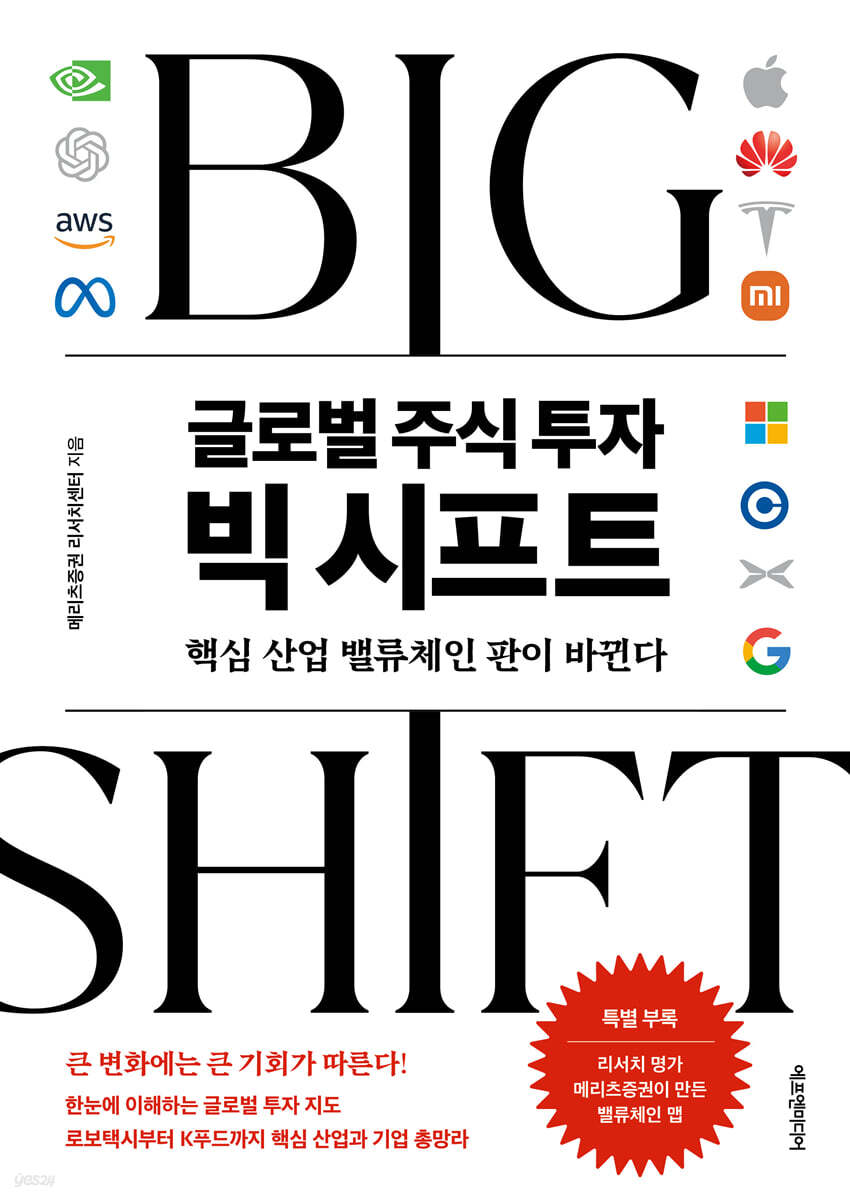
The Big Shift in Global Stock Investment
 |
Description
Book Introduction
Comprehensive Analysis of Megatrends for Overseas Stock Investors
Korea's first comprehensive survey of 1,300 companies across 16 industries and 45 countries.
This book, written by an analyst specializing in industry and corporate analysis, shares the deep and broad knowledge he has accumulated over many years of observing the movements of major companies in his field, along with the inflection points of megatrends he has identified based on this knowledge, with individual investors.
This ambitious project was created by 17 industry analysts from Meritz Securities Research Center, renowned as a "research powerhouse," and covers 1,300 companies across 16 industries and 45 countries.
The special appendix, "Global Value Chain Map at a Glance," provides a quick overview of the value chain trends and companies at each stage of 16 key industries unfolding in the global market.
It was produced in single sheets twice the size of a book so that readers can stick it on their desks and refer to it, and it helps them find the 'next Tesla' or 'next Nvidia' by separately marking the key companies in each industry.
Research Center Director Lee Jin-woo explained, “Now is the time when new businesses and value chains, such as generative AI, robotics, and space, are emerging, and existing value chains are changing rapidly and significantly.” He added, “The consensus and sense of mission of the Meritz Securities analysts who planned this book is that we must share investment knowledge related to this massive trend with individual investors.”
Korea's first comprehensive survey of 1,300 companies across 16 industries and 45 countries.
This book, written by an analyst specializing in industry and corporate analysis, shares the deep and broad knowledge he has accumulated over many years of observing the movements of major companies in his field, along with the inflection points of megatrends he has identified based on this knowledge, with individual investors.
This ambitious project was created by 17 industry analysts from Meritz Securities Research Center, renowned as a "research powerhouse," and covers 1,300 companies across 16 industries and 45 countries.
The special appendix, "Global Value Chain Map at a Glance," provides a quick overview of the value chain trends and companies at each stage of 16 key industries unfolding in the global market.
It was produced in single sheets twice the size of a book so that readers can stick it on their desks and refer to it, and it helps them find the 'next Tesla' or 'next Nvidia' by separately marking the key companies in each industry.
Research Center Director Lee Jin-woo explained, “Now is the time when new businesses and value chains, such as generative AI, robotics, and space, are emerging, and existing value chains are changing rapidly and significantly.” He added, “The consensus and sense of mission of the Meritz Securities analysts who planned this book is that we must share investment knowledge related to this massive trend with individual investors.”
- You can preview some of the book's contents.
Preview
index
Essential Investment Map for a Time of Great Transition in Recommendations _ Hong Seong-guk
Drawing a 'New Map' of Global Investment _ Jinwoo Lee
Part 1.
Advanced and Tech Stocks: A Big Opportunity Opens
Chapter 1 Mobility: Robotaxis Are Coming
A revolution is coming to shift the links between life and movement.
The automotive industry: the starting point for the development of physical artificial intelligence.
The first business model based on autonomous mobility capabilities
Leading companies' next goal is physical AI robots.
The Age of Deflation Revolution
Mobility Value Chain
Mobility Value Chain Map
Chapter 2 Robots: From 'Working Machines' to 'Smart Robots'
The inevitable arrival of the robot age
Robots: The Changing Concept of Labor Replacement
Humanoids: Fantasy or Reality?
An essential element of humanoids: physical artificial intelligence
Robot Value Chain
Robot Value Chain Map
Chapter 3: Space: Space Makes a Big Step into Communications and Industry
Space, humanity's last frontier
Development of the space industry
NewSpace, which started with the emergence of SpaceX
Low-Earth Orbit Satellite Communications to Become Core to 6G Networks
A global space industry with high growth potential
Space Value Chain
Space Value Chain Map
Chapter 4: Energy: AI is a glutton for electricity… What will we feed it?
Why does AI consume so much electricity?
The answer to electricity: On-site power plants
Big Tech's Choice of Own Power Plants
AI Energy's Global Value Chain
Korea's Challenges and Opportunities
Energy value chain
Chapter 5: Power Infrastructure: The 'Heart' and 'Veins' of the Power Grid Are Critically Undersupplied
From power and dynamics to intelligence
The agonies of the 'aging giant' global power grid
The Heart of the Power Grid: Transformers
The blood vessels of the power grid: wires
Expansion of power grid infrastructure is an inevitable task of the times.
Power Infrastructure Value Chain
Energy & Power Infrastructure Value Chain Map
Chapter 6: Secondary Batteries: Will Korea's "High Density" Beat China's "Low Price"?
China's Battery Rise: Will It Be the Ultimate Winner?
The Blossoming of the Electric Vehicle Market and the Evolution of Batteries
LG Group, which was serious about the battery business
In the electric vehicle era, lithium, the second oil, and POSCO
The battery materials supply chain market is also growing.
Secondary battery value chain
Secondary Battery Value Chain Map
Chapter 7: Semiconductors: AI, especially in post-processing
The Evolution of Digital Brain Semiconductors
· Core components of all electronic products
· Artificial intelligence is born from increased semiconductor integration.
The future of Korean semiconductors
Innovation is slowing down; the breakthrough lies in new technologies.
· Miniaturization reaching its limit
Glass substrates: improving performance through materials
· Advanced Packaging: The Role of Back-End Processes Reassessed
· Various attempts to find technological breakthroughs
Semiconductor value chain
Semiconductor Value Chain Map
Chapter 8: Electrical and Electronics: AI is Changing Sets and Components
At a time when a new paradigm is required
On-device AI at the center of the set market
How will AI impact component manufacturers?
The Emergence of On-Device AI and New Form Factors
Electrical and Electronic Value Chain
Electrical and Electronics Value Chain Map
Part 2.
Tradition and Consumerism: The New Market Rules
Chapter 9: Finance: A World of 0.1 Pieces, Anyone Can Become an Investor
Why Digital Assets Are Inescapable
The Reality of Change Proven by Bitcoin
Exchanges become banks, and coins become money.
Current cryptocurrencies are different from past cryptocurrencies
Coinbase, the core of the digital finance ecosystem
Digital Assets: Structure, Not Flow
Financial value chain
Financial Value Chain Map
Chapter 10: The Game: Post-Corona Stillness and Movement
Are the rules of the game changing?
The Butterfly Effect of Short-Form, Moving to Mobile
The Steam platform is heating up.
AI is also entering game development.
Game Value Chain
Game Value Chain Map
Chapter 11 Entertainment: Music IP Companies Call on Superfans
Music Becomes an Industry
Global Music Value Chain and Major Companies
The Rise of the Superfan Industry and the Evolution of the Music Business
Entertainment Value Chain
Entertainment Value Chain Map
Chapter 12: Korea: US Winds Up for LNG Propulsion, Cruise Continues
The shipbuilding industry continues to boom
Escape the slump by riding an LNG ship.
Significant Growth in the LNG Bunkering Market
America's SOS, a green light for K-Chosun
Pay attention to the large-scale beneficiary turning point.
Joseon Value Chain
Joseon Value Chain Map
Chapter 13: Transportation: Structural Changes Writhe Under the Calm Current
Cyclical stocks with high entry barriers
Pay attention to shipping and supply-side variables.
The fundamental reason for the delivery speed war
Restructuring of the Korean Air Sky Market
Transportation Value Chain
Transportation Value Chain Map
Chapter 14: Constraints: Constraints are high-risk, high-reward, and require a multi-layered understanding.
How far have we come in new drug development?
M&A of clinical trial contract organizations is gaining momentum.
Consignment development and production in the spotlight
Understanding the New Drug Approval Process
You need to know the structure of US drug distribution
The Real Reason Why American Healthcare Is So Expensive
Why are drug prices falling?
Pharmaceutical value chain
Pharmaceutical Value Chain Map
Chapter 15: Cosmetics: The Spring of K-Beauty, Leaping Forward to Becoming a Global Cosmetics Powerhouse
The long-awaited future of K-beauty
Why I Have a Rosy Outlook on K-Beauty
America is big and there are many places to sell.
Expanding to Europe, Russia, and the Middle East
K-Beauty: Three Things to Know
Cosmetics value chain
Cosmetics Value Chain Map
Chapter 16 Food and Beverage: The New Success Formula of K-Food
Move the 'global network'
Step-by-step upgrade of the Korean food industry
Variables that have driven food industry stock prices
Exports are the springboard for overcoming the food cliff.
Trading down is actually an opportunity
Global network effects, some ahead, some behind
Food and Beverage Value Chain
Food and Beverage Value Chain Map
Search
[Special Appendix] Global Value Chain Map at a Glance (16 Chapters)
Drawing a 'New Map' of Global Investment _ Jinwoo Lee
Part 1.
Advanced and Tech Stocks: A Big Opportunity Opens
Chapter 1 Mobility: Robotaxis Are Coming
A revolution is coming to shift the links between life and movement.
The automotive industry: the starting point for the development of physical artificial intelligence.
The first business model based on autonomous mobility capabilities
Leading companies' next goal is physical AI robots.
The Age of Deflation Revolution
Mobility Value Chain
Mobility Value Chain Map
Chapter 2 Robots: From 'Working Machines' to 'Smart Robots'
The inevitable arrival of the robot age
Robots: The Changing Concept of Labor Replacement
Humanoids: Fantasy or Reality?
An essential element of humanoids: physical artificial intelligence
Robot Value Chain
Robot Value Chain Map
Chapter 3: Space: Space Makes a Big Step into Communications and Industry
Space, humanity's last frontier
Development of the space industry
NewSpace, which started with the emergence of SpaceX
Low-Earth Orbit Satellite Communications to Become Core to 6G Networks
A global space industry with high growth potential
Space Value Chain
Space Value Chain Map
Chapter 4: Energy: AI is a glutton for electricity… What will we feed it?
Why does AI consume so much electricity?
The answer to electricity: On-site power plants
Big Tech's Choice of Own Power Plants
AI Energy's Global Value Chain
Korea's Challenges and Opportunities
Energy value chain
Chapter 5: Power Infrastructure: The 'Heart' and 'Veins' of the Power Grid Are Critically Undersupplied
From power and dynamics to intelligence
The agonies of the 'aging giant' global power grid
The Heart of the Power Grid: Transformers
The blood vessels of the power grid: wires
Expansion of power grid infrastructure is an inevitable task of the times.
Power Infrastructure Value Chain
Energy & Power Infrastructure Value Chain Map
Chapter 6: Secondary Batteries: Will Korea's "High Density" Beat China's "Low Price"?
China's Battery Rise: Will It Be the Ultimate Winner?
The Blossoming of the Electric Vehicle Market and the Evolution of Batteries
LG Group, which was serious about the battery business
In the electric vehicle era, lithium, the second oil, and POSCO
The battery materials supply chain market is also growing.
Secondary battery value chain
Secondary Battery Value Chain Map
Chapter 7: Semiconductors: AI, especially in post-processing
The Evolution of Digital Brain Semiconductors
· Core components of all electronic products
· Artificial intelligence is born from increased semiconductor integration.
The future of Korean semiconductors
Innovation is slowing down; the breakthrough lies in new technologies.
· Miniaturization reaching its limit
Glass substrates: improving performance through materials
· Advanced Packaging: The Role of Back-End Processes Reassessed
· Various attempts to find technological breakthroughs
Semiconductor value chain
Semiconductor Value Chain Map
Chapter 8: Electrical and Electronics: AI is Changing Sets and Components
At a time when a new paradigm is required
On-device AI at the center of the set market
How will AI impact component manufacturers?
The Emergence of On-Device AI and New Form Factors
Electrical and Electronic Value Chain
Electrical and Electronics Value Chain Map
Part 2.
Tradition and Consumerism: The New Market Rules
Chapter 9: Finance: A World of 0.1 Pieces, Anyone Can Become an Investor
Why Digital Assets Are Inescapable
The Reality of Change Proven by Bitcoin
Exchanges become banks, and coins become money.
Current cryptocurrencies are different from past cryptocurrencies
Coinbase, the core of the digital finance ecosystem
Digital Assets: Structure, Not Flow
Financial value chain
Financial Value Chain Map
Chapter 10: The Game: Post-Corona Stillness and Movement
Are the rules of the game changing?
The Butterfly Effect of Short-Form, Moving to Mobile
The Steam platform is heating up.
AI is also entering game development.
Game Value Chain
Game Value Chain Map
Chapter 11 Entertainment: Music IP Companies Call on Superfans
Music Becomes an Industry
Global Music Value Chain and Major Companies
The Rise of the Superfan Industry and the Evolution of the Music Business
Entertainment Value Chain
Entertainment Value Chain Map
Chapter 12: Korea: US Winds Up for LNG Propulsion, Cruise Continues
The shipbuilding industry continues to boom
Escape the slump by riding an LNG ship.
Significant Growth in the LNG Bunkering Market
America's SOS, a green light for K-Chosun
Pay attention to the large-scale beneficiary turning point.
Joseon Value Chain
Joseon Value Chain Map
Chapter 13: Transportation: Structural Changes Writhe Under the Calm Current
Cyclical stocks with high entry barriers
Pay attention to shipping and supply-side variables.
The fundamental reason for the delivery speed war
Restructuring of the Korean Air Sky Market
Transportation Value Chain
Transportation Value Chain Map
Chapter 14: Constraints: Constraints are high-risk, high-reward, and require a multi-layered understanding.
How far have we come in new drug development?
M&A of clinical trial contract organizations is gaining momentum.
Consignment development and production in the spotlight
Understanding the New Drug Approval Process
You need to know the structure of US drug distribution
The Real Reason Why American Healthcare Is So Expensive
Why are drug prices falling?
Pharmaceutical value chain
Pharmaceutical Value Chain Map
Chapter 15: Cosmetics: The Spring of K-Beauty, Leaping Forward to Becoming a Global Cosmetics Powerhouse
The long-awaited future of K-beauty
Why I Have a Rosy Outlook on K-Beauty
America is big and there are many places to sell.
Expanding to Europe, Russia, and the Middle East
K-Beauty: Three Things to Know
Cosmetics value chain
Cosmetics Value Chain Map
Chapter 16 Food and Beverage: The New Success Formula of K-Food
Move the 'global network'
Step-by-step upgrade of the Korean food industry
Variables that have driven food industry stock prices
Exports are the springboard for overcoming the food cliff.
Trading down is actually an opportunity
Global network effects, some ahead, some behind
Food and Beverage Value Chain
Food and Beverage Value Chain Map
Search
[Special Appendix] Global Value Chain Map at a Glance (16 Chapters)
Into the book
It is difficult for ordinary investors to analyze a company's financial status as precisely as fund managers or analysts.
However, if there is an industry or company that you are interested in, you should be able to at least sketch out the value chain of that industry, that is, the structure and flow of connections between companies.
Only then can we grasp why certain companies grow or stagnate in response to market changes, and where new opportunities and challenges arise.
Even when the market is shaky, the power to maintain balance comes from understanding the value chain.
---"introduction.
From “Drawing a ‘New Map’ of Global Investment”
By 2025, autonomous vehicles equipped with fully developed learning models will fully penetrate our daily lives. These devices will redefine the consumer mobility experience by providing optimized driving performance based on movement data.
The commercialization of autonomous driving technology heralds a new turning point that will reshape the competitive landscape of the automotive market and fundamentally revolutionize the way people move around.
---「Chapter 1.
From "Mobility: Robotaxis are Coming"
SpaceX's position in the global space industry can be intuitively seen through its launch performance.
Of the 263 global space launches in 2024, SpaceX accounted for 52.5%, and SpaceX accounted for an overwhelming 75.3% of low-Earth orbit launches.
SpaceX's launch frequency, which stood at just 31 in 2021, is expected to grow 40-100% annually, reaching 138 in 2024 and 196 in 2025, a 43% increase year-over-year.
---From "Chapter 3 Space: Space is Making Great strides into Communications and Industry"
SMR is a next-generation nuclear power plant that produces electricity by manufacturing multiple small reactors in a factory and assembling them on site.
Existing large nuclear power plants produce more than 1,000 MW of output per unit, but SMRs are typically less than 300 MW.
Even though the size has decreased, the basic principles of the reactor remain the same.
Nuclear fission is used to create steam, which turns turbines to produce electricity.
(…) Currently, more than 70 SMR models are under development worldwide, with most of them planned for commercialization around 2030.
---「Chapter 4.
Energy: AI is a glutton for electricity… What will we feed AI?
Artificial intelligence (AI) is emerging as a key tool in retaining existing consumers and monetizing strategies in the IT set market.
For example, smartphone and PC manufacturers are incorporating AI capabilities into their devices to improve user experience, increase on-device time, and generate service-linked revenue.
The era of 'on-device AI' is dawning.
On-device AI refers to technology that processes AI calculations directly within the device, moving away from cloud-based AI.
This has become possible thanks to recent advancements in chipsets and hardware performance, as well as the development of lightweight AI models.
---「Chapter 8.
Electrical and Electronics: AI is also changing sets and components.
Moreover, cryptocurrencies are beginning to outpace traditional financial platforms not only in terms of available infrastructure but also in terms of the number of actual users.
As of 2024, the number of active cryptocurrency users worldwide is estimated to be approximately 620 million, a figure that vastly exceeds the number of users of American Express (140 million) and PayPal (430 million).
Cryptocurrencies are now more than just a means of payment; they are establishing themselves as one of the fastest-growing payment networks globally.
---「Chapter 9.
Finance: 0.1 Piece of the World, Anyone Can Become an Investor
The global popularity of K-beauty is by no means a coincidence, riding the Korean Wave.
This can be called a 'long future' in that it is the accumulated result of structural changes and increased competitiveness in the Korean cosmetics market.
This global momentum is stronger and more dynamic than any period in the past.
The success of numerous indie brands, the record-breaking sales and operating profit rates of raw materials and original design manufacturing (ODM) companies are testament to this boom.
However, if there is an industry or company that you are interested in, you should be able to at least sketch out the value chain of that industry, that is, the structure and flow of connections between companies.
Only then can we grasp why certain companies grow or stagnate in response to market changes, and where new opportunities and challenges arise.
Even when the market is shaky, the power to maintain balance comes from understanding the value chain.
---"introduction.
From “Drawing a ‘New Map’ of Global Investment”
By 2025, autonomous vehicles equipped with fully developed learning models will fully penetrate our daily lives. These devices will redefine the consumer mobility experience by providing optimized driving performance based on movement data.
The commercialization of autonomous driving technology heralds a new turning point that will reshape the competitive landscape of the automotive market and fundamentally revolutionize the way people move around.
---「Chapter 1.
From "Mobility: Robotaxis are Coming"
SpaceX's position in the global space industry can be intuitively seen through its launch performance.
Of the 263 global space launches in 2024, SpaceX accounted for 52.5%, and SpaceX accounted for an overwhelming 75.3% of low-Earth orbit launches.
SpaceX's launch frequency, which stood at just 31 in 2021, is expected to grow 40-100% annually, reaching 138 in 2024 and 196 in 2025, a 43% increase year-over-year.
---From "Chapter 3 Space: Space is Making Great strides into Communications and Industry"
SMR is a next-generation nuclear power plant that produces electricity by manufacturing multiple small reactors in a factory and assembling them on site.
Existing large nuclear power plants produce more than 1,000 MW of output per unit, but SMRs are typically less than 300 MW.
Even though the size has decreased, the basic principles of the reactor remain the same.
Nuclear fission is used to create steam, which turns turbines to produce electricity.
(…) Currently, more than 70 SMR models are under development worldwide, with most of them planned for commercialization around 2030.
---「Chapter 4.
Energy: AI is a glutton for electricity… What will we feed AI?
Artificial intelligence (AI) is emerging as a key tool in retaining existing consumers and monetizing strategies in the IT set market.
For example, smartphone and PC manufacturers are incorporating AI capabilities into their devices to improve user experience, increase on-device time, and generate service-linked revenue.
The era of 'on-device AI' is dawning.
On-device AI refers to technology that processes AI calculations directly within the device, moving away from cloud-based AI.
This has become possible thanks to recent advancements in chipsets and hardware performance, as well as the development of lightweight AI models.
---「Chapter 8.
Electrical and Electronics: AI is also changing sets and components.
Moreover, cryptocurrencies are beginning to outpace traditional financial platforms not only in terms of available infrastructure but also in terms of the number of actual users.
As of 2024, the number of active cryptocurrency users worldwide is estimated to be approximately 620 million, a figure that vastly exceeds the number of users of American Express (140 million) and PayPal (430 million).
Cryptocurrencies are now more than just a means of payment; they are establishing themselves as one of the fastest-growing payment networks globally.
---「Chapter 9.
Finance: 0.1 Piece of the World, Anyone Can Become an Investor
The global popularity of K-beauty is by no means a coincidence, riding the Korean Wave.
This can be called a 'long future' in that it is the accumulated result of structural changes and increased competitiveness in the Korean cosmetics market.
This global momentum is stronger and more dynamic than any period in the past.
The success of numerous indie brands, the record-breaking sales and operating profit rates of raw materials and original design manufacturing (ODM) companies are testament to this boom.
---「Chapter 15.
Cosmetics: The Spring of K-Beauty, Leaping Forward to Becoming a Global Cosmetics Powerhouse
Cosmetics: The Spring of K-Beauty, Leaping Forward to Becoming a Global Cosmetics Powerhouse
Publisher's Review
A comprehensive map to keep pace with megatrends
There is a stock market adage that says, “If you try to ride a small wave, you will drown.”
This means that the more you buy and sell based on daily corporate announcements and market news, the more you risk losing money and moving further away from stable profits.
The problem is that it is extremely difficult for individual investors to spot big waves, or new trends in major industries, ahead of others.
Expert insight is essential, and foresight is required.
However, with the guidance of a reliable expert, you can at least outperform the market average while staying in step with megatrends.
This book, "The Big Shift in Global Stock Investment," is a comprehensive guide that serves as just that.
For example, in the semiconductor industry, let's say that Company A begins supplying its newly developed 'hybrid bonding' equipment to a memory semiconductor manufacturing customer.
If you don't know where hybrid bonding fits into the semiconductor value chain and what changes are occurring within it, you may only ride a small wave before realizing your profits by buying the stock.
Investors who have read Chapter 7 of this book will know that while the semiconductor industry previously focused on increasing integration through circuit miniaturization across all processes, it is now focusing on changing materials and packaging.
The reduction in investment in the entire process is because circuit miniaturization has reached its physical limits.
Hybrid bonding is a new packaging method.
If the semiconductor industry's added value continues to come from post-processing processes like hybrid bonding, should you buy Company A's stock and hold it for the medium to long term? To make this decision, you'll need to reread Chapter 7.
This chapter explains the different types of hybrid bonding.
If you venture into overseas stock investing without a guide…
The background for planning this book is to expand overseas stock investment by individual investors.
The proportion of overseas stocks held by individual investors surged by 15.0 percentage points, from 2.6% at the end of 2019 to 17.6% at the end of 2024.
Despite the increase in overseas stock investment, systematic knowledge of global core industries is lacking.
As a result, there are many cases of people buying foreign stocks with vague expectations based on fragmentary news and then selling them hastily.
This is why Meritz Securities Research Center, renowned for its research excellence, decided to publish this book.
Anyone can easily access real-time market news and corporate performance updates.
However, the deep and extensive knowledge accumulated by industry analysts who have observed the movements of major companies in their respective fields for many years, and the inflection points of change captured based on this knowledge, are not easily accessible to individual investors.
Especially now, we are in a time when new value chains are emerging or existing value chains are undergoing rapid and significant changes, primarily in fields such as robotics and space, led by generative artificial intelligence (AI).
The consensus and sense of mission of the Meritz Securities analysts who wrote this book is that they must share investment knowledge related to this massive trend with individual investors.
The 16 industries analyzed include mobility, robotics, space, energy, power infrastructure, secondary batteries, semiconductors, electrical and electronics, finance, games, entertainment, shipbuilding, transportation, pharmaceuticals, cosmetics, and food and beverage, encompassing major global industries and Korea's leading industries.
Guide you to the cutting edge of change, including robotaxis and robots.
Robo-taxi is not just about advancing taxi service.
It is a ‘deflation technology’ that dramatically reduces transportation costs.
It has the potential to revolutionize existing vehicle ownership and mobility service models, offering convenience and privacy at far lower fares than traditional taxis.
Understanding the value chain of robotaxis, led by the US and China, is crucial for understanding the pulse of investment in this sector.
In the past, robots were industrial machines that performed repetitive and dangerous tasks, but now they are evolving into 'smart robots' equipped with artificial intelligence, capable of collaboration and autonomous decision-making.
In particular, collaborative robots that can cooperate with humans and humanoids that can work in various environments are attracting attention.
General-purpose robots that can perform various tasks on their own are expected to become key workers not only in manufacturing but also in the service and household sectors.
From Beyond the Clouds to Everyday Services.
Space is being reorganized into a tangible industrial realm.
For example, the ultra-high-speed satellite internet business is changing the global communications landscape.
Investment opportunities are expanding across the space industry value chain, including launches, satellites, and ground infrastructure.
Korean companies are also strong in power and grids.
AI is a glutton for power. What will feed it? Gas-fired power generation is a realistic option, but the ultimate solution is small modular reactors (SMRs).
Korean companies have the potential to become key suppliers of SMRs, from manufacturing core components to construction.
Even if electricity is produced to meet rapidly increasing demand, it is useless if it cannot be supplied.
However, major national power grids are aging and underinvestment makes them unable to meet new demand.
Renewable energy here requires the construction of new power grids, including submarine cables.
This is why major countries, including the United States, are investing heavily in power grid infrastructure.
Korean companies are benefiting from the development of transformers and ultra-high voltage cables, and their order backlog is growing.
Secondary batteries are a key component in electric vehicles, energy storage systems (ESS), and smart devices, and demand is steadily growing.
In the global market, Korean companies based on technological prowess and customer base are competing with Chinese companies that prioritize low-cost competitiveness.
Who will be the final winner?
New form factor technologies, such as foldables and microdisplays, are being commercialized in IT products such as smartphones, extended reality (XR) devices, and wearables.
Accordingly, related parts manufacturers are expected to benefit.
In particular, LEDoS and waveguide technologies are attracting attention as the core of next-generation XR devices because they enable high brightness and miniaturization.
Here, we briefly introduced the semiconductor industry, which was introduced in the beginning, and the industries covered in Part 1.
The order of the main chapters was determined based on the criteria of placing industries with high interest first, and industries with a larger share of the domestic market than overseas markets last.
In Part 2, eight industries are analyzed, from finance to food and beverage.
A rosy outlook for K-beauty's "long-term future"
Demand for digital assets is growing, especially among the MZ generation.
In the digital asset era, the primary investment target is the structure that sustains and connects this market.
In this context, Coinbase and Robinhood, platforms in the digital asset market, deserve attention.
Robinhood, in particular, is expanding its reach into the asset management market.
The global gaming market remained stagnant last year.
A notable change among these is the advancement of casual games.
Just as short-form video games have become a popular genre, casual games like Scopely's "Monopoly Go!" are enjoying a surge in popularity in the gaming market. A key shift in PC gaming in recent years has been the growing influence of the Steam platform.
In addition to game distribution, Steam is also leading the way in communication and marketing with consumers.
The music industry is evolving into a complex ecosystem combining performances, streaming, merchandise, and fan platforms.
At the center is the 'superfan'.
They account for only 20% of all users, but 18% of streaming, and they actively consume live performances, physical albums, and even on fan platforms.
Accordingly, global record labels and K-pop agencies are focusing on fan community-based monetization strategies.
The shipbuilding industry is a supply industry closely linked to the shipping industry. During a shipping boom, new ship orders increase as freight rates surge due to a shortage of ships.
As demand for eco-friendly and high-efficiency ships increases, competitiveness in high-value-added ships, including LNG carriers, is becoming increasingly important.
Technological prowess and delivery responsiveness are emerging as key competitive factors.
The transportation industry is a cyclical stock that follows the cycle of booms and recessions depending on the economy.
However, within the transportation industry, the competitive landscape is undergoing changes due to internal or policy variables.
In the shipping industry, the market is expected to improve from 2027 as environmental regulations lead to the retirement of older vessels.
In land transport, we analyze the service differentiation actively emerging in domestic courier services and also examine the air transport market.
Biosimilars are benefiting from institutional changes, such as expanded interchangeability, in the U.S. market, and domestic companies are accelerating their entry.
In the new drug sector, AI-based new drug development and global clinical trials are in full swing.
Long-term growth potential remains valid despite institutional risks such as changes in U.S. drug pricing policy.
Over the past 20 years, K-beauty has secured global competitiveness by combining technological prowess, online and offline distribution networks, and product planning capabilities.
As a result, it will surpass Germany and rise to third place in the world in terms of exports in 2024.
The potential for future growth is even greater.
This is because we are just beginning to enter major overseas markets, including the United States.
The future of Korea's food industry depends on exports.
The global success of Samyang Foods' "Buldak Bokkeum Myeon" demonstrated the trend of food being consumed as content based on taste.
To be consumed as content, you need to move through a global network.
Nongshim pioneered overseas markets with Shin Ramyun before Samyang Foods.
We analyze the strategies and challenges the two companies will face in conquering the global market in the future.
A global value chain map to put on your desk
The core of this book is the global value chain map provided as a separate appendix.
This map provides a quick overview of the value chains and companies at each stage of 16 key industries unfolding in the global market.
It was made twice the size of a book so that it can be pasted on the front of a desk and used as a reference.
If you venture into the unknown sea of the overseas stock market without prior knowledge, you run a high risk of drifting and running aground.
《Global Stock Investment Big Shift》 was created to serve as a detailed map of overseas stock markets.
This book is tailored to the general investor who is investing in overseas stocks but has not yet considered analyzing the industries in which the companies they are investing belong.
For readers planning to invest in overseas stocks, this book will serve as a guide for narrowing down areas of interest and selecting investment targets within the overall market landscape.
This book also contains content that will satisfy the demand for understanding and investing in domestic stocks within the global industrial value chain.
There is a stock market adage that says, “If you try to ride a small wave, you will drown.”
This means that the more you buy and sell based on daily corporate announcements and market news, the more you risk losing money and moving further away from stable profits.
The problem is that it is extremely difficult for individual investors to spot big waves, or new trends in major industries, ahead of others.
Expert insight is essential, and foresight is required.
However, with the guidance of a reliable expert, you can at least outperform the market average while staying in step with megatrends.
This book, "The Big Shift in Global Stock Investment," is a comprehensive guide that serves as just that.
For example, in the semiconductor industry, let's say that Company A begins supplying its newly developed 'hybrid bonding' equipment to a memory semiconductor manufacturing customer.
If you don't know where hybrid bonding fits into the semiconductor value chain and what changes are occurring within it, you may only ride a small wave before realizing your profits by buying the stock.
Investors who have read Chapter 7 of this book will know that while the semiconductor industry previously focused on increasing integration through circuit miniaturization across all processes, it is now focusing on changing materials and packaging.
The reduction in investment in the entire process is because circuit miniaturization has reached its physical limits.
Hybrid bonding is a new packaging method.
If the semiconductor industry's added value continues to come from post-processing processes like hybrid bonding, should you buy Company A's stock and hold it for the medium to long term? To make this decision, you'll need to reread Chapter 7.
This chapter explains the different types of hybrid bonding.
If you venture into overseas stock investing without a guide…
The background for planning this book is to expand overseas stock investment by individual investors.
The proportion of overseas stocks held by individual investors surged by 15.0 percentage points, from 2.6% at the end of 2019 to 17.6% at the end of 2024.
Despite the increase in overseas stock investment, systematic knowledge of global core industries is lacking.
As a result, there are many cases of people buying foreign stocks with vague expectations based on fragmentary news and then selling them hastily.
This is why Meritz Securities Research Center, renowned for its research excellence, decided to publish this book.
Anyone can easily access real-time market news and corporate performance updates.
However, the deep and extensive knowledge accumulated by industry analysts who have observed the movements of major companies in their respective fields for many years, and the inflection points of change captured based on this knowledge, are not easily accessible to individual investors.
Especially now, we are in a time when new value chains are emerging or existing value chains are undergoing rapid and significant changes, primarily in fields such as robotics and space, led by generative artificial intelligence (AI).
The consensus and sense of mission of the Meritz Securities analysts who wrote this book is that they must share investment knowledge related to this massive trend with individual investors.
The 16 industries analyzed include mobility, robotics, space, energy, power infrastructure, secondary batteries, semiconductors, electrical and electronics, finance, games, entertainment, shipbuilding, transportation, pharmaceuticals, cosmetics, and food and beverage, encompassing major global industries and Korea's leading industries.
Guide you to the cutting edge of change, including robotaxis and robots.
Robo-taxi is not just about advancing taxi service.
It is a ‘deflation technology’ that dramatically reduces transportation costs.
It has the potential to revolutionize existing vehicle ownership and mobility service models, offering convenience and privacy at far lower fares than traditional taxis.
Understanding the value chain of robotaxis, led by the US and China, is crucial for understanding the pulse of investment in this sector.
In the past, robots were industrial machines that performed repetitive and dangerous tasks, but now they are evolving into 'smart robots' equipped with artificial intelligence, capable of collaboration and autonomous decision-making.
In particular, collaborative robots that can cooperate with humans and humanoids that can work in various environments are attracting attention.
General-purpose robots that can perform various tasks on their own are expected to become key workers not only in manufacturing but also in the service and household sectors.
From Beyond the Clouds to Everyday Services.
Space is being reorganized into a tangible industrial realm.
For example, the ultra-high-speed satellite internet business is changing the global communications landscape.
Investment opportunities are expanding across the space industry value chain, including launches, satellites, and ground infrastructure.
Korean companies are also strong in power and grids.
AI is a glutton for power. What will feed it? Gas-fired power generation is a realistic option, but the ultimate solution is small modular reactors (SMRs).
Korean companies have the potential to become key suppliers of SMRs, from manufacturing core components to construction.
Even if electricity is produced to meet rapidly increasing demand, it is useless if it cannot be supplied.
However, major national power grids are aging and underinvestment makes them unable to meet new demand.
Renewable energy here requires the construction of new power grids, including submarine cables.
This is why major countries, including the United States, are investing heavily in power grid infrastructure.
Korean companies are benefiting from the development of transformers and ultra-high voltage cables, and their order backlog is growing.
Secondary batteries are a key component in electric vehicles, energy storage systems (ESS), and smart devices, and demand is steadily growing.
In the global market, Korean companies based on technological prowess and customer base are competing with Chinese companies that prioritize low-cost competitiveness.
Who will be the final winner?
New form factor technologies, such as foldables and microdisplays, are being commercialized in IT products such as smartphones, extended reality (XR) devices, and wearables.
Accordingly, related parts manufacturers are expected to benefit.
In particular, LEDoS and waveguide technologies are attracting attention as the core of next-generation XR devices because they enable high brightness and miniaturization.
Here, we briefly introduced the semiconductor industry, which was introduced in the beginning, and the industries covered in Part 1.
The order of the main chapters was determined based on the criteria of placing industries with high interest first, and industries with a larger share of the domestic market than overseas markets last.
In Part 2, eight industries are analyzed, from finance to food and beverage.
A rosy outlook for K-beauty's "long-term future"
Demand for digital assets is growing, especially among the MZ generation.
In the digital asset era, the primary investment target is the structure that sustains and connects this market.
In this context, Coinbase and Robinhood, platforms in the digital asset market, deserve attention.
Robinhood, in particular, is expanding its reach into the asset management market.
The global gaming market remained stagnant last year.
A notable change among these is the advancement of casual games.
Just as short-form video games have become a popular genre, casual games like Scopely's "Monopoly Go!" are enjoying a surge in popularity in the gaming market. A key shift in PC gaming in recent years has been the growing influence of the Steam platform.
In addition to game distribution, Steam is also leading the way in communication and marketing with consumers.
The music industry is evolving into a complex ecosystem combining performances, streaming, merchandise, and fan platforms.
At the center is the 'superfan'.
They account for only 20% of all users, but 18% of streaming, and they actively consume live performances, physical albums, and even on fan platforms.
Accordingly, global record labels and K-pop agencies are focusing on fan community-based monetization strategies.
The shipbuilding industry is a supply industry closely linked to the shipping industry. During a shipping boom, new ship orders increase as freight rates surge due to a shortage of ships.
As demand for eco-friendly and high-efficiency ships increases, competitiveness in high-value-added ships, including LNG carriers, is becoming increasingly important.
Technological prowess and delivery responsiveness are emerging as key competitive factors.
The transportation industry is a cyclical stock that follows the cycle of booms and recessions depending on the economy.
However, within the transportation industry, the competitive landscape is undergoing changes due to internal or policy variables.
In the shipping industry, the market is expected to improve from 2027 as environmental regulations lead to the retirement of older vessels.
In land transport, we analyze the service differentiation actively emerging in domestic courier services and also examine the air transport market.
Biosimilars are benefiting from institutional changes, such as expanded interchangeability, in the U.S. market, and domestic companies are accelerating their entry.
In the new drug sector, AI-based new drug development and global clinical trials are in full swing.
Long-term growth potential remains valid despite institutional risks such as changes in U.S. drug pricing policy.
Over the past 20 years, K-beauty has secured global competitiveness by combining technological prowess, online and offline distribution networks, and product planning capabilities.
As a result, it will surpass Germany and rise to third place in the world in terms of exports in 2024.
The potential for future growth is even greater.
This is because we are just beginning to enter major overseas markets, including the United States.
The future of Korea's food industry depends on exports.
The global success of Samyang Foods' "Buldak Bokkeum Myeon" demonstrated the trend of food being consumed as content based on taste.
To be consumed as content, you need to move through a global network.
Nongshim pioneered overseas markets with Shin Ramyun before Samyang Foods.
We analyze the strategies and challenges the two companies will face in conquering the global market in the future.
A global value chain map to put on your desk
The core of this book is the global value chain map provided as a separate appendix.
This map provides a quick overview of the value chains and companies at each stage of 16 key industries unfolding in the global market.
It was made twice the size of a book so that it can be pasted on the front of a desk and used as a reference.
If you venture into the unknown sea of the overseas stock market without prior knowledge, you run a high risk of drifting and running aground.
《Global Stock Investment Big Shift》 was created to serve as a detailed map of overseas stock markets.
This book is tailored to the general investor who is investing in overseas stocks but has not yet considered analyzing the industries in which the companies they are investing belong.
For readers planning to invest in overseas stocks, this book will serve as a guide for narrowing down areas of interest and selecting investment targets within the overall market landscape.
This book also contains content that will satisfy the demand for understanding and investing in domestic stocks within the global industrial value chain.
GOODS SPECIFICS
- Date of issue: July 12, 2025
- Page count, weight, size: 424 pages | 978g | 179*251*26mm
- ISBN13: 9791194322115
- ISBN10: 1194322115
You may also like
카테고리
korean


korean

![GQ KOREA Mark (Monthly): December [2025]](http://librairie.coreenne.fr/cdn/shop/files/8ef265dbbfbf186523ed75ba7319009d.jpg?v=1765340328&width=3840)


