

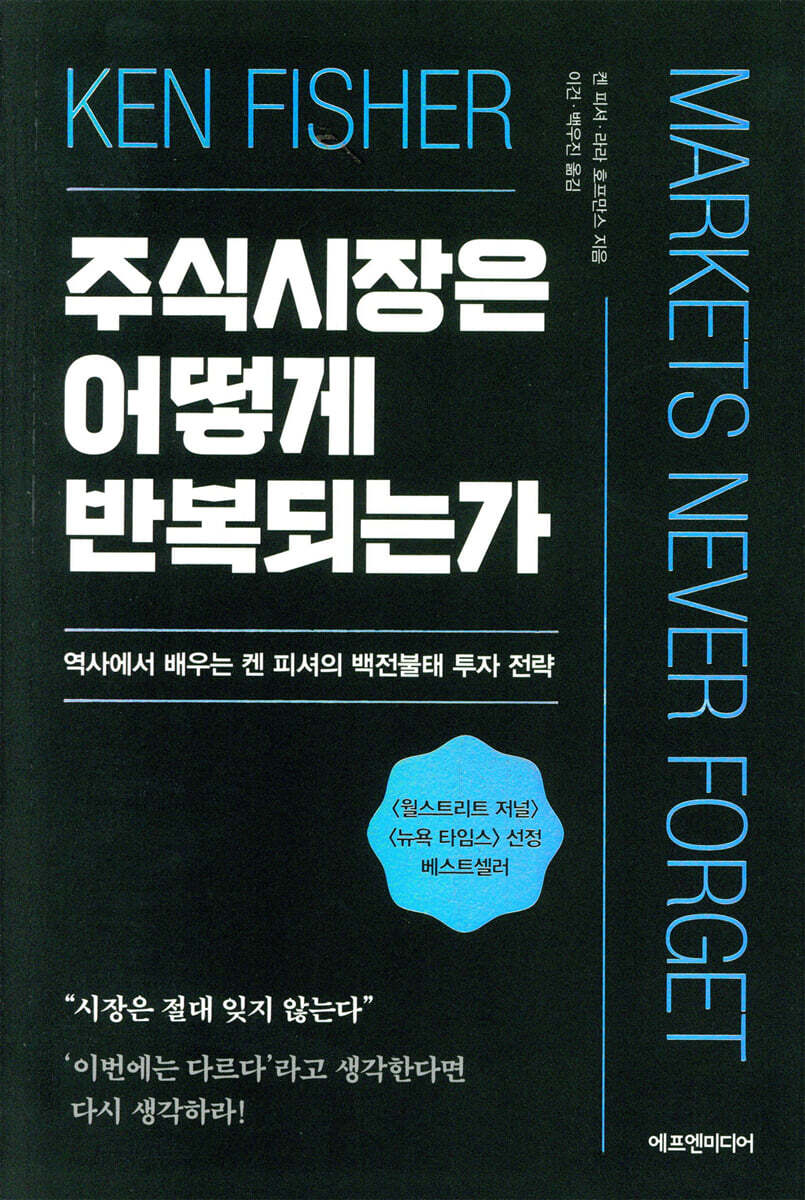
How the Stock Market Repeats Itself
 |
Description
Book Introduction
If you think 'this time is different', think again!
The market repeats itself without exception, and investors forget.
Our memory of economics and markets is appallingly poor.
The stock market never forgets, but investors always do.
Because of this, we keep making ridiculous mistakes and suffer losses.
And soon, even these mistakes and losses are forgotten, and once again, greed and fear take over, thinking, 'This time is different.'
But market history shows a repeating pattern, saying, 'This time is no different.'
The author, Ken Fisher, is a world-renowned investment strategist.
He believes in capitalism and the market, and that the two factors that determine stock prices are supply and demand.
For him, investing is not a game of certainty but a game of probability, and history is a powerful tool for predicting capital markets.
What matters is not the confidence of the media or experts, but the probabilities shown by the actual markets of the past.
It is a pattern confirmed by hundreds of years of history.
This is why the author chose to “concisely convey the key points through quotations rather than publishing it as an 800-page academic book.”
The market repeats itself without exception, and investors forget.
Our memory of economics and markets is appallingly poor.
The stock market never forgets, but investors always do.
Because of this, we keep making ridiculous mistakes and suffer losses.
And soon, even these mistakes and losses are forgotten, and once again, greed and fear take over, thinking, 'This time is different.'
But market history shows a repeating pattern, saying, 'This time is no different.'
The author, Ken Fisher, is a world-renowned investment strategist.
He believes in capitalism and the market, and that the two factors that determine stock prices are supply and demand.
For him, investing is not a game of certainty but a game of probability, and history is a powerful tool for predicting capital markets.
What matters is not the confidence of the media or experts, but the probabilities shown by the actual markets of the past.
It is a pattern confirmed by hundreds of years of history.
This is why the author chose to “concisely convey the key points through quotations rather than publishing it as an 800-page academic book.”
- You can preview some of the book's contents.
Preview
index
Recommendation | Is this time different? This time again! _ Shin Jin-oh
How to Deal with the All-or-Nothing Korean Stock Market _ Hong Chun-wook
Introduction | Inferring Probability from History _ Ken Fisher
Chapter 1: The idea that "this time is different" is always wrong
High accuracy comes from an accurate worldview.
A new normal, nothing new
It's not a "jobless economic recovery," but rather "employment improvement after economic recovery."
Double dip, always feared but rarely occurring
Chapter 2: Don't Be Fooled by Averages
Bull market returns are higher than average.
A V-shaped rebound overwhelms the downtrend at the end of the bear market.
Extreme returns are normal.
The stock market, a master of insults and a vicious charlatan
Achieving average returns is very difficult.
Chapter 3: Volatility is normal and fluctuates on its own.
Volatility is neither good nor bad
Volatility does not increase
The painful daily ups and downs
The loss period for stocks is shorter than that for bonds.
Economic volatility is also normal.
Embrace volatility to avoid fraud and fraud.
There was never a single monotonous moment.
Chapter 4: The Long-Term Bear Market That Never Existed
The colored glasses of a bear market
Even major adjustments don't hurt returns.
Chapter 5: The False Fear of Debt
The problem is not the deficit, but the surplus.
The economy has never been bad because of debt.
A default that will never become a reality
Chapter 6: There is no superior stock.
Long-term returns becoming similar
Long-term predictions are impossible
It may seem safe, but it could actually be heat tracking.
Timing as History Tells Us
Chapter 7: Investors Blinded by Ideology
Enter the ideology-free zone
Your party is no better either
The President and Risk Aversion
Presidential Election and Inverse Investment
China's economic control
Running a business is more beneficial to the world than politics.
Chapter 8: The World Economy, Always Global
An irreversible global trend
The real risk is not investing abroad.
We shouldn't rely solely on history.
Appendix | There's No Place Like Kansas
annotation
How to Deal with the All-or-Nothing Korean Stock Market _ Hong Chun-wook
Introduction | Inferring Probability from History _ Ken Fisher
Chapter 1: The idea that "this time is different" is always wrong
High accuracy comes from an accurate worldview.
A new normal, nothing new
It's not a "jobless economic recovery," but rather "employment improvement after economic recovery."
Double dip, always feared but rarely occurring
Chapter 2: Don't Be Fooled by Averages
Bull market returns are higher than average.
A V-shaped rebound overwhelms the downtrend at the end of the bear market.
Extreme returns are normal.
The stock market, a master of insults and a vicious charlatan
Achieving average returns is very difficult.
Chapter 3: Volatility is normal and fluctuates on its own.
Volatility is neither good nor bad
Volatility does not increase
The painful daily ups and downs
The loss period for stocks is shorter than that for bonds.
Economic volatility is also normal.
Embrace volatility to avoid fraud and fraud.
There was never a single monotonous moment.
Chapter 4: The Long-Term Bear Market That Never Existed
The colored glasses of a bear market
Even major adjustments don't hurt returns.
Chapter 5: The False Fear of Debt
The problem is not the deficit, but the surplus.
The economy has never been bad because of debt.
A default that will never become a reality
Chapter 6: There is no superior stock.
Long-term returns becoming similar
Long-term predictions are impossible
It may seem safe, but it could actually be heat tracking.
Timing as History Tells Us
Chapter 7: Investors Blinded by Ideology
Enter the ideology-free zone
Your party is no better either
The President and Risk Aversion
Presidential Election and Inverse Investment
China's economic control
Running a business is more beneficial to the world than politics.
Chapter 8: The World Economy, Always Global
An irreversible global trend
The real risk is not investing abroad.
We shouldn't rely solely on history.
Appendix | There's No Place Like Kansas
annotation
Into the book
Credit crises are nothing new, and neither are bear and bull markets.
Geopolitical conflicts are as deep-rooted as human history, as are wars and terrorism.
Natural disasters are nothing new.
The claim that 'natural disasters have become larger, more severe, and more frequent in recent years' is completely incorrect.
The belief that we live in a unique new era is nothing but arrogance.
The era we live in is no different from that of previous generations.
So Lord Templeton believed that history must be studied and remembered.
Without a reference point called history, we cannot understand our present position or reasonably predict the future.
He studied the history of the market at a time when most market participants' historical awareness did not extend beyond their own investment period.
--- p.37
Note that unemployment rates tend to rise just before or immediately after a recession begins.
However, throughout economic history, unemployment rates have consistently continued to rise even after recessions ended.
The period of rising unemployment rates lasted from several months to more than a year.
So people complained that the official unemployment rate was fake during and after a recession.
Because people were either unemployed or, if they did get jobs, they weren't good jobs.
But this has always been normal.
Even during boom times, unemployment was high, and official unemployment statistics released by the government were not always satisfactory.
Whether you accept this fact or swing your fist at the air, the outcome is the same.
I guarantee that in the next recession, unemployment will continue to rise after the recession ends.
And the media will complain about a jobless recovery.
I guess I'm right.
People mistakenly believe that a high unemployment rate means the economy is not growing, but we need to keep this in mind.
Although this illusion seems logical, in reality, there has never been a case like this.
And people think that stock prices can only rise if the economy grows.
This idea seems logical, but there has never been a case like this.
It's all a foolish delusion that costs a lot of money.
If you wait to see if the unemployment problem is solved, you will miss the opportunity.
Verification is generally expensive, especially in capital markets.
--- pp.62~64
There is no such thing as a 'too big and too fast rise'.
This means that there is no limit to the amount of stock price increase allowed in a bull market.
Of course, there is no limit to the weekly, monthly, or yearly allowable stock price increase.
In any given year, stock prices can skyrocket in just a few weeks or days.
No one knows when that will be.
When that moment actually arrives, people think the upward trend is too big and too fast.
The market is unpredictable even an inch ahead.
This is also normal.
The same goes for bear markets.
(Omitted) Stock prices can rise and fall.
But just because something goes up doesn't mean it goes down.
People forget even after seeing it many times.
If someone tells you that the upward trend was too big and too fast, ignore them.
Anyone who claims that “the uptrend was too big and too fast” without providing evidence that the fundamentals have deteriorated only reveals their poor memory.
--- pp.98~99
Market trends are always normal.
This means that the drastic fluctuations are a normal market trend.
But what people think of as normal market flow is different.
People want clear signals from the market.
For example, you want a signal like “It’s safe now, everyone come in” or “It’s dangerous now, time to leave.”
And I hope that after the signal, the market will flow steadily.
I hope that the volatility of returns will be lower, which will make it more certain.
But if you wait for this to happen, you're going to be waiting a very long time.
Market trends are inherently difficult to predict, and it is very rare for a year to be stable.
--- p.101
During the session, you should turn off the TV and internet or delegate decision-making power to someone else.
You should completely ignore daily volatility and even ignore monthly volatility.
It would also be a good idea to create some sort of control mechanism to prevent reacting to large short-term fluctuations.
Even if you watch the market every day (I'm not talking about professional investors),
If they discipline themselves to check their returns on a quarterly basis (of course they look at the market every day), their relative returns will improve significantly within three years.
You'll make fewer reflexive decisions at the wrong time and you'll be less likely to vacillate.
This alone can improve performance.
Of course, most people won't do that, since most of us are born with myopia.
--- p.128
Your investment horizon shouldn't be determined by how long it's left until retirement.
In my view, a more appropriate investment horizon should be determined by 'how long should the asset last?'
You must think about the rest of your life and that of your spouse (I hope the gentlemen reading this book will remember this)
There is a good chance that your wife will live longer than you.
It must be designed accordingly.
This will increase the chances that your remaining wife will think well of you and not curse you.)
It is reasonable for a 60-year-old man to plan for the future based on the assumption that he will live another 25 to 30 years.
Because life expectancy is increasing, and with medical innovations and improvements in health, this life expectancy will continue to increase.
Additionally, readers in their 50s and 60s today are likely more active (and healthier) than their parents were when they were this age.
If a 60-year-old man marries a 50-year-old woman, his investment horizon will be much longer.
As your investment horizon grows and you need to grow your assets, you are more likely to prefer stocks over bonds.
This doesn't mean you should always hold 100% of your assets in stocks.
Because there will be other considerations besides the investment horizon.
Also, in asset management, there are times when you absolutely must be conservative.
However, the longer the investment horizon, the more advantageous it is to maintain a high proportion of stocks.
--- pp.175~176
Most people would assume that stock prices would perform much worse after a large fiscal deficit than after a fiscal surplus.
There is an important lesson to be learned here.
The point is, you shouldn't assume anything reflexively! History, a useful laboratory, shows us that the opposite is true.
In the 12 months following the peak fiscal surplus, stock prices rose an average of 1.3%.
It rose 0.1% over 24 months and 7.1% over 36 months.
Moreover, there were many returns that were significantly below average and even negative.
Volatility increased after a large fiscal surplus.
This pattern is more pronounced when compared to large fiscal deficits.
After a large fiscal deficit, returns over the 12, 24, and 36 months were almost all positive.
The yields were also much higher at 20.1%, 29.7%, and 35.1%, respectively.
If you instinctively sold stocks after seeing the fiscal deficit expand so dramatically, "just because you're afraid of the deficit," you're likely making a mistake.
The opposite is true.
Likewise, a large surplus is not a sign that there will be no trouble ahead (there is another important lesson to be learned).
The point is that in the stock market, you shouldn't be moved by one factor.
Capital markets are much more complex).
This relationship is historically true.
It's the same all over the world.
Every time the budget deficit starts to grow, we hear (just like before) fears of a catastrophe.
But there is no catastrophe.
Again, I say this because people forget too quickly and fail to learn from past mistakes.
---pp.186~188
A look at history shows that small cap stocks are good investments when a bear market bottoms out.
Of course, this assumes that you know the timing of the bear market bottom.
If it were possible to recognize this timing, there would be no need to narrow the category down to small cap stocks.
In any case, small cap stocks usually outperform at the end of a bear market and at the beginning of a new bull market.
There's another aspect to this: as a bull market matures, investors tend to hold large-cap stocks.
This trend becomes stronger as the bull market progresses.
Of course, it is impossible to know whether a bull market is in its early stages or in its mature stage by looking at history.
Because the duration of a bull market is unpredictable.
However, there are many historical precedents for the investment trend of initially holding small-cap stocks and then holding large-cap stocks after a bull market has progressed.
Another thing history tells us is that many investors tend to hold stocks that have fallen significantly in price at the end of a bear market.
This is because such stocks tend to rebound significantly in the early stages of a bull market.
--- p.248
Many people have misconceptions about the world and don't realize (or forget) how global it has been for so long.
So what? If you continue like this, you could end up making a serious investment mistake.
You may miss opportunities to manage risk and increase performance.
Many people think that investing overseas is risky, but the real risk may be not investing overseas at all.
This is especially true if, for whatever reason, America's future doesn't look so bright.
Investing in just one country while overlooking the global landscape also ignores factors that significantly impact your own country.
Whether your country is the United States, the United Kingdom, Germany, Japan or Bhutan.
Geopolitical conflicts are as deep-rooted as human history, as are wars and terrorism.
Natural disasters are nothing new.
The claim that 'natural disasters have become larger, more severe, and more frequent in recent years' is completely incorrect.
The belief that we live in a unique new era is nothing but arrogance.
The era we live in is no different from that of previous generations.
So Lord Templeton believed that history must be studied and remembered.
Without a reference point called history, we cannot understand our present position or reasonably predict the future.
He studied the history of the market at a time when most market participants' historical awareness did not extend beyond their own investment period.
--- p.37
Note that unemployment rates tend to rise just before or immediately after a recession begins.
However, throughout economic history, unemployment rates have consistently continued to rise even after recessions ended.
The period of rising unemployment rates lasted from several months to more than a year.
So people complained that the official unemployment rate was fake during and after a recession.
Because people were either unemployed or, if they did get jobs, they weren't good jobs.
But this has always been normal.
Even during boom times, unemployment was high, and official unemployment statistics released by the government were not always satisfactory.
Whether you accept this fact or swing your fist at the air, the outcome is the same.
I guarantee that in the next recession, unemployment will continue to rise after the recession ends.
And the media will complain about a jobless recovery.
I guess I'm right.
People mistakenly believe that a high unemployment rate means the economy is not growing, but we need to keep this in mind.
Although this illusion seems logical, in reality, there has never been a case like this.
And people think that stock prices can only rise if the economy grows.
This idea seems logical, but there has never been a case like this.
It's all a foolish delusion that costs a lot of money.
If you wait to see if the unemployment problem is solved, you will miss the opportunity.
Verification is generally expensive, especially in capital markets.
--- pp.62~64
There is no such thing as a 'too big and too fast rise'.
This means that there is no limit to the amount of stock price increase allowed in a bull market.
Of course, there is no limit to the weekly, monthly, or yearly allowable stock price increase.
In any given year, stock prices can skyrocket in just a few weeks or days.
No one knows when that will be.
When that moment actually arrives, people think the upward trend is too big and too fast.
The market is unpredictable even an inch ahead.
This is also normal.
The same goes for bear markets.
(Omitted) Stock prices can rise and fall.
But just because something goes up doesn't mean it goes down.
People forget even after seeing it many times.
If someone tells you that the upward trend was too big and too fast, ignore them.
Anyone who claims that “the uptrend was too big and too fast” without providing evidence that the fundamentals have deteriorated only reveals their poor memory.
--- pp.98~99
Market trends are always normal.
This means that the drastic fluctuations are a normal market trend.
But what people think of as normal market flow is different.
People want clear signals from the market.
For example, you want a signal like “It’s safe now, everyone come in” or “It’s dangerous now, time to leave.”
And I hope that after the signal, the market will flow steadily.
I hope that the volatility of returns will be lower, which will make it more certain.
But if you wait for this to happen, you're going to be waiting a very long time.
Market trends are inherently difficult to predict, and it is very rare for a year to be stable.
--- p.101
During the session, you should turn off the TV and internet or delegate decision-making power to someone else.
You should completely ignore daily volatility and even ignore monthly volatility.
It would also be a good idea to create some sort of control mechanism to prevent reacting to large short-term fluctuations.
Even if you watch the market every day (I'm not talking about professional investors),
If they discipline themselves to check their returns on a quarterly basis (of course they look at the market every day), their relative returns will improve significantly within three years.
You'll make fewer reflexive decisions at the wrong time and you'll be less likely to vacillate.
This alone can improve performance.
Of course, most people won't do that, since most of us are born with myopia.
--- p.128
Your investment horizon shouldn't be determined by how long it's left until retirement.
In my view, a more appropriate investment horizon should be determined by 'how long should the asset last?'
You must think about the rest of your life and that of your spouse (I hope the gentlemen reading this book will remember this)
There is a good chance that your wife will live longer than you.
It must be designed accordingly.
This will increase the chances that your remaining wife will think well of you and not curse you.)
It is reasonable for a 60-year-old man to plan for the future based on the assumption that he will live another 25 to 30 years.
Because life expectancy is increasing, and with medical innovations and improvements in health, this life expectancy will continue to increase.
Additionally, readers in their 50s and 60s today are likely more active (and healthier) than their parents were when they were this age.
If a 60-year-old man marries a 50-year-old woman, his investment horizon will be much longer.
As your investment horizon grows and you need to grow your assets, you are more likely to prefer stocks over bonds.
This doesn't mean you should always hold 100% of your assets in stocks.
Because there will be other considerations besides the investment horizon.
Also, in asset management, there are times when you absolutely must be conservative.
However, the longer the investment horizon, the more advantageous it is to maintain a high proportion of stocks.
--- pp.175~176
Most people would assume that stock prices would perform much worse after a large fiscal deficit than after a fiscal surplus.
There is an important lesson to be learned here.
The point is, you shouldn't assume anything reflexively! History, a useful laboratory, shows us that the opposite is true.
In the 12 months following the peak fiscal surplus, stock prices rose an average of 1.3%.
It rose 0.1% over 24 months and 7.1% over 36 months.
Moreover, there were many returns that were significantly below average and even negative.
Volatility increased after a large fiscal surplus.
This pattern is more pronounced when compared to large fiscal deficits.
After a large fiscal deficit, returns over the 12, 24, and 36 months were almost all positive.
The yields were also much higher at 20.1%, 29.7%, and 35.1%, respectively.
If you instinctively sold stocks after seeing the fiscal deficit expand so dramatically, "just because you're afraid of the deficit," you're likely making a mistake.
The opposite is true.
Likewise, a large surplus is not a sign that there will be no trouble ahead (there is another important lesson to be learned).
The point is that in the stock market, you shouldn't be moved by one factor.
Capital markets are much more complex).
This relationship is historically true.
It's the same all over the world.
Every time the budget deficit starts to grow, we hear (just like before) fears of a catastrophe.
But there is no catastrophe.
Again, I say this because people forget too quickly and fail to learn from past mistakes.
---pp.186~188
A look at history shows that small cap stocks are good investments when a bear market bottoms out.
Of course, this assumes that you know the timing of the bear market bottom.
If it were possible to recognize this timing, there would be no need to narrow the category down to small cap stocks.
In any case, small cap stocks usually outperform at the end of a bear market and at the beginning of a new bull market.
There's another aspect to this: as a bull market matures, investors tend to hold large-cap stocks.
This trend becomes stronger as the bull market progresses.
Of course, it is impossible to know whether a bull market is in its early stages or in its mature stage by looking at history.
Because the duration of a bull market is unpredictable.
However, there are many historical precedents for the investment trend of initially holding small-cap stocks and then holding large-cap stocks after a bull market has progressed.
Another thing history tells us is that many investors tend to hold stocks that have fallen significantly in price at the end of a bear market.
This is because such stocks tend to rebound significantly in the early stages of a bull market.
--- p.248
Many people have misconceptions about the world and don't realize (or forget) how global it has been for so long.
So what? If you continue like this, you could end up making a serious investment mistake.
You may miss opportunities to manage risk and increase performance.
Many people think that investing overseas is risky, but the real risk may be not investing overseas at all.
This is especially true if, for whatever reason, America's future doesn't look so bright.
Investing in just one country while overlooking the global landscape also ignores factors that significantly impact your own country.
Whether your country is the United States, the United Kingdom, Germany, Japan or Bhutan.
--- p.309
Publisher's Review
The market always presents the same problem
Investors are always looking for different answers.
Investors often forget things that happened not long ago.
We forget the event, the cause, the result, the feeling, and even the fact that we are forgetting.
Because we forget this, we think what's happening 'here and now' is new and unique, but history confirms that most of it has already existed in the past.
This tendency toward myopia is a product of evolution.
Humans have evolved to forget pain quickly.
If we hadn't evolved this way, we wouldn't have gone hunting with sticks and stones, we wouldn't have plowed our fields after drought or hail destroyed our crops, and women would never have had second children.
Forgetting pain is a survival instinct.
But unfortunately, we even forget the lessons.
When individuals forget, society also forgets.
But the market doesn't forget.
Even situations that people perceive as unusual are often, in hindsight, just normal fluctuations.
Even though we have experienced volatility many times in the past, we forget that experience, so greed and fear repeat themselves.
Although we may think that events that happened decades ago have nothing to do with the present, the fundamental principles of how markets actually work haven't changed much.
This fundamental principle also includes the fact that investors who fail to learn from their mistakes often repeat them.
Probability by rational inference, prediction based on probability
Ken Fisher's never-ending investment strategy
Those who argue that past performance cannot predict future performance often assert with confidence:
"Excessive debt will ruin the economy and force stock prices to fall." "High unemployment will prevent the economy from recovering." Is this really true? Is there any basis for this?
The author says, “There has never been such a case before,” and the mass media and various social media outlets simultaneously explode with anger.
The author uses the "laboratory of history" to examine debt and the economy (stock market), and analyzes unemployment and the economy.
Then he goes on to criticize how foolish it is to prepare for the possibility of an asteroid colliding with Earth and wiping out all life.
Stock prices rise far more often than they fall.
Among investors, there are many optimists and many pessimists.
Of course, even staunch pessimists sometimes become optimistic when they feel euphoric (which is often a warning sign for the market), but overall, pessimists vastly outnumber optimists.
However, stock prices rise far more often than they fall.
Because of this, many people do not get the results they want.
That's why Warren Buffett's saying, "Be fearful when others are greedy, and greedy when others are fearful" became famous.
These facts can be easily confirmed through the numerous graphs and tables in this book.
The Korean stock market is an all-or-nothing affair.
Expect high returns, not stable returns.
The Korean stock market has recorded annual returns of 10% including dividends, but is highly volatile.
This means that it is often an all or nothing situation.
Therefore, Korean investors should consider two aspects when dealing with the stock market.
First, you need to have a "distribution" that allows you to invest in stocks even during a recession when the worst returns occur.
Second, we must recognize that the stock market is a place where extreme returns frequently occur, and rather than expecting stable performance, we must strive to stay in the stock market during periods of "high returns."
It's not easy, but it's possible if you read this book and take his advice to heart.
This book, which advocates not to forget the past but to remember history, will provide high returns to investors in the Korean stock market, which experiences extreme booms and busts, profits and losses.
Investors are always looking for different answers.
Investors often forget things that happened not long ago.
We forget the event, the cause, the result, the feeling, and even the fact that we are forgetting.
Because we forget this, we think what's happening 'here and now' is new and unique, but history confirms that most of it has already existed in the past.
This tendency toward myopia is a product of evolution.
Humans have evolved to forget pain quickly.
If we hadn't evolved this way, we wouldn't have gone hunting with sticks and stones, we wouldn't have plowed our fields after drought or hail destroyed our crops, and women would never have had second children.
Forgetting pain is a survival instinct.
But unfortunately, we even forget the lessons.
When individuals forget, society also forgets.
But the market doesn't forget.
Even situations that people perceive as unusual are often, in hindsight, just normal fluctuations.
Even though we have experienced volatility many times in the past, we forget that experience, so greed and fear repeat themselves.
Although we may think that events that happened decades ago have nothing to do with the present, the fundamental principles of how markets actually work haven't changed much.
This fundamental principle also includes the fact that investors who fail to learn from their mistakes often repeat them.
Probability by rational inference, prediction based on probability
Ken Fisher's never-ending investment strategy
Those who argue that past performance cannot predict future performance often assert with confidence:
"Excessive debt will ruin the economy and force stock prices to fall." "High unemployment will prevent the economy from recovering." Is this really true? Is there any basis for this?
The author says, “There has never been such a case before,” and the mass media and various social media outlets simultaneously explode with anger.
The author uses the "laboratory of history" to examine debt and the economy (stock market), and analyzes unemployment and the economy.
Then he goes on to criticize how foolish it is to prepare for the possibility of an asteroid colliding with Earth and wiping out all life.
Stock prices rise far more often than they fall.
Among investors, there are many optimists and many pessimists.
Of course, even staunch pessimists sometimes become optimistic when they feel euphoric (which is often a warning sign for the market), but overall, pessimists vastly outnumber optimists.
However, stock prices rise far more often than they fall.
Because of this, many people do not get the results they want.
That's why Warren Buffett's saying, "Be fearful when others are greedy, and greedy when others are fearful" became famous.
These facts can be easily confirmed through the numerous graphs and tables in this book.
The Korean stock market is an all-or-nothing affair.
Expect high returns, not stable returns.
The Korean stock market has recorded annual returns of 10% including dividends, but is highly volatile.
This means that it is often an all or nothing situation.
Therefore, Korean investors should consider two aspects when dealing with the stock market.
First, you need to have a "distribution" that allows you to invest in stocks even during a recession when the worst returns occur.
Second, we must recognize that the stock market is a place where extreme returns frequently occur, and rather than expecting stable performance, we must strive to stay in the stock market during periods of "high returns."
It's not easy, but it's possible if you read this book and take his advice to heart.
This book, which advocates not to forget the past but to remember history, will provide high returns to investors in the Korean stock market, which experiences extreme booms and busts, profits and losses.
GOODS SPECIFICS
- Date of issue: June 10, 2019
- Page count, weight, size: 332 pages | 522g | 142*210*20mm
- ISBN13: 9791188754168
- ISBN10: 1188754165
You may also like
카테고리
korean


korean

![GQ KOREA Mark (Monthly): December [2025]](http://librairie.coreenne.fr/cdn/shop/files/8ef265dbbfbf186523ed75ba7319009d.jpg?v=1765340328&width=3840)


