

HBR Great Insights
 |
Description
Book Introduction
◆ A core collection commemorating HBR's 100th anniversary!
◆ The only business journal trusted by world leaders from Bill Gates to Jensen Huang.
HBR's carefully curated selection of critical management insights that shaped the past 100 years!
The origins of management ideas that led the times are contained in one volume!
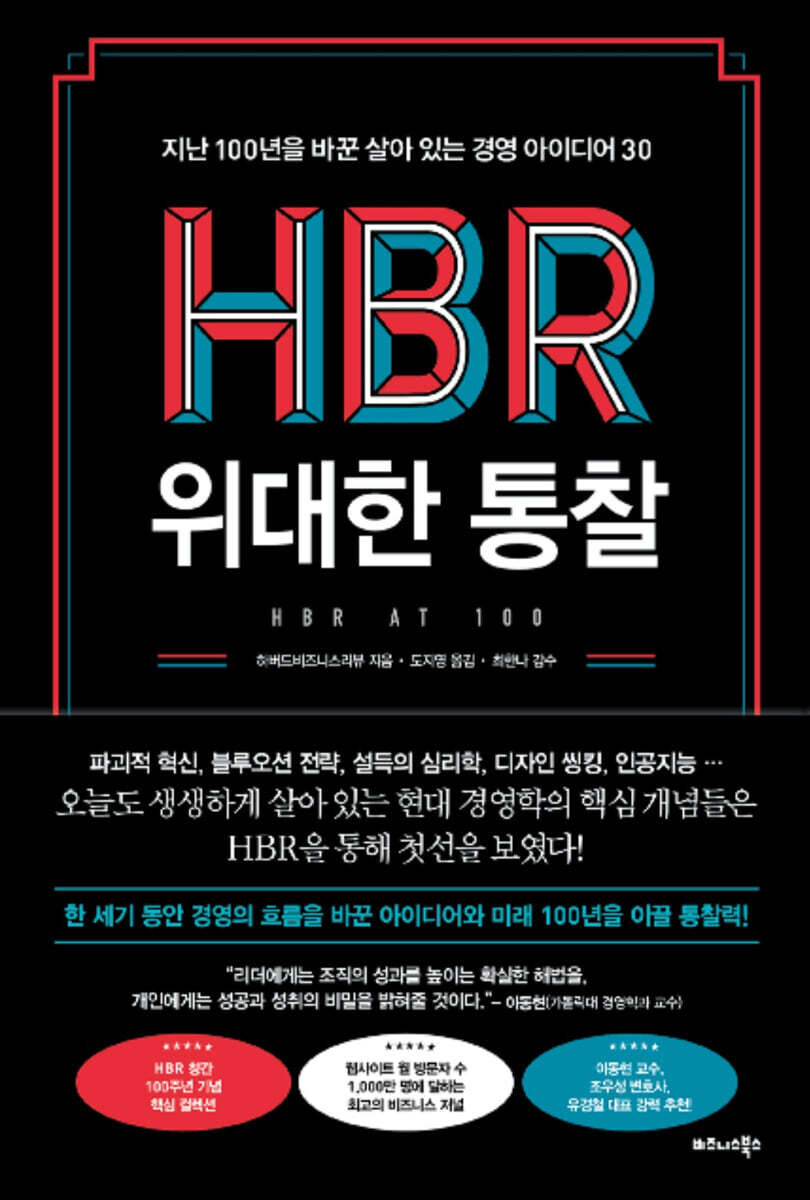
A book titled "HBR Great Insights," which contains 30 representative articles that have had a significant impact on the management paradigm shift over the past century, has been published.
This book is not just a collection of HBR articles.
We've carefully selected key concepts that have revolutionized management academia and real-world business practices over the past 100 years.
For example, 'Blue Ocean Strategy', 'Disruptive Innovation', 'Psychology of Persuasion', and 'Design Thinking' explore how they have changed the thinking and behavior of companies, organizations, and individuals.
This single volume provides insight into the historical moments of modern management through the insightful observations of management masters who have shaped the evolution of ideological trends.
We delve into the essence of management by key topic and prepare for the future!
This book explores the roots of management, examines the present, and prepares for the next 100 years by covering a variety of topics related to organizational management, including leadership, education, technology, marketing, strategy, and human resources.
In particular, readers will gain both general information and practical knowledge from articles selected using rigorous and objective criteria, leveraging HBR's expertise, resulting in the most dense reading experience for their time.
Professor Dong-Hyeon Lee of the Catholic University Department of Business Administration recommended this book, saying, “As the bible of management, it will reveal solutions for improving organizational performance to leaders and the secrets of success and achievement to individuals.”
Some representative articles included in this book are as follows:
Self-Development: Peter Drucker's 'The Age of Self-Management'
● Leadership: Daniel Goleman's 'EQ Makes the Leader'
● Operations Management: How Managers Take Back Control of Their Time by William Onken Jr. and Donald Barth
● Human Resources: "Increasing Psychological Safety in the Hybrid Workplace" by Amy Edmondson and Mark Mortensen
● Strategy: Michael Porter's 'Competitive Strategies', Gary Hamel and Prahalad's 'Strategic Intent'
Innovation: Matt Weingier and Mehek Sarang's "Commercial Space Era Has Arrived"
Sustainability: Nigel Topping's 'Are You Ready to Thrive in a Zero-Carbon Future?'
This book, which focuses on management discourse that has led the times and provides insights closely related to the trends and changes in real-world management, can be read in order or based on a specific interest. HBR Korea editor-in-chief Choi Han-na explained, "It covers everything from deeply held personal concerns to chronic problems afflicting organizations and communities, to environmental and ethical issues that all humans cannot escape." Attorney Cho Woo-seong recommended the book, saying, "It carefully selects the essence of timeless insights, such as Porter's 'Competitive Strategy' and Christensen's 'Disruptive Innovation.'"
Today's business world is a world of constant change, turbulent and uncertain.
The truth that even in these chaotic times, there is a breakthrough in the classics is a truth that applies to management as well.
By meeting management masters and following the process through which their thinking was formed and realized through this book, you will gain profound insight and understanding that will enable you to identify and understand management issues that will remain relevant even 100 years from now.
◆ The only business journal trusted by world leaders from Bill Gates to Jensen Huang.
HBR's carefully curated selection of critical management insights that shaped the past 100 years!
The origins of management ideas that led the times are contained in one volume!
A book titled "HBR Great Insights," which contains 30 representative articles that have had a significant impact on the management paradigm shift over the past century, has been published.
This book is not just a collection of HBR articles.
We've carefully selected key concepts that have revolutionized management academia and real-world business practices over the past 100 years.
For example, 'Blue Ocean Strategy', 'Disruptive Innovation', 'Psychology of Persuasion', and 'Design Thinking' explore how they have changed the thinking and behavior of companies, organizations, and individuals.
This single volume provides insight into the historical moments of modern management through the insightful observations of management masters who have shaped the evolution of ideological trends.
We delve into the essence of management by key topic and prepare for the future!
This book explores the roots of management, examines the present, and prepares for the next 100 years by covering a variety of topics related to organizational management, including leadership, education, technology, marketing, strategy, and human resources.
In particular, readers will gain both general information and practical knowledge from articles selected using rigorous and objective criteria, leveraging HBR's expertise, resulting in the most dense reading experience for their time.
Professor Dong-Hyeon Lee of the Catholic University Department of Business Administration recommended this book, saying, “As the bible of management, it will reveal solutions for improving organizational performance to leaders and the secrets of success and achievement to individuals.”
Some representative articles included in this book are as follows:
Self-Development: Peter Drucker's 'The Age of Self-Management'
● Leadership: Daniel Goleman's 'EQ Makes the Leader'
● Operations Management: How Managers Take Back Control of Their Time by William Onken Jr. and Donald Barth
● Human Resources: "Increasing Psychological Safety in the Hybrid Workplace" by Amy Edmondson and Mark Mortensen
● Strategy: Michael Porter's 'Competitive Strategies', Gary Hamel and Prahalad's 'Strategic Intent'
Innovation: Matt Weingier and Mehek Sarang's "Commercial Space Era Has Arrived"
Sustainability: Nigel Topping's 'Are You Ready to Thrive in a Zero-Carbon Future?'
This book, which focuses on management discourse that has led the times and provides insights closely related to the trends and changes in real-world management, can be read in order or based on a specific interest. HBR Korea editor-in-chief Choi Han-na explained, "It covers everything from deeply held personal concerns to chronic problems afflicting organizations and communities, to environmental and ethical issues that all humans cannot escape." Attorney Cho Woo-seong recommended the book, saying, "It carefully selects the essence of timeless insights, such as Porter's 'Competitive Strategy' and Christensen's 'Disruptive Innovation.'"
Today's business world is a world of constant change, turbulent and uncertain.
The truth that even in these chaotic times, there is a breakthrough in the classics is a truth that applies to management as well.
By meeting management masters and following the process through which their thinking was formed and realized through this book, you will gain profound insight and understanding that will enable you to identify and understand management issues that will remain relevant even 100 years from now.
- You can preview some of the book's contents.
Preview
index
Reviewer's note
Introduction
Chapter 1: The Age of Self-Management | Peter Drucker
Chapter 2: EQ Creates High-Performing Leaders | Daniel Goleman
Chapter 3: How to Become an Authentic Leader | Presenters: Amy Bernstein, Sarah Greene Carmichael, Nicole Torres * Interviewee: Tina Opie
Chapter 4: Competitive Strategy | Michael Porter
Chapter 5: Blue Ocean Strategy | Kim Wi-chan and René Mauborgne
Chapter 6: The Innovation Dilemma | Joseph Bauer and Clayton Christensen
Chapter 7: How to Lead Change | John Kotter
Chapter 8: What Is Motivation? | Frederick Herzberg
Chapter 9: The Law of Progress | Teresa Amabile and Stephen Kramer
Chapter 10: The Merits of Having Multiple Careers | Kabir Sehgal
Chapter 11: Why New Managers Frustrate | Linda Hill
Chapter 12: The Struggles of Women Managers | Kathleen Rearden
Chapter 13: Why Incompetent Men Become Leaders | Thomas Chamorro-Premuzic
Chapter 14: 5 Steps to Addressing Workplace Racism | Robert Livingston
Chapter 15: The Psychology of Persuasion | Robert Cialdini
Chapter 16: The Essence of Communication Is Listening | Carl Rogers and Fritz Roethlisberger
Chapter 17: When AI Becomes a General Purpose Technology | Erik Brynjolfsson and Andrew McAfee
Chapter 18: There's Nothing Cooler Than Being a Data Scientist | Thomas Davenport and Dhinurjai Patil
Chapter 19: The Secret to Achieving Your Goals | Heidi Grant Halverson
Chapter 20: How Managers Take Back Control of Their Time | William Onken Jr. and Donald Barth
Chapter 21: How to Use Lean Startup in Large Enterprises | Steve Blank
Chapter 22: How to Implement Agile Across Your Organization | Jeff Godelf
Chapter 23: What Is Agile Leadership? | Host: Kurt Nikisi * Interviewees: Deborah Ancona and Kate Isaacs
Chapter 24: Are You Ready for Success in a Zero-Carbon Future? | Nigel Topping
Chapter 25: IDEO's Design Thinking | Tim Brown
Chapter 26: Marketing Myopia | Theodore Levitt
Chapter 27: The Age of Commercial Space Industry Arrives | Matt Weingial and Mehek Sarang
Chapter 28: The Discomfort You Feel Right Now Is Sadness | Host: Scott Berinato * Interviewer: David Kessler
Chapter 29: Enhancing Psychological Safety in Hybrid Workplaces | Amy Edmondson and Mark Mortensen
Chapter 30: Strategic Intent | Gary Hamel and Prahalad
Introduction
Chapter 1: The Age of Self-Management | Peter Drucker
Chapter 2: EQ Creates High-Performing Leaders | Daniel Goleman
Chapter 3: How to Become an Authentic Leader | Presenters: Amy Bernstein, Sarah Greene Carmichael, Nicole Torres * Interviewee: Tina Opie
Chapter 4: Competitive Strategy | Michael Porter
Chapter 5: Blue Ocean Strategy | Kim Wi-chan and René Mauborgne
Chapter 6: The Innovation Dilemma | Joseph Bauer and Clayton Christensen
Chapter 7: How to Lead Change | John Kotter
Chapter 8: What Is Motivation? | Frederick Herzberg
Chapter 9: The Law of Progress | Teresa Amabile and Stephen Kramer
Chapter 10: The Merits of Having Multiple Careers | Kabir Sehgal
Chapter 11: Why New Managers Frustrate | Linda Hill
Chapter 12: The Struggles of Women Managers | Kathleen Rearden
Chapter 13: Why Incompetent Men Become Leaders | Thomas Chamorro-Premuzic
Chapter 14: 5 Steps to Addressing Workplace Racism | Robert Livingston
Chapter 15: The Psychology of Persuasion | Robert Cialdini
Chapter 16: The Essence of Communication Is Listening | Carl Rogers and Fritz Roethlisberger
Chapter 17: When AI Becomes a General Purpose Technology | Erik Brynjolfsson and Andrew McAfee
Chapter 18: There's Nothing Cooler Than Being a Data Scientist | Thomas Davenport and Dhinurjai Patil
Chapter 19: The Secret to Achieving Your Goals | Heidi Grant Halverson
Chapter 20: How Managers Take Back Control of Their Time | William Onken Jr. and Donald Barth
Chapter 21: How to Use Lean Startup in Large Enterprises | Steve Blank
Chapter 22: How to Implement Agile Across Your Organization | Jeff Godelf
Chapter 23: What Is Agile Leadership? | Host: Kurt Nikisi * Interviewees: Deborah Ancona and Kate Isaacs
Chapter 24: Are You Ready for Success in a Zero-Carbon Future? | Nigel Topping
Chapter 25: IDEO's Design Thinking | Tim Brown
Chapter 26: Marketing Myopia | Theodore Levitt
Chapter 27: The Age of Commercial Space Industry Arrives | Matt Weingial and Mehek Sarang
Chapter 28: The Discomfort You Feel Right Now Is Sadness | Host: Scott Berinato * Interviewer: David Kessler
Chapter 29: Enhancing Psychological Safety in Hybrid Workplaces | Amy Edmondson and Mark Mortensen
Chapter 30: Strategic Intent | Gary Hamel and Prahalad
Detailed image

Into the book
“HBR has published many of the most influential ideas in modern business history, and this book highlights many of them.
We tried to select articles that are still relevant even after decades have passed.
Even though the business environment has evolved and changed, and even though other scholars have added their own thoughts and research to the concepts in the article, it still remains meaningful to people.”
--- From the "Preface"
“‘Do I like to read, or do I like to listen? And how do I learn?’ These are the first questions you should ask yourself.
But the questions are by no means limited to these two.
To manage yourself effectively, you must also ask yourself the following questions:
“Do I like working with others, or do I prefer working alone?” If you like working with others, you should also consider what kind of relationships you fit in well with.”
--- From "Chapter 1: Peter Drucker's 'The Age of Self-Management'"
“Other research has confirmed that emotional intelligence not only distinguishes outstanding leaders but also leads to outstanding performance.
A good example is the research of the late David McClelland, a prominent scholar of human and organizational behavior.
In 1996, McClelland conducted a study of a global food and beverage company and found that when senior managers possessed a certain level of emotional intelligence, their departments exceeded their annual profit goals by 20 percent.
On the other hand, departments where the emotional intelligence of their managers did not reach a certain level fell short of their goals by nearly 20 percent.
It is interesting to note that McClelland's study found similar results not only in departments within the United States, but also in departments in Asia and Europe.”
--- From Chapter 2, “EQ Creates High-Performance Leaders”
“There are two ways to create a blue ocean.
Rarely, a company creates an entirely new industry, like eBay did with the online auction industry.
However, most blue oceans are created when a company within a red ocean changes the boundaries of its existing business.
We will look at this in more detail later, but this is exactly the approach taken by Cirque du Soleil.
“By transcending the traditional boundaries that separate circus and theater, we have created a new, profitable blue ocean within the red ocean of the circus industry.”
--- From "Chapter 5: Kim Wi-chan and Rene Mauborgne's 'Blue Ocean Strategy'"
“The technological changes that threaten existing businesses are not entirely new or difficult from a ‘technological’ perspective.
However, these techniques must have two important features.
First, it generally presents performance characteristics that are different from existing technologies.
And at least initially, existing customers in the market don't perceive the value of that feature.
Second, the performance characteristics that existing customers clearly value are improving at a rapid pace, to the point where new technologies can later invade existing markets.
It is only at this point that mainstream customers begin to want the technology.
Unfortunately, by this point it is too late for established companies to take action.
“Ultimately, the company that pioneers new technologies dominates the market.”
--- From "Chapter 6: The Innovation Dilemma by Joseph Bauer and Clayton Christensen"
“Reading someone else’s mind accurately is a delicate task, but it doesn’t require magic.
All that is needed is perception and cognition.
And machine learning is currently showing its strengths in the areas of perception and cognition, and this area will only become stronger in the future.
A good starting point for discussing the limitations of artificial intelligence is Pablo Picasso's observation of computers.
“But computers are useless.
Because they only give us the answers.” As the recent triumphs in machine learning have shown, computers are not actually useless.
But Picasso's words still contain meaningful insights.
As Picasso said, a computer is not a device that asks questions, but a device that answers them.
This means that entrepreneurs, innovators, scientists, and creators—people who figure out what problems, opportunities, or areas we should tackle next—will continue to play a crucial role.”
--- From "Chapter 17: When Artificial Intelligence Becomes a General Purpose Technology" by Erik Brynjolfsson and Andrew McAfee
“The current ‘space for space’ market is limited to activities that provide goods and services to people already in space.
That is, it is a market only for a small number of astronauts employed by NASA and other government-run programs.
While SpaceX has a grand vision of supporting mass private space tourism, its current "space for space's sake" business is solely responding to the needs of government customers like NASA.
But as the cost of launching rockets decreases, companies like SpaceX will be able to leverage economies of scale to send more people into space.
Then, demand will increase from the private sector, such as tourists and space settlers, rather than government-employed astronauts.
And, in keeping with this demand, the "space for space" market, currently in the pre-verification phase, can be transformed into a sustainable, large-scale industry.
SpaceX has demonstrated a business model that sells goods and services to NASA in the hope that it can one day create and expand a large-scale private market in space.
But SpaceX isn't the only company approaching the space market this way.”
We tried to select articles that are still relevant even after decades have passed.
Even though the business environment has evolved and changed, and even though other scholars have added their own thoughts and research to the concepts in the article, it still remains meaningful to people.”
--- From the "Preface"
“‘Do I like to read, or do I like to listen? And how do I learn?’ These are the first questions you should ask yourself.
But the questions are by no means limited to these two.
To manage yourself effectively, you must also ask yourself the following questions:
“Do I like working with others, or do I prefer working alone?” If you like working with others, you should also consider what kind of relationships you fit in well with.”
--- From "Chapter 1: Peter Drucker's 'The Age of Self-Management'"
“Other research has confirmed that emotional intelligence not only distinguishes outstanding leaders but also leads to outstanding performance.
A good example is the research of the late David McClelland, a prominent scholar of human and organizational behavior.
In 1996, McClelland conducted a study of a global food and beverage company and found that when senior managers possessed a certain level of emotional intelligence, their departments exceeded their annual profit goals by 20 percent.
On the other hand, departments where the emotional intelligence of their managers did not reach a certain level fell short of their goals by nearly 20 percent.
It is interesting to note that McClelland's study found similar results not only in departments within the United States, but also in departments in Asia and Europe.”
--- From Chapter 2, “EQ Creates High-Performance Leaders”
“There are two ways to create a blue ocean.
Rarely, a company creates an entirely new industry, like eBay did with the online auction industry.
However, most blue oceans are created when a company within a red ocean changes the boundaries of its existing business.
We will look at this in more detail later, but this is exactly the approach taken by Cirque du Soleil.
“By transcending the traditional boundaries that separate circus and theater, we have created a new, profitable blue ocean within the red ocean of the circus industry.”
--- From "Chapter 5: Kim Wi-chan and Rene Mauborgne's 'Blue Ocean Strategy'"
“The technological changes that threaten existing businesses are not entirely new or difficult from a ‘technological’ perspective.
However, these techniques must have two important features.
First, it generally presents performance characteristics that are different from existing technologies.
And at least initially, existing customers in the market don't perceive the value of that feature.
Second, the performance characteristics that existing customers clearly value are improving at a rapid pace, to the point where new technologies can later invade existing markets.
It is only at this point that mainstream customers begin to want the technology.
Unfortunately, by this point it is too late for established companies to take action.
“Ultimately, the company that pioneers new technologies dominates the market.”
--- From "Chapter 6: The Innovation Dilemma by Joseph Bauer and Clayton Christensen"
“Reading someone else’s mind accurately is a delicate task, but it doesn’t require magic.
All that is needed is perception and cognition.
And machine learning is currently showing its strengths in the areas of perception and cognition, and this area will only become stronger in the future.
A good starting point for discussing the limitations of artificial intelligence is Pablo Picasso's observation of computers.
“But computers are useless.
Because they only give us the answers.” As the recent triumphs in machine learning have shown, computers are not actually useless.
But Picasso's words still contain meaningful insights.
As Picasso said, a computer is not a device that asks questions, but a device that answers them.
This means that entrepreneurs, innovators, scientists, and creators—people who figure out what problems, opportunities, or areas we should tackle next—will continue to play a crucial role.”
--- From "Chapter 17: When Artificial Intelligence Becomes a General Purpose Technology" by Erik Brynjolfsson and Andrew McAfee
“The current ‘space for space’ market is limited to activities that provide goods and services to people already in space.
That is, it is a market only for a small number of astronauts employed by NASA and other government-run programs.
While SpaceX has a grand vision of supporting mass private space tourism, its current "space for space's sake" business is solely responding to the needs of government customers like NASA.
But as the cost of launching rockets decreases, companies like SpaceX will be able to leverage economies of scale to send more people into space.
Then, demand will increase from the private sector, such as tourists and space settlers, rather than government-employed astronauts.
And, in keeping with this demand, the "space for space" market, currently in the pre-verification phase, can be transformed into a sustainable, large-scale industry.
SpaceX has demonstrated a business model that sells goods and services to NASA in the hope that it can one day create and expand a large-scale private market in space.
But SpaceX isn't the only company approaching the space market this way.”
--- From Chapter 27, Matt Weingier and Meheck Sarang's 'Commercial Space Industry Era Arrives'
Publisher's Review
30 management ideas that transcend the times, carefully selected by HBR!
"HBR Great Insights" is a collection of articles by HBR, which has led innovation in the management field for over a century, presenting insights that are still vivid today and will remain relevant for the next 100 years.
The 30 articles cover every aspect of organizational management, including strategy, innovation, organization, leadership, and change management. They also illustrate how the critical challenges facing businesses today—including digital transformation, ESG, women's leadership, hybrid workplaces, artificial intelligence, and the space industry—are intertwined with business strategy.
Why, 'HBR Great Insights'?
The title, “HBR Great Insights,” has two meanings.
First, the articles in this book are not concepts confined to print, but are being realized as practical strategies, organizational culture, and innovative activities in the ever-changing field.
Second, it offers living answers to timeless questions that remain constant even in complex business environments, such as how organizations should operate, what questions leaders should ask, and where innovation begins.
Meanwhile, HBR's selection of articles, which examine core issues in modern management while simultaneously considering not only organizational direction but also individual growth, is also noteworthy.
Living, breathing knowledge and information from management legends proven by history and practice.
The authors are thinkers who have changed the very paradigm of management, and their sharp analysis and abundant examples shine throughout the book.
As the subtitle, "30 Living Management Ideas That Changed the Past 100 Years," suggests, the 30 articles introduced in HBR created a buzz around the world and sparked innovation in the management field.
As such, the purpose of this book is not to commemorate the past, but to impart proven wisdom to help you make wiser choices and decisions now.
Among the many issues covered in this book, some have already been thoroughly discussed, such as self-management and competitive strategy, while others, such as ESG management and the space industry, have only recently begun to receive attention.
The important thing is that all of these issues are still issues that we encounter from time to time in the business world, and they are unavoidable tasks in the midst of the unstoppable flow of change.
Therefore, if this book sparks deeper discussion, each topic will be refined and broadly developed, leading to more effective and sustainable alternatives.
Management wisdom revealed by 30 stars!
The 30 articles in this book each address an independent topic, like stars scattered across the universe. However, taken together, they are like a constellation that will serve as a guide in the vast world of business.
The timeless voices of the masters who shaped the paradigm of modern management, including Peter Drucker, Michael Porter, Clayton Christensen, and Andrew McAfee, are a living compass that provides direction to leaders, entrepreneurs, and organizational members working in the field even at this very moment.
Readers will find great enjoyment in this journey of visiting 30 stars and discovering management wisdom one by one. You can read the book in the order suggested by HBR, or start with the topic that best addresses your current challenges.
Each article is like an independent star, but just as lines connect the stars to form meaningful constellations, completing this book will provide you with the deep management wisdom and practical skills you need to tackle the challenges you face.
"HBR Great Insights" is a collection of articles by HBR, which has led innovation in the management field for over a century, presenting insights that are still vivid today and will remain relevant for the next 100 years.
The 30 articles cover every aspect of organizational management, including strategy, innovation, organization, leadership, and change management. They also illustrate how the critical challenges facing businesses today—including digital transformation, ESG, women's leadership, hybrid workplaces, artificial intelligence, and the space industry—are intertwined with business strategy.
Why, 'HBR Great Insights'?
The title, “HBR Great Insights,” has two meanings.
First, the articles in this book are not concepts confined to print, but are being realized as practical strategies, organizational culture, and innovative activities in the ever-changing field.
Second, it offers living answers to timeless questions that remain constant even in complex business environments, such as how organizations should operate, what questions leaders should ask, and where innovation begins.
Meanwhile, HBR's selection of articles, which examine core issues in modern management while simultaneously considering not only organizational direction but also individual growth, is also noteworthy.
Living, breathing knowledge and information from management legends proven by history and practice.
The authors are thinkers who have changed the very paradigm of management, and their sharp analysis and abundant examples shine throughout the book.
As the subtitle, "30 Living Management Ideas That Changed the Past 100 Years," suggests, the 30 articles introduced in HBR created a buzz around the world and sparked innovation in the management field.
As such, the purpose of this book is not to commemorate the past, but to impart proven wisdom to help you make wiser choices and decisions now.
Among the many issues covered in this book, some have already been thoroughly discussed, such as self-management and competitive strategy, while others, such as ESG management and the space industry, have only recently begun to receive attention.
The important thing is that all of these issues are still issues that we encounter from time to time in the business world, and they are unavoidable tasks in the midst of the unstoppable flow of change.
Therefore, if this book sparks deeper discussion, each topic will be refined and broadly developed, leading to more effective and sustainable alternatives.
Management wisdom revealed by 30 stars!
The 30 articles in this book each address an independent topic, like stars scattered across the universe. However, taken together, they are like a constellation that will serve as a guide in the vast world of business.
The timeless voices of the masters who shaped the paradigm of modern management, including Peter Drucker, Michael Porter, Clayton Christensen, and Andrew McAfee, are a living compass that provides direction to leaders, entrepreneurs, and organizational members working in the field even at this very moment.
Readers will find great enjoyment in this journey of visiting 30 stars and discovering management wisdom one by one. You can read the book in the order suggested by HBR, or start with the topic that best addresses your current challenges.
Each article is like an independent star, but just as lines connect the stars to form meaningful constellations, completing this book will provide you with the deep management wisdom and practical skills you need to tackle the challenges you face.
GOODS SPECIFICS
- Date of issue: November 3, 2025
- Format: Hardcover book binding method guide
- Page count, weight, size: 680 pages | 1,098g | 152*225*36mm
- ISBN13: 9791162544426
- ISBN10: 1162544422
You may also like
카테고리
korean


korean

![ELLE 엘르 스페셜 에디션 A형 : 12월 [2025]](http://librairie.coreenne.fr/cdn/shop/files/b8e27a3de6c9538896439686c6b0e8fb.jpg?v=1766436872&width=3840)


