

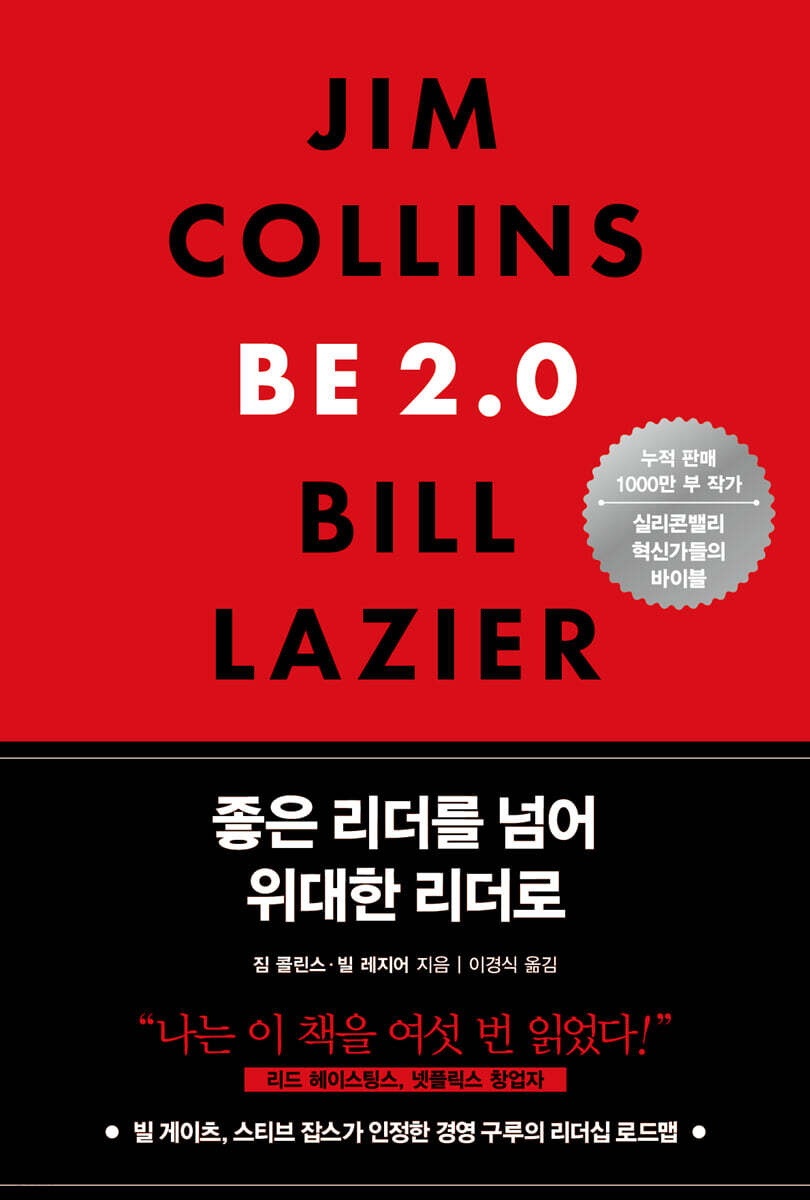
From a good leader to a great leader
 |
Description
Book Introduction
From tolerance, vision, strategy, tactics, to innovation Jim Collins, the management guru for Silicon Valley innovators, shares his insights. Everything You Need to Know About Great Leaders Who Create Great Organizations When Steve Jobs founded Apple University, when Jeff Bezos refined Amazon's management vision, when Sheryl Sandberg led Facebook's resurgence, and when Reed Hastings founded Netflix, there was one mentor who inspired them all. That's Jim Collins. The management guru for Silicon Valley innovators and best-selling author of over 10 million copies translated into 35 languages worldwide, has published a book that culminates his leadership theory, "From Good to Great." From the art of tolerance, vision, strategy, and tactics to designing innovative organizations and managing luck, Jim Collins' management philosophy and specific methodologies, developed over 30 years of research into the conditions for great companies and great leaders, are all contained in this book. |
- You can preview some of the book's contents.
Preview
index
Expanded Edition Preface: Are You Ready to Be Born Again? · 5
Chapter 1: From Good Leader to Great Leader
Meeting Bill
Don't suppress your generous impulses.
When is the moment of the stars?
Virtuous cycle of trust
Pursue relationships over profits
Values always come first
One last tip: butter your waffles generously.
Chapter 2: In the end, it's about people
Who will climb the mountain with you?
The single most important management indicator
Will you believe or change?
If you want to grow, grow first.
A person who brings good luck
Unit Department Leadership
Jorge Paulo's Dilemma
Limits of monetary compensation
“Never disappoint your comrades.”
Chapter 3: Seven Qualities of a Great Leader
There is no right answer to leadership.
Effective Leadership: A Combination of Functions and Types
The Essence of Leadership
7 Qualities of a Great Leader
Authenticity: Live it out
What is your cause?
Decisiveness: Believe in yourself
Right decision, right timeline
Concentration: One step at a time
Interpersonal Relationships: Get Your Butt Off the Chair
Delegation of authority is different from indifference.
The Hard and Soft Skills of People Management: The Duality of Leadership
Communication: Communicate in every way
Enterprising: How to Energize Your Organization
Chapter 4: Vision: The Beginning and End of Leadership
Vision is a guiding star
Vision creates great companies.
The Good Thing About Having a Vision
The Three Elements of Vision: Values, Purpose, and Mission
Core Values and Beliefs
purpose
Don't confuse the rare with the new.
mission
BHAGs are everywhere
Goal Achievement Syndrome
Declaration of vision
Tie everything together
A clear vision shared by all
Chapter 5: The Mind That Brings Luck
The opposite of success is growth.
Rain falls on everyone
How to take advantage of the good fortune that has come your way
“Never give up.
Never, never, never”
Chapter 6: The Road to Greatness
Step 1: Disciplined People
Step 2: Disciplined Thinking
Step 3: Disciplined Action
Step 4: Building Persistence
The output of greatness
After the map… what comes next?
Chapter 7: Strategy: Creating Sustainable Competitive Advantage
Strategy formulation
3 Questions for Strategic Thinking
Making strategic decisions
Four Key Strategic Issues Facing Small and Medium-Sized Enterprises
Chapter 8: Transforming into an Innovative Organization
Condition 1 for innovation.
Accepting ideas
Condition 2 for innovation.
Become a customer
Condition 3 for innovation.
Experiments and mistakes
Condition 4 for innovation.
creative staff
Condition 5 for innovation.
Autonomy and decentralization
Condition 6 for innovation.
compensation system
Not the product itself, but the process that led to it.
8 Management Techniques to Foster Creativity
Belief in creative inspiration
The best beats the first
Chapter 9: Tactical Excellence: God is in the Details
The beginning of tactical excellence is execution.
Deadline, freedom within the framework
From vision and strategy to tactics
Smack (SMaC) mindset
To create an environment that fosters sustained tactical excellence.
Tactical BHAG
Six Levels of Tactical Excellence
Make your employees offer OPUR
The last secret, respect
Preface to the first edition
Source
Chapter 1: From Good Leader to Great Leader
Meeting Bill
Don't suppress your generous impulses.
When is the moment of the stars?
Virtuous cycle of trust
Pursue relationships over profits
Values always come first
One last tip: butter your waffles generously.
Chapter 2: In the end, it's about people
Who will climb the mountain with you?
The single most important management indicator
Will you believe or change?
If you want to grow, grow first.
A person who brings good luck
Unit Department Leadership
Jorge Paulo's Dilemma
Limits of monetary compensation
“Never disappoint your comrades.”
Chapter 3: Seven Qualities of a Great Leader
There is no right answer to leadership.
Effective Leadership: A Combination of Functions and Types
The Essence of Leadership
7 Qualities of a Great Leader
Authenticity: Live it out
What is your cause?
Decisiveness: Believe in yourself
Right decision, right timeline
Concentration: One step at a time
Interpersonal Relationships: Get Your Butt Off the Chair
Delegation of authority is different from indifference.
The Hard and Soft Skills of People Management: The Duality of Leadership
Communication: Communicate in every way
Enterprising: How to Energize Your Organization
Chapter 4: Vision: The Beginning and End of Leadership
Vision is a guiding star
Vision creates great companies.
The Good Thing About Having a Vision
The Three Elements of Vision: Values, Purpose, and Mission
Core Values and Beliefs
purpose
Don't confuse the rare with the new.
mission
BHAGs are everywhere
Goal Achievement Syndrome
Declaration of vision
Tie everything together
A clear vision shared by all
Chapter 5: The Mind That Brings Luck
The opposite of success is growth.
Rain falls on everyone
How to take advantage of the good fortune that has come your way
“Never give up.
Never, never, never”
Chapter 6: The Road to Greatness
Step 1: Disciplined People
Step 2: Disciplined Thinking
Step 3: Disciplined Action
Step 4: Building Persistence
The output of greatness
After the map… what comes next?
Chapter 7: Strategy: Creating Sustainable Competitive Advantage
Strategy formulation
3 Questions for Strategic Thinking
Making strategic decisions
Four Key Strategic Issues Facing Small and Medium-Sized Enterprises
Chapter 8: Transforming into an Innovative Organization
Condition 1 for innovation.
Accepting ideas
Condition 2 for innovation.
Become a customer
Condition 3 for innovation.
Experiments and mistakes
Condition 4 for innovation.
creative staff
Condition 5 for innovation.
Autonomy and decentralization
Condition 6 for innovation.
compensation system
Not the product itself, but the process that led to it.
8 Management Techniques to Foster Creativity
Belief in creative inspiration
The best beats the first
Chapter 9: Tactical Excellence: God is in the Details
The beginning of tactical excellence is execution.
Deadline, freedom within the framework
From vision and strategy to tactics
Smack (SMaC) mindset
To create an environment that fosters sustained tactical excellence.
Tactical BHAG
Six Levels of Tactical Excellence
Make your employees offer OPUR
The last secret, respect
Preface to the first edition
Source
Detailed image

Into the book
“You can view life as a series of transactions or as a process of building relationships.
“Deals may bring success, but it is relationships that make life great.”
--- p.30
Apple, once hailed as the greatest startup in history, was on the verge of collapse.
With this in mind, I asked Jobs:
"What was the first thing you built to escape that bleak situation? Where did you find hope?"
I was talking to the greatest person of our time when it came to product vision, so I expected Jobs to explain in his answer the revolutionary ideas he had about object-oriented operating systems, the potential for which lay in the Macintosh or some other "crazy great" product he had in mind at the time.
But, alas, my expectations were completely off the mark.
Jobs listened to people.
The first thing Jobs did was to find talented people who could work together to create a turning point.
These talented individuals were those who still held the same fervent vision of changing the world that Apple had in its early days, those who shared Jobs' passion and determination to create the best products, and those who were still passionate about building a mental bicycle that could amplify their creativity.
--- p.44
Leadership is not a right, it's a responsibility.
It is not something that is obtained by chance, but rather through precise decision-making.
It is not determined by genes, but is acquired through conscious action.
In short, whether you learn to be a great leader or not is ultimately a matter of choice.
--- p.66
George Marshall said that the greatest virtue a leader must have is the ability to make decisions.
When you realize how many managers suffer from indecision, you'll see that Marshall is right.
Great leaders do not suffer from indecision.
The ability to make decisions even in the absence of perfect information (perfect information doesn't exist in the first place) is a must-have for a leader.
--- p.113
There is one important criterion when creating a mission.
It must be powerfully persuasive and contain genuine passion.
So, don't set your mission like this:
“We make and sell sneakers that sell well all over the world.”
Instead, do this.
“Break up Nike.”
--- p.223
A good strategy isn't a lengthy, complex plan detailing every activity in the company, nor is it an intricate plan that the strategic planning department spends at least six months racking its brains to come up with.
Business, like life, cannot and should not proceed according to plan from beginning to end.
When you do business, there are so many uncertainties and unexpected opportunities that arise.
Therefore, a clear, thoughtful, and uncomplicated methodology is much better than an extremely detailed and complex one.
In other words, a methodology that allows individual employees to exercise autonomy and embrace unexpected changes, experiments, and innovations is better.
--- p.322
IBM became a great company because Tom Watson laid the foundation for a great company before IBM grew into the giant it is today.
Nike is great today because of what Phil Knight did back in the day when Nike was David against Goliath.
3M is a great company today because William McKnight brought his own values to the company decades ago.
L.L. Bean exists today as a great company thanks to the actions of Leon Bean, who ran his small business from a small building in Freeport, Maine.
Patagonia also qualifies as a great company because of the indelible mark Christine McDivitt left on the company when it was just starting out.
If you are the leader of a small business, whether your company will become great in the future is entirely up to you.
This book is for people who can do that.
“Deals may bring success, but it is relationships that make life great.”
--- p.30
Apple, once hailed as the greatest startup in history, was on the verge of collapse.
With this in mind, I asked Jobs:
"What was the first thing you built to escape that bleak situation? Where did you find hope?"
I was talking to the greatest person of our time when it came to product vision, so I expected Jobs to explain in his answer the revolutionary ideas he had about object-oriented operating systems, the potential for which lay in the Macintosh or some other "crazy great" product he had in mind at the time.
But, alas, my expectations were completely off the mark.
Jobs listened to people.
The first thing Jobs did was to find talented people who could work together to create a turning point.
These talented individuals were those who still held the same fervent vision of changing the world that Apple had in its early days, those who shared Jobs' passion and determination to create the best products, and those who were still passionate about building a mental bicycle that could amplify their creativity.
--- p.44
Leadership is not a right, it's a responsibility.
It is not something that is obtained by chance, but rather through precise decision-making.
It is not determined by genes, but is acquired through conscious action.
In short, whether you learn to be a great leader or not is ultimately a matter of choice.
--- p.66
George Marshall said that the greatest virtue a leader must have is the ability to make decisions.
When you realize how many managers suffer from indecision, you'll see that Marshall is right.
Great leaders do not suffer from indecision.
The ability to make decisions even in the absence of perfect information (perfect information doesn't exist in the first place) is a must-have for a leader.
--- p.113
There is one important criterion when creating a mission.
It must be powerfully persuasive and contain genuine passion.
So, don't set your mission like this:
“We make and sell sneakers that sell well all over the world.”
Instead, do this.
“Break up Nike.”
--- p.223
A good strategy isn't a lengthy, complex plan detailing every activity in the company, nor is it an intricate plan that the strategic planning department spends at least six months racking its brains to come up with.
Business, like life, cannot and should not proceed according to plan from beginning to end.
When you do business, there are so many uncertainties and unexpected opportunities that arise.
Therefore, a clear, thoughtful, and uncomplicated methodology is much better than an extremely detailed and complex one.
In other words, a methodology that allows individual employees to exercise autonomy and embrace unexpected changes, experiments, and innovations is better.
--- p.322
IBM became a great company because Tom Watson laid the foundation for a great company before IBM grew into the giant it is today.
Nike is great today because of what Phil Knight did back in the day when Nike was David against Goliath.
3M is a great company today because William McKnight brought his own values to the company decades ago.
L.L. Bean exists today as a great company thanks to the actions of Leon Bean, who ran his small business from a small building in Freeport, Maine.
Patagonia also qualifies as a great company because of the indelible mark Christine McDivitt left on the company when it was just starting out.
If you are the leader of a small business, whether your company will become great in the future is entirely up to you.
This book is for people who can do that.
--- p.517
Publisher's Review
Do you want to be reborn as a true leader?
The most influential business thinker of our time,
Jim Collins' timeless insights
***Author with 10 Million Copies Sold, the Bible of Silicon Valley Innovators***
***A Leadership Roadmap Compiled by Management Gurus Bill Gates, Steve Jobs, and Reed Hastings***
Jim Collins, a rising star professor at Stanford University's Graduate School of Business, published Beyond Entrepreneurship in 1992 with his mentor and life mentor, Professor Bill Regier, setting a new standard for leadership.
This book is one that Netflix founder Reed Hastings said he has read “six times.”
It has become a must-read among Silicon Valley entrepreneurs, to the point where people say, “Memorize the first 89 pages.”
Thirty years later, Jim Collins has established himself as a management guru respected by IT innovators and global CEOs such as Steve Jobs, Bill Gates, and Jeff Bezos.
The concepts of Stage 5 Leadership, the Flywheel Effect, SMAC (Small, Risky, Audacious Goal), and BHAG (Big, Risky, Audacious Goal) that emerged from his research have become standard theories adopted by global companies today for organizational innovation.
Jim Collins defined the current corporate environment as one overflowing with ideas but stagnant growth, and believed that a leadership theory suited to the new era was needed.
So, based on the research and data we've gathered so far, we've expanded on "Beyond Entrepreneurship" and released "Beyond Good Leaders to Great Leaders."
The author warns that in today's business environment, differentiation can no longer be achieved through technology, products, or ideas, and argues that a company's success or failure ultimately depends on the qualities of its leaders.
This book offers insights and concrete methodologies on what makes great leaders different and how to lead organizations to become lasting, great companies.
In particular, it contains a systematic method for all members, from the CEO to new employees, to grow into leaders, moving beyond relying on individual heroic leadership.
A 9-Chapter Roadmap for Aspiring Great Leaders
This book, which consists of 4 new chapters and 15 topics in addition to the original manuscript, contains the major philosophies and theories that Jim Collins and his research team have perfected through 30 years of research, from the art of tolerance to the conditions for a successful leader, how to establish a vision and concretely implement strategies and tactics, and how to manage luck, in a clear and practical way that can be applied immediately in the field.
Chapter 1.
From a good leader to a great leader
Explores the essence of leadership through the stories of Jim Collins and his mentor, Bill Regier.
We explore the leadership elements necessary for organizational success and explore why leadership that prioritizes the success of the entire organization is crucial.
In particular, Bill Regier's lifelong lessons, such as "never suppress your generous impulses," "pursue relationships over profits," and "values always come first," provide important clues to what attitude a leader should have when faced with a crisis.
Chapter 2.
After all, it's people
The success of an organization ultimately depends on its people.
The first thing Steve Jobs did to save Apple from crisis was not to develop new products.
It was about finding the right talent that had been hiding.
Chapter 2 covers how to identify and develop key talent.
Chapter 3.
7 Qualities of a Great Leader
We examine the seven elements that make up effective leadership.
We will examine seven key leadership qualities—authenticity, decisiveness, focus, interpersonal relationships, ambivalence in personnel management, communication, and initiative—through the case studies of various companies and CEOs, and explore ways to develop individual leadership capabilities.
Chapter 4.
Vision, the beginning and end of leadership
Vision is an important element that provides direction to an organization, and through it, leaders unite the organization and set the direction for its future.
Collins emphasizes that a vision should go beyond simply setting goals and embody the organization's core values and purpose, laying the foundation for the organization's long-term prosperity.
Chapter 5.
A mind that brings good luck
Leaders create opportunities through a positive and proactive mindset.
This chapter delivers the message that "the opposite of success is growth" and explores how leaders must think to achieve sustained growth.
In particular, it emphasizes that a positive mindset can bring good luck even in difficult situations.
Chapter 6.
A Map to Great Business
This chapter summarizes Jim Collins' management theory in a single map (MAP) and presents a step-by-step roadmap for becoming a great company.
It describes the path to organizational greatness through four stages: disciplined people, disciplined thinking, and disciplined action, building permanence.
Chapter 7.
Strategy: How to Create Sustainable Competitive Advantage
This chapter emphasizes the importance of strategic thinking and decision-making to secure sustainable competitive advantage.
Through "Three Questions for Strategic Thinking," we explore how leaders can maintain and grow their organizations' competitiveness, and we also address key strategic issues facing small and medium-sized businesses in particular.
Chapter 8.
Transforming into an innovative organization
We explore how to build a culture of innovation within your organization.
This book explores the specific conditions for innovation, including accepting ideas, becoming customers, experimentation and mistakes, hiring creative employees, autonomy and decentralization, and reward systems. It also provides guidelines for laying the foundation for organizations to achieve sustainable growth.
Chapter 9.
Tactical Excellence: God is in the Details
A strategy not executed is not a strategy.
This chapter emphasizes the importance of execution and provides guidelines for a successful tactical approach.
The '6 Steps to Tactical Excellence' outlines the specific actions needed to achieve your goals.
The image of a leader also changes with the times.
But there is also leadership that transcends time.
"From Good to Great" presents a leadership model that achieves results in any organization and any environment by balancing change with consistency.
For those who dream of an organization where everyone, from the CEO to the team members, is a leader, Jim Collins' leadership model will provide a new breakthrough.
The most influential business thinker of our time,
Jim Collins' timeless insights
***Author with 10 Million Copies Sold, the Bible of Silicon Valley Innovators***
***A Leadership Roadmap Compiled by Management Gurus Bill Gates, Steve Jobs, and Reed Hastings***
Jim Collins, a rising star professor at Stanford University's Graduate School of Business, published Beyond Entrepreneurship in 1992 with his mentor and life mentor, Professor Bill Regier, setting a new standard for leadership.
This book is one that Netflix founder Reed Hastings said he has read “six times.”
It has become a must-read among Silicon Valley entrepreneurs, to the point where people say, “Memorize the first 89 pages.”
Thirty years later, Jim Collins has established himself as a management guru respected by IT innovators and global CEOs such as Steve Jobs, Bill Gates, and Jeff Bezos.
The concepts of Stage 5 Leadership, the Flywheel Effect, SMAC (Small, Risky, Audacious Goal), and BHAG (Big, Risky, Audacious Goal) that emerged from his research have become standard theories adopted by global companies today for organizational innovation.
Jim Collins defined the current corporate environment as one overflowing with ideas but stagnant growth, and believed that a leadership theory suited to the new era was needed.
So, based on the research and data we've gathered so far, we've expanded on "Beyond Entrepreneurship" and released "Beyond Good Leaders to Great Leaders."
The author warns that in today's business environment, differentiation can no longer be achieved through technology, products, or ideas, and argues that a company's success or failure ultimately depends on the qualities of its leaders.
This book offers insights and concrete methodologies on what makes great leaders different and how to lead organizations to become lasting, great companies.
In particular, it contains a systematic method for all members, from the CEO to new employees, to grow into leaders, moving beyond relying on individual heroic leadership.
A 9-Chapter Roadmap for Aspiring Great Leaders
This book, which consists of 4 new chapters and 15 topics in addition to the original manuscript, contains the major philosophies and theories that Jim Collins and his research team have perfected through 30 years of research, from the art of tolerance to the conditions for a successful leader, how to establish a vision and concretely implement strategies and tactics, and how to manage luck, in a clear and practical way that can be applied immediately in the field.
Chapter 1.
From a good leader to a great leader
Explores the essence of leadership through the stories of Jim Collins and his mentor, Bill Regier.
We explore the leadership elements necessary for organizational success and explore why leadership that prioritizes the success of the entire organization is crucial.
In particular, Bill Regier's lifelong lessons, such as "never suppress your generous impulses," "pursue relationships over profits," and "values always come first," provide important clues to what attitude a leader should have when faced with a crisis.
Chapter 2.
After all, it's people
The success of an organization ultimately depends on its people.
The first thing Steve Jobs did to save Apple from crisis was not to develop new products.
It was about finding the right talent that had been hiding.
Chapter 2 covers how to identify and develop key talent.
Chapter 3.
7 Qualities of a Great Leader
We examine the seven elements that make up effective leadership.
We will examine seven key leadership qualities—authenticity, decisiveness, focus, interpersonal relationships, ambivalence in personnel management, communication, and initiative—through the case studies of various companies and CEOs, and explore ways to develop individual leadership capabilities.
Chapter 4.
Vision, the beginning and end of leadership
Vision is an important element that provides direction to an organization, and through it, leaders unite the organization and set the direction for its future.
Collins emphasizes that a vision should go beyond simply setting goals and embody the organization's core values and purpose, laying the foundation for the organization's long-term prosperity.
Chapter 5.
A mind that brings good luck
Leaders create opportunities through a positive and proactive mindset.
This chapter delivers the message that "the opposite of success is growth" and explores how leaders must think to achieve sustained growth.
In particular, it emphasizes that a positive mindset can bring good luck even in difficult situations.
Chapter 6.
A Map to Great Business
This chapter summarizes Jim Collins' management theory in a single map (MAP) and presents a step-by-step roadmap for becoming a great company.
It describes the path to organizational greatness through four stages: disciplined people, disciplined thinking, and disciplined action, building permanence.
Chapter 7.
Strategy: How to Create Sustainable Competitive Advantage
This chapter emphasizes the importance of strategic thinking and decision-making to secure sustainable competitive advantage.
Through "Three Questions for Strategic Thinking," we explore how leaders can maintain and grow their organizations' competitiveness, and we also address key strategic issues facing small and medium-sized businesses in particular.
Chapter 8.
Transforming into an innovative organization
We explore how to build a culture of innovation within your organization.
This book explores the specific conditions for innovation, including accepting ideas, becoming customers, experimentation and mistakes, hiring creative employees, autonomy and decentralization, and reward systems. It also provides guidelines for laying the foundation for organizations to achieve sustainable growth.
Chapter 9.
Tactical Excellence: God is in the Details
A strategy not executed is not a strategy.
This chapter emphasizes the importance of execution and provides guidelines for a successful tactical approach.
The '6 Steps to Tactical Excellence' outlines the specific actions needed to achieve your goals.
The image of a leader also changes with the times.
But there is also leadership that transcends time.
"From Good to Great" presents a leadership model that achieves results in any organization and any environment by balancing change with consistency.
For those who dream of an organization where everyone, from the CEO to the team members, is a leader, Jim Collins' leadership model will provide a new breakthrough.
GOODS SPECIFICS
- Date of issue: September 5, 2024
- Page count, weight, size: 520 pages | 778g | 152*225*33mm
- ISBN13: 9788965966463
- ISBN10: 8965966469
You may also like
카테고리
korean


korean

![ELLE 엘르 스페셜 에디션 A형 : 12월 [2025]](http://librairie.coreenne.fr/cdn/shop/files/b8e27a3de6c9538896439686c6b0e8fb.jpg?v=1766436872&width=3840)


