

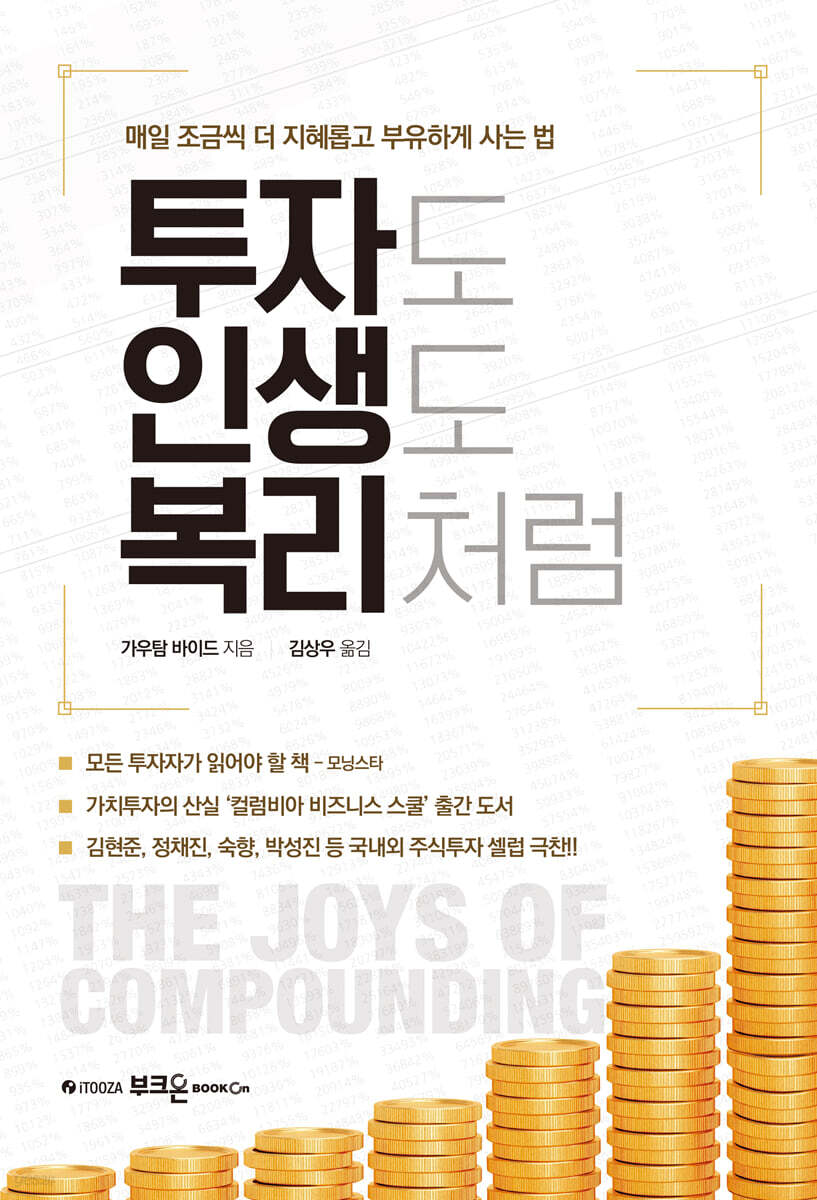
Investing and life are like compound interest.
 |
Description
Book Introduction
- A word from MD
- This book contains the author's investment methods, self-management, and business insights gleaned from his extensive reading and experience, embodying the wisdom of value investing.
It offers reflections on a rich life by synthesizing lessons learned from investment gurus such as Warren Buffett and Charlie Munger, as well as from many scholars.
- Economic Management MD Kim Sang-geun
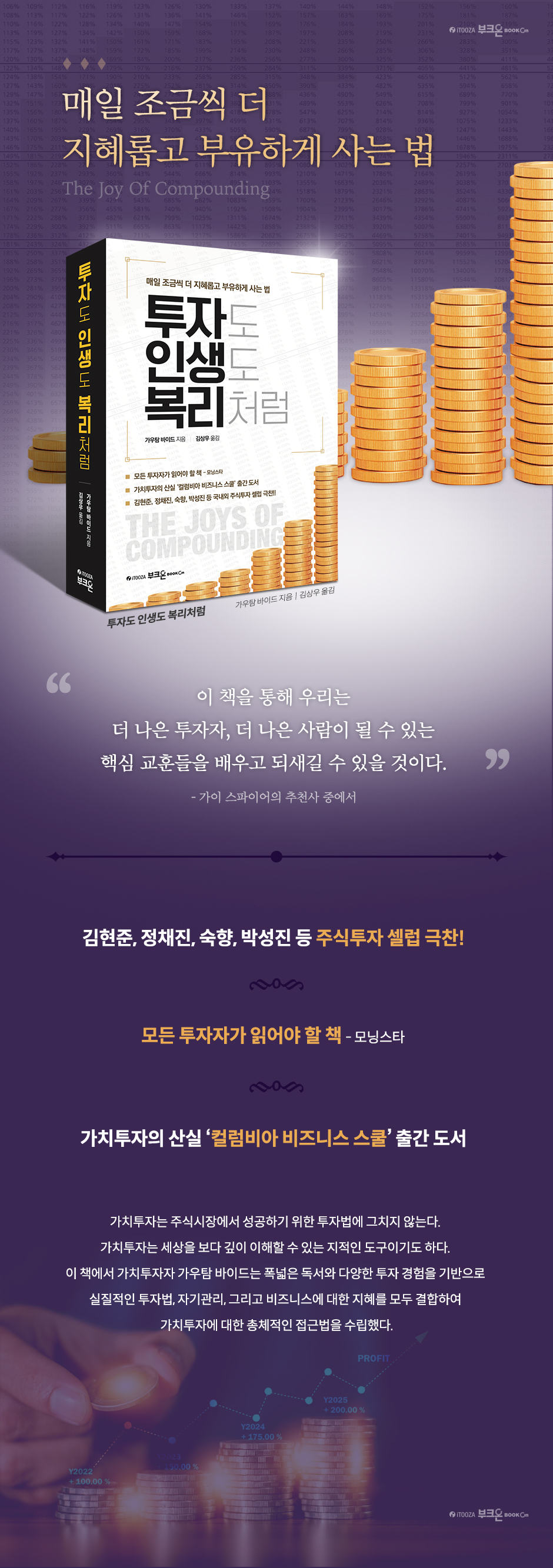
Value investing is not just a method for success in the stock market.
Value investing is also an intellectual tool that allows us to understand the world more deeply.
In this book, value investor Gautam Vaid develops a holistic approach to value investing, combining practical investment methods, self-management, and business wisdom based on his extensive reading and diverse investment experience.
The author has compiled the strategies and wisdom of renowned figures who have imparted time-tested teachings into a comprehensive guide to investing and life lessons.
In this process, the author brilliantly synthesizes the lessons he has learned from various mentors, drawing on the works of investment gurus such as Warren Buffett, Charlie Munger, and Benjamin Graham, as well as many great philosophers and scholars.
And finally, it showed that these lessons apply not only to business, investing, and decision-making, but also to individual lives.
The author, who highly values the discipline of value investing, clearly demonstrates through his own real-life investing experience that the best investment we can make is investing in ourselves.
This book will provide systematic reflection on life and learning for all investors, potential investors, and readers seeking practical wisdom.
Value investing is also an intellectual tool that allows us to understand the world more deeply.
In this book, value investor Gautam Vaid develops a holistic approach to value investing, combining practical investment methods, self-management, and business wisdom based on his extensive reading and diverse investment experience.
The author has compiled the strategies and wisdom of renowned figures who have imparted time-tested teachings into a comprehensive guide to investing and life lessons.
In this process, the author brilliantly synthesizes the lessons he has learned from various mentors, drawing on the works of investment gurus such as Warren Buffett, Charlie Munger, and Benjamin Graham, as well as many great philosophers and scholars.
And finally, it showed that these lessons apply not only to business, investing, and decision-making, but also to individual lives.
The author, who highly values the discipline of value investing, clearly demonstrates through his own real-life investing experience that the best investment we can make is investing in ourselves.
This book will provide systematic reflection on life and learning for all investors, potential investors, and readers seeking practical wisdom.
- You can preview some of the book's contents.
Preview
index
Acknowledgements
Recommendation - Guy Spier
Chapter 1: Introduction: The Best Investment is Investing in Yourself
Passionate lifelong learning and investment performance
Part 1: Worldly Wisdom and How to Use It
Chapter 2: Investing Through Lifelong Learning
Indirect Learning in Learning Machines | Investing in "Reading, Learning, and Thinking" | Reading to Reduce Investment Mistakes | How to Read Well | Focusing on the Matthew Effect in Knowledge Acquisition | Reasoning from "First Principles" | The Four Steps of the Feynman Method
Chapter 3: The Grid Mental Model and Investment
The Hedgehog and the Fox | 5 Ways to Think Productively | Learning is a Lifelong Investment
Chapter 4: The Power of Passion and Focus
A top performer in a field | Explore, dream, and discover | Performance improvement and 'conscious execution'
Part 2: The Conditions of a Daily Growing Investor
Chapter 5: Finding Your Role Model
To be a winner, be with winners | Trust is the core of all relationships.
Chapter 6: Humility is the Source of Wisdom
Become a follower before becoming a leader | The shackles of experience and bias | 'Becoming rich' and 'Maintaining wealth' | Checking your 'range of abilities' | How to expand your range of abilities
Chapter 7: Valuable Investments and Positive Influence
Wealth Building and Happiness | The World of Investments and Relationships
Chapter 8: Simple Investing vs.
Complex investments
Simplicity and Long-Term Success | What It Takes to Make Good Investment Decisions | An American Banker and a Mexican Fisherman
Chapter 9: How to Achieve Financial Independence
The Virtues of Humility and Saving | Charlie Munger's Path to Financial Independence | The Power of His First Million Dollars | Easterlin's Paradox and the Hedonic Hamster Wheel
Chapter 10: "Internal Scorecard" and Investment Principles
Buffett's Principles from the "Buffett Partnership" Era | Internal Scorecard and Intrinsic Value vs.
External Scorecards and Market Prices | Internal Scorecards and Ethics
Chapter 11: Delayed Gratification and the Compounding Effect
Investing in "Delayed Gratification" Companies | The "Ability to Suffer" and Rewards | Patience and Economic Rewards | The Fallacy of "Discounting Future Value" | Controlling Your "Binge-Eating Gene" | The Power of Tiny Repetitions | The Power of Compounding When You Improve 1% Every Day
Part 3: How to Choose Stocks to Increase Your Chances of Success
Chapter 12: "Corporate Ownership Mindset" as a Starting Point
6 Benefits of a Business Ownership Mindset | Insights from Warren Buffett
Chapter 13: Finding the Meaning Between the Lines
How to Spot an Honest CEO | Reading Between the Lines in Corporate Documents
Chapter 14: How to Use the Checklist
1.
Profit and Loss Analysis | 2.
Cash Flow Analysis | 3.
Analysis of various ratios | 4.
Business Efficiency Analysis | 5.
Financial Analysis | 6.
Management Analysis | 7.
Errors in Judgment and Charlie Munger's Checklist
Chapter 15: Investment Notes: Essentials for the Smart Investor
Reducing Planning Errors with Pre-Analysis | Writing, the Ultimate Value Investing
Chapter 16: The Impact of Incentives on Investment
Incentives and the Lessons from Berkshire Hathaway | The Power of Interest | The Harmful Effects of a Faulty Incentive System | My Money Taker vs.
The person who gives me my money
Chapter 17: The Pros and Cons of "Understanding the Numbers" in Investing
Sophistication and Simplicity in Investing | The Difference Between Smart and Wise | Thinking the Other Way
Chapter 18: The Key to Smart Investing: Intrinsic Value
Ultimately, what matters is "shareholder value." | Moat sustainability and capital expenditures. | The dark side of stock issuance and dividends. | Benjamin Graham's "Rough Range of Values." | Wealth-destroying "value traps."
Chapter 19: The Most Important Word in Investing: "Margin of Safety."
'Great Companies' and 'Great Stocks' | How to Avoid Compounding Losses | The Margin of Safety in Qualitatively Superior Companies | Two Value Investing Approaches | The Evolution of Buffett: From Graham to Fisher
Chapter 20: Using the Capital Cycle
Capital Cycles and Risk Signals | Empathy and Investment Skills | A Bitter Failure and a Quadruple Return in Five Months | The Power of Intuition | Lessons from Commodity Investing | Expanding Your Abilities: Investing in Cyclical Stocks
Chapter 21: How to Turn Corporate Spin-Offs into Investment Opportunities
3 Things Investors Should Watch Out For
Part 4: Operational know-how to increase profits and reduce losses
Chapter 22: How long should I hold which stocks?
Great, Good, Terrible | Companies with Compound Earnings | Various Sources of 'Competitive Advantage' | 'Corporate Culture': A Still-Unfamiliar Moat | 'Capital Allocation': Connecting Intrinsic Value and Shareholder Value
Chapter 23: Coping with Market Volatility
Blue Chips and the Bystander Effect | Bull Market vs.
Bear Market | What Investors Really Need to Focus on | Mr. Market's Mistakes and Opportunities | Market Efficiency and the Wisdom of Crowds
Chapter 24: Best Stocks and Optimal Weightings
Over-dispersion and Under-dispersion | The Babe Ruth Effect | Optimal Bet Size and the Kelly Criterion | Your Investment Philosophy and Patience
Chapter 25: To win first place, you must first finish the race.
How to Survive a Bear Market | Multiply Anything by Zero, and the Result is Zero | The Biggest Risk: The Black Swans Not in the News | The Dangers of Greed and Leverage | A Company's "Sustainability" and an Investor's "Investment Sustainability"
Part 5: The Art of Choosing and Decision-Making for Better Investments
Chapter 26: Analyzing Instead of Predicting
'Bad News' and the Smart Pessimist | Warren Buffett's 'Very Good Game' | What Politics Means for Long-Term Investors | Find the Answer in 'The History of Finance'
Chapter 27: Principled Perseverance and Rational Acceptance
Think Flexible | Conditional Probability and Our Views | 6 Insights into the Wisdom of the World | When to Sell and When Not to Sell
Chapter 28: Opportunity Cost Perspective and Investment Choices
Focus on 'Mistakes of Omission' | Opportunity Cost and the Best Choice | And then what?
Chapter 29: Repeating Patterns and Prepared Opportunities
The allure of "unused pricing power" | The power of "brands" | Accounting pitfalls and valuation | Uncertainty and sidecar investing | Investing in companies riding the tailwind | Investing in companies nearing facility expansion | Focusing on gradual change
Chapter 30: Investment Skills and Luck
The Power of Curiosity and Questioning | How to Improve Your Luck | Market Randomness and the Gambler's Fallacy | Luck and Reversion to the Mean | The Relationship Between "Process" and "Performance"
Chapter 31: Investment Lessons Learned from Mistakes
The Problem with Obeying Authority | The Investing Trap of Obsessing Over "Reference Points" | Jealousy That Ruins Investments | CEO Affinity and Investment Decisions | Stress and Delaying Decisions | How to Overcome the Pain of Loss | The High Cost of Greed and Fear
Chapter 32: Conclusion: Investing and Life, Like Compound Interest
Compounding Positive Thinking | Compounding Health | Compounding Good Habits | Compounding Wealth | Compounding Knowledge | Compounding Good Will
main
References
Recommendation - Guy Spier
Chapter 1: Introduction: The Best Investment is Investing in Yourself
Passionate lifelong learning and investment performance
Part 1: Worldly Wisdom and How to Use It
Chapter 2: Investing Through Lifelong Learning
Indirect Learning in Learning Machines | Investing in "Reading, Learning, and Thinking" | Reading to Reduce Investment Mistakes | How to Read Well | Focusing on the Matthew Effect in Knowledge Acquisition | Reasoning from "First Principles" | The Four Steps of the Feynman Method
Chapter 3: The Grid Mental Model and Investment
The Hedgehog and the Fox | 5 Ways to Think Productively | Learning is a Lifelong Investment
Chapter 4: The Power of Passion and Focus
A top performer in a field | Explore, dream, and discover | Performance improvement and 'conscious execution'
Part 2: The Conditions of a Daily Growing Investor
Chapter 5: Finding Your Role Model
To be a winner, be with winners | Trust is the core of all relationships.
Chapter 6: Humility is the Source of Wisdom
Become a follower before becoming a leader | The shackles of experience and bias | 'Becoming rich' and 'Maintaining wealth' | Checking your 'range of abilities' | How to expand your range of abilities
Chapter 7: Valuable Investments and Positive Influence
Wealth Building and Happiness | The World of Investments and Relationships
Chapter 8: Simple Investing vs.
Complex investments
Simplicity and Long-Term Success | What It Takes to Make Good Investment Decisions | An American Banker and a Mexican Fisherman
Chapter 9: How to Achieve Financial Independence
The Virtues of Humility and Saving | Charlie Munger's Path to Financial Independence | The Power of His First Million Dollars | Easterlin's Paradox and the Hedonic Hamster Wheel
Chapter 10: "Internal Scorecard" and Investment Principles
Buffett's Principles from the "Buffett Partnership" Era | Internal Scorecard and Intrinsic Value vs.
External Scorecards and Market Prices | Internal Scorecards and Ethics
Chapter 11: Delayed Gratification and the Compounding Effect
Investing in "Delayed Gratification" Companies | The "Ability to Suffer" and Rewards | Patience and Economic Rewards | The Fallacy of "Discounting Future Value" | Controlling Your "Binge-Eating Gene" | The Power of Tiny Repetitions | The Power of Compounding When You Improve 1% Every Day
Part 3: How to Choose Stocks to Increase Your Chances of Success
Chapter 12: "Corporate Ownership Mindset" as a Starting Point
6 Benefits of a Business Ownership Mindset | Insights from Warren Buffett
Chapter 13: Finding the Meaning Between the Lines
How to Spot an Honest CEO | Reading Between the Lines in Corporate Documents
Chapter 14: How to Use the Checklist
1.
Profit and Loss Analysis | 2.
Cash Flow Analysis | 3.
Analysis of various ratios | 4.
Business Efficiency Analysis | 5.
Financial Analysis | 6.
Management Analysis | 7.
Errors in Judgment and Charlie Munger's Checklist
Chapter 15: Investment Notes: Essentials for the Smart Investor
Reducing Planning Errors with Pre-Analysis | Writing, the Ultimate Value Investing
Chapter 16: The Impact of Incentives on Investment
Incentives and the Lessons from Berkshire Hathaway | The Power of Interest | The Harmful Effects of a Faulty Incentive System | My Money Taker vs.
The person who gives me my money
Chapter 17: The Pros and Cons of "Understanding the Numbers" in Investing
Sophistication and Simplicity in Investing | The Difference Between Smart and Wise | Thinking the Other Way
Chapter 18: The Key to Smart Investing: Intrinsic Value
Ultimately, what matters is "shareholder value." | Moat sustainability and capital expenditures. | The dark side of stock issuance and dividends. | Benjamin Graham's "Rough Range of Values." | Wealth-destroying "value traps."
Chapter 19: The Most Important Word in Investing: "Margin of Safety."
'Great Companies' and 'Great Stocks' | How to Avoid Compounding Losses | The Margin of Safety in Qualitatively Superior Companies | Two Value Investing Approaches | The Evolution of Buffett: From Graham to Fisher
Chapter 20: Using the Capital Cycle
Capital Cycles and Risk Signals | Empathy and Investment Skills | A Bitter Failure and a Quadruple Return in Five Months | The Power of Intuition | Lessons from Commodity Investing | Expanding Your Abilities: Investing in Cyclical Stocks
Chapter 21: How to Turn Corporate Spin-Offs into Investment Opportunities
3 Things Investors Should Watch Out For
Part 4: Operational know-how to increase profits and reduce losses
Chapter 22: How long should I hold which stocks?
Great, Good, Terrible | Companies with Compound Earnings | Various Sources of 'Competitive Advantage' | 'Corporate Culture': A Still-Unfamiliar Moat | 'Capital Allocation': Connecting Intrinsic Value and Shareholder Value
Chapter 23: Coping with Market Volatility
Blue Chips and the Bystander Effect | Bull Market vs.
Bear Market | What Investors Really Need to Focus on | Mr. Market's Mistakes and Opportunities | Market Efficiency and the Wisdom of Crowds
Chapter 24: Best Stocks and Optimal Weightings
Over-dispersion and Under-dispersion | The Babe Ruth Effect | Optimal Bet Size and the Kelly Criterion | Your Investment Philosophy and Patience
Chapter 25: To win first place, you must first finish the race.
How to Survive a Bear Market | Multiply Anything by Zero, and the Result is Zero | The Biggest Risk: The Black Swans Not in the News | The Dangers of Greed and Leverage | A Company's "Sustainability" and an Investor's "Investment Sustainability"
Part 5: The Art of Choosing and Decision-Making for Better Investments
Chapter 26: Analyzing Instead of Predicting
'Bad News' and the Smart Pessimist | Warren Buffett's 'Very Good Game' | What Politics Means for Long-Term Investors | Find the Answer in 'The History of Finance'
Chapter 27: Principled Perseverance and Rational Acceptance
Think Flexible | Conditional Probability and Our Views | 6 Insights into the Wisdom of the World | When to Sell and When Not to Sell
Chapter 28: Opportunity Cost Perspective and Investment Choices
Focus on 'Mistakes of Omission' | Opportunity Cost and the Best Choice | And then what?
Chapter 29: Repeating Patterns and Prepared Opportunities
The allure of "unused pricing power" | The power of "brands" | Accounting pitfalls and valuation | Uncertainty and sidecar investing | Investing in companies riding the tailwind | Investing in companies nearing facility expansion | Focusing on gradual change
Chapter 30: Investment Skills and Luck
The Power of Curiosity and Questioning | How to Improve Your Luck | Market Randomness and the Gambler's Fallacy | Luck and Reversion to the Mean | The Relationship Between "Process" and "Performance"
Chapter 31: Investment Lessons Learned from Mistakes
The Problem with Obeying Authority | The Investing Trap of Obsessing Over "Reference Points" | Jealousy That Ruins Investments | CEO Affinity and Investment Decisions | Stress and Delaying Decisions | How to Overcome the Pain of Loss | The High Cost of Greed and Fear
Chapter 32: Conclusion: Investing and Life, Like Compound Interest
Compounding Positive Thinking | Compounding Health | Compounding Good Habits | Compounding Wealth | Compounding Knowledge | Compounding Good Will
main
References
Detailed image
Into the book
Our personal philosophies are often a result of what we do and the people we look up to and follow as role models and mentors.
In that respect, I was fortunate enough to learn from some truly great people.
Warren Buffett and Adam Smith remind us of the importance of living life according to our internal scorecard (see Chapter 10).
Charlie Munger encouraged me to pursue lifelong learning and helped me recognize the power of incentives in any situation.
---From "Acknowledgements, page 13"
This book is yet another example of the value investing tribe's insight into the world we live in.
In this book, we learn lessons the author has learned (and updated by more recent researchers) from many great people.
So, in addition to Warren Buffett, Charlie Munger, and Benjamin Graham, you can see what lessons the author has drawn from people like Mohnish Pabrai, Thomas Russo, Michael Mauboussin, Peter Veblen, Sourav Madan, Marcelo Lima, and Paul Raunchis.
The author also reads extensively across multiple disciplines, digesting the works of authors from various fields, including Herbert Simon, Shane Parrish, Nassim Taleb, Rolf Dobelli, and Richard Zeckhauser, and conveys their core content to readers in a well-organized manner.
… … Through this book, we will be able to learn and reflect on key lessons that will help us become better investors and better people.
---From “Recommendation, pages 23-24”
The extra expense of these little luxuries (self-improvement) might seem a bit hefty at first, but over time you'll find it's well worth it.
Investing in learning something new and developing yourself every day will ultimately pay off handsomely.
Therefore, the best investment of your time is investing in your own development.
I hope the time you invest in reading this book now will have positive consequences for the rest of your life.
Having achieved financial freedom through my passionate pursuit of lifelong learning, I can proudly say that being a lifelong learner has made me a better investor, and being an investor has made me a better lifelong learner.
---From "Chapter 1 Introduction: The Best Investment is Investing in Yourself, p. 35"
Compare the kind of hubris found on Wall Street to the humility of one of the greatest thinkers outside finance, theoretical physicist Richard Feynman.
Feynman humbly acknowledged that nothing is ever certain when he said, “We know that all our statements are approximate statements of varying degrees of certainty, and that the question to ask when a statement is presented is not ‘Is it true or false?’ but ‘How likely is it that it is true or false?’”
We all should learn from this great scholar.
Investing is no different.
Because of the rough statements and varying degrees of certainty, we need to think probabilistically.
The question to ask is not, “Will I be right or wrong?”
Rather, we should ask, "What are the probabilities of this scenario and that scenario? How does this information influence my valuation?"
Even for those ideas that seem most certain, there should always be room for doubt.
Otherwise, you risk becoming complacent.
---From "Chapter 6 Humility is the Source of Wisdom, pp. 123-124"
A business model based on the continuous issuance of overpriced stocks (like the chain letter model) is purely a redistribution of wealth, not a creation of wealth.
Yet, both phenomena thrive periodically in the United States in cleverly disguised forms (every promoter's dream).
But the result is always the same.
Money flows from the pockets of the gullible to the pockets of the con artists.
And in the case of stocks, unlike the chain letter, the amount of money stolen can be enormous. At BPL (Buffett Partnerships LLC) and Berkshire, we have never invested in companies that are obsessed with issuing stock.
Desperate to issue stock is among the most obvious examples of promotionally driven management, weak accounting, overpriced stock, and—too often—outright dishonesty.
---From "Chapter 18: The Core of Wise Investment, 'Intrinsic Value,' p. 320"
Fundamentally, your lifetime performance as an investor depends on how you behave during the extreme market fluctuations that often occur.
Benjamin Graham said, “Fundamentally, price volatility means only one thing to a true investor.
In short, price volatility gives him the opportunity to buy wisely when the stock price is falling sharply and to sell wisely when the stock price is rising sharply.
“At other times, you may be better off forgetting about the stock market and focusing solely on dividend yield and the business performance of the companies you own,” he said.
This timeless wisdom from Benjamin Graham deserves to be read, reread, and deeply pondered.
If you can put this into practice when investing, you are bound to succeed.
When Buffett introduces the secret to becoming rich in the stock market, he says, “I will tell you how to become rich.
Please close the door.
The secret is to be fearful when others are greedy, and greedy when others are fearful.”
---From "Chapter 23: How to Deal with Market Volatility, p. 432"
In this chapter, I introduce the mistakes I made while investing.
Because I believe that those mistakes have been great teachers for me, and the lessons I learned from them have greatly helped me grow over time.
I am deeply grateful for the valuable experience and wisdom each loss has given me.
There are no mistakes in life, only lessons.
If you adopt a positive mindset, you will never lose.
You either win or you learn.
Good judgment comes from experience, and experience comes from bad judgment (I've had a lot of experience).
In that respect, I was fortunate enough to learn from some truly great people.
Warren Buffett and Adam Smith remind us of the importance of living life according to our internal scorecard (see Chapter 10).
Charlie Munger encouraged me to pursue lifelong learning and helped me recognize the power of incentives in any situation.
---From "Acknowledgements, page 13"
This book is yet another example of the value investing tribe's insight into the world we live in.
In this book, we learn lessons the author has learned (and updated by more recent researchers) from many great people.
So, in addition to Warren Buffett, Charlie Munger, and Benjamin Graham, you can see what lessons the author has drawn from people like Mohnish Pabrai, Thomas Russo, Michael Mauboussin, Peter Veblen, Sourav Madan, Marcelo Lima, and Paul Raunchis.
The author also reads extensively across multiple disciplines, digesting the works of authors from various fields, including Herbert Simon, Shane Parrish, Nassim Taleb, Rolf Dobelli, and Richard Zeckhauser, and conveys their core content to readers in a well-organized manner.
… … Through this book, we will be able to learn and reflect on key lessons that will help us become better investors and better people.
---From “Recommendation, pages 23-24”
The extra expense of these little luxuries (self-improvement) might seem a bit hefty at first, but over time you'll find it's well worth it.
Investing in learning something new and developing yourself every day will ultimately pay off handsomely.
Therefore, the best investment of your time is investing in your own development.
I hope the time you invest in reading this book now will have positive consequences for the rest of your life.
Having achieved financial freedom through my passionate pursuit of lifelong learning, I can proudly say that being a lifelong learner has made me a better investor, and being an investor has made me a better lifelong learner.
---From "Chapter 1 Introduction: The Best Investment is Investing in Yourself, p. 35"
Compare the kind of hubris found on Wall Street to the humility of one of the greatest thinkers outside finance, theoretical physicist Richard Feynman.
Feynman humbly acknowledged that nothing is ever certain when he said, “We know that all our statements are approximate statements of varying degrees of certainty, and that the question to ask when a statement is presented is not ‘Is it true or false?’ but ‘How likely is it that it is true or false?’”
We all should learn from this great scholar.
Investing is no different.
Because of the rough statements and varying degrees of certainty, we need to think probabilistically.
The question to ask is not, “Will I be right or wrong?”
Rather, we should ask, "What are the probabilities of this scenario and that scenario? How does this information influence my valuation?"
Even for those ideas that seem most certain, there should always be room for doubt.
Otherwise, you risk becoming complacent.
---From "Chapter 6 Humility is the Source of Wisdom, pp. 123-124"
A business model based on the continuous issuance of overpriced stocks (like the chain letter model) is purely a redistribution of wealth, not a creation of wealth.
Yet, both phenomena thrive periodically in the United States in cleverly disguised forms (every promoter's dream).
But the result is always the same.
Money flows from the pockets of the gullible to the pockets of the con artists.
And in the case of stocks, unlike the chain letter, the amount of money stolen can be enormous. At BPL (Buffett Partnerships LLC) and Berkshire, we have never invested in companies that are obsessed with issuing stock.
Desperate to issue stock is among the most obvious examples of promotionally driven management, weak accounting, overpriced stock, and—too often—outright dishonesty.
---From "Chapter 18: The Core of Wise Investment, 'Intrinsic Value,' p. 320"
Fundamentally, your lifetime performance as an investor depends on how you behave during the extreme market fluctuations that often occur.
Benjamin Graham said, “Fundamentally, price volatility means only one thing to a true investor.
In short, price volatility gives him the opportunity to buy wisely when the stock price is falling sharply and to sell wisely when the stock price is rising sharply.
“At other times, you may be better off forgetting about the stock market and focusing solely on dividend yield and the business performance of the companies you own,” he said.
This timeless wisdom from Benjamin Graham deserves to be read, reread, and deeply pondered.
If you can put this into practice when investing, you are bound to succeed.
When Buffett introduces the secret to becoming rich in the stock market, he says, “I will tell you how to become rich.
Please close the door.
The secret is to be fearful when others are greedy, and greedy when others are fearful.”
---From "Chapter 23: How to Deal with Market Volatility, p. 432"
In this chapter, I introduce the mistakes I made while investing.
Because I believe that those mistakes have been great teachers for me, and the lessons I learned from them have greatly helped me grow over time.
I am deeply grateful for the valuable experience and wisdom each loss has given me.
There are no mistakes in life, only lessons.
If you adopt a positive mindset, you will never lose.
You either win or you learn.
Good judgment comes from experience, and experience comes from bad judgment (I've had a lot of experience).
---From "Investment Lessons Learned from Mistakes, Chapter 31, p. 645"
Publisher's Review
How to live a little wiser and richer every day
Kim Hyun-jun, Jeong Chae-jin, Sook Hyang, Park Sung-jin, and other stock investment celebrities praise it!
A book published by Columbia Business School, the cradle of value investing.
A Must-Read for Value Investors - Morningstar
Through this book we
Become a better investor and a better person
You will be able to learn and reflect on key lessons.
- From Guy Spier's recommendation
This recommendation perfectly captures the true value of this book.
The core message of 『Investing and Life, Like Compound Interest』 is to 'live a little wiser and wealthier every day' with a longer breath.
If you live 1% wiser and richer every day, the effects are very tangible.
If it improves by 1% for just one day, the result is only 1.01 (= 1.00 + 0.01).
But if it improved by 1% every day for a year, the number would be 37.78 (= 1.01365).
It's compound interest that makes the difference between 1.01 and 37.78.
And the result of the 'investment engine' called compound interest is the realization of 'economic independence', the dream and hope of all investors in the world.
So, this book is about 'investments that change lives.'
A friendly guide to everything about value investing!
"Investing and Life, Like Compound Interest" is a book that tightly covers all the knowledge about value investing.
This book very accurately introduces the investment cases and insights of legendary investors.
It's full of lessons on investing and life from giants like Warren Buffett, Charlie Munger, and Benjamin Graham.
Moreover, based on the works of many philosophers and scholars who have been verified over time, the strategies and wisdom they have imparted have been compiled into a single, concrete guideline.
Based on extensive reading and diverse investment experience, the author has compiled "practically helpful investment methods," self-management know-how, and business insights into a single book.
In short, this is an investment guide that presents a new, comprehensive approach to value investing through the keyword "welfare."
The author is on the path to becoming a successful value investor, inspired by value investing masters such as Warren Buffett and his colleague Charlie Munger.
The author is known for investing in companies with strong fundamentals and growth potential from a long-term perspective.
This book, written by an author with such experience, is a must-read in the field of value investing, published by Columbia Business School, the true cradle of value investing.
Over 32 chapters, the book delves into the most important principles of sound investing, adding the strategies and wisdom of great investment gurus to the mix, bringing the book to over 750 pages.
The 'life-changing investment' discussed in this book is also just as thick and solid.
The author introduces nearly 130 people in his Acknowledgments.
This is his list of 'teachers' (which is also the list of 'teachers' for all value investors).
He remained faithful to the teachings of his masters in all aspects of life, including investing and business management.
That's what puts him in world class status now.
In other words, this book is both a document and a user manual for the author's successful investment.
“(This book) is my heartfelt tribute to all the teachers who helped me achieve financial independence, become a wiser and better person, and live a fulfilling and meaningful life.”
Kim Hyun-jun, Jeong Chae-jin, Sook Hyang, Park Sung-jin, and other stock investment celebrities praise it!
A book published by Columbia Business School, the cradle of value investing.
A Must-Read for Value Investors - Morningstar
Through this book we
Become a better investor and a better person
You will be able to learn and reflect on key lessons.
- From Guy Spier's recommendation
This recommendation perfectly captures the true value of this book.
The core message of 『Investing and Life, Like Compound Interest』 is to 'live a little wiser and wealthier every day' with a longer breath.
If you live 1% wiser and richer every day, the effects are very tangible.
If it improves by 1% for just one day, the result is only 1.01 (= 1.00 + 0.01).
But if it improved by 1% every day for a year, the number would be 37.78 (= 1.01365).
It's compound interest that makes the difference between 1.01 and 37.78.
And the result of the 'investment engine' called compound interest is the realization of 'economic independence', the dream and hope of all investors in the world.
So, this book is about 'investments that change lives.'
A friendly guide to everything about value investing!
"Investing and Life, Like Compound Interest" is a book that tightly covers all the knowledge about value investing.
This book very accurately introduces the investment cases and insights of legendary investors.
It's full of lessons on investing and life from giants like Warren Buffett, Charlie Munger, and Benjamin Graham.
Moreover, based on the works of many philosophers and scholars who have been verified over time, the strategies and wisdom they have imparted have been compiled into a single, concrete guideline.
Based on extensive reading and diverse investment experience, the author has compiled "practically helpful investment methods," self-management know-how, and business insights into a single book.
In short, this is an investment guide that presents a new, comprehensive approach to value investing through the keyword "welfare."
The author is on the path to becoming a successful value investor, inspired by value investing masters such as Warren Buffett and his colleague Charlie Munger.
The author is known for investing in companies with strong fundamentals and growth potential from a long-term perspective.
This book, written by an author with such experience, is a must-read in the field of value investing, published by Columbia Business School, the true cradle of value investing.
Over 32 chapters, the book delves into the most important principles of sound investing, adding the strategies and wisdom of great investment gurus to the mix, bringing the book to over 750 pages.
The 'life-changing investment' discussed in this book is also just as thick and solid.
The author introduces nearly 130 people in his Acknowledgments.
This is his list of 'teachers' (which is also the list of 'teachers' for all value investors).
He remained faithful to the teachings of his masters in all aspects of life, including investing and business management.
That's what puts him in world class status now.
In other words, this book is both a document and a user manual for the author's successful investment.
“(This book) is my heartfelt tribute to all the teachers who helped me achieve financial independence, become a wiser and better person, and live a fulfilling and meaningful life.”
GOODS SPECIFICS
- Date of issue: June 30, 2023
- Page count, weight, size: 756 pages | 1,072g | 152*225*37mm
- ISBN13: 9791197811784
- ISBN10: 1197811788
You may also like
카테고리
korean


korean

![ELLE 엘르 스페셜 에디션 A형 : 12월 [2025]](http://librairie.coreenne.fr/cdn/shop/files/b8e27a3de6c9538896439686c6b0e8fb.jpg?v=1766436872&width=3840)


