

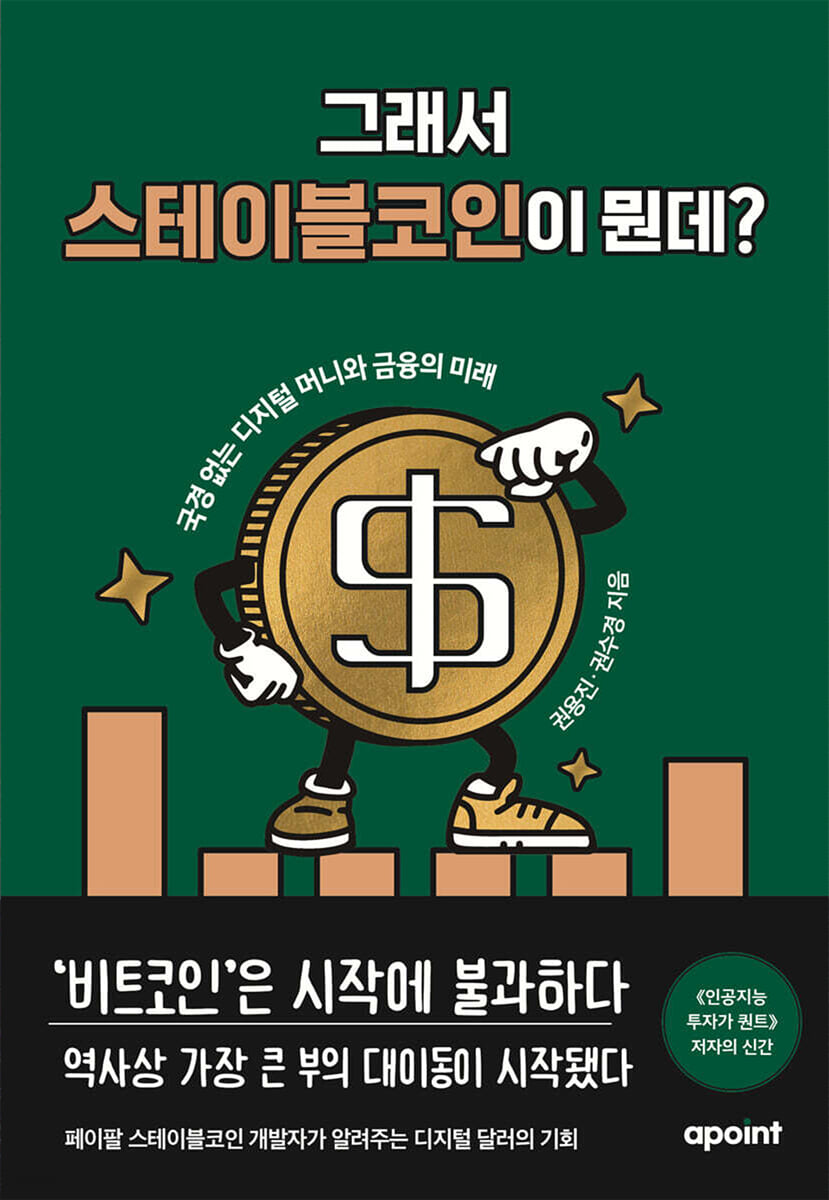
So what is a stablecoin?
 |
Description
Book Introduction
Bitcoin is just the beginning.
The greatest wealth transfer in history has begun.
★ The Future of the Digital Dollar: A Look Inside PayPal's Stablecoin, PYUSD
★ Professor Shin Kwan-ho of Korea University and Kim Hee-jae, Scale AI Leader, Recommended
“The greatest revolution in financial technology since the advent of the internet.” This declaration, made by President Trump in July 2025 while passing the Genius Act, shook the world.
From that moment on, central banks and global corporations from around the world, including the United States, began competing to seize the lead in the stablecoin era.
But many people still have question marks in their minds.
"Stablecoins, what's all the fuss about? Isn't this another bubble?"
"So What Are Stablecoins?" answers this very question.
Beyond simple technical explanations, it vividly portrays the profound changes stablecoins will bring to finance and industry, like a video of the future.
The author is a former quant who developed AI investment algorithms at Bank of America and is a global blockchain expert who led the launch of PayPal's stablecoin 'PYUSD'.
Currently, we are conducting joint research with the Circle Economic Research Institute, suggesting a paradigm shift in money and the potential for new businesses and services to emerge within it.
The book begins by examining the past and present of stablecoins.
Focusing on the case of the United States, which has entered the institutional system, we present specific scenarios for what new companies will emerge and what services will change our daily lives in the next 10 years.
Just as the internet gave birth to Amazon and Google, and smartphones gave birth to Instagram and Uber, stablecoins are expected to give rise to an explosion of innovative financial apps and services based on blockchain networks.
In particular, the author emphasizes that "the era of stablecoins has already been decided to some extent."
The United States is leading the way, and the principles of change that occurred in the Internet and smartphone era are similar to those at play.
This book offers a broader perspective on the implications of the introduction of a won-denominated stablecoin, extending beyond the scope of remittance convenience and financial sovereignty. It also explores its implications within the context of global competition.
Ultimately, "So What Are Stablecoins?" is a guidebook that predicts the coming decade, a decade of shifting monetary paradigms and a profound shift in wealth, and provides guidance on how to seize the opportunities within it.
Whether you're investing, starting a business, or managing your assets defensively, this is a must-read.
The greatest wealth transfer in history has begun.
★ The Future of the Digital Dollar: A Look Inside PayPal's Stablecoin, PYUSD
★ Professor Shin Kwan-ho of Korea University and Kim Hee-jae, Scale AI Leader, Recommended
“The greatest revolution in financial technology since the advent of the internet.” This declaration, made by President Trump in July 2025 while passing the Genius Act, shook the world.
From that moment on, central banks and global corporations from around the world, including the United States, began competing to seize the lead in the stablecoin era.
But many people still have question marks in their minds.
"Stablecoins, what's all the fuss about? Isn't this another bubble?"
"So What Are Stablecoins?" answers this very question.
Beyond simple technical explanations, it vividly portrays the profound changes stablecoins will bring to finance and industry, like a video of the future.
The author is a former quant who developed AI investment algorithms at Bank of America and is a global blockchain expert who led the launch of PayPal's stablecoin 'PYUSD'.
Currently, we are conducting joint research with the Circle Economic Research Institute, suggesting a paradigm shift in money and the potential for new businesses and services to emerge within it.
The book begins by examining the past and present of stablecoins.
Focusing on the case of the United States, which has entered the institutional system, we present specific scenarios for what new companies will emerge and what services will change our daily lives in the next 10 years.
Just as the internet gave birth to Amazon and Google, and smartphones gave birth to Instagram and Uber, stablecoins are expected to give rise to an explosion of innovative financial apps and services based on blockchain networks.
In particular, the author emphasizes that "the era of stablecoins has already been decided to some extent."
The United States is leading the way, and the principles of change that occurred in the Internet and smartphone era are similar to those at play.
This book offers a broader perspective on the implications of the introduction of a won-denominated stablecoin, extending beyond the scope of remittance convenience and financial sovereignty. It also explores its implications within the context of global competition.
Ultimately, "So What Are Stablecoins?" is a guidebook that predicts the coming decade, a decade of shifting monetary paradigms and a profound shift in wealth, and provides guidance on how to seize the opportunities within it.
Whether you're investing, starting a business, or managing your assets defensively, this is a must-read.
- You can preview some of the book's contents.
Preview
index
Recommendation
So, what on earth is a stablecoin?
Part 1.
It's my money, but it's not my money.
1.
Why a 100,000 won gift certificate costs 95,000 won
2.
Is the 1 million won displayed on the app really mine?
3.
You can't pay hospital bills with Starbucks Cash.
4.
Is Pay Money free?
5.
The money in the bank isn't even my money?
6.
Why There Is No Global Bank
7.
The Birth of Ethereum, a Global Financial Network
Part 2.
If sending money could be as easy as sending an email
8.
“Do you have my wallet address?”
9.
1.7 billion people without accounts encounter finance for the first time.
10.
When the government takes my money
11.
Why do they exchange all their salaries into dollars?
12.
Digital cash that no one can take away
13.
If you store all your assets in one digital wallet
Part 3.
If stablecoins become commonplace
14.
The law is far away and lawyers are expensive.
15.
A world where the phrase "pay back the money" has disappeared
16.
A "glass box" gathering where relays cannot escape
17.
No more empty promises
18.
A "Promise Account" where your promises turn into money
19.
How to make my money work overnight
20.
Pay 5 won for listening to just 30 seconds of a song?
21.
Invest 10,000 won in a local bakery and receive daily dividends.
22.
Borrow real money by entrusting the game's "Legendary Sword"
23.
What do we gain when money has intelligence?
24.
Why a financial app store now?
Part 4.
Stablecoins: Are They Really That Good?
25.
Lessons from Terra-Luna
26.
Transfers are faster, but why are fees more expensive?
27.
The fear that every transaction will be recorded forever
28.
A hotbed of international crime and money laundering
29.
A single line of code error can cost you your entire fortune.
30.
The Invisible Central Bank Shakes Up the National Economy
Part 5.
What should we prepare?
31.
Trump's Return and the Era of Stablecoins
32.
Every company becomes a bank
33.
The Central Bank's Dilemma: CBDC or Stablecoin?
34.
How to protect your assets in the stablecoin era
35.
Don't mine Bitcoin, sell your pickaxe.
36 Start slowly, but start now
In conclusion, an ordinary day in Seoul in 2035
References
So, what on earth is a stablecoin?
Part 1.
It's my money, but it's not my money.
1.
Why a 100,000 won gift certificate costs 95,000 won
2.
Is the 1 million won displayed on the app really mine?
3.
You can't pay hospital bills with Starbucks Cash.
4.
Is Pay Money free?
5.
The money in the bank isn't even my money?
6.
Why There Is No Global Bank
7.
The Birth of Ethereum, a Global Financial Network
Part 2.
If sending money could be as easy as sending an email
8.
“Do you have my wallet address?”
9.
1.7 billion people without accounts encounter finance for the first time.
10.
When the government takes my money
11.
Why do they exchange all their salaries into dollars?
12.
Digital cash that no one can take away
13.
If you store all your assets in one digital wallet
Part 3.
If stablecoins become commonplace
14.
The law is far away and lawyers are expensive.
15.
A world where the phrase "pay back the money" has disappeared
16.
A "glass box" gathering where relays cannot escape
17.
No more empty promises
18.
A "Promise Account" where your promises turn into money
19.
How to make my money work overnight
20.
Pay 5 won for listening to just 30 seconds of a song?
21.
Invest 10,000 won in a local bakery and receive daily dividends.
22.
Borrow real money by entrusting the game's "Legendary Sword"
23.
What do we gain when money has intelligence?
24.
Why a financial app store now?
Part 4.
Stablecoins: Are They Really That Good?
25.
Lessons from Terra-Luna
26.
Transfers are faster, but why are fees more expensive?
27.
The fear that every transaction will be recorded forever
28.
A hotbed of international crime and money laundering
29.
A single line of code error can cost you your entire fortune.
30.
The Invisible Central Bank Shakes Up the National Economy
Part 5.
What should we prepare?
31.
Trump's Return and the Era of Stablecoins
32.
Every company becomes a bank
33.
The Central Bank's Dilemma: CBDC or Stablecoin?
34.
How to protect your assets in the stablecoin era
35.
Don't mine Bitcoin, sell your pickaxe.
36 Start slowly, but start now
In conclusion, an ordinary day in Seoul in 2035
References
Detailed image

Into the book
In a network with an owner, users are not true 'owners'.
You are just a 'user' whose rules can change at any time, whose access can be restricted, and who can even be kicked from the network.
Our financial sovereignty is not as complete as we think.
We may simply be allowed to use money for a while, subject to the rules of a vast network.
--- p.52
Ethereum provides the foundation for a single, massive 'financial internet' that encompasses all of this.
This network has no borders, no shareholders, and no CEO.
No one can turn it off or change its contents at will.
For example, imagine a young Kenyan developer who wants to create a micro-lending service for the world.
Traditionally, he would have had to partner with a Kenyan bank, navigate financial regulations in each country, and build expensive servers.
It is virtually impossible.
But on Ethereum, you just need to write code called a 'smart contract' and upload it.
--- p.55
The changes brought about by stablecoins are the same.
This is how ‘Money Email’ was born.
In the past, international remittances were a major barrier.
Minimum 3-5 days, 3-7% commission.
When sending 1 million won, a fee of 50,000 won is charged.
Besides, the paperwork is complicated.
The purpose of the remittance, recipient information, and supporting documents are all there is to it. Now, however, it's different. All you need is a single USDT address.
Copy and paste, hit the send button, and it will arrive within 10 minutes.
The fee is $1.
Available 24 hours a day, 365 days a year.
--- p.84
Financial sovereignty refers to the ability to control one's own assets.
Until now, this authority has been limited.
Because accounts could only be opened and money moved within the scope of bank and government approval.
Stablecoins have cracked this structure.
It's not complete freedom, but at least it broadens your choices.
In principle, stablecoins held in personal wallets are not affected even if the government freezes accounts or a bank goes bankrupt.
--- p.123
Rally in the US allows influencers and creators to issue their own tokens and sell them to fans.
This allowed creators to fund themselves without advertising deals, and fans became more than just followers; they became investors in the creator's growth.
In another example, Friend.tech, the influence of XX (formerly Twitter) influencers is reflected in the price of a token called 'key' and is traded.
Prices fluctuate based on the number of followers and popularity, creating an investment-type community in which fans actively participate.
--- p.169
When the iPhone was released in 2007, Steve Jobs declared that we had “reinvented the telephone.”
But the real revolution wasn't the telephone.
The 'app economy' began in 2008 with the opening of the App Store.
Apple only created 20 basic apps, but as of 2024, 1.78 million apps have been created.
Anyone with an idea can now create an app.
The changes brought about by stablecoins are the same.
We are moving from an era where only time deposits, savings, and loan products were created by 'manufacturers' called banks to an era where anyone can create financial products.
--- p.179
If the advent of financial app stores is transforming our financial lives, the next revolution will come from the economy of autonomous "AI agents."
Future AI will go beyond being mere tools; it will become an independent economic entity that collects data on its own (paying for API calls), allocates cloud resources (paying for computing costs), and collaborates with other AIs (paying for service usage) to perform complex tasks.
--- p.191
A startup has started paying its employees a portion of their salaries in the stablecoin USDC.
The company boasted that it was a “future-oriented experiment,” but just a month later, unexpected problems arose.
This is because all USDC payments flowing from the company wallet to employee wallets are transparently recorded on the blockchain.
When a curious intern searched the company's wallet address on the blockchain explorer Etherscan, the exact salary amounts for each employee were revealed.
It was clear at a glance that Sales Team Manager Kim earned a higher salary than Accounting Team Manager Park, and who received the performance bonus.
--- p.210
So which services will take on this role? Some possibilities are already beginning to emerge.
One of them is a salary streaming service.
This is a method of receiving wages in real time for the hours worked.
No need to wait for payday anymore.
If you worked 8 hours today, the amount of pay you get will be deposited into your wallet as soon as you leave work.
In the United States, a service called Sablier has implemented this method, and it is already being used in several blockchain projects.
This is particularly noticeable in occupations with high income fluctuations, such as on-demand workers or Uber drivers.
You are just a 'user' whose rules can change at any time, whose access can be restricted, and who can even be kicked from the network.
Our financial sovereignty is not as complete as we think.
We may simply be allowed to use money for a while, subject to the rules of a vast network.
--- p.52
Ethereum provides the foundation for a single, massive 'financial internet' that encompasses all of this.
This network has no borders, no shareholders, and no CEO.
No one can turn it off or change its contents at will.
For example, imagine a young Kenyan developer who wants to create a micro-lending service for the world.
Traditionally, he would have had to partner with a Kenyan bank, navigate financial regulations in each country, and build expensive servers.
It is virtually impossible.
But on Ethereum, you just need to write code called a 'smart contract' and upload it.
--- p.55
The changes brought about by stablecoins are the same.
This is how ‘Money Email’ was born.
In the past, international remittances were a major barrier.
Minimum 3-5 days, 3-7% commission.
When sending 1 million won, a fee of 50,000 won is charged.
Besides, the paperwork is complicated.
The purpose of the remittance, recipient information, and supporting documents are all there is to it. Now, however, it's different. All you need is a single USDT address.
Copy and paste, hit the send button, and it will arrive within 10 minutes.
The fee is $1.
Available 24 hours a day, 365 days a year.
--- p.84
Financial sovereignty refers to the ability to control one's own assets.
Until now, this authority has been limited.
Because accounts could only be opened and money moved within the scope of bank and government approval.
Stablecoins have cracked this structure.
It's not complete freedom, but at least it broadens your choices.
In principle, stablecoins held in personal wallets are not affected even if the government freezes accounts or a bank goes bankrupt.
--- p.123
Rally in the US allows influencers and creators to issue their own tokens and sell them to fans.
This allowed creators to fund themselves without advertising deals, and fans became more than just followers; they became investors in the creator's growth.
In another example, Friend.tech, the influence of XX (formerly Twitter) influencers is reflected in the price of a token called 'key' and is traded.
Prices fluctuate based on the number of followers and popularity, creating an investment-type community in which fans actively participate.
--- p.169
When the iPhone was released in 2007, Steve Jobs declared that we had “reinvented the telephone.”
But the real revolution wasn't the telephone.
The 'app economy' began in 2008 with the opening of the App Store.
Apple only created 20 basic apps, but as of 2024, 1.78 million apps have been created.
Anyone with an idea can now create an app.
The changes brought about by stablecoins are the same.
We are moving from an era where only time deposits, savings, and loan products were created by 'manufacturers' called banks to an era where anyone can create financial products.
--- p.179
If the advent of financial app stores is transforming our financial lives, the next revolution will come from the economy of autonomous "AI agents."
Future AI will go beyond being mere tools; it will become an independent economic entity that collects data on its own (paying for API calls), allocates cloud resources (paying for computing costs), and collaborates with other AIs (paying for service usage) to perform complex tasks.
--- p.191
A startup has started paying its employees a portion of their salaries in the stablecoin USDC.
The company boasted that it was a “future-oriented experiment,” but just a month later, unexpected problems arose.
This is because all USDC payments flowing from the company wallet to employee wallets are transparently recorded on the blockchain.
When a curious intern searched the company's wallet address on the blockchain explorer Etherscan, the exact salary amounts for each employee were revealed.
It was clear at a glance that Sales Team Manager Kim earned a higher salary than Accounting Team Manager Park, and who received the performance bonus.
--- p.210
So which services will take on this role? Some possibilities are already beginning to emerge.
One of them is a salary streaming service.
This is a method of receiving wages in real time for the hours worked.
No need to wait for payday anymore.
If you worked 8 hours today, the amount of pay you get will be deposited into your wallet as soon as you leave work.
In the United States, a service called Sablier has implemented this method, and it is already being used in several blockchain projects.
This is particularly noticeable in occupations with high income fluctuations, such as on-demand workers or Uber drivers.
--- p.286
Publisher's Review
Bitcoin is just the beginning.
The greatest wealth transfer in history has begun.
“The greatest revolution in financial technology since the advent of the internet.” This declaration, made by President Trump in July 2025 while passing the Genius Act, shook the world.
From that moment on, central banks and global corporations from around the world, including the United States, began competing to seize the lead in the stablecoin era.
But many people still have question marks in their minds.
"Stablecoins, what's all the fuss about? Isn't this another bubble?"
"So What Are Stablecoins?" answers this very question.
Beyond simple technical explanations, it vividly portrays the profound changes stablecoins will bring to finance and industry, like a video of the future.
The author is a former quant who developed AI investment algorithms at Bank of America and is a global blockchain expert who led the launch of PayPal's stablecoin 'PYUSD'.
Currently, we are conducting joint research with the Circle Economic Research Institute, suggesting a paradigm shift in money and the potential for new businesses and services to emerge within it.
The book begins by examining the past and present of stablecoins.
Focusing on the case of the United States, which has entered the institutional system, we present specific scenarios for what new companies will emerge and what services will change our daily lives in the next 10 years.
Just as the internet gave birth to Amazon and Google, and smartphones gave birth to Instagram and Uber, stablecoins are expected to give rise to an explosion of innovative financial apps and services based on blockchain networks.
In particular, the author emphasizes that "the era of stablecoins has already been decided to some extent."
The United States is leading the way, and the principles of change that occurred in the Internet and smartphone era are similar.
This book offers a broader perspective on the implications of the introduction of a won-denominated stablecoin, extending beyond the scope of remittance convenience and financial sovereignty. It also explores its implications within the context of global competition.
Ultimately, "So What Are Stablecoins?" is a guidebook that predicts the coming decade, a decade of shifting monetary paradigms and a profound shift in wealth, and provides guidance on how to seize the opportunities within it.
Whether you're investing, starting a business, or managing your assets defensively, this is a must-read.
“Do you have my wallet address?”
When sending money becomes as easy as sending an email
The money, cash mileage, and points we put in our bank accounts are actually not 'ownership' but merely 'rights to use'.
The moment the owner of the network where that money is stored (a bank, a company, a government) blocks access for whatever reason, you realize that what you believed was your money was not actually yours.
It happens frequently in the form of corporate bankruptcy, remittance limits, and account freezing, but it is just something we have become accustomed to.
On the other hand, the stablecoins in my Ethereum wallet are my complete assets that no one can take away.
You can send money across borders in seconds, 24 hours a day, 365 days a year, with fees several dozen times lower than those at banks.
The 1.7 billion people around the world who don't have a bank account can create a "wallet" in just three seconds with just a smartphone and enter the world of finance.
In Lebanon, where banks have effectively ceased functioning, in Turkey and Argentina, where the value of their currencies has collapsed, in Ukraine, where citizens are in the midst of war, and in foreign workers who send money home every month, they are using dollar stablecoins to protect their assets and continue to transact.
It is no longer an exaggeration to say that “banks could disappear.”
In 10 years, we'll be asking this question as naturally as saying, "Do you have an email address?"
“Do you have my wallet address?”
“How will our daily lives change?”
The Opportunities and Risks That Occur When Money Becomes Intelligent
The true innovation of stablecoins goes beyond the convenience of remittances; it transforms our very way of life.
The key is a smart contract, also known as a “contract written in code.”
This is a system where money moves automatically when certain conditions are met. Salaries are paid in real time according to the amount of work done, and content is settled immediately down to 0.01 won based on viewing time or number of views.
Additionally, tokenization of assets opens a new chapter in finance.
You can jointly own a building in Gangnam by dividing it into 100,000 won units or sell parking tickets to make a profit.
Individuals can borrow against future earnings, pre-sell future advertising revenue on Instagram, and even invest 10,000 won in local restaurants to receive a portion of their daily sales.
If creating financial products was once the exclusive domain of financial companies, in the future, it will expand into an app store-like ecosystem where anyone can create them through smart contracts.
Of course, there are not only opportunities.
Laws and regulations have yet to keep pace with the pace of technology, and risks are significant, including uncertainty surrounding government policy changes, the risk of crime and hacking, and the lack of bank-level safeguards.
But despite this, stablecoins have already become an unstoppable trend.
Just as the 1990s adage "you can live without the internet" quickly became meaningless, stablecoins will soon become a reality for everyone.
"Sell your pickaxe, not mine Bitcoin."
The Greatest Wealth Migration in History: What Should We Prepare for?
During the 19th century Gold Rush, millions flocked to California in search of gold, but there were others who made the real money.
Samuel Brannan, who sold pickaxes to gold diggers; Levi's, which grew into a global brand by selling jeans; and Wells Fargo, which took their money and built a financial network.
It was the same during the dot-com bubble.
Many dot-com companies have risen and fallen, but Oracle, which provided databases, and Cisco, which made Internet routers, have survived and become giants.
If the "gold" of today's gold rush is stablecoins, then who sells the "pickaxes"? The author provides the answer.
Representative examples include Ethereum, which provides a blockchain network, Tether and Circle, which issue stablecoins, Coinbase, which expands the ecosystem, and Chainlink, which ensures system trust.
Here, we broadly explore the potential of Samsung Electronics, which has built-in wallets into its smartphones, and existing financial networks like Visa and Mastercard, which transfer value and collect fees.
As the great wave approaches, it is up to each of us to prepare for the future.
Some will launch innovative fintech companies like Toss, while others will seek out the next Bitcoin and invest.
Or, some people may guard their assets defensively, or just go about their daily lives without a care.
But no matter which choice you make, this book will serve as a solid guide for preparing for the era of stablecoins, drawing on the author's global experience and insights.
The greatest wealth transfer in history has begun.
“The greatest revolution in financial technology since the advent of the internet.” This declaration, made by President Trump in July 2025 while passing the Genius Act, shook the world.
From that moment on, central banks and global corporations from around the world, including the United States, began competing to seize the lead in the stablecoin era.
But many people still have question marks in their minds.
"Stablecoins, what's all the fuss about? Isn't this another bubble?"
"So What Are Stablecoins?" answers this very question.
Beyond simple technical explanations, it vividly portrays the profound changes stablecoins will bring to finance and industry, like a video of the future.
The author is a former quant who developed AI investment algorithms at Bank of America and is a global blockchain expert who led the launch of PayPal's stablecoin 'PYUSD'.
Currently, we are conducting joint research with the Circle Economic Research Institute, suggesting a paradigm shift in money and the potential for new businesses and services to emerge within it.
The book begins by examining the past and present of stablecoins.
Focusing on the case of the United States, which has entered the institutional system, we present specific scenarios for what new companies will emerge and what services will change our daily lives in the next 10 years.
Just as the internet gave birth to Amazon and Google, and smartphones gave birth to Instagram and Uber, stablecoins are expected to give rise to an explosion of innovative financial apps and services based on blockchain networks.
In particular, the author emphasizes that "the era of stablecoins has already been decided to some extent."
The United States is leading the way, and the principles of change that occurred in the Internet and smartphone era are similar.
This book offers a broader perspective on the implications of the introduction of a won-denominated stablecoin, extending beyond the scope of remittance convenience and financial sovereignty. It also explores its implications within the context of global competition.
Ultimately, "So What Are Stablecoins?" is a guidebook that predicts the coming decade, a decade of shifting monetary paradigms and a profound shift in wealth, and provides guidance on how to seize the opportunities within it.
Whether you're investing, starting a business, or managing your assets defensively, this is a must-read.
“Do you have my wallet address?”
When sending money becomes as easy as sending an email
The money, cash mileage, and points we put in our bank accounts are actually not 'ownership' but merely 'rights to use'.
The moment the owner of the network where that money is stored (a bank, a company, a government) blocks access for whatever reason, you realize that what you believed was your money was not actually yours.
It happens frequently in the form of corporate bankruptcy, remittance limits, and account freezing, but it is just something we have become accustomed to.
On the other hand, the stablecoins in my Ethereum wallet are my complete assets that no one can take away.
You can send money across borders in seconds, 24 hours a day, 365 days a year, with fees several dozen times lower than those at banks.
The 1.7 billion people around the world who don't have a bank account can create a "wallet" in just three seconds with just a smartphone and enter the world of finance.
In Lebanon, where banks have effectively ceased functioning, in Turkey and Argentina, where the value of their currencies has collapsed, in Ukraine, where citizens are in the midst of war, and in foreign workers who send money home every month, they are using dollar stablecoins to protect their assets and continue to transact.
It is no longer an exaggeration to say that “banks could disappear.”
In 10 years, we'll be asking this question as naturally as saying, "Do you have an email address?"
“Do you have my wallet address?”
“How will our daily lives change?”
The Opportunities and Risks That Occur When Money Becomes Intelligent
The true innovation of stablecoins goes beyond the convenience of remittances; it transforms our very way of life.
The key is a smart contract, also known as a “contract written in code.”
This is a system where money moves automatically when certain conditions are met. Salaries are paid in real time according to the amount of work done, and content is settled immediately down to 0.01 won based on viewing time or number of views.
Additionally, tokenization of assets opens a new chapter in finance.
You can jointly own a building in Gangnam by dividing it into 100,000 won units or sell parking tickets to make a profit.
Individuals can borrow against future earnings, pre-sell future advertising revenue on Instagram, and even invest 10,000 won in local restaurants to receive a portion of their daily sales.
If creating financial products was once the exclusive domain of financial companies, in the future, it will expand into an app store-like ecosystem where anyone can create them through smart contracts.
Of course, there are not only opportunities.
Laws and regulations have yet to keep pace with the pace of technology, and risks are significant, including uncertainty surrounding government policy changes, the risk of crime and hacking, and the lack of bank-level safeguards.
But despite this, stablecoins have already become an unstoppable trend.
Just as the 1990s adage "you can live without the internet" quickly became meaningless, stablecoins will soon become a reality for everyone.
"Sell your pickaxe, not mine Bitcoin."
The Greatest Wealth Migration in History: What Should We Prepare for?
During the 19th century Gold Rush, millions flocked to California in search of gold, but there were others who made the real money.
Samuel Brannan, who sold pickaxes to gold diggers; Levi's, which grew into a global brand by selling jeans; and Wells Fargo, which took their money and built a financial network.
It was the same during the dot-com bubble.
Many dot-com companies have risen and fallen, but Oracle, which provided databases, and Cisco, which made Internet routers, have survived and become giants.
If the "gold" of today's gold rush is stablecoins, then who sells the "pickaxes"? The author provides the answer.
Representative examples include Ethereum, which provides a blockchain network, Tether and Circle, which issue stablecoins, Coinbase, which expands the ecosystem, and Chainlink, which ensures system trust.
Here, we broadly explore the potential of Samsung Electronics, which has built-in wallets into its smartphones, and existing financial networks like Visa and Mastercard, which transfer value and collect fees.
As the great wave approaches, it is up to each of us to prepare for the future.
Some will launch innovative fintech companies like Toss, while others will seek out the next Bitcoin and invest.
Or, some people may guard their assets defensively, or just go about their daily lives without a care.
But no matter which choice you make, this book will serve as a solid guide for preparing for the era of stablecoins, drawing on the author's global experience and insights.
GOODS SPECIFICS
- Date of issue: October 3, 2025
- Page count, weight, size: 300 pages | 140*210*20mm
- ISBN13: 9791198290595
- ISBN10: 1198290595
You may also like
카테고리
korean


korean

![ELLE 엘르 스페셜 에디션 A형 : 12월 [2025]](http://librairie.coreenne.fr/cdn/shop/files/b8e27a3de6c9538896439686c6b0e8fb.jpg?v=1766436872&width=3840)


