

Park Soon-hyuk's K-Stock Investment Bible
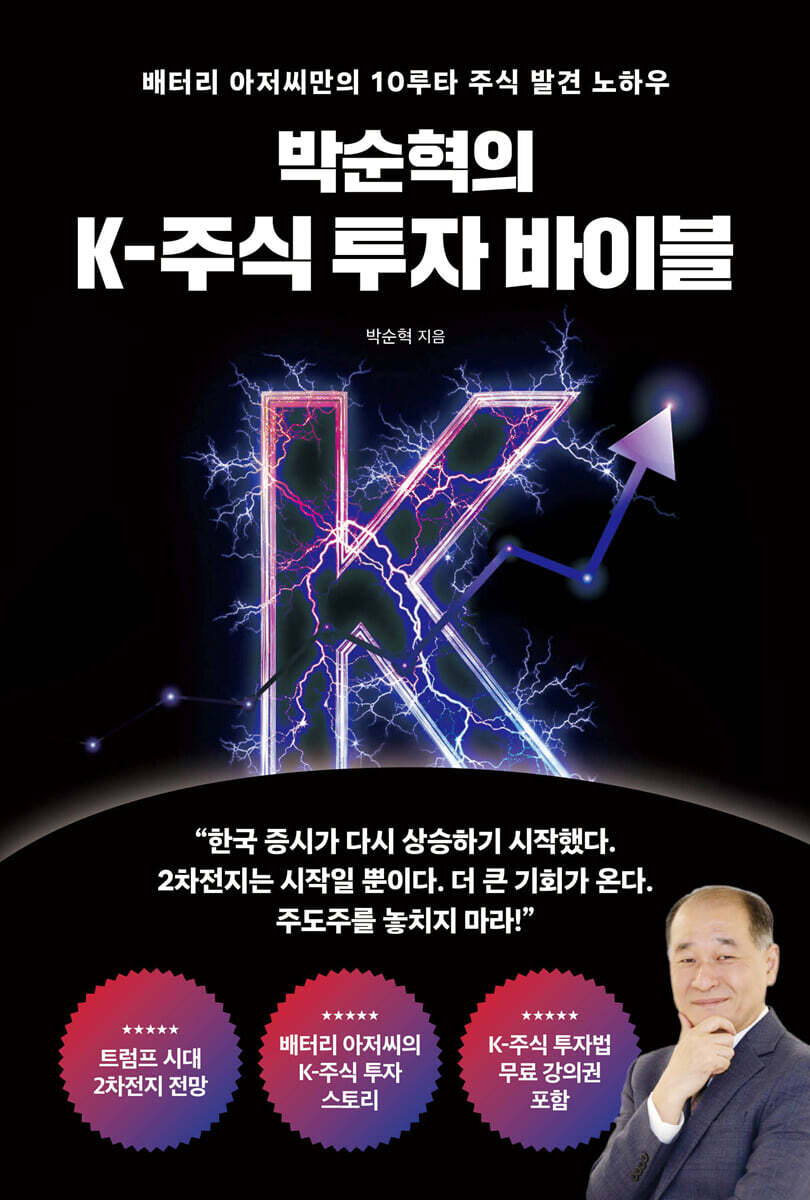 |
Description
Book Introduction
“Key stocks that will lead the future of the Korean stock market
“If you know secondary batteries, you can see the market trends!”
From K-battery industry and company analysis to practical investment
All the essential information on 'K-stock investment' is included in this one book!
Leaders always appear at turning points of the times.
In 2007, when Apple's iPhone sparked a global 'smartphone revolution,' the stocks of companies at the forefront of the mobile revolution rose dozens or even hundreds of times, becoming leading stocks in global stock markets.
But there is a stock market adage that says, 'There is no tree that grows forever.'
If the global economic growth of the 2010s was driven by big tech companies, fueled by the mobile revolution, what new industry will drive global economic growth in the next decade, the 2020s? It's the "secondary battery industry," fueled by the "electric vehicle revolution."
"Park Soon-hyeok's K-Stock Investment Bible" is a book that, as the title suggests, is like a "stock investment bible" as it gathers together the core information of "K-stock investment" from K-battery industry and corporate analysis to actual investment by the author, who has been active as an analyst in the Yeouido securities market for over 30 years and is an outstanding expert in industry and corporate analysis.
The text is largely divided into two parts.
Part 1, "The Past, Present, and Future of K-Stocks," presents the author's fascinating story of investing in K-stocks, which has accompanied the growth of the Korean stock market.
As the saying goes, "The past is an old future," by properly understanding the history and characteristics of the Korean stock market, you will be able to foresee the future of the market with greater clarity, as it gains new momentum.
In addition, Part 1 details the technologies and investment points of key companies in the K-battery industry, living up to the reputation of the nickname “Battery Uncle.”
In the book, the author predicts that K-battery companies will lead the secondary battery industry, which will drive the future global stock market, based on their outstanding technological prowess.
By building a portfolio centered on the author's "Battery Man's 9 Stocks," maintaining a long-term perspective and participating in the growth of Korean industry, individual investors can achieve optimal results that outperform the market.
Part 2, "The Essentials of K-Stock Investment," covers only the core of the two pillars of stock investment: "fundamental analysis" and "technical analysis (chart analysis)."
The author first warns that while approaching individual stocks might yield a few lucky profits, it's impossible to maintain the myth of success in the long term. He then goes on to detail the principles and know-how of "portfolio investing."
In addition, it teaches you how to properly understand documents essential for value investing, such as how to read a company's financial statements and analyst reports.
Up to this point, this is the 'fundamental analysis' method.
In addition to fundamental analysis methods, the author also covers technical analysis, commonly referred to as chart analysis.
The key is to be clear about your goals when investing in stocks, whether through fundamental or technical analysis, and avoid the foolish mistake of mixing the two and wandering between "investment and speculation."
The market is showing signs of a rebound in the secondary battery industry in the second half of 2025, driven by recent rebounds in global lithium prices and rising demand for energy storage systems (ESS).
Additionally, with the KOSPI index breaking through the 3,000 mark, the Korean stock market as a whole is entering a new phase.
If you broaden your understanding of future key leaders with "Park Soon-hyeok's K-Stock Investment Bible," written by an expert in the "K-Battery Industry," at this opportune time for investment, you will undoubtedly emerge as a successful investor.
“If you know secondary batteries, you can see the market trends!”
From K-battery industry and company analysis to practical investment
All the essential information on 'K-stock investment' is included in this one book!
Leaders always appear at turning points of the times.
In 2007, when Apple's iPhone sparked a global 'smartphone revolution,' the stocks of companies at the forefront of the mobile revolution rose dozens or even hundreds of times, becoming leading stocks in global stock markets.
But there is a stock market adage that says, 'There is no tree that grows forever.'
If the global economic growth of the 2010s was driven by big tech companies, fueled by the mobile revolution, what new industry will drive global economic growth in the next decade, the 2020s? It's the "secondary battery industry," fueled by the "electric vehicle revolution."
"Park Soon-hyeok's K-Stock Investment Bible" is a book that, as the title suggests, is like a "stock investment bible" as it gathers together the core information of "K-stock investment" from K-battery industry and corporate analysis to actual investment by the author, who has been active as an analyst in the Yeouido securities market for over 30 years and is an outstanding expert in industry and corporate analysis.
The text is largely divided into two parts.
Part 1, "The Past, Present, and Future of K-Stocks," presents the author's fascinating story of investing in K-stocks, which has accompanied the growth of the Korean stock market.
As the saying goes, "The past is an old future," by properly understanding the history and characteristics of the Korean stock market, you will be able to foresee the future of the market with greater clarity, as it gains new momentum.
In addition, Part 1 details the technologies and investment points of key companies in the K-battery industry, living up to the reputation of the nickname “Battery Uncle.”
In the book, the author predicts that K-battery companies will lead the secondary battery industry, which will drive the future global stock market, based on their outstanding technological prowess.
By building a portfolio centered on the author's "Battery Man's 9 Stocks," maintaining a long-term perspective and participating in the growth of Korean industry, individual investors can achieve optimal results that outperform the market.
Part 2, "The Essentials of K-Stock Investment," covers only the core of the two pillars of stock investment: "fundamental analysis" and "technical analysis (chart analysis)."
The author first warns that while approaching individual stocks might yield a few lucky profits, it's impossible to maintain the myth of success in the long term. He then goes on to detail the principles and know-how of "portfolio investing."
In addition, it teaches you how to properly understand documents essential for value investing, such as how to read a company's financial statements and analyst reports.
Up to this point, this is the 'fundamental analysis' method.
In addition to fundamental analysis methods, the author also covers technical analysis, commonly referred to as chart analysis.
The key is to be clear about your goals when investing in stocks, whether through fundamental or technical analysis, and avoid the foolish mistake of mixing the two and wandering between "investment and speculation."
The market is showing signs of a rebound in the secondary battery industry in the second half of 2025, driven by recent rebounds in global lithium prices and rising demand for energy storage systems (ESS).
Additionally, with the KOSPI index breaking through the 3,000 mark, the Korean stock market as a whole is entering a new phase.
If you broaden your understanding of future key leaders with "Park Soon-hyeok's K-Stock Investment Bible," written by an expert in the "K-Battery Industry," at this opportune time for investment, you will undoubtedly emerge as a successful investor.
- You can preview some of the book's contents.
Preview
index
Part 1: The Past, Present, and Future of K-Stocks
Chapter 1: My K-Stock Investment Story
· Aspiring Stock Investors Become Analysts: A History of the Korean Stock Market from the 1980s to the 2000s
Witnessing the Turning Points of Global Stock Markets: A History of the Korean Stock Market in the 2000s and 2010s
· The fame and hardships of being the "Battery Man" come together.
Secondary batteries face their first upward rally
Secondary batteries are experiencing a second upward rally.
· Helping level the tilted short selling playing field.
Chapter 2: The Future of the Korean Stock Market and Industry: Everything You Need to Know About K-Battery Investment
· Why I talked about the 9 major sports
· LG Energy Solution and LG Chem, the world's leading battery manufacturers
· EcoPro BM and EcoPro, the world's leading cathode material manufacturers
· POSCO Holdings and POSCO FutureM, the world's leading lithium development companies
· Achieving Global Competitiveness with Premium Technology: SK Innovation and Samsung SDI
· A leader in nanotechnology, the next-generation battery technology: nanomaterials
· How can we overcome the electric vehicle chasm?
· The impact of Trump's second term on K-batteries
· Perspectives on secondary batteries: What remains the same and what has changed?
Part 2: The Basics of K-Stock Investment
Chapter 3: Optimizing K-Stock Portfolios
· Why you need a portfolio that survives in the market
· Things to consider before building a portfolio
· Stocks to include in the K-stock optimized portfolio
· How should I adjust my portfolio?
Chapter 4: K-Stocks: Understanding Financial Statements First
· Financial statement principles that even beginners can understand
· Financial statements: where and how can I view them?
· A balance sheet that shows money and what can be made into money
· Income statement showing how much was earned during the year
· Cash flow statement showing how money actually flows in and out
· Utilizing Naver Pay Securities' 'Corporate Performance Analysis'
· K-stocks shouldn't be viewed solely through financial statements.
Chapter 5: The Core Fundamentals of Corporate Analysis Essential for K-Stock Investment
· Why K-Stock Analyst Reports Are So Reliable
· What you can discard from analyst reports
· Must-read content from analyst reports
· A list of materials you need to gather for successful stock investment
Chapter 6: The Core Principles of Technical Analysis Essential for K-Stock Investment
· Principles of technical analysis that even beginners can understand
· Core Principle 1: Trends Underlying Technical Analysis
· Core Principle 2: Thinking about Capital
· Core Principle 3: Water-Curved Waves
· Technical analysis is ultimately about understanding psychology.
· Battery Man's technical analysis know-how and cash holdings
Chapter 1: My K-Stock Investment Story
· Aspiring Stock Investors Become Analysts: A History of the Korean Stock Market from the 1980s to the 2000s
Witnessing the Turning Points of Global Stock Markets: A History of the Korean Stock Market in the 2000s and 2010s
· The fame and hardships of being the "Battery Man" come together.
Secondary batteries face their first upward rally
Secondary batteries are experiencing a second upward rally.
· Helping level the tilted short selling playing field.
Chapter 2: The Future of the Korean Stock Market and Industry: Everything You Need to Know About K-Battery Investment
· Why I talked about the 9 major sports
· LG Energy Solution and LG Chem, the world's leading battery manufacturers
· EcoPro BM and EcoPro, the world's leading cathode material manufacturers
· POSCO Holdings and POSCO FutureM, the world's leading lithium development companies
· Achieving Global Competitiveness with Premium Technology: SK Innovation and Samsung SDI
· A leader in nanotechnology, the next-generation battery technology: nanomaterials
· How can we overcome the electric vehicle chasm?
· The impact of Trump's second term on K-batteries
· Perspectives on secondary batteries: What remains the same and what has changed?
Part 2: The Basics of K-Stock Investment
Chapter 3: Optimizing K-Stock Portfolios
· Why you need a portfolio that survives in the market
· Things to consider before building a portfolio
· Stocks to include in the K-stock optimized portfolio
· How should I adjust my portfolio?
Chapter 4: K-Stocks: Understanding Financial Statements First
· Financial statement principles that even beginners can understand
· Financial statements: where and how can I view them?
· A balance sheet that shows money and what can be made into money
· Income statement showing how much was earned during the year
· Cash flow statement showing how money actually flows in and out
· Utilizing Naver Pay Securities' 'Corporate Performance Analysis'
· K-stocks shouldn't be viewed solely through financial statements.
Chapter 5: The Core Fundamentals of Corporate Analysis Essential for K-Stock Investment
· Why K-Stock Analyst Reports Are So Reliable
· What you can discard from analyst reports
· Must-read content from analyst reports
· A list of materials you need to gather for successful stock investment
Chapter 6: The Core Principles of Technical Analysis Essential for K-Stock Investment
· Principles of technical analysis that even beginners can understand
· Core Principle 1: Trends Underlying Technical Analysis
· Core Principle 2: Thinking about Capital
· Core Principle 3: Water-Curved Waves
· Technical analysis is ultimately about understanding psychology.
· Battery Man's technical analysis know-how and cash holdings
Detailed image

Into the book
If the global economic growth of the 2010s was driven by big tech companies, fueled by the mobile revolution, what new industry will drive global economic growth in the next decade, the 2020s? I believe it's the "secondary battery industry," fueled by the "electric vehicle revolution."
Even today, the industry that forms the largest market for a single consumer good is the automobile industry.
The industry with the largest international trade volume is also the automobile industry.
However, in the next 10 to 15 years, around 2035 to 2040, all of these cars are expected to be replaced by electric vehicles from existing internal combustion engine vehicles.
--- From "Why I Talked About the 9 Major Sports"
Who is the world's best battery company? It's LG Energy Solution, hands down.
(…) Battery manufacturing is a precision chemical industry.
Precision chemistry is a typical analog technology industry, a typical "experience industry" where technological prowess is accumulated step by step through countless trials and errors.
This means that karma becomes the most important competitive advantage.
LG Energy Solution has been in the battery manufacturing industry longer than any of its competitors, and despite facing various crises, it has continued to invest and invest in R&D, resulting in becoming the world's most competitive battery manufacturer.
--- From "'The World's Best Battery Manufacturers: LG Energy Solution and LG Chem'"
The heart of an electric vehicle is the battery.
So what's the heart of a battery? It's the cathode material.
Among these cathode materials companies, which one is the world's best? It's EcoPro BM.
In the Yeouido financial district, the four major materials for secondary batteries are presented as 'positive electrode material, negative electrode material, electrolyte, and separator', and it is said that these four are equally important.
But that's not the case at all.
Among secondary battery materials, the key material that determines battery performance is the cathode material.
Cathode materials are an overwhelmingly important material, accounting for nearly 50% of battery manufacturing costs.
Moreover, the production of superior cathode materials requires enormous technological expertise and barriers to entry comparable to those required to produce the unique colors of Goryeo celadon.
Therefore, it is wrong to compare cathode materials with other materials on the same level.
It is more correct to view it as ‘positive electrode materials and other materials’ rather than the four major secondary battery materials.
--- From "EcoPro BM and EcoPro, the world's best cathode material manufacturers"
The battery industry is resource dependent.
No matter how excellent the technology is, if you cannot secure the various mineral resources that go into making batteries, such as lithium, nickel, cobalt, manganese, and graphite, you cannot produce the product.
Then even great skills become useless.
China, which is well aware of this, has been trying to monopolize the world's mineral resources since the days of Deng Xiaoping when developed countries were reluctant to mine and refine minerals due to environmental pollution issues.
(…) Manufacturing secondary batteries requires mining and refining of a large number of mineral resources.
In the battery industry, South Korea has secured cathode material manufacturing technology and battery manufacturing technology that are far superior to those of China.
However, it is true that we are far behind in mining and refining mineral resources.
Therefore, securing this is of utmost importance to the Korean battery industry, and POSCO Holdings is a company that has established a unique position in this field.
--- From "POSCO Holdings and POSCO Future M, the World's Best Lithium Development Companies"
Now, global battery companies are jumping into the race to develop 46-pi cylindrical batteries.
Not only South Korea's four battery companies, LG, Samsung, Kumyang, and SK, but also Japan's Panasonic, China's CATL, and EVE Energy have announced plans to develop 46-pi cylindrical batteries.
However, the 46-pie cylindrical battery is a product with a very high technological barrier, so most battery companies are having difficulty completing its development.
Ultimately, the key is who will complete the development of the 46-pie cylindrical battery the fastest and begin mass production.
And the companies leading the way in this competition are Samsung SDI and LG Energy Solution.
--- From "Achieving Global Competitiveness with Special Technology: SK Innovation and Samsung SDI"
Excessive volatility makes it difficult to make rational decisions by causing people's psychology to fluctuate to extremes.
However, volatility cannot be avoided when investing.
Therefore, to maintain peace of mind and maintain rational judgment while investing, it is necessary to manage volatility.
For this reason, it is necessary to construct a portfolio and invest in it as a unit.
--- From "Why You Need a Portfolio to Survive the Market"
Financial statements are inherently backward-looking and conservative, often omitting information that is truly important for actual investment.
For example, key information such as the manager's management ability, the company's unique technological prowess, brand power, and economic moat are not revealed in the financial statements due to the nature of financial statements that "value reliability and emphasize conservatism."
This is also why simply having excellent financial indicators listed on financial statements does not necessarily mean that a company is a good company or that it will lead to excellent investment performance.
This is precisely why you should not become a "financial statement nerd" who judges investment companies solely by analyzing their financial statements.
--- From "Financial Statement Principles Even Beginners Can Understand"
Analyst reports are a treasure trove of information.
In particular, the in-depth reports published by analysts once or twice a year are a truly valuable source of information, containing a tremendous amount of effort and sincerity.
If you fail to utilize this properly and end up only looking at the useless conclusions of 'target stock price, investment opinions, and analyst performance estimates,' it would be a truly enormous waste of resources.
When reading analyst reports, you must develop the ability to properly acquire, understand, critically analyze, and utilize the information contained within.
If not, and you just habitually read the conclusion and move on, it would be worse than not reading at all.
It's a universal truth that the results are proportional to the effort put in. It's good to keep in mind that this same truth applies to reading analyst reports.
--- From "List of Materials to Collect for Successful Stock Investment"
The three core principles that permeate technical analysis ultimately relate to the human mind.
A trend arises from the desire to 'burn more when you earn, and quit when you lose.'
In 'Useless Obsession with the Principal', techniques for analyzing moving averages, support and resistance, and selling price are developed.
The principle of a polar opposite applies to the stock market because of the 'mind that goes back and forth between fear and greed'.
Ultimately, technical analysis is about exploring recurring phenomena created by the monster called the human mind.
So, in the end, investing is a matter of the mind.
Even today, the industry that forms the largest market for a single consumer good is the automobile industry.
The industry with the largest international trade volume is also the automobile industry.
However, in the next 10 to 15 years, around 2035 to 2040, all of these cars are expected to be replaced by electric vehicles from existing internal combustion engine vehicles.
--- From "Why I Talked About the 9 Major Sports"
Who is the world's best battery company? It's LG Energy Solution, hands down.
(…) Battery manufacturing is a precision chemical industry.
Precision chemistry is a typical analog technology industry, a typical "experience industry" where technological prowess is accumulated step by step through countless trials and errors.
This means that karma becomes the most important competitive advantage.
LG Energy Solution has been in the battery manufacturing industry longer than any of its competitors, and despite facing various crises, it has continued to invest and invest in R&D, resulting in becoming the world's most competitive battery manufacturer.
--- From "'The World's Best Battery Manufacturers: LG Energy Solution and LG Chem'"
The heart of an electric vehicle is the battery.
So what's the heart of a battery? It's the cathode material.
Among these cathode materials companies, which one is the world's best? It's EcoPro BM.
In the Yeouido financial district, the four major materials for secondary batteries are presented as 'positive electrode material, negative electrode material, electrolyte, and separator', and it is said that these four are equally important.
But that's not the case at all.
Among secondary battery materials, the key material that determines battery performance is the cathode material.
Cathode materials are an overwhelmingly important material, accounting for nearly 50% of battery manufacturing costs.
Moreover, the production of superior cathode materials requires enormous technological expertise and barriers to entry comparable to those required to produce the unique colors of Goryeo celadon.
Therefore, it is wrong to compare cathode materials with other materials on the same level.
It is more correct to view it as ‘positive electrode materials and other materials’ rather than the four major secondary battery materials.
--- From "EcoPro BM and EcoPro, the world's best cathode material manufacturers"
The battery industry is resource dependent.
No matter how excellent the technology is, if you cannot secure the various mineral resources that go into making batteries, such as lithium, nickel, cobalt, manganese, and graphite, you cannot produce the product.
Then even great skills become useless.
China, which is well aware of this, has been trying to monopolize the world's mineral resources since the days of Deng Xiaoping when developed countries were reluctant to mine and refine minerals due to environmental pollution issues.
(…) Manufacturing secondary batteries requires mining and refining of a large number of mineral resources.
In the battery industry, South Korea has secured cathode material manufacturing technology and battery manufacturing technology that are far superior to those of China.
However, it is true that we are far behind in mining and refining mineral resources.
Therefore, securing this is of utmost importance to the Korean battery industry, and POSCO Holdings is a company that has established a unique position in this field.
--- From "POSCO Holdings and POSCO Future M, the World's Best Lithium Development Companies"
Now, global battery companies are jumping into the race to develop 46-pi cylindrical batteries.
Not only South Korea's four battery companies, LG, Samsung, Kumyang, and SK, but also Japan's Panasonic, China's CATL, and EVE Energy have announced plans to develop 46-pi cylindrical batteries.
However, the 46-pie cylindrical battery is a product with a very high technological barrier, so most battery companies are having difficulty completing its development.
Ultimately, the key is who will complete the development of the 46-pie cylindrical battery the fastest and begin mass production.
And the companies leading the way in this competition are Samsung SDI and LG Energy Solution.
--- From "Achieving Global Competitiveness with Special Technology: SK Innovation and Samsung SDI"
Excessive volatility makes it difficult to make rational decisions by causing people's psychology to fluctuate to extremes.
However, volatility cannot be avoided when investing.
Therefore, to maintain peace of mind and maintain rational judgment while investing, it is necessary to manage volatility.
For this reason, it is necessary to construct a portfolio and invest in it as a unit.
--- From "Why You Need a Portfolio to Survive the Market"
Financial statements are inherently backward-looking and conservative, often omitting information that is truly important for actual investment.
For example, key information such as the manager's management ability, the company's unique technological prowess, brand power, and economic moat are not revealed in the financial statements due to the nature of financial statements that "value reliability and emphasize conservatism."
This is also why simply having excellent financial indicators listed on financial statements does not necessarily mean that a company is a good company or that it will lead to excellent investment performance.
This is precisely why you should not become a "financial statement nerd" who judges investment companies solely by analyzing their financial statements.
--- From "Financial Statement Principles Even Beginners Can Understand"
Analyst reports are a treasure trove of information.
In particular, the in-depth reports published by analysts once or twice a year are a truly valuable source of information, containing a tremendous amount of effort and sincerity.
If you fail to utilize this properly and end up only looking at the useless conclusions of 'target stock price, investment opinions, and analyst performance estimates,' it would be a truly enormous waste of resources.
When reading analyst reports, you must develop the ability to properly acquire, understand, critically analyze, and utilize the information contained within.
If not, and you just habitually read the conclusion and move on, it would be worse than not reading at all.
It's a universal truth that the results are proportional to the effort put in. It's good to keep in mind that this same truth applies to reading analyst reports.
--- From "List of Materials to Collect for Successful Stock Investment"
The three core principles that permeate technical analysis ultimately relate to the human mind.
A trend arises from the desire to 'burn more when you earn, and quit when you lose.'
In 'Useless Obsession with the Principal', techniques for analyzing moving averages, support and resistance, and selling price are developed.
The principle of a polar opposite applies to the stock market because of the 'mind that goes back and forth between fear and greed'.
Ultimately, technical analysis is about exploring recurring phenomena created by the monster called the human mind.
So, in the end, investing is a matter of the mind.
--- From "'Technical analysis is ultimately about understanding psychology'"
Publisher's Review
Discovering 10-Bit Stocks from Korea's Leading K-Battery Industry Expert
“Secondary batteries are just the beginning; even greater opportunities lie ahead!”
In 2023, there was one person who heated up the South Korean stock market: author Park Soon-hyeok, better known by the nickname "Battery Uncle."
Throughout the first half of 2023, major secondary battery stocks in South Korea, centered around the "Battery Man's 8 Stocks" he recommended, enjoyed a daily upward rally.
In particular, the stock price of Ecopro rose by a whopping 15 times from 100,000 won to 1.5 million won in 2023 alone. However, about a year ago, in the summer of 2022, when the stock price of Ecopro was 60,000 won, author Park Soon-hyeok had already predicted, “This stock is so undervalued that it can go up 30 times.”
"Park Soon-hyeok's K-Stock Investment Bible" is a book that is like a "K-Stock Investment Classic" written by the author, who is recognized as Korea's best K-battery expert, who predicted the growth potential of the Korean secondary battery industry faster and more accurately than anyone else, and spared no expense in covering everything about K-stock investment, from the future outlook of the K-battery industry to analysis of related companies and actual investments.
The author, who has worked as an analyst, PB, and head of an investment advisory firm's operations department for over 30 years and has been at the heart of the Yeouido financial district, has been a part of the growth of the Korean stock market. With his unique insight, he predicts that K-battery companies will lead the market in the secondary battery industry, which will drive the future global stock market, based on their overwhelmingly superior technological prowess.
“China’s electric vehicle penetration rate is expected to exceed 55% by 2024 and is moving towards the 60% range.
This story means that the growth of Chinese batteries through monopolization of the Chinese domestic market is not far off.
There is zero chance that Chinese batteries will enter the US, which will be the largest market in the future.
So, while Chinese batteries are turning their attention to Europe, China's defeat in the competition with K-batteries is practically a foregone conclusion due to Trump's restraint and a lack of technological prowess and competitiveness.
So, what lies ahead is K-batteries dominating the global market and a bright future for K-batteries through this.
If the semiconductor industry, centered around Samsung Electronics, has sustained South Korea since the early 2000s, there is no doubt that the K-battery industry will sustain South Korea from now until 2040.
“I have no doubt that if you build your portfolio around the ‘Battery Man’s 9 Major Stocks’ and join the growth of Korean industry for the long term, you will be participating in patriotism, and second, it will be a wise decision that will significantly change your future.” (Excerpt from the text)
Let's focus on K-battery companies with global competitiveness and top-tier technology.
"Don't miss out on the key stocks that will drive the Korean stock market, which is entering a new phase of momentum!"
This book is largely divided into two parts.
Part 1 is divided into two chapters. Chapter 1 closely examines the changes in the Korean stock market, focusing on the most important scenes that served as turning points in the history of the Korean stock market.
In addition, the author's life as an analyst, which has accompanied the growth of the Korean stock market, is explained by linking it to the trends of the Korean economy, especially the stock market.
As the saying goes, “The past is an old future,” in order to have a vision for the future, it is important to first understand the history of the past.
By understanding how the Korean financial and stock markets have cycled through booms and busts since 1980, when the concept of "value investing" didn't even exist, and how the Korean stock market has been influenced by global economic trends, you will be able to gain insight into how to invest in the future.
In particular, contents such as “Historically, when people fell into fear and panic, the stock market fell significantly, and in most cases, a bull market followed” (pp. 29-30) and “The reason I expected EcoPro to rise significantly was because it had the ideal combination of ‘low PER + high growth’” (p. 55) are valuable pieces of advice that demonstrate the author’s insight into investment.
Chapter 1 also details, in dramatic detail, the author's prediction of a bull market for secondary battery stocks in 2022, the subsequent realization of that prediction, the trials and tribulations he faced as a result, and his influence on reforming the short-selling system.
Chapter 2 is where the author's expertise as an expert in the 'K-battery industry' shines.
The automobile industry currently constitutes the largest single consumer goods market and has the largest international trade volume.
The automobile industry is expected to transition from existing internal combustion engine vehicles to electric vehicles around 2035-2040, 10-15 years from now.
This 'electric vehicle revolution' is an irreversible trend, judging by various statistics and policies of each country.
And the 'secondary battery industry' is a key future industry that will most directly benefit from the electric vehicle revolution and lead the way.
The author predicts that K-battery companies will lead the global secondary battery industry ecosystem with their overwhelming technological prowess. Among them, he selects nine companies with overwhelming growth potential and recommends them as the "Battery Man's Top 9 Stocks."
In addition, the core technologies and investment points of these companies are conveyed in an easily understandable manner tailored to investors' perspectives.
★ Battery Man's 9 Major Items ★
Battery manufacturers: LG Energy Solution, SK Innovation, Samsung SDI
· Cathode material manufacturers: EcoPro BM, LG Chem, POSCO Future M
· Resource companies: POSCO Holdings, Ecopro
· Cathode material company: Nano New Materials
The secondary battery industry, which achieved rapid growth through two remarkable upward rallies in 2023, encountered a "chasm" (temporary stagnation in demand) in 2024, resulting in temporary deterioration in performance and falling stock prices.
However, electric vehicle manufacturers, battery manufacturers, and governments around the world are currently working hard to overcome the chasm.
For example, electric vehicle manufacturers are dedicated to creating new customer demand by releasing electric vehicle lineups that significantly improve cost-effectiveness, marketability, and charging convenience.
According to the author, “electric vehicles now account for more than 50% of new car models released each year.
This ratio will continue to increase over the years, and eventually, a time will come when only electric vehicles will be released.
This period is projected to be around 2035-2040, at which point consumers will no longer be able to purchase internal combustion engine vehicles even if they want to.
In short, overcoming the electric vehicle chasm is a set process and is only a matter of time.
In addition, with the inauguration of the second Trump administration, China's entry into the North American market was completely blocked, opening the way for the K-battery industry to maintain a monopoly in the US market in the long term.
In other words, the author firmly believes that, in the long run, K-battery companies will overcome the current chasm and welcome a bright future through new, ultra-gap products.
30 years of analyst experience! The secret to beating the market lies in principles and fundamentals.
“Don't be swayed by the immediate stock price. Instead, look at a company's valuation from a long-term perspective!”
While Part 1 contained a detailed, pinpoint analysis and future outlook on the 'K-battery industry,' Part 2 broadens the scope a bit more comprehensively, covering knowledge encompassing the entire spectrum of 'K-stock investment.'
In other words, it provides essential investment information to become a successful stock investor: portfolio construction strategies (Chapter 3), how to read a company's financial statements (Chapter 4), how to read analyst reports (Chapter 5), and the core principles of technical analysis (Chapter 6).
According to the author, volatility interferes with rational judgment by causing people's psychology to fluctuate to extremes.
However, it is impossible to avoid volatility when investing.
Portfolio investing, which involves combining multiple stocks or financial assets into a single package, is the optimal investment method for managing volatility.
Chapter 3 explains in detail the appropriate number of stocks to include in portfolio asset allocation, how to allocate weight to each stock, and the tricks of changing and adjusting the portfolio.
To be successful in stock investing, you must invest in 'great companies that are undervalued but have excellent growth potential.'
Valuation, which identifies '10-bagger stocks', is the most important process in stock investment.
Knowing how to read financial statements, which are documents intended to provide information about a company to various stakeholders outside the company, will help you understand basic information about the company you're considering investing in.
However, according to the author, when investing in stocks, you don't need to know all the numbers on the financial statements.
Chapter 4 explains the most efficient way to read the "balance sheet, income statement, and cash flow statement," which contain the core information essential for stock investment.
We also provide guidance on how to utilize the 'Corporate Performance Analysis' of 'Naver Pay Securities', which is most frequently used by Korean investors.
However, the author warns that in order to find a "great company with outstanding growth potential," one should never just look at financial statements; one must also be able to understand the "qualitative information" of a company that cannot be quantified.
Analyst reports are a valuable source of qualitative information about these companies.
Chapter 5 introduces the essential information that must be referenced in analyst reports, which are reports of corporate information, the information that must be discarded, and the data that must be extracted and kept.
This will help you develop the ability to critically analyze and utilize the contents of analyst reports without blindly believing them.
Rather than simply listing theoretical stories, the text is structured in a way that readers can learn how to read analyst reports and gain a deeper understanding of the secondary battery market by providing examples of actual analyst reports analyzing the secondary battery market.
Chapter 6, the final chapter of the book, covers the core principles of "technical analysis," commonly referred to as "chart analysis."
Unlike fundamental analysis, which analyzes a company's fundamentals and the industry in which it operates, technical analysis is primarily used to predict stock price movements by analyzing stock charts and determine short-term trading timing.
The beauty of this book is that it doesn't simply teach you how to read charts; it also touches on the core principles that underpin technical analysis.
According to the author, there are recurring patterns in stock price movements, which are rooted in human psychology.
In other words, the desire to 'burn more when you earn and quit when you lose' creates trends, and the 'obsession with capital' creates techniques for analyzing moving averages, support and resistance, and selling prices.
Also, the principle of a polar opposite applies to the stock market due to the 'mind that goes back and forth between fear and greed'.
Ultimately, according to the author, technical analysis is essentially about exploring psychological phenomena created by the human mind.
That is why investing is a matter of the mind.
The author advises that one should keep in mind that technical analysis is a probabilistic method, but it does not guarantee a probability close to 100%.
In other words, he emphasizes that various indicators of technical analysis are only auxiliary indicators that tell us when others are panicking and when they are greedy, and should never be used as tools to predict the future of stock prices, and that the most important thing when investing in stocks is still 'finding great companies.'
By the end of the book, you'll begin to realize that stock investing isn't just a "numbers game," but rather a highly advanced mental discipline, akin to a kind of "mental training."
"Park Soon-hyeok's K-Stock Investment Bible" is packed with information on the past, present, and future of K-stocks, as well as a solid foundation in the fundamentals and philosophy of stock investment.
If you carefully digest the contents of this book, internalize them one by one, and invest in future blue chip stocks with a long-term perspective, you will undoubtedly achieve market-beating results.
“Secondary batteries are just the beginning; even greater opportunities lie ahead!”
In 2023, there was one person who heated up the South Korean stock market: author Park Soon-hyeok, better known by the nickname "Battery Uncle."
Throughout the first half of 2023, major secondary battery stocks in South Korea, centered around the "Battery Man's 8 Stocks" he recommended, enjoyed a daily upward rally.
In particular, the stock price of Ecopro rose by a whopping 15 times from 100,000 won to 1.5 million won in 2023 alone. However, about a year ago, in the summer of 2022, when the stock price of Ecopro was 60,000 won, author Park Soon-hyeok had already predicted, “This stock is so undervalued that it can go up 30 times.”
"Park Soon-hyeok's K-Stock Investment Bible" is a book that is like a "K-Stock Investment Classic" written by the author, who is recognized as Korea's best K-battery expert, who predicted the growth potential of the Korean secondary battery industry faster and more accurately than anyone else, and spared no expense in covering everything about K-stock investment, from the future outlook of the K-battery industry to analysis of related companies and actual investments.
The author, who has worked as an analyst, PB, and head of an investment advisory firm's operations department for over 30 years and has been at the heart of the Yeouido financial district, has been a part of the growth of the Korean stock market. With his unique insight, he predicts that K-battery companies will lead the market in the secondary battery industry, which will drive the future global stock market, based on their overwhelmingly superior technological prowess.
“China’s electric vehicle penetration rate is expected to exceed 55% by 2024 and is moving towards the 60% range.
This story means that the growth of Chinese batteries through monopolization of the Chinese domestic market is not far off.
There is zero chance that Chinese batteries will enter the US, which will be the largest market in the future.
So, while Chinese batteries are turning their attention to Europe, China's defeat in the competition with K-batteries is practically a foregone conclusion due to Trump's restraint and a lack of technological prowess and competitiveness.
So, what lies ahead is K-batteries dominating the global market and a bright future for K-batteries through this.
If the semiconductor industry, centered around Samsung Electronics, has sustained South Korea since the early 2000s, there is no doubt that the K-battery industry will sustain South Korea from now until 2040.
“I have no doubt that if you build your portfolio around the ‘Battery Man’s 9 Major Stocks’ and join the growth of Korean industry for the long term, you will be participating in patriotism, and second, it will be a wise decision that will significantly change your future.” (Excerpt from the text)
Let's focus on K-battery companies with global competitiveness and top-tier technology.
"Don't miss out on the key stocks that will drive the Korean stock market, which is entering a new phase of momentum!"
This book is largely divided into two parts.
Part 1 is divided into two chapters. Chapter 1 closely examines the changes in the Korean stock market, focusing on the most important scenes that served as turning points in the history of the Korean stock market.
In addition, the author's life as an analyst, which has accompanied the growth of the Korean stock market, is explained by linking it to the trends of the Korean economy, especially the stock market.
As the saying goes, “The past is an old future,” in order to have a vision for the future, it is important to first understand the history of the past.
By understanding how the Korean financial and stock markets have cycled through booms and busts since 1980, when the concept of "value investing" didn't even exist, and how the Korean stock market has been influenced by global economic trends, you will be able to gain insight into how to invest in the future.
In particular, contents such as “Historically, when people fell into fear and panic, the stock market fell significantly, and in most cases, a bull market followed” (pp. 29-30) and “The reason I expected EcoPro to rise significantly was because it had the ideal combination of ‘low PER + high growth’” (p. 55) are valuable pieces of advice that demonstrate the author’s insight into investment.
Chapter 1 also details, in dramatic detail, the author's prediction of a bull market for secondary battery stocks in 2022, the subsequent realization of that prediction, the trials and tribulations he faced as a result, and his influence on reforming the short-selling system.
Chapter 2 is where the author's expertise as an expert in the 'K-battery industry' shines.
The automobile industry currently constitutes the largest single consumer goods market and has the largest international trade volume.
The automobile industry is expected to transition from existing internal combustion engine vehicles to electric vehicles around 2035-2040, 10-15 years from now.
This 'electric vehicle revolution' is an irreversible trend, judging by various statistics and policies of each country.
And the 'secondary battery industry' is a key future industry that will most directly benefit from the electric vehicle revolution and lead the way.
The author predicts that K-battery companies will lead the global secondary battery industry ecosystem with their overwhelming technological prowess. Among them, he selects nine companies with overwhelming growth potential and recommends them as the "Battery Man's Top 9 Stocks."
In addition, the core technologies and investment points of these companies are conveyed in an easily understandable manner tailored to investors' perspectives.
★ Battery Man's 9 Major Items ★
Battery manufacturers: LG Energy Solution, SK Innovation, Samsung SDI
· Cathode material manufacturers: EcoPro BM, LG Chem, POSCO Future M
· Resource companies: POSCO Holdings, Ecopro
· Cathode material company: Nano New Materials
The secondary battery industry, which achieved rapid growth through two remarkable upward rallies in 2023, encountered a "chasm" (temporary stagnation in demand) in 2024, resulting in temporary deterioration in performance and falling stock prices.
However, electric vehicle manufacturers, battery manufacturers, and governments around the world are currently working hard to overcome the chasm.
For example, electric vehicle manufacturers are dedicated to creating new customer demand by releasing electric vehicle lineups that significantly improve cost-effectiveness, marketability, and charging convenience.
According to the author, “electric vehicles now account for more than 50% of new car models released each year.
This ratio will continue to increase over the years, and eventually, a time will come when only electric vehicles will be released.
This period is projected to be around 2035-2040, at which point consumers will no longer be able to purchase internal combustion engine vehicles even if they want to.
In short, overcoming the electric vehicle chasm is a set process and is only a matter of time.
In addition, with the inauguration of the second Trump administration, China's entry into the North American market was completely blocked, opening the way for the K-battery industry to maintain a monopoly in the US market in the long term.
In other words, the author firmly believes that, in the long run, K-battery companies will overcome the current chasm and welcome a bright future through new, ultra-gap products.
30 years of analyst experience! The secret to beating the market lies in principles and fundamentals.
“Don't be swayed by the immediate stock price. Instead, look at a company's valuation from a long-term perspective!”
While Part 1 contained a detailed, pinpoint analysis and future outlook on the 'K-battery industry,' Part 2 broadens the scope a bit more comprehensively, covering knowledge encompassing the entire spectrum of 'K-stock investment.'
In other words, it provides essential investment information to become a successful stock investor: portfolio construction strategies (Chapter 3), how to read a company's financial statements (Chapter 4), how to read analyst reports (Chapter 5), and the core principles of technical analysis (Chapter 6).
According to the author, volatility interferes with rational judgment by causing people's psychology to fluctuate to extremes.
However, it is impossible to avoid volatility when investing.
Portfolio investing, which involves combining multiple stocks or financial assets into a single package, is the optimal investment method for managing volatility.
Chapter 3 explains in detail the appropriate number of stocks to include in portfolio asset allocation, how to allocate weight to each stock, and the tricks of changing and adjusting the portfolio.
To be successful in stock investing, you must invest in 'great companies that are undervalued but have excellent growth potential.'
Valuation, which identifies '10-bagger stocks', is the most important process in stock investment.
Knowing how to read financial statements, which are documents intended to provide information about a company to various stakeholders outside the company, will help you understand basic information about the company you're considering investing in.
However, according to the author, when investing in stocks, you don't need to know all the numbers on the financial statements.
Chapter 4 explains the most efficient way to read the "balance sheet, income statement, and cash flow statement," which contain the core information essential for stock investment.
We also provide guidance on how to utilize the 'Corporate Performance Analysis' of 'Naver Pay Securities', which is most frequently used by Korean investors.
However, the author warns that in order to find a "great company with outstanding growth potential," one should never just look at financial statements; one must also be able to understand the "qualitative information" of a company that cannot be quantified.
Analyst reports are a valuable source of qualitative information about these companies.
Chapter 5 introduces the essential information that must be referenced in analyst reports, which are reports of corporate information, the information that must be discarded, and the data that must be extracted and kept.
This will help you develop the ability to critically analyze and utilize the contents of analyst reports without blindly believing them.
Rather than simply listing theoretical stories, the text is structured in a way that readers can learn how to read analyst reports and gain a deeper understanding of the secondary battery market by providing examples of actual analyst reports analyzing the secondary battery market.
Chapter 6, the final chapter of the book, covers the core principles of "technical analysis," commonly referred to as "chart analysis."
Unlike fundamental analysis, which analyzes a company's fundamentals and the industry in which it operates, technical analysis is primarily used to predict stock price movements by analyzing stock charts and determine short-term trading timing.
The beauty of this book is that it doesn't simply teach you how to read charts; it also touches on the core principles that underpin technical analysis.
According to the author, there are recurring patterns in stock price movements, which are rooted in human psychology.
In other words, the desire to 'burn more when you earn and quit when you lose' creates trends, and the 'obsession with capital' creates techniques for analyzing moving averages, support and resistance, and selling prices.
Also, the principle of a polar opposite applies to the stock market due to the 'mind that goes back and forth between fear and greed'.
Ultimately, according to the author, technical analysis is essentially about exploring psychological phenomena created by the human mind.
That is why investing is a matter of the mind.
The author advises that one should keep in mind that technical analysis is a probabilistic method, but it does not guarantee a probability close to 100%.
In other words, he emphasizes that various indicators of technical analysis are only auxiliary indicators that tell us when others are panicking and when they are greedy, and should never be used as tools to predict the future of stock prices, and that the most important thing when investing in stocks is still 'finding great companies.'
By the end of the book, you'll begin to realize that stock investing isn't just a "numbers game," but rather a highly advanced mental discipline, akin to a kind of "mental training."
"Park Soon-hyeok's K-Stock Investment Bible" is packed with information on the past, present, and future of K-stocks, as well as a solid foundation in the fundamentals and philosophy of stock investment.
If you carefully digest the contents of this book, internalize them one by one, and invest in future blue chip stocks with a long-term perspective, you will undoubtedly achieve market-beating results.
GOODS SPECIFICS
- Date of issue: September 15, 2025
- Page count, weight, size: 480 pages | 152*225*30mm
- ISBN13: 9791198758347
- ISBN10: 1198758341
You may also like
카테고리
korean


korean

![ELLE 엘르 스페셜 에디션 A형 : 12월 [2025]](http://librairie.coreenne.fr/cdn/shop/files/b8e27a3de6c9538896439686c6b0e8fb.jpg?v=1766436872&width=3840)


