

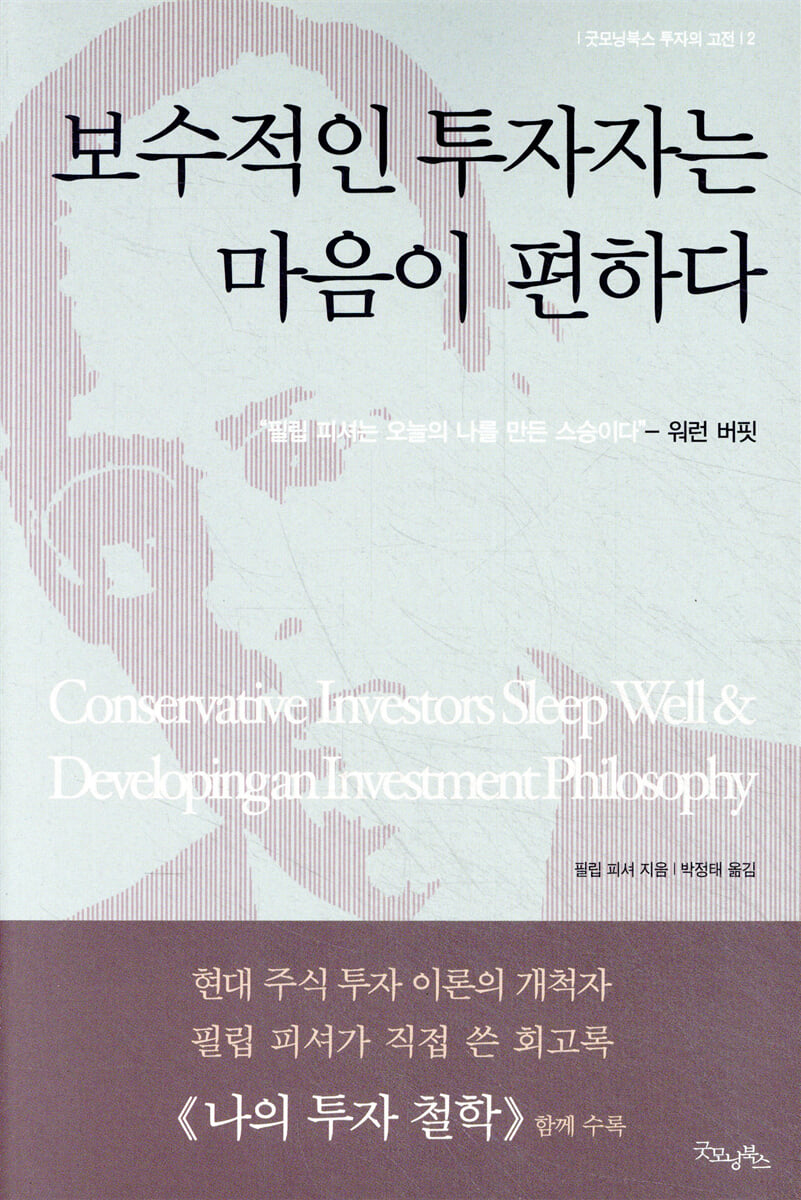
Conservative investors feel at ease
 |
Description
Book Introduction
This book is a collection of the two later books in Philip Fisher's trilogy: Investing in Great Companies, Conservative Investors Have Peace of Mind, and My Investment Philosophy.
The first volume of this book, "Conservative Investors Have Peace of Mind," was published in 1975, 17 years after "Invest in Great Companies," which was first published in 1958 and was evaluated to have completely changed the investment trend on Wall Street.
If "Invest in Great Companies" is a book that vividly explains Fisher's growth stock investment theory, "Conservative Investors Have Peace of Mind" is an investment strategy that captures the essence of the author's investment philosophy and investment theory.
In this book, the author clearly explains, through firsthand experience, why conservative investors should invest in growth stocks and how to select conservative investment targets with the lowest risk.
The author argues that investors should invest based on the company, not its stock price, and points out that when the stock market's valuation fails to properly reflect the company's true value, its fundamentals, the stocks of such companies are the most conservative and least risky investments.
The second volume of this book, "My Investment Philosophy," is Fisher's memoir published in 1980.
This is also a confessional essay written honestly by the author, who was already a seasoned investment strategist and outstanding investment theorist in his seventies at the time of writing, as he looked back on his life.
The author, with over 60 years of experience in the field, details the mistakes he has made and what he has learned from them, providing insightful case studies.
The first volume of this book, "Conservative Investors Have Peace of Mind," was published in 1975, 17 years after "Invest in Great Companies," which was first published in 1958 and was evaluated to have completely changed the investment trend on Wall Street.
If "Invest in Great Companies" is a book that vividly explains Fisher's growth stock investment theory, "Conservative Investors Have Peace of Mind" is an investment strategy that captures the essence of the author's investment philosophy and investment theory.
In this book, the author clearly explains, through firsthand experience, why conservative investors should invest in growth stocks and how to select conservative investment targets with the lowest risk.
The author argues that investors should invest based on the company, not its stock price, and points out that when the stock market's valuation fails to properly reflect the company's true value, its fundamentals, the stocks of such companies are the most conservative and least risky investments.
The second volume of this book, "My Investment Philosophy," is Fisher's memoir published in 1980.
This is also a confessional essay written honestly by the author, who was already a seasoned investment strategist and outstanding investment theorist in his seventies at the time of writing, as he looked back on his life.
The author, with over 60 years of experience in the field, details the mistakes he has made and what he has learned from them, providing insightful case studies.
index
Volume 1: Conservative Investors Have Peace of Mind
introduction
Chapter 1: The First Area of Conservative Investment: Excellence in Production, Marketing, Research and Development, and Financial Capabilities
Chapter 2: The Second Area of Conservative Investing: The Human Factor
Chapter 3: The Third Area of Conservative Investing: The Essential Nature of Corporate Activity
Chapter 4: The Fourth Area of Conservative Investing: Factors That Determine Stock Prices
Chapter 5: Explanation of the Fourth Area: Three Evaluations of the Stock Market
Chapter 6: Additional Explanation on the Fourth Area: Stock Prices and Fundamentals
Volume 2: My Investment Philosophy
Chapter 1: The Origins of Investment Philosophy
Chapter 2: Learning from Mistakes
Chapter 3: Maturity of Investment Philosophy
Chapter 4: Are markets efficient?
Chapter 5: Key Factors in Evaluating Promising Companies
Translator's Note: The emergence of Philip Fisher's growth stock investment theory.
introduction
Chapter 1: The First Area of Conservative Investment: Excellence in Production, Marketing, Research and Development, and Financial Capabilities
Chapter 2: The Second Area of Conservative Investing: The Human Factor
Chapter 3: The Third Area of Conservative Investing: The Essential Nature of Corporate Activity
Chapter 4: The Fourth Area of Conservative Investing: Factors That Determine Stock Prices
Chapter 5: Explanation of the Fourth Area: Three Evaluations of the Stock Market
Chapter 6: Additional Explanation on the Fourth Area: Stock Prices and Fundamentals
Volume 2: My Investment Philosophy
Chapter 1: The Origins of Investment Philosophy
Chapter 2: Learning from Mistakes
Chapter 3: Maturity of Investment Philosophy
Chapter 4: Are markets efficient?
Chapter 5: Key Factors in Evaluating Promising Companies
Translator's Note: The emergence of Philip Fisher's growth stock investment theory.
Into the book
Regardless of the industry, it is people who determine whether a company becomes an attractive investment or a mediocre or even inferior one.
--- p.26
Companies that are not obsessed with increasing net income are very valuable investments in the long run.
These companies are willing to sacrifice the highest possible net income when they see a truly valuable opportunity: developing a new product or process, launching a new production line, or investing a dollar today to earn tens of dollars tomorrow.
--- p.43
The laws that govern the decisive movements of stock prices can be stated very simply.
The reason why the stock price of an individual stock fluctuates significantly compared to the movement of the entire stock market is entirely because the securities industry's evaluation of that stock has changed.
--- p.64
Conservative investors should be clear about the nature of the current market valuations for any industry or sector they are interested in.
Conservative investors should constantly research these valuations to determine whether they are more positive or negative than the industry's fundamentals warrant.
--- p.83
While it's often the case that stubbornly going one way when most stock market participants are going one way can yield surprising investment returns, this presupposes a strong and solid belief that the direction you're going is correct.
--- p.133
As in most other areas of human life, success in stock investing depends on how hard you work, how much knowledge you acquire, and how honestly you act.
--- p.26
Companies that are not obsessed with increasing net income are very valuable investments in the long run.
These companies are willing to sacrifice the highest possible net income when they see a truly valuable opportunity: developing a new product or process, launching a new production line, or investing a dollar today to earn tens of dollars tomorrow.
--- p.43
The laws that govern the decisive movements of stock prices can be stated very simply.
The reason why the stock price of an individual stock fluctuates significantly compared to the movement of the entire stock market is entirely because the securities industry's evaluation of that stock has changed.
--- p.64
Conservative investors should be clear about the nature of the current market valuations for any industry or sector they are interested in.
Conservative investors should constantly research these valuations to determine whether they are more positive or negative than the industry's fundamentals warrant.
--- p.83
While it's often the case that stubbornly going one way when most stock market participants are going one way can yield surprising investment returns, this presupposes a strong and solid belief that the direction you're going is correct.
--- p.133
As in most other areas of human life, success in stock investing depends on how hard you work, how much knowledge you acquire, and how honestly you act.
--- p.196
Publisher's Review
“My investment philosophy is partly derived from logical thinking, and partly from observing the successes and failures of other investors.
But the most important part was learning from the mistakes he made, which was a very painful process.” The author, who is considered a pioneer of modern stock investment theory and one of the best investment strategists of his time, looks back on how his investment philosophy was formed, and the part where he looks back on how his investment philosophy was formed is very honest and human.
"What is truly conservative investing?" from a pioneer in growth investing.
This book is a compilation of the two later volumes of Philip Fisher's trilogy.
《Conservative Investors Have Peace of Mind》 was published in 1975, 17 years after 《Invest in Great Companies》, which was first published in 1958 and was evaluated to have completely changed the investment trend on Wall Street.
If "Invest in Great Companies" is a kind of investment theory that gradually unravels Fisher's investment theory, "Conservative Investors Have Peace of Mind" can be said to be an investment strategy theory that captures the essence of the author's investment philosophy and investment theory.
In this book, the author clearly explains, through firsthand experience, why conservative investors should invest in growth stocks and how to select truly conservative investment targets with the lowest risk.
The first three chapters, which explain the fundamentals of a company one by one in three areas of conservative investment, perfectly illustrate "how great companies are actually created," to the point where they could easily be considered a management guide.
The Law of Stock Price Movement: A Company's Fundamentals and Market Assessments
The author explains the human factor as the second area of conservative investment, emphasizing that a company's outstanding competitiveness is ultimately created by its people, and that the role of top management is paramount.
It is also noteworthy that the passage points out three valuations by stock market investors as laws that govern the decisive movements of stock prices.
“The significant fluctuations in the stock price of an individual stock compared to the movement of the entire stock market are entirely due to a change in the securities market’s evaluation of that stock.” Philip Fisher, who advocated investing by looking at the company rather than the stock price, reached a cold yet accurate conclusion in this book about the causes of stock price fluctuations.
The reason why the stock price of a certain company fluctuates is because the securities market's evaluation of the company, the securities market's evaluation of the industry the company belongs to, and the securities market's evaluation of the entire stock market have changed.
When the securities market's valuation fails to properly reflect the company's true value, its fundamentals, it is pointed out that the stocks of such companies are the most conservative (lowest risk) investment targets.
A memoir by a veteran investor who stubbornly adhered to his investment principles throughout his life.
Published in 1980, following "The Conservative Investor's Peace of Mind," "My Investment Philosophy" is Fisher's memoir.
This is also a confessional essay written honestly by the author, who was already a seasoned investment strategist and outstanding investment theorist in his seventies at the time of writing, as he looked back on his life.
In particular, this book contains "gem-like" case studies in which the author, with over 60 years of experience in field investment, explains in detail how many mistakes he has made and what he has learned from them.
The author's "three-year rule" of holding a stock for at least three years no matter what has been violated only once, and that was when the stock had poor returns over the three years and had to be sold, but its growth potential was so obvious that it was held on to. This passage shows the author's perfectionism and even stubbornness.
The author of this book, Philip Fisher, founded the investment advisory firm Fisher & Company in 1931 during the height of the Great Depression and worked as an investment advisor throughout his life. In the 1960s, he also lectured on investment theory at Stanford University Business School.
Published in 1958, "Investing in Great Companies" was the first stock investment book to become a New York Times bestseller and is an "enduring investment classic." It is still considered one of the "most influential investment books of all time."
Fisher emphasized that when selecting a company to invest in, the most important factors to consider are the top management's outstanding capabilities, future plans, and research and development capabilities.
In short, Fisher placed the highest value on the quality of a company, and in that respect, he differed from Benjamin Graham, who emphasized the book value and quantitative analysis of a company.
Beginning in the 1930s, when technical analysis, which uses past stock price movements to determine trading timing, was widely accepted, he personally identified companies with high growth potential by gathering facts by visiting investment targets, customers, and competitors.
This is how he was able to invest in great companies like Texas Instruments and Motorola in the 1950s.
He is also known for discovering and holding stocks of excellent companies that are not well-known in the stock market for a very long time. In fact, he sold Texas Instruments stock in the late 1980s and held Motorola stock until after 2000.
This is a completely revised edition with a new translation.
Good Morning Books first introduced Philip Fisher's growth investment theory to Korea in 2005 with the publication of "Invest in Great Companies" and "Conservative Investors Have Peace of Mind." Now, to mark the 20th anniversary of the publication, they have released a revised edition with a new translation.
But the most important part was learning from the mistakes he made, which was a very painful process.” The author, who is considered a pioneer of modern stock investment theory and one of the best investment strategists of his time, looks back on how his investment philosophy was formed, and the part where he looks back on how his investment philosophy was formed is very honest and human.
"What is truly conservative investing?" from a pioneer in growth investing.
This book is a compilation of the two later volumes of Philip Fisher's trilogy.
《Conservative Investors Have Peace of Mind》 was published in 1975, 17 years after 《Invest in Great Companies》, which was first published in 1958 and was evaluated to have completely changed the investment trend on Wall Street.
If "Invest in Great Companies" is a kind of investment theory that gradually unravels Fisher's investment theory, "Conservative Investors Have Peace of Mind" can be said to be an investment strategy theory that captures the essence of the author's investment philosophy and investment theory.
In this book, the author clearly explains, through firsthand experience, why conservative investors should invest in growth stocks and how to select truly conservative investment targets with the lowest risk.
The first three chapters, which explain the fundamentals of a company one by one in three areas of conservative investment, perfectly illustrate "how great companies are actually created," to the point where they could easily be considered a management guide.
The Law of Stock Price Movement: A Company's Fundamentals and Market Assessments
The author explains the human factor as the second area of conservative investment, emphasizing that a company's outstanding competitiveness is ultimately created by its people, and that the role of top management is paramount.
It is also noteworthy that the passage points out three valuations by stock market investors as laws that govern the decisive movements of stock prices.
“The significant fluctuations in the stock price of an individual stock compared to the movement of the entire stock market are entirely due to a change in the securities market’s evaluation of that stock.” Philip Fisher, who advocated investing by looking at the company rather than the stock price, reached a cold yet accurate conclusion in this book about the causes of stock price fluctuations.
The reason why the stock price of a certain company fluctuates is because the securities market's evaluation of the company, the securities market's evaluation of the industry the company belongs to, and the securities market's evaluation of the entire stock market have changed.
When the securities market's valuation fails to properly reflect the company's true value, its fundamentals, it is pointed out that the stocks of such companies are the most conservative (lowest risk) investment targets.
A memoir by a veteran investor who stubbornly adhered to his investment principles throughout his life.
Published in 1980, following "The Conservative Investor's Peace of Mind," "My Investment Philosophy" is Fisher's memoir.
This is also a confessional essay written honestly by the author, who was already a seasoned investment strategist and outstanding investment theorist in his seventies at the time of writing, as he looked back on his life.
In particular, this book contains "gem-like" case studies in which the author, with over 60 years of experience in field investment, explains in detail how many mistakes he has made and what he has learned from them.
The author's "three-year rule" of holding a stock for at least three years no matter what has been violated only once, and that was when the stock had poor returns over the three years and had to be sold, but its growth potential was so obvious that it was held on to. This passage shows the author's perfectionism and even stubbornness.
The author of this book, Philip Fisher, founded the investment advisory firm Fisher & Company in 1931 during the height of the Great Depression and worked as an investment advisor throughout his life. In the 1960s, he also lectured on investment theory at Stanford University Business School.
Published in 1958, "Investing in Great Companies" was the first stock investment book to become a New York Times bestseller and is an "enduring investment classic." It is still considered one of the "most influential investment books of all time."
Fisher emphasized that when selecting a company to invest in, the most important factors to consider are the top management's outstanding capabilities, future plans, and research and development capabilities.
In short, Fisher placed the highest value on the quality of a company, and in that respect, he differed from Benjamin Graham, who emphasized the book value and quantitative analysis of a company.
Beginning in the 1930s, when technical analysis, which uses past stock price movements to determine trading timing, was widely accepted, he personally identified companies with high growth potential by gathering facts by visiting investment targets, customers, and competitors.
This is how he was able to invest in great companies like Texas Instruments and Motorola in the 1950s.
He is also known for discovering and holding stocks of excellent companies that are not well-known in the stock market for a very long time. In fact, he sold Texas Instruments stock in the late 1980s and held Motorola stock until after 2000.
This is a completely revised edition with a new translation.
Good Morning Books first introduced Philip Fisher's growth investment theory to Korea in 2005 with the publication of "Invest in Great Companies" and "Conservative Investors Have Peace of Mind." Now, to mark the 20th anniversary of the publication, they have released a revised edition with a new translation.
GOODS SPECIFICS
- Date of issue: July 1, 2025
- Page count, weight, size: 226 pages | 188*257*20mm
- ISBN13: 9788991378407
- ISBN10: 8991378404
You may also like
카테고리
korean


korean

![GQ KOREA Mark (Monthly): December [2025]](http://librairie.coreenne.fr/cdn/shop/files/8ef265dbbfbf186523ed75ba7319009d.jpg?v=1765340328&width=3840)


