

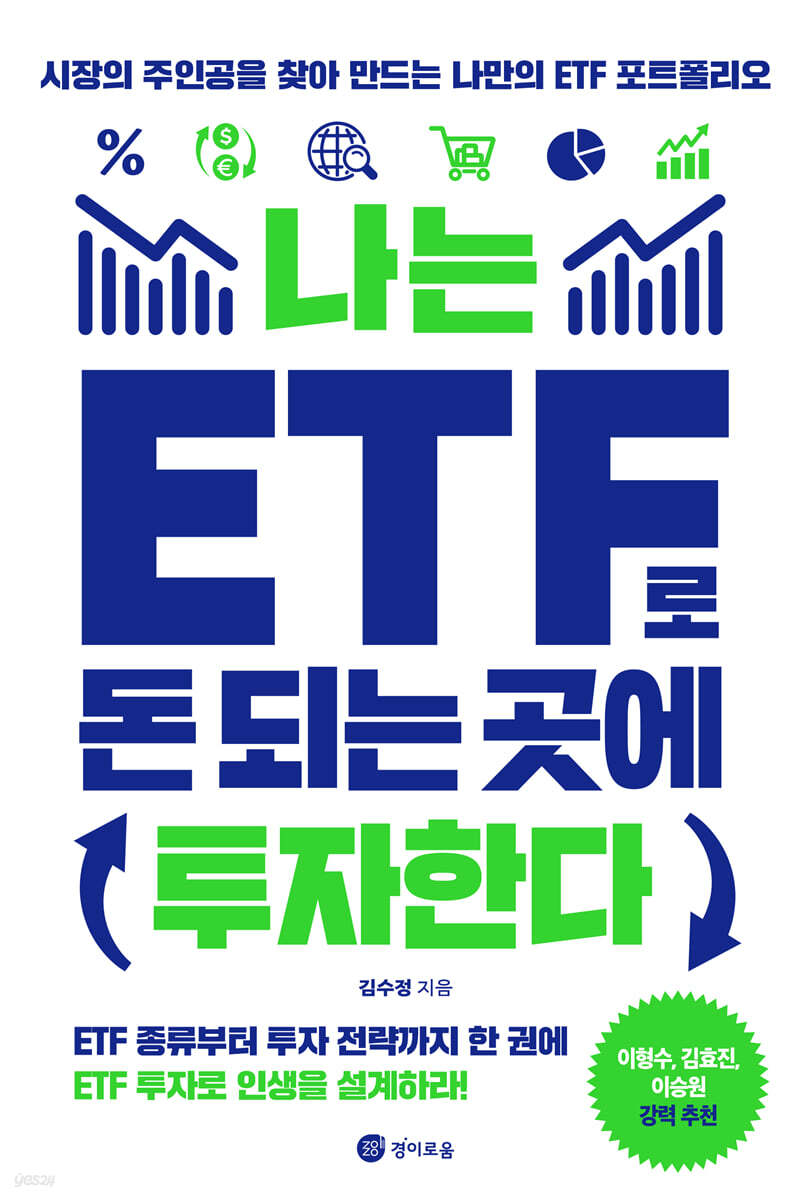
I invest in profitable places through ETFs.
 |
Description
Book Introduction
Investing is about time, not timing. Invest in ETFs consistently over the long term Let's prepare for an economically stable future! The purpose of investment varies from person to person. But most of them have something in common. The ultimate goal of investment is to achieve an economically stable future. Even if it is an investment for my child, the goal is ultimately to 'prepare for a financially stable and prosperous future for the child.' The author of this book recommends ETF investment to investors aiming for a financially stable future. The author, considered a leading analyst in the ETF product field, says that if you want to prepare for an economically stable future, you should create your own ETF portfolio. So, this book explains in detail macro analysis, industry outlook, and methods for detecting changes in economic conditions. And it explained which ETFs and in what proportions should be included in a portfolio depending on each person's investment tendencies and circumstances. In other words, this book does not simply contain the concept of ETFs. This book analyzes and forecasts the international political landscape, economy, and industry, encompassing not only the United States and Japan, already well-known advanced economies, but also emerging economies and promising industries that will lead the future. ETFs have already proven to be the best financial products of the 21st century, so I hope this book will help you create your own ETF portfolio and plan your life. |
- You can preview some of the book's contents.
Preview
index
Recommendation
Prologue - For everyone who is wondering how to invest well
PART 1 Why ETFs?
CHAPTER 1: ETF Investment: The Shining Light Right Now
CHAPTER 2: Pros and Cons of ETF Investment
CHAPTER 3 ETF Classification
PART 2: What ETF Investors Must Know
CHAPTER 1: Macro Analysis You Should Never Miss
CHAPTER 2: Developing the Habit of Identifying Market Players
PART 3: Building a Full-Fledged ETF Portfolio! ETFs Tracking National Indices
CHAPTER 1 The United States
CHAPTER 2 India
CHAPTER 3 Japan
CHAPTER 4 China
So which country's ETF should you actively buy?
PART 4 Innovative Growth Theme ETF (1) IT
CHAPTER 1: Why You Should Invest in Innovation Growth Theme ETFs
CHAPTER 2 SEMICONDUCTORS
CHAPTER 3 AI and American Big Tech Companies
CHAPTER 4 Metaverse
Which innovation growth-themed ETFs have the lowest risk?
PART 5 Innovative Growth Theme ETF (2) Non-IT
CHAPTER 1 Electric Vehicle/Autonomous Driving Industry
CHAPTER 2 Secondary Battery Industry
CHAPTER 3 Luxury Industry
CHAPTER 4: THE PET INDUSTRY
CHAPTER 5 Bio-Industry
Which innovation growth-themed ETFs have the highest growth potential?
PART 6 Bond ETFs
CHAPTER 1 Bond ETFs: An Essential Portfolio
CHAPTER 2 Types of Bond ETFs
CHAPTER 3 Short-Term Bond Rate Tracking ETFs
CHAPTER 4 Bond Price Index Tracking ETFs
CHAPTER 5: What You Need to Know to Develop a Bond ETF Strategy
How to invest in bond ETFs when interest rates are lowered?
PART 7 Exchange Rate ETFs, REIT ETFs, Monthly Dividend ETFs, and Commodity ETFs
CHAPTER 1 Exchange Rate ETFs
CHAPTER 2 Domestic REIT ETFs
CHAPTER 3 US REIT ETFs
CHAPTER 4 Monthly Dividend ETFs
CHAPTER 5 Commodity ETFs
Which ETF should I invest in considering my investment horizon and stability?
PART 8: PRACTICE! Build Your Own ETF Portfolio
CHAPTER 1 Investing is about Time, Not Timing
CHAPTER 2: Creating an ETF Portfolio Tailored to Your Investment Style
CHAPTER 3: Creating an ETF Portfolio That's Right for You, Depending on Your Situation
Prologue - For everyone who is wondering how to invest well
PART 1 Why ETFs?
CHAPTER 1: ETF Investment: The Shining Light Right Now
CHAPTER 2: Pros and Cons of ETF Investment
CHAPTER 3 ETF Classification
PART 2: What ETF Investors Must Know
CHAPTER 1: Macro Analysis You Should Never Miss
CHAPTER 2: Developing the Habit of Identifying Market Players
PART 3: Building a Full-Fledged ETF Portfolio! ETFs Tracking National Indices
CHAPTER 1 The United States
CHAPTER 2 India
CHAPTER 3 Japan
CHAPTER 4 China
So which country's ETF should you actively buy?
PART 4 Innovative Growth Theme ETF (1) IT
CHAPTER 1: Why You Should Invest in Innovation Growth Theme ETFs
CHAPTER 2 SEMICONDUCTORS
CHAPTER 3 AI and American Big Tech Companies
CHAPTER 4 Metaverse
Which innovation growth-themed ETFs have the lowest risk?
PART 5 Innovative Growth Theme ETF (2) Non-IT
CHAPTER 1 Electric Vehicle/Autonomous Driving Industry
CHAPTER 2 Secondary Battery Industry
CHAPTER 3 Luxury Industry
CHAPTER 4: THE PET INDUSTRY
CHAPTER 5 Bio-Industry
Which innovation growth-themed ETFs have the highest growth potential?
PART 6 Bond ETFs
CHAPTER 1 Bond ETFs: An Essential Portfolio
CHAPTER 2 Types of Bond ETFs
CHAPTER 3 Short-Term Bond Rate Tracking ETFs
CHAPTER 4 Bond Price Index Tracking ETFs
CHAPTER 5: What You Need to Know to Develop a Bond ETF Strategy
How to invest in bond ETFs when interest rates are lowered?
PART 7 Exchange Rate ETFs, REIT ETFs, Monthly Dividend ETFs, and Commodity ETFs
CHAPTER 1 Exchange Rate ETFs
CHAPTER 2 Domestic REIT ETFs
CHAPTER 3 US REIT ETFs
CHAPTER 4 Monthly Dividend ETFs
CHAPTER 5 Commodity ETFs
Which ETF should I invest in considering my investment horizon and stability?
PART 8: PRACTICE! Build Your Own ETF Portfolio
CHAPTER 1 Investing is about Time, Not Timing
CHAPTER 2: Creating an ETF Portfolio Tailored to Your Investment Style
CHAPTER 3: Creating an ETF Portfolio That's Right for You, Depending on Your Situation
Detailed image

Into the book
Asking questions about how to view the economy, how to analyze industries, and what drives asset price movements leads to further questions.
I believe that constantly asking questions about the market and repeating the process of learning about them is the fundamental attitude for investing.
--- p.9
It's not far-fetched to say that simply understanding and selecting ETFs allows you to invest globally according to market conditions.
That's why large U.S. institutions and even the Norwegian sovereign wealth fund, which manages national funds, create and manage portfolios using ETFs.
--- p.57
If you were to ask me which ETFs should I invest in right now, from a long-term perspective, I would say the Nasdaq 100 ETF, the S&P 500 ETF, and the Nifty 50 ETF.
--- p.148
While the US presidential election may be a bit shaky, whoever wins the next presidency will likely find it difficult to disrupt America's massive growth engine. If you want to enjoy the AI boom with peace of mind, consider investing in ETFs that invest in leading US tech companies.
--- p.194
However, it is difficult to directly invest in luxury companies in Korea.
This is because most of them are listed in Europe (France and the UK), making them less accessible. However, by utilizing ETFs, it is possible to more easily enjoy the growth of luxury companies through products listed in Europe or Korea.
--- p.256
The most important thing when investing in bond ETFs is what the US Federal Reserve says.
Even now, when investing in bond ETFs, it's important to understand what the Federal Reserve is saying, how interest rates will change in the future, and the current state of the economy.
--- p.317
It is realistically difficult to become rich overnight by creating an ETF portfolio.
Consider an ETF portfolio that suits you well and doesn't stress you out, and invest with a more relaxed mindset.
I believe that constantly asking questions about the market and repeating the process of learning about them is the fundamental attitude for investing.
--- p.9
It's not far-fetched to say that simply understanding and selecting ETFs allows you to invest globally according to market conditions.
That's why large U.S. institutions and even the Norwegian sovereign wealth fund, which manages national funds, create and manage portfolios using ETFs.
--- p.57
If you were to ask me which ETFs should I invest in right now, from a long-term perspective, I would say the Nasdaq 100 ETF, the S&P 500 ETF, and the Nifty 50 ETF.
--- p.148
While the US presidential election may be a bit shaky, whoever wins the next presidency will likely find it difficult to disrupt America's massive growth engine. If you want to enjoy the AI boom with peace of mind, consider investing in ETFs that invest in leading US tech companies.
--- p.194
However, it is difficult to directly invest in luxury companies in Korea.
This is because most of them are listed in Europe (France and the UK), making them less accessible. However, by utilizing ETFs, it is possible to more easily enjoy the growth of luxury companies through products listed in Europe or Korea.
--- p.256
The most important thing when investing in bond ETFs is what the US Federal Reserve says.
Even now, when investing in bond ETFs, it's important to understand what the Federal Reserve is saying, how interest rates will change in the future, and the current state of the economy.
--- p.317
It is realistically difficult to become rich overnight by creating an ETF portfolio.
Consider an ETF portfolio that suits you well and doesn't stress you out, and invest with a more relaxed mindset.
--- pp.384-385
Publisher's Review
Investing in ETFs in a complex investment market
How to get a stable income
Can it be created?
ETF investments are generally said to have relatively low volatility and are suitable for long-term investment.
This is because most ETFs hold 10 to 30 or more stocks, and no single stock can account for more than 30% of the domestic market.
Therefore, when it is impossible to predict who will emerge as a winner due to the emergence of new technologies, ETFs allow you to invest in multiple potential winners simultaneously, and when a specific industry is underperforming in the investment market, you can enjoy the 'diversification' effect by preventing losses that may arise from excessive declines in a single stock.
The reason it is suitable for long-term investment is ultimately due to its low volatility.
Most ETFs are passive investments that invest in an 'index' rather than a specific stock.
According to S&P Dow Jones Indices, only 35% of active funds investing in large-cap U.S. stocks have outperformed the S&P 500's annual returns on average since 2001.
There is no stock investment that beats index investment when investing for the long term.
Even Warren Buffett, the investment guru, is said to have written in his will, “When I die, invest 90% of my assets in an index fund that tracks the S&P 500, and 10% in bonds.”
Even in the United States, where capitalism is the foundation of society and competitive companies support the economy, the S&P 500 has continued to rise.
Of course, the economy goes through boom and bust cycles, but long-term investing can reduce this volatility and maximize your investment returns.
If you're struggling to decide how to invest due to the many unexpected variables and complex investment products available, choose ETFs.
It is possible to achieve sufficiently satisfactory investment returns even with stability.
Predicting the future and investing in assets around the world
Create your own ETF portfolio!
Anything worth investing in can be invested in as an ETF. ETFs invest in every asset class in the world, including stocks, bonds, commodities, currencies, and real estate.
Therefore, investing in ETFs is like investing in all assets in the world.
So, what are ETFs, and how should you invest in them? This book has the answers.
Part 1 introduces the concept and types of ETFs, as well as the pros and cons of investing in ETFs.
With many unresolved risks, an economic downturn, and high volatility ahead of the US presidential election, which will likely influence the global economy, now is the perfect time to invest in ETFs.
Moreover, ETF investment is appropriate when a new technology that will lead the future has emerged but there is no leader yet.
Of course, ETF investing has its drawbacks, but if you're looking for a long-term, stable investment, there's no better investment product.
In Part 2, we introduced macro analysis and how to identify the main players in the market.
Analyzing the global economy from a top-down perspective and identifying the key players in the market—central banks, governments, and corporations—is crucial not only for deciding whether to buy or sell ETFs, but also for determining the appropriate holdings for each ETF.
In Part 2, we looked at macro indicators and identified the current market leaders. In Part 3, we take things a step further and introduce information that will help you decide which countries to invest in.
There are various indices representing each country, and the indicators that need to be examined differ from country to country.
This book introduces national representative indices for the United States, India, Japan, and China.
In Parts 4 and 5, we introduce innovative growth-themed ETFs.
The innovation growth theme offers high growth potential, but its stock price movements are quite rapid and volatile, making it very risky.
However, the fact that we can expect high growth potential means that we can expect high returns.
As the development of new technologies is a driving force for the future, it is worth investing in a certain proportion of them, taking into account your investment tendencies and current situation.
In Part 6, we introduce 'bond ETFs', which invest in bonds, which are classified as representative safe assets, through ETFs.
Bond investment strategies vary greatly depending on interest rates.
Depending on the strategy and type of bonds invested in, some bond ETFs function as parking accounts, while others aim to predict interest rate changes and profit from price differences.
In addition, there are bond ETFs that generate income in the form of dividends.
However, since it is not a product that is invested in with the expectation of continuous growth, it is better to use it when necessary, taking into account the interest rate environment and portfolio stability.
In Part 7, we introduce some slightly different ETFs.
These are exchange rate ETFs, REIT ETFs, monthly dividend ETFs, and raw material ETFs.
Among them, exchange rate ETFs and raw material ETFs are recommended for short-term investment rather than long-term investment due to the high risk of being difficult to predict.
On the other hand, REIT ETFs and monthly dividend ETFs are products that can create a second monthly salary called 'dividends'.
In particular, REIT ETFs offer the potential for both dividends and growth.
Now that we've looked at what ETFs are and what they cover in terms of politics, economics, and industry, it's time to build an ETF portfolio that suits your investment style and circumstances.
Part 8 introduces how to construct a customized portfolio tailored to each individual's circumstances. ETF investing is fundamentally suitable for both active and aggressive investors.
And you also have to consider your own life cycle.
Whether you're currently economically active, planning a major event like a wedding in the near future, approaching retirement, or needing to build assets to pass on to your children will determine whether you should invest in the various ETFs introduced in Parts 3 through 7, and the proportion of your investments.
They say that if you persevere, you will win every battle.
I don't know what risks might stand in my way of investing.
However, by constantly questioning the market, checking various indicators available today, and predicting the future, you can hedge your risk with your own investment strategy.
This is precisely the author's intention in writing this book.
How to get a stable income
Can it be created?
ETF investments are generally said to have relatively low volatility and are suitable for long-term investment.
This is because most ETFs hold 10 to 30 or more stocks, and no single stock can account for more than 30% of the domestic market.
Therefore, when it is impossible to predict who will emerge as a winner due to the emergence of new technologies, ETFs allow you to invest in multiple potential winners simultaneously, and when a specific industry is underperforming in the investment market, you can enjoy the 'diversification' effect by preventing losses that may arise from excessive declines in a single stock.
The reason it is suitable for long-term investment is ultimately due to its low volatility.
Most ETFs are passive investments that invest in an 'index' rather than a specific stock.
According to S&P Dow Jones Indices, only 35% of active funds investing in large-cap U.S. stocks have outperformed the S&P 500's annual returns on average since 2001.
There is no stock investment that beats index investment when investing for the long term.
Even Warren Buffett, the investment guru, is said to have written in his will, “When I die, invest 90% of my assets in an index fund that tracks the S&P 500, and 10% in bonds.”
Even in the United States, where capitalism is the foundation of society and competitive companies support the economy, the S&P 500 has continued to rise.
Of course, the economy goes through boom and bust cycles, but long-term investing can reduce this volatility and maximize your investment returns.
If you're struggling to decide how to invest due to the many unexpected variables and complex investment products available, choose ETFs.
It is possible to achieve sufficiently satisfactory investment returns even with stability.
Predicting the future and investing in assets around the world
Create your own ETF portfolio!
Anything worth investing in can be invested in as an ETF. ETFs invest in every asset class in the world, including stocks, bonds, commodities, currencies, and real estate.
Therefore, investing in ETFs is like investing in all assets in the world.
So, what are ETFs, and how should you invest in them? This book has the answers.
Part 1 introduces the concept and types of ETFs, as well as the pros and cons of investing in ETFs.
With many unresolved risks, an economic downturn, and high volatility ahead of the US presidential election, which will likely influence the global economy, now is the perfect time to invest in ETFs.
Moreover, ETF investment is appropriate when a new technology that will lead the future has emerged but there is no leader yet.
Of course, ETF investing has its drawbacks, but if you're looking for a long-term, stable investment, there's no better investment product.
In Part 2, we introduced macro analysis and how to identify the main players in the market.
Analyzing the global economy from a top-down perspective and identifying the key players in the market—central banks, governments, and corporations—is crucial not only for deciding whether to buy or sell ETFs, but also for determining the appropriate holdings for each ETF.
In Part 2, we looked at macro indicators and identified the current market leaders. In Part 3, we take things a step further and introduce information that will help you decide which countries to invest in.
There are various indices representing each country, and the indicators that need to be examined differ from country to country.
This book introduces national representative indices for the United States, India, Japan, and China.
In Parts 4 and 5, we introduce innovative growth-themed ETFs.
The innovation growth theme offers high growth potential, but its stock price movements are quite rapid and volatile, making it very risky.
However, the fact that we can expect high growth potential means that we can expect high returns.
As the development of new technologies is a driving force for the future, it is worth investing in a certain proportion of them, taking into account your investment tendencies and current situation.
In Part 6, we introduce 'bond ETFs', which invest in bonds, which are classified as representative safe assets, through ETFs.
Bond investment strategies vary greatly depending on interest rates.
Depending on the strategy and type of bonds invested in, some bond ETFs function as parking accounts, while others aim to predict interest rate changes and profit from price differences.
In addition, there are bond ETFs that generate income in the form of dividends.
However, since it is not a product that is invested in with the expectation of continuous growth, it is better to use it when necessary, taking into account the interest rate environment and portfolio stability.
In Part 7, we introduce some slightly different ETFs.
These are exchange rate ETFs, REIT ETFs, monthly dividend ETFs, and raw material ETFs.
Among them, exchange rate ETFs and raw material ETFs are recommended for short-term investment rather than long-term investment due to the high risk of being difficult to predict.
On the other hand, REIT ETFs and monthly dividend ETFs are products that can create a second monthly salary called 'dividends'.
In particular, REIT ETFs offer the potential for both dividends and growth.
Now that we've looked at what ETFs are and what they cover in terms of politics, economics, and industry, it's time to build an ETF portfolio that suits your investment style and circumstances.
Part 8 introduces how to construct a customized portfolio tailored to each individual's circumstances. ETF investing is fundamentally suitable for both active and aggressive investors.
And you also have to consider your own life cycle.
Whether you're currently economically active, planning a major event like a wedding in the near future, approaching retirement, or needing to build assets to pass on to your children will determine whether you should invest in the various ETFs introduced in Parts 3 through 7, and the proportion of your investments.
They say that if you persevere, you will win every battle.
I don't know what risks might stand in my way of investing.
However, by constantly questioning the market, checking various indicators available today, and predicting the future, you can hedge your risk with your own investment strategy.
This is precisely the author's intention in writing this book.
GOODS SPECIFICS
- Date of issue: June 26, 2024
- Page count, weight, size: 412 pages | 152*225*24mm
- ISBN13: 9791192445762
- ISBN10: 1192445767
You may also like
카테고리
korean


korean

![ELLE 엘르 스페셜 에디션 A형 : 12월 [2025]](http://librairie.coreenne.fr/cdn/shop/files/b8e27a3de6c9538896439686c6b0e8fb.jpg?v=1766436872&width=3840)


