

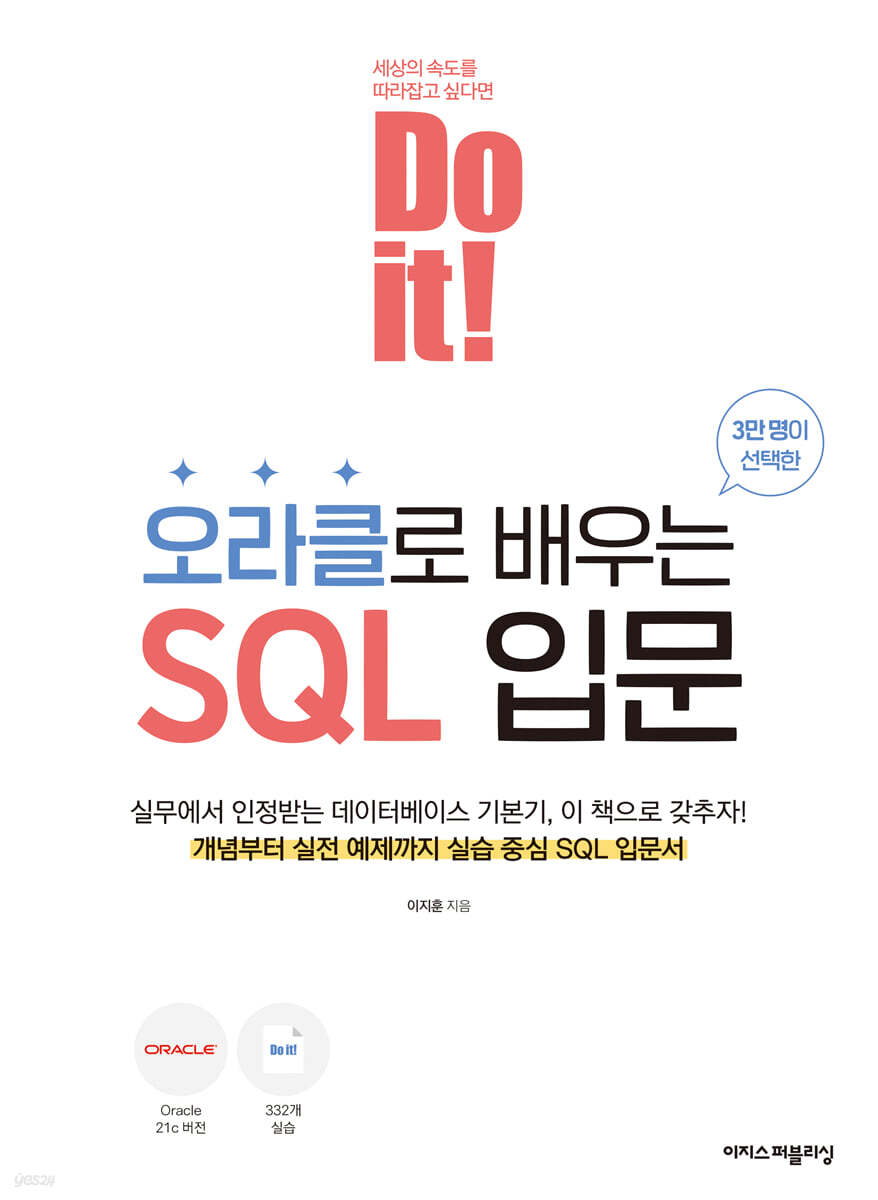
Do it! Learn SQL with Oracle
 |
Description
Book Introduction
From concepts to practice, the easiest way to learn SQL for beginners!
"Do it! Introduction to Databases with Oracle," chosen by over 30,000 people, is back!
In the AI era, where data becomes competitive advantage, learning SQL is no longer optional, but essential.
"Do it! Learn SQL with Oracle" is an introductory book designed for anyone, from beginners new to databases to professionals who want to utilize SQL in their work.
This revised edition of "Do it! Introduction to Databases with Oracle," published in 2018, incorporates the latest Oracle 21c version and enhances hands-on learning. The course is designed to seamlessly transition from theory to practice, with 332 hands-on examples covering everything from basic SQL syntax to frequently used query writing techniques and database management techniques.
It also allows you to naturally learn advanced concepts like transactions, indexes, and permission management, making it a must-read for any SQL learner. Don't put off learning SQL and databases any longer.
By practicing with the various examples in this book, you will soon become a database expert!
"Do it! Introduction to Databases with Oracle," chosen by over 30,000 people, is back!
In the AI era, where data becomes competitive advantage, learning SQL is no longer optional, but essential.
"Do it! Learn SQL with Oracle" is an introductory book designed for anyone, from beginners new to databases to professionals who want to utilize SQL in their work.
This revised edition of "Do it! Introduction to Databases with Oracle," published in 2018, incorporates the latest Oracle 21c version and enhances hands-on learning. The course is designed to seamlessly transition from theory to practice, with 332 hands-on examples covering everything from basic SQL syntax to frequently used query writing techniques and database management techniques.
It also allows you to naturally learn advanced concepts like transactions, indexes, and permission management, making it a must-read for any SQL learner. Don't put off learning SQL and databases any longer.
By practicing with the various examples in this book, you will soon become a database expert!
- You can preview some of the book's contents.
Preview
index
First Yard | Oracle and Databases
Chapter 1 Databases and SQL
__01-1 Data and Database, DBMS
__01-2 Data Model
__01-3 Relational Databases and SQL
Chapter __01 Review Problem
Chapter 2 Relational Databases and Oracle Database
__02-1 Tables and keys in a relational database
__02-2 Oracle Database
__Chapter 2 Review Problem
Chapter 3: Setting Up the Oracle Database and Practice Environment
__03-1 Installing Oracle Database and Setting Up Accounts
__03-2 Installing and Running SQL Developer
Second Yard | Data Retrieval Using SQL and SELECT Statements Frequently Used in Practice
Chapter 4 Basic Format of SELECT Statement
__04-1 Examining the Practice Table
__04-2 Three ways to query data: selection, projection, and join
__04-3 Basic skeleton of SQL, SELECT clause and FROM clause
__04-4 DISTINCT to remove duplicate data
__04-5 Setting up an alias for better viewing
__04-6 ORDER BY clause to sort output data in the desired order
__Chapter 4 Review Problem
Chapter 5: WHERE clause and operators for more accurate and diverse results
__05-1 WHERE clause that outputs only the necessary data
__05-2 AND, OR operators using multiple conditions
__05-3 Learn about operator types and how to use them
Chapter 05 Review Problem
Chapter 6: Oracle Functions for Data Processing and Processing
__06-1 Oracle function
__06-2 Character function for processing character data
__06-3 Numeric functions that calculate numeric data and adjust values
__06-4 Date functions for handling date data
__06-5 Type conversion function that converts data types
__06-6 NULL handling function
__06-7 DECODE function and CASE statement that return different data depending on the situation
Chapter 6 Review Problem
Chapter 7 Multi-Row Functions and Data Grouping
__07-1 Multi-row function that stores output results in one column
__07-2 GROUP BY clause that groups the result values into desired columns and outputs them
__07-3 HAVING clause used when outputting the created group according to conditions
Chapter 7 Review Problem
Chapter 8 Joins: Using Multiple Tables as One Table
__08-1 Join
__08-2 Join Type
__08-3 Learning Joins with Standard SQL Grammar
__Chapter 8 Review Problem
Chapter 9: Another SQL in SQL: Subqueries
__09-1 Subquery
__09-2 Single-row subquery with one execution result
__09-3 Multi-row subquery with multiple execution results
__09-4 Multi-column subquery with multiple columns to compare
__09-5 Subqueries and WITH clauses used in the FROM clause
__09-6 Subqueries used in the SELECT clause
Chapter 9 Review Problem
Third Yard | Learn SQL to Manipulate and Define Data
Chapter 10: Data manipulation language for adding, modifying, and deleting data
INSERT to add data to table __10-1
UPDATE to modify data in table __10-2
DELETE to delete data from table __10-3
__Chapter 10 Review Problems
Chapter 11 Transaction Control and Sessions
__11-1 Transaction that processes data as a single unit
__11-2 Commands that control transactions
__11-3 Session and Read Consistency
__11-4 LOCK to prevent access to data being modified
__Chapter 11 Review Problems
Chapter 12 Data Definition Language
__12-1 Data definition language for creating, changing, and deleting objects
CREATE __12-2 Create a table
__12-3 ALTER to change a table
__12-4 RENAME to change the table name
TRUNCATE to delete data from table __12-5
__DROP to delete the 12-6 table
__Chapter 12 Review Problems
Chapter 13 Object Types
__13-1 Data dictionary that stores database-related data
__13-2 Index for faster searches
__13-3 View used like a table
__13-4 Sequence that generates a sequence according to the rule
__13-5 Synonyms for specifying official aliases
Chapter 13 Review Problem
Chapter 14 Constraints
__14-1 Constraint Types
__14-2 NOT NULL that does not allow empty values
__14-3 Unique value without duplicates
__14-4 PRIMARY KEY with only one value
__14-5 FOREIGN KEY that establishes relationships with other tables
__14-6 CHECK to determine data type and range
__14-7 DEFAULT to set default values
Chapter 14 Review Problem
Appendix A | Managing Users, Permissions, and Roles
__A-1 User Management
__A-2 Permission Management
__A-3 Roll Management
Search
Chapter 1 Databases and SQL
__01-1 Data and Database, DBMS
__01-2 Data Model
__01-3 Relational Databases and SQL
Chapter __01 Review Problem
Chapter 2 Relational Databases and Oracle Database
__02-1 Tables and keys in a relational database
__02-2 Oracle Database
__Chapter 2 Review Problem
Chapter 3: Setting Up the Oracle Database and Practice Environment
__03-1 Installing Oracle Database and Setting Up Accounts
__03-2 Installing and Running SQL Developer
Second Yard | Data Retrieval Using SQL and SELECT Statements Frequently Used in Practice
Chapter 4 Basic Format of SELECT Statement
__04-1 Examining the Practice Table
__04-2 Three ways to query data: selection, projection, and join
__04-3 Basic skeleton of SQL, SELECT clause and FROM clause
__04-4 DISTINCT to remove duplicate data
__04-5 Setting up an alias for better viewing
__04-6 ORDER BY clause to sort output data in the desired order
__Chapter 4 Review Problem
Chapter 5: WHERE clause and operators for more accurate and diverse results
__05-1 WHERE clause that outputs only the necessary data
__05-2 AND, OR operators using multiple conditions
__05-3 Learn about operator types and how to use them
Chapter 05 Review Problem
Chapter 6: Oracle Functions for Data Processing and Processing
__06-1 Oracle function
__06-2 Character function for processing character data
__06-3 Numeric functions that calculate numeric data and adjust values
__06-4 Date functions for handling date data
__06-5 Type conversion function that converts data types
__06-6 NULL handling function
__06-7 DECODE function and CASE statement that return different data depending on the situation
Chapter 6 Review Problem
Chapter 7 Multi-Row Functions and Data Grouping
__07-1 Multi-row function that stores output results in one column
__07-2 GROUP BY clause that groups the result values into desired columns and outputs them
__07-3 HAVING clause used when outputting the created group according to conditions
Chapter 7 Review Problem
Chapter 8 Joins: Using Multiple Tables as One Table
__08-1 Join
__08-2 Join Type
__08-3 Learning Joins with Standard SQL Grammar
__Chapter 8 Review Problem
Chapter 9: Another SQL in SQL: Subqueries
__09-1 Subquery
__09-2 Single-row subquery with one execution result
__09-3 Multi-row subquery with multiple execution results
__09-4 Multi-column subquery with multiple columns to compare
__09-5 Subqueries and WITH clauses used in the FROM clause
__09-6 Subqueries used in the SELECT clause
Chapter 9 Review Problem
Third Yard | Learn SQL to Manipulate and Define Data
Chapter 10: Data manipulation language for adding, modifying, and deleting data
INSERT to add data to table __10-1
UPDATE to modify data in table __10-2
DELETE to delete data from table __10-3
__Chapter 10 Review Problems
Chapter 11 Transaction Control and Sessions
__11-1 Transaction that processes data as a single unit
__11-2 Commands that control transactions
__11-3 Session and Read Consistency
__11-4 LOCK to prevent access to data being modified
__Chapter 11 Review Problems
Chapter 12 Data Definition Language
__12-1 Data definition language for creating, changing, and deleting objects
CREATE __12-2 Create a table
__12-3 ALTER to change a table
__12-4 RENAME to change the table name
TRUNCATE to delete data from table __12-5
__DROP to delete the 12-6 table
__Chapter 12 Review Problems
Chapter 13 Object Types
__13-1 Data dictionary that stores database-related data
__13-2 Index for faster searches
__13-3 View used like a table
__13-4 Sequence that generates a sequence according to the rule
__13-5 Synonyms for specifying official aliases
Chapter 13 Review Problem
Chapter 14 Constraints
__14-1 Constraint Types
__14-2 NOT NULL that does not allow empty values
__14-3 Unique value without duplicates
__14-4 PRIMARY KEY with only one value
__14-5 FOREIGN KEY that establishes relationships with other tables
__14-6 CHECK to determine data type and range
__14-7 DEFAULT to set default values
Chapter 14 Review Problem
Appendix A | Managing Users, Permissions, and Roles
__A-1 User Management
__A-2 Permission Management
__A-3 Roll Management
Search
Detailed image

Publisher's Review
Features of this book
ㆍ It is composed of friendly explanations and practical exercises that even non-majors can easily understand!
ㆍ You can learn everything from basic SQL grammar to practical application in one book!
ㆍ You can review and internalize what you have learned before you forget it with '1-minute review' and 'reflection questions'!
ㆍ You can go one step further and develop advanced skills and application abilities with 'Good to know!'
ㆍ You can learn tips and know-how based on the author's practical experience through 'Practical Tips'!
Recommended for these types of people!
ㆍ Beginners learning databases and SQL for the first time
ㆍ Students who want to preview before taking a database lecture
ㆍ Practitioners who need to use SQL in an Oracle environment
Job seekers who want to learn SQL in an Oracle environment and use it in interviews or tests.
A SQL guide from beginner to advanced, with 332 practical exercises and practical tips!
Let's end the '3-day resolution' and start practicing SQL and databases!
SQL is an essential skill for data analysis and management, but it can be overwhelming to know where to start when learning it for the first time.
This book is designed to help you learn SQL through practice, rather than just learning database concepts and SQL grammar.
It is structured so that even beginners can easily follow along, with 332 practice examples and sequential learning through '1-minute reviews' and 'reflection problems', helping you naturally learn core concepts.
Furthermore, while this book is an introductory text, it also considers practical application. It will be the perfect guide for everyone, from readers new to SQL and databases to practitioners seeking to re-establish the fundamentals and gain valuable practical tips.
Based on Oracle 21c version, including SQL optimization techniques and data processing strategies!
Let's develop data capabilities recognized in the field!
Database technology is constantly evolving, and in practice, the ability to utilize SQL in a modern environment is essential.
This book provides hands-on practice based on Oracle 21c version, helping you learn SQL in line with the latest trends.
You can learn the functions required in practice step by step, from installing Oracle database to processing transactions and writing advanced queries.
By covering practical SQL optimization techniques and case studies, you can go beyond simple grammar learning and develop the ability to apply it directly to your work.
We've made it easy to understand essential information for practitioners, including performance enhancement and large-scale data processing.
With this book, you'll learn how to use SQL not just as a simple command, but as a powerful tool for manipulating data, and gain database skills that will be recognized in the real world!
We provide a variety of study materials to help you study this book!
Provides a study plan, code, and author communication channel
Page 10 of this book provides a study plan.
If you are studying alone, try studying according to this schedule.
If you write down your target date and study 2 hours a day for about 20 days, you can escape from being a SQL beginner.
If you already have some programming experience, I recommend the 10-day course.
The author provides practice code on GitHub and the Easy Publishing website's data room, so you can increase your learning effectiveness by comparing it with your own code.
You can also develop your learning, employment, and practical skills through various channels provided by the author, a professional instructor with 15 years of practical experience.
Get advice and learn about the latest trends based on the author's teaching experience and practical know-how.
Easy Publishing website | www.easyspub.co.kr → [Data Room] → Search by book title
Author's GitHub | github.com/easyspubjava/JavaSecondEdition
Author Email: groovysunday@naver.com
Author Linktree | linktr.ee/seongnyang_unkind_coding
Apply for a study group at 'Do it! Study Room'!
You can meet friends and receive books as gifts.
If you plan and study alone, you will quickly become tired.
Join the 'Do it! Study Room' study group and challenge yourself to read this book in its entirety.
You can meet people who study together, upload and share what you are studying, and get a book gift if you verify it.
Also, if you have any questions, please leave them on the 'Do it! Study Room' bulletin board.
Experts and authors will provide clear answers.
Do it! Study Room: cafe.naver.com/doitstudyroom
ㆍ It is composed of friendly explanations and practical exercises that even non-majors can easily understand!
ㆍ You can learn everything from basic SQL grammar to practical application in one book!
ㆍ You can review and internalize what you have learned before you forget it with '1-minute review' and 'reflection questions'!
ㆍ You can go one step further and develop advanced skills and application abilities with 'Good to know!'
ㆍ You can learn tips and know-how based on the author's practical experience through 'Practical Tips'!
Recommended for these types of people!
ㆍ Beginners learning databases and SQL for the first time
ㆍ Students who want to preview before taking a database lecture
ㆍ Practitioners who need to use SQL in an Oracle environment
Job seekers who want to learn SQL in an Oracle environment and use it in interviews or tests.
A SQL guide from beginner to advanced, with 332 practical exercises and practical tips!
Let's end the '3-day resolution' and start practicing SQL and databases!
SQL is an essential skill for data analysis and management, but it can be overwhelming to know where to start when learning it for the first time.
This book is designed to help you learn SQL through practice, rather than just learning database concepts and SQL grammar.
It is structured so that even beginners can easily follow along, with 332 practice examples and sequential learning through '1-minute reviews' and 'reflection problems', helping you naturally learn core concepts.
Furthermore, while this book is an introductory text, it also considers practical application. It will be the perfect guide for everyone, from readers new to SQL and databases to practitioners seeking to re-establish the fundamentals and gain valuable practical tips.
Based on Oracle 21c version, including SQL optimization techniques and data processing strategies!
Let's develop data capabilities recognized in the field!
Database technology is constantly evolving, and in practice, the ability to utilize SQL in a modern environment is essential.
This book provides hands-on practice based on Oracle 21c version, helping you learn SQL in line with the latest trends.
You can learn the functions required in practice step by step, from installing Oracle database to processing transactions and writing advanced queries.
By covering practical SQL optimization techniques and case studies, you can go beyond simple grammar learning and develop the ability to apply it directly to your work.
We've made it easy to understand essential information for practitioners, including performance enhancement and large-scale data processing.
With this book, you'll learn how to use SQL not just as a simple command, but as a powerful tool for manipulating data, and gain database skills that will be recognized in the real world!
We provide a variety of study materials to help you study this book!
Provides a study plan, code, and author communication channel
Page 10 of this book provides a study plan.
If you are studying alone, try studying according to this schedule.
If you write down your target date and study 2 hours a day for about 20 days, you can escape from being a SQL beginner.
If you already have some programming experience, I recommend the 10-day course.
The author provides practice code on GitHub and the Easy Publishing website's data room, so you can increase your learning effectiveness by comparing it with your own code.
You can also develop your learning, employment, and practical skills through various channels provided by the author, a professional instructor with 15 years of practical experience.
Get advice and learn about the latest trends based on the author's teaching experience and practical know-how.
Easy Publishing website | www.easyspub.co.kr → [Data Room] → Search by book title
Author's GitHub | github.com/easyspubjava/JavaSecondEdition
Author Email: groovysunday@naver.com
Author Linktree | linktr.ee/seongnyang_unkind_coding
Apply for a study group at 'Do it! Study Room'!
You can meet friends and receive books as gifts.
If you plan and study alone, you will quickly become tired.
Join the 'Do it! Study Room' study group and challenge yourself to read this book in its entirety.
You can meet people who study together, upload and share what you are studying, and get a book gift if you verify it.
Also, if you have any questions, please leave them on the 'Do it! Study Room' bulletin board.
Experts and authors will provide clear answers.
Do it! Study Room: cafe.naver.com/doitstudyroom
GOODS SPECIFICS
- Date of issue: March 5, 2025
- Page count, weight, size: 416 pages | 188*257*17mm
- ISBN13: 9791163036784
You may also like
카테고리
korean


korean

![ELLE 엘르 스페셜 에디션 A형 : 12월 [2025]](http://librairie.coreenne.fr/cdn/shop/files/b8e27a3de6c9538896439686c6b0e8fb.jpg?v=1766436872&width=3840)


