

Logic for Critical Thinking
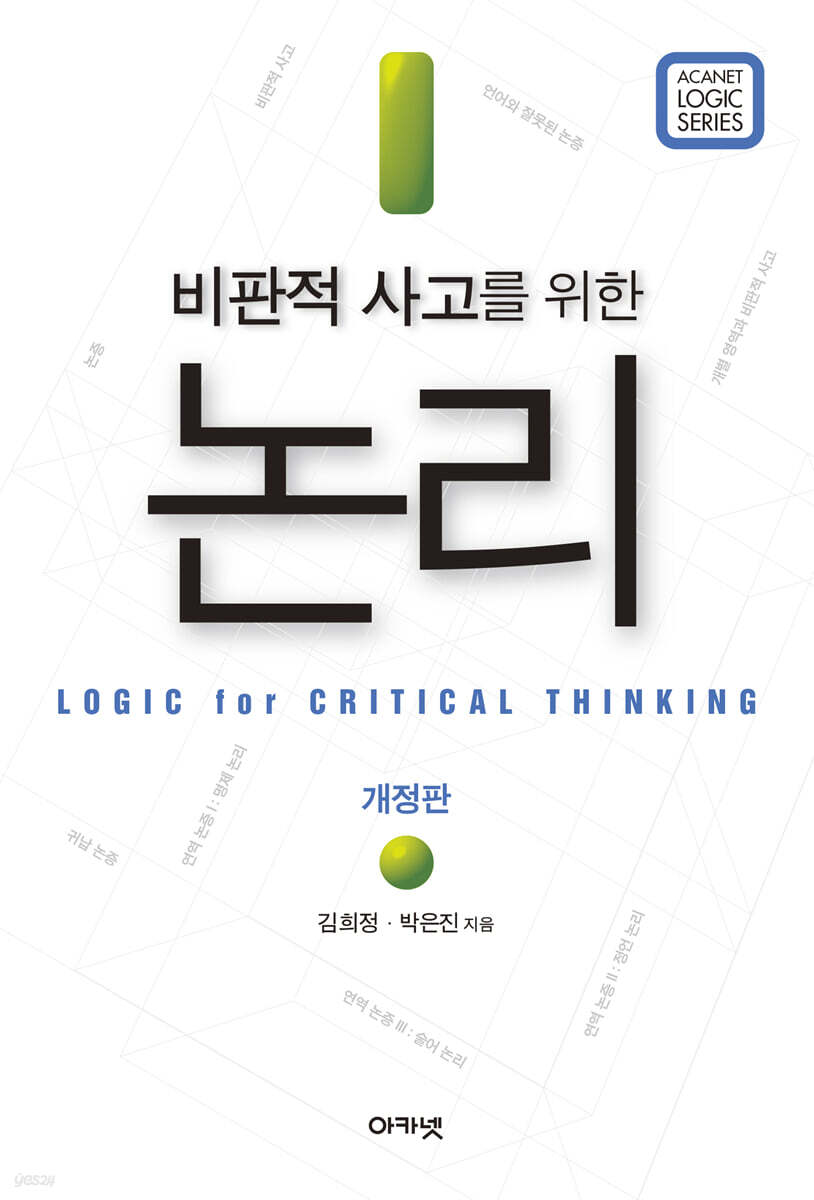 |
Description
Book Introduction
Today, we live in a world overflowing with information, with people representing diverse values and positions.
In these circumstances, we must appropriately select and select information, coexist with others by better understanding their perspectives, and, above all, cultivate critical thinking.
This book is designed as a textbook for students taking courses in introductory logic, especially logic-related courses for critical thinking.
[Logic for Critical Thinking] mainly deals with argumentation.
In particular, it focuses on how the contents of symbolic logic can be utilized to appropriately handle reasoning in everyday language.
[Critical Thinking], published early this year, added items such as argument explanations in addition to argumentation, and strengthened the content on moral arguments commonly encountered in everyday life.
[Critical Thinking] and [Logic for Critical Thinking] are very different in terms of content.
Although there is some overlap, the two books complement each other by structuring the narrative and practice questions differently.
In particular, the predicate logic included in [Logic for Critical Thinking] this time will show the difference from [Critical Thinking] more clearly.
Through predicate logic, we can clearly examine the various complex and subtle expressions we use in our daily lives.
Through predicate logic, we can clearly analyze the logical structure of various expressions we encounter in daily life.
Another reason we need to know this is because the Law School Aptitude Test is expected to include content covered in predicate logic.
In these circumstances, we must appropriately select and select information, coexist with others by better understanding their perspectives, and, above all, cultivate critical thinking.
This book is designed as a textbook for students taking courses in introductory logic, especially logic-related courses for critical thinking.
[Logic for Critical Thinking] mainly deals with argumentation.
In particular, it focuses on how the contents of symbolic logic can be utilized to appropriately handle reasoning in everyday language.
[Critical Thinking], published early this year, added items such as argument explanations in addition to argumentation, and strengthened the content on moral arguments commonly encountered in everyday life.
[Critical Thinking] and [Logic for Critical Thinking] are very different in terms of content.
Although there is some overlap, the two books complement each other by structuring the narrative and practice questions differently.
In particular, the predicate logic included in [Logic for Critical Thinking] this time will show the difference from [Critical Thinking] more clearly.
Through predicate logic, we can clearly examine the various complex and subtle expressions we use in our daily lives.
Through predicate logic, we can clearly analyze the logical structure of various expressions we encounter in daily life.
Another reason we need to know this is because the Law School Aptitude Test is expected to include content covered in predicate logic.
- You can preview some of the book's contents.
Preview
index
1.
critical thinking
_What is critical thinking?
_Learning Critical Thinking
2.
demonstration
_What is an argument?
_Classification and Evaluation of Arguments
_Reconstruction and Analysis of Argument
3.
Language and Faulty Arguments
_What is language?
_False argument: fallacy
4.
Deductive Argument 1: Propositional Logic
_System of propositional logic
Propositional logic and everyday language
_Usage of truth table
_Natural deduction
5.
Deductive Argument 2: Categorical Logic
_Categorical proposition
_Categorical syllogism
6.
Deductive Argument 3: Predicate Logic
_Predicate Logic 1: Unary Predicates
_Predicate Logic 2: Polynomial Predicates
7.
inductive argument
_Ubi argument
_Causal argument
Inductive generalization
_Statistical syllogism
_Argument by Best Explanation
8.
Individual domains and critical thinking
_Science and Critical Thinking
_Morality and Critical Thinking
_Mi, Art and Critical Thinking
critical thinking
_What is critical thinking?
_Learning Critical Thinking
2.
demonstration
_What is an argument?
_Classification and Evaluation of Arguments
_Reconstruction and Analysis of Argument
3.
Language and Faulty Arguments
_What is language?
_False argument: fallacy
4.
Deductive Argument 1: Propositional Logic
_System of propositional logic
Propositional logic and everyday language
_Usage of truth table
_Natural deduction
5.
Deductive Argument 2: Categorical Logic
_Categorical proposition
_Categorical syllogism
6.
Deductive Argument 3: Predicate Logic
_Predicate Logic 1: Unary Predicates
_Predicate Logic 2: Polynomial Predicates
7.
inductive argument
_Ubi argument
_Causal argument
Inductive generalization
_Statistical syllogism
_Argument by Best Explanation
8.
Individual domains and critical thinking
_Science and Critical Thinking
_Morality and Critical Thinking
_Mi, Art and Critical Thinking
Into the book
In reality, the words we use are very complex.
We also use a variety of complex sentences.
However, if we look closely, these diverse and complex sentences can be organized into the most basic sentence forms.
In terms of sentence structure, the smallest unit that cannot be divided any further is a simple proposition.
In fact, even a simple proposition, which is the smallest unit of a sentence, has elements that make it up.
The smallest unit of a sentence is made up of words combined together.
Categorical logic, which consists of categorical propositions, examines the logical system through the relationships between these components.
In short, categorical logic is a logical system composed of categorical propositions... (omitted)
We also use a variety of complex sentences.
However, if we look closely, these diverse and complex sentences can be organized into the most basic sentence forms.
In terms of sentence structure, the smallest unit that cannot be divided any further is a simple proposition.
In fact, even a simple proposition, which is the smallest unit of a sentence, has elements that make it up.
The smallest unit of a sentence is made up of words combined together.
Categorical logic, which consists of categorical propositions, examines the logical system through the relationships between these components.
In short, categorical logic is a logical system composed of categorical propositions... (omitted)
--- p.288
GOODS SPECIFICS
- Date of issue: June 15, 2008
- Page count, weight, size: 552 pages | 1,100g | 153*224*35mm
- ISBN13: 9788957331323
- ISBN10: 8957331328
You may also like
카테고리
korean


korean

![GQ KOREA Mark (Monthly): December [2025]](http://librairie.coreenne.fr/cdn/shop/files/8ef265dbbfbf186523ed75ba7319009d.jpg?v=1765340328&width=3840)


