

Permeating AI Writing
 |
Description
Book Introduction
A Teacher's Reference Book that Can Be Applied Immediately to Real-World Classes
A must-read for students that will improve their skills in all subjects, starting with Korean.
A Citizen's Guide to Social Life
In front of a powerful tool called artificial intelligence
How to Grow into an Inclusive Writer
ㆍCan we acknowledge that something written by artificial intelligence is something I wrote?
ㆍIs there anything more important than knowing how to use it?
ㆍWill artificial intelligence replace human writing?
ㆍHow far can we leave it to artificial intelligence?
ㆍIs it writing ability or artificial intelligence utilization ability?
We are now at a turning point where writing is fundamentally changing.
While writing used to be a creative act solely driven by human thought and fingertips, now artificial intelligence is naturally intervening in the writing process.
Generative AI, such as ChatGPiT, has already established itself as a powerful tool in various aspects of writing, such as drafting, data exploration, and sentence polishing.
These changes present us with both opportunities and challenges.
While artificial intelligence can lower the barriers to writing and make it easier for anyone to write, it can also weaken the author's agency and threaten writing ethics.
In this context, the authors of this book, "Permeating AI Writing," pose the following questions: "What is AI writing?", "What skills should writers in this era possess?", and "What should writing in collaboration with AI look like?", and offer reflections and answers to these questions.
In this book, the authors explore the nature and potential of AI writing, examine the issues that arise in the process, and explore how it can be utilized in actual writing education and practice.
Above all, I hope to find a way for me to grow into a more proactive writer, rather than being alienated from the powerful tool that is artificial intelligence.
In the age of artificial intelligence, writing ultimately goes beyond simply writing “good writing” to becoming a “good writer.”
A must-read for students that will improve their skills in all subjects, starting with Korean.
A Citizen's Guide to Social Life
In front of a powerful tool called artificial intelligence
How to Grow into an Inclusive Writer
ㆍCan we acknowledge that something written by artificial intelligence is something I wrote?
ㆍIs there anything more important than knowing how to use it?
ㆍWill artificial intelligence replace human writing?
ㆍHow far can we leave it to artificial intelligence?
ㆍIs it writing ability or artificial intelligence utilization ability?
We are now at a turning point where writing is fundamentally changing.
While writing used to be a creative act solely driven by human thought and fingertips, now artificial intelligence is naturally intervening in the writing process.
Generative AI, such as ChatGPiT, has already established itself as a powerful tool in various aspects of writing, such as drafting, data exploration, and sentence polishing.
These changes present us with both opportunities and challenges.
While artificial intelligence can lower the barriers to writing and make it easier for anyone to write, it can also weaken the author's agency and threaten writing ethics.
In this context, the authors of this book, "Permeating AI Writing," pose the following questions: "What is AI writing?", "What skills should writers in this era possess?", and "What should writing in collaboration with AI look like?", and offer reflections and answers to these questions.
In this book, the authors explore the nature and potential of AI writing, examine the issues that arise in the process, and explore how it can be utilized in actual writing education and practice.
Above all, I hope to find a way for me to grow into a more proactive writer, rather than being alienated from the powerful tool that is artificial intelligence.
In the age of artificial intelligence, writing ultimately goes beyond simply writing “good writing” to becoming a “good writer.”
- You can preview some of the book's contents.
Preview
index
A word from the 'Conceptual Korean Language Life' project
preface
Class 1.
The Essence of Artificial Intelligence Writing
The Emergence of a New Writing Style - What is AI Writing?
What is AI writing, and what approach is needed?
How is artificial intelligence used in writing?
How is AI writing written, and what is the role of humans?
In an age of AI, what new writing skills do we need to cultivate?
Can we trust everything that appears in the text? - Let's develop critical thinking skills!
Want to write something that reflects your own unique personality? - Develop your creative expression!
Want to write better and more easily? - Develop your ability to collaborate with AI!
Can we acknowledge AI-written texts as our own? - Let's cultivate writing ethics!
In this changing era, what writing skills are essential to have?
Is there anything more important than knowing how to write? - “I want to become a better writer!”
What does it mean to say, "Writing is rewriting"? - Deep reflection and careful selection.
Class 2.
The debate surrounding AI writing
Whose writing is generated by AI?
Can artificial intelligence own copyright?
How to Become an "Ethical" Writer in the Age of Artificial Intelligence
Are you the author or the user?
Will artificial intelligence replace human writing?
How can AI-generated text be recognized as authored?
What does it mean to grow as a writer?
Is artificial intelligence really omnipotent?
How has the writing environment changed?
Smart AI, but is it also fair?
Class 3.
Types of AI Writing
How can AI writing help in business situations?
When will AI-powered business writing be useful?
How to Use AI for Business Writing
Should we study 'with artificial intelligence' or should we study 'with artificial intelligence'?
What will I do if AI does everything?
How far can we leave it to artificial intelligence?
Is it the ability to write or the ability to use artificial intelligence?
What Does Artificial Intelligence's Literary Creation Mean?
Can artificial intelligence write poetry and novels like humans?
In the age of AI-powered literary creation, what does the future hold for writers?
In the age of artificial intelligence literary creation, what is our role?
How can we create literature with artificial intelligence?
What Does AI's Reflection Journal Mean?
Can AI write essays and reflective journals?
What's wrong with AI being able to write something like this?
What are the areas of application of artificial intelligence?
Where does it start to not work?
Note
References
preface
Class 1.
The Essence of Artificial Intelligence Writing
The Emergence of a New Writing Style - What is AI Writing?
What is AI writing, and what approach is needed?
How is artificial intelligence used in writing?
How is AI writing written, and what is the role of humans?
In an age of AI, what new writing skills do we need to cultivate?
Can we trust everything that appears in the text? - Let's develop critical thinking skills!
Want to write something that reflects your own unique personality? - Develop your creative expression!
Want to write better and more easily? - Develop your ability to collaborate with AI!
Can we acknowledge AI-written texts as our own? - Let's cultivate writing ethics!
In this changing era, what writing skills are essential to have?
Is there anything more important than knowing how to write? - “I want to become a better writer!”
What does it mean to say, "Writing is rewriting"? - Deep reflection and careful selection.
Class 2.
The debate surrounding AI writing
Whose writing is generated by AI?
Can artificial intelligence own copyright?
How to Become an "Ethical" Writer in the Age of Artificial Intelligence
Are you the author or the user?
Will artificial intelligence replace human writing?
How can AI-generated text be recognized as authored?
What does it mean to grow as a writer?
Is artificial intelligence really omnipotent?
How has the writing environment changed?
Smart AI, but is it also fair?
Class 3.
Types of AI Writing
How can AI writing help in business situations?
When will AI-powered business writing be useful?
How to Use AI for Business Writing
Should we study 'with artificial intelligence' or should we study 'with artificial intelligence'?
What will I do if AI does everything?
How far can we leave it to artificial intelligence?
Is it the ability to write or the ability to use artificial intelligence?
What Does Artificial Intelligence's Literary Creation Mean?
Can artificial intelligence write poetry and novels like humans?
In the age of AI-powered literary creation, what does the future hold for writers?
In the age of artificial intelligence literary creation, what is our role?
How can we create literature with artificial intelligence?
What Does AI's Reflection Journal Mean?
Can AI write essays and reflective journals?
What's wrong with AI being able to write something like this?
What are the areas of application of artificial intelligence?
Where does it start to not work?
Note
References
Detailed image
Publisher's Review
artificial intelligence writing,
From its ‘essence’ to its ‘various types’
Chapter 1 explores the nature of AI writing, emphasizing that AI-powered writing is not simply a "technology that writes for you," but rather a collaborative process that presupposes human initiative and thought.
While generative AI like ChatGPIT can quickly produce text, the authors argue that true writing must be a subjective act that reflects the writer's voice and thoughts.
Moreover, in the age of artificial intelligence, authors must cultivate the ability to collaborate with artificial intelligence by critically verifying and creatively reconstructing information. Furthermore, they emphasize the importance of "writing ethics," which is the attitude of checking and taking responsibility for the results rather than simply using sentences generated by artificial intelligence, and "author identity," which is a uniquely human domain that allows authors to incorporate their own voice and way of thinking into their writing.
Ultimately, the core of AI writing is not technology, but human thinking, and it conveys the message that being a "good writer" is more important than writing "good writing."
Chapter 2 delves into the legal and ethical debate surrounding AI writing and the role of human writers.
The authors argue that AI cannot own copyright, and that the copyright to the text it generates belongs to the humans who processed it and added creativity.
However, controversies over plagiarism and copyright infringement persist due to issues with citations, citations, and unauthorized use of data.
Academia does not recognize AI as a co-author, and emphasizes 'authorship', that is, the identity of the author with subjectivity and responsibility.
In the age of AI, writers must grow beyond mere users or practitioners to become designers who plan, coordinate, and evaluate the entire writing process, as well as agents of self-regulated learning.
He also says that we must critically recognize the biases and limitations of artificial intelligence and practice writing that takes cultural diversity and ethical responsibility into account.
Chapter 3 specifically demonstrates the various types of AI writing and their practical applications.
In business writing, artificial intelligence acts as a secretary throughout the entire process, from data collection and organization to planning and presentation preparation, and even assists with idea generation, editing, and evaluation.
In academic writing, the summary and organizing functions increase efficiency, but it emphasizes that the true subject of learning is "me, not AI."
In particular, in academic writing, it is essential to establish research questions, ensure accuracy of citations, and maintain writing ethics, and the results of artificial intelligence should also be subject to inspection and review.
In the field of literary creation, it demonstrates the arrival of an era in which artificial intelligence creates poetry and novels, and calls into question the role of human writers and the meaning of creation.
The authors emphasize that in an era where artificial intelligence even performs judging, we must protect human creativity and ethics beyond technology.
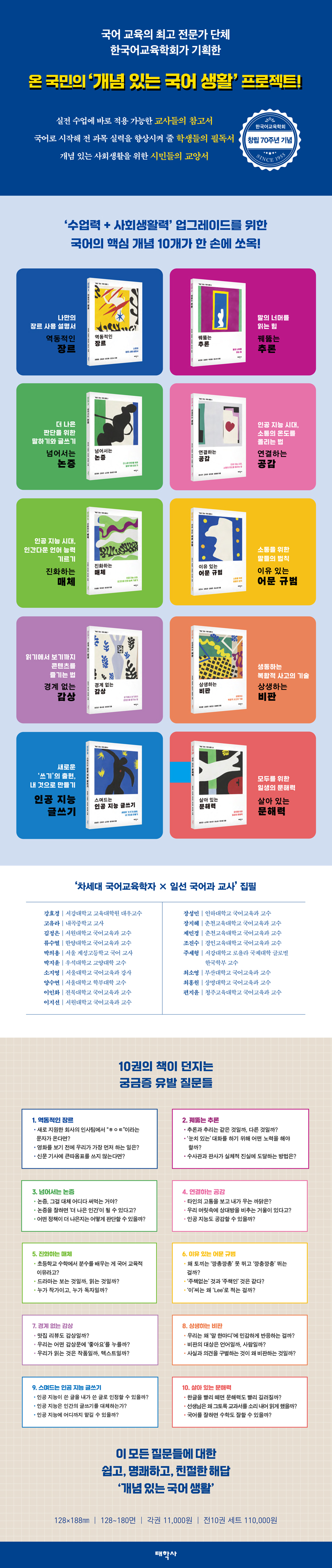
Korean Language Life with 'Concepts' (10 Volumes, Part 1)
"Conceptual Korean Language Life" is a publication by the Korean Language Education Society, Korea's first, best, and largest academic organization. To celebrate its 70th anniversary (launched as the "Korean Language Education Research Society" in 1955), the Society selects and publishes 20 of the most important "concepts" in Korean language education to summarize its academic achievements to date. The publication plan is to begin with the first 10 volumes in 2025, with the remaining 10 volumes to be completed in 2026.
This series was centered around the next generation of Korean language education scholars who will lead the Korean language education field and teachers who are leading the Korean language education field. It was planned with the goal of providing practical help not only to teachers and students in school education, but also to contribute to the language life of ordinary citizens by writing easy-to-understand content on the 'concepts' that are important in Korean language education.
From its ‘essence’ to its ‘various types’
Chapter 1 explores the nature of AI writing, emphasizing that AI-powered writing is not simply a "technology that writes for you," but rather a collaborative process that presupposes human initiative and thought.
While generative AI like ChatGPIT can quickly produce text, the authors argue that true writing must be a subjective act that reflects the writer's voice and thoughts.
Moreover, in the age of artificial intelligence, authors must cultivate the ability to collaborate with artificial intelligence by critically verifying and creatively reconstructing information. Furthermore, they emphasize the importance of "writing ethics," which is the attitude of checking and taking responsibility for the results rather than simply using sentences generated by artificial intelligence, and "author identity," which is a uniquely human domain that allows authors to incorporate their own voice and way of thinking into their writing.
Ultimately, the core of AI writing is not technology, but human thinking, and it conveys the message that being a "good writer" is more important than writing "good writing."
Chapter 2 delves into the legal and ethical debate surrounding AI writing and the role of human writers.
The authors argue that AI cannot own copyright, and that the copyright to the text it generates belongs to the humans who processed it and added creativity.
However, controversies over plagiarism and copyright infringement persist due to issues with citations, citations, and unauthorized use of data.
Academia does not recognize AI as a co-author, and emphasizes 'authorship', that is, the identity of the author with subjectivity and responsibility.
In the age of AI, writers must grow beyond mere users or practitioners to become designers who plan, coordinate, and evaluate the entire writing process, as well as agents of self-regulated learning.
He also says that we must critically recognize the biases and limitations of artificial intelligence and practice writing that takes cultural diversity and ethical responsibility into account.
Chapter 3 specifically demonstrates the various types of AI writing and their practical applications.
In business writing, artificial intelligence acts as a secretary throughout the entire process, from data collection and organization to planning and presentation preparation, and even assists with idea generation, editing, and evaluation.
In academic writing, the summary and organizing functions increase efficiency, but it emphasizes that the true subject of learning is "me, not AI."
In particular, in academic writing, it is essential to establish research questions, ensure accuracy of citations, and maintain writing ethics, and the results of artificial intelligence should also be subject to inspection and review.
In the field of literary creation, it demonstrates the arrival of an era in which artificial intelligence creates poetry and novels, and calls into question the role of human writers and the meaning of creation.
The authors emphasize that in an era where artificial intelligence even performs judging, we must protect human creativity and ethics beyond technology.
Korean Language Life with 'Concepts' (10 Volumes, Part 1)
"Conceptual Korean Language Life" is a publication by the Korean Language Education Society, Korea's first, best, and largest academic organization. To celebrate its 70th anniversary (launched as the "Korean Language Education Research Society" in 1955), the Society selects and publishes 20 of the most important "concepts" in Korean language education to summarize its academic achievements to date. The publication plan is to begin with the first 10 volumes in 2025, with the remaining 10 volumes to be completed in 2026.
This series was centered around the next generation of Korean language education scholars who will lead the Korean language education field and teachers who are leading the Korean language education field. It was planned with the goal of providing practical help not only to teachers and students in school education, but also to contribute to the language life of ordinary citizens by writing easy-to-understand content on the 'concepts' that are important in Korean language education.
GOODS SPECIFICS
- Date of issue: October 18, 2025
- Page count, weight, size: 160 pages | 128*188*20mm
- ISBN13: 9791168103863
- ISBN10: 116810386X
You may also like
카테고리
korean


korean

![GQ KOREA Mark (Monthly): December [2025]](http://librairie.coreenne.fr/cdn/shop/files/8ef265dbbfbf186523ed75ba7319009d.jpg?v=1765340328&width=3840)


