

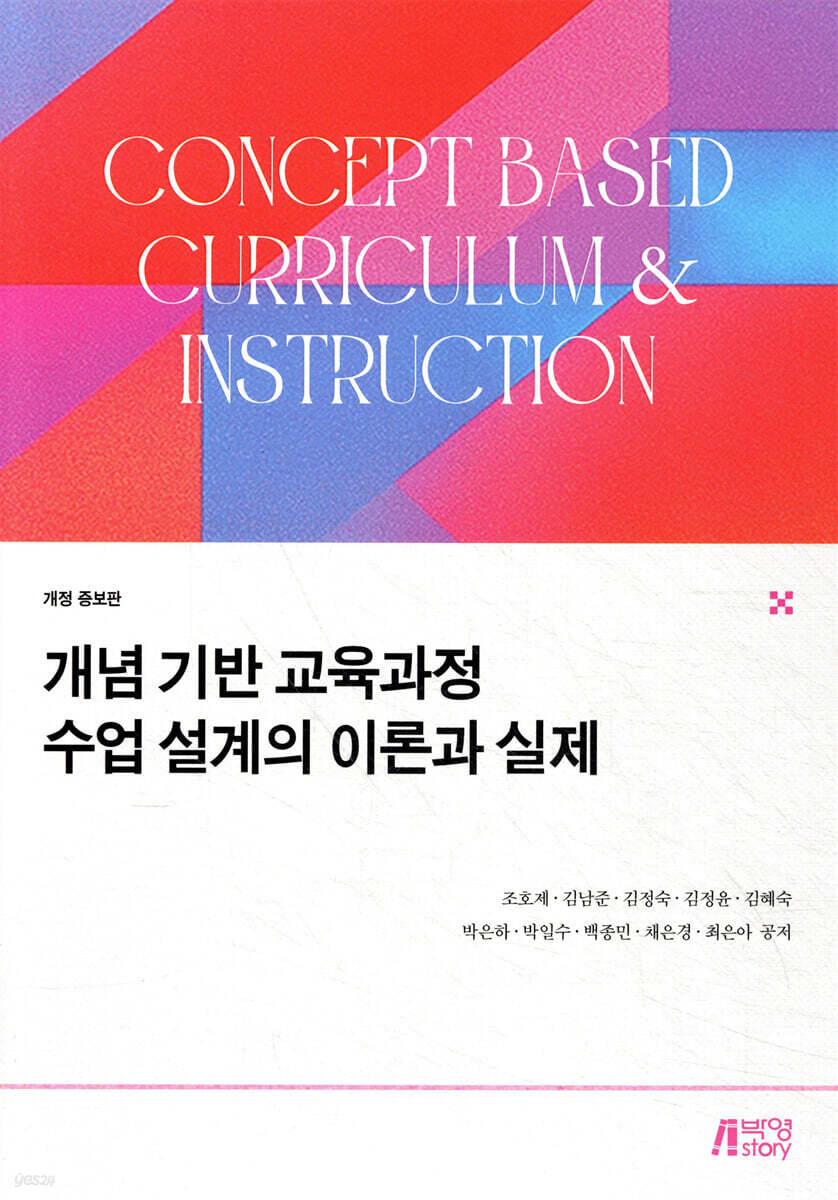
Theory and Practice of Concept-Based Curriculum Instructional Design
 |
Description
Book Introduction
The book is largely divided into six parts.
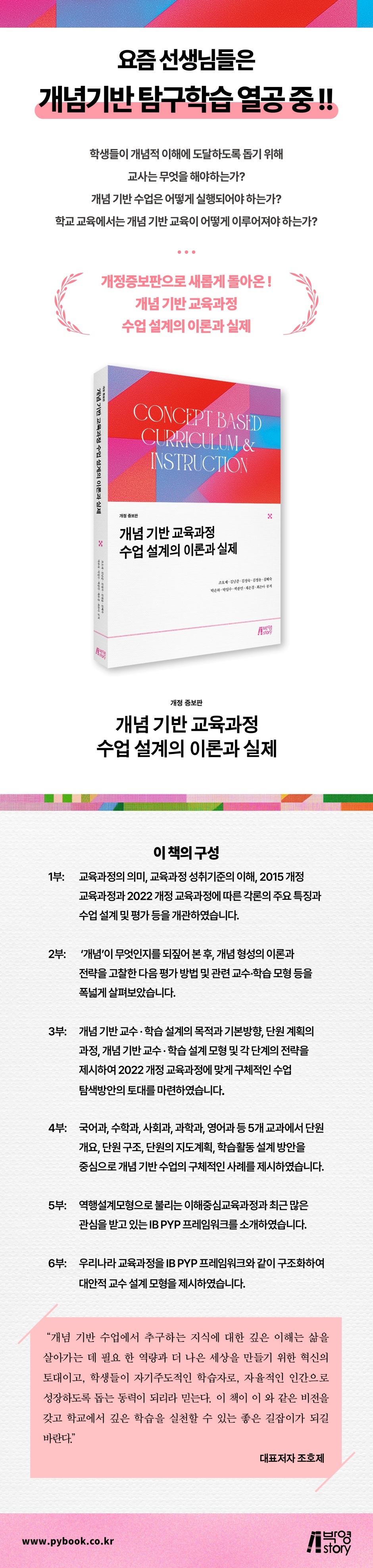
Part 1 provides an overview of the meaning of the curriculum, understanding of curriculum achievement standards, key features of each theory according to the 2015 and 2022 revised curriculum, and lesson design and evaluation.
In Part 2, we looked back at what a 'concept' is, examined the theory and strategies of concept formation, and then broadly examined evaluation methods and related teaching and learning models.
Part 3 presents the purpose and basic direction of concept-based teaching and learning design, the process of unit planning, the concept-based teaching and learning design model, and strategies for each stage, thereby laying the foundation for specific class exploration plans in line with the 2022 revised curriculum.
In Part 4, specific examples of concept-based classes were presented in five subjects: Korean, Mathematics, Social Studies, Science, and English, focusing on unit outlines, unit structures, unit teaching plans, and learning activity design plans.
Finally, in Part 5, we introduced the understanding-centered curriculum, commonly referred to as the backward design model, and the IB PYP framework, which has recently been receiving much attention.
This is because they are all using concept-based instructional design.
Part 6 is a section added in the revised and expanded edition.
Here, we present an alternative instructional design model by structuring our country's curriculum in the same way as the IB PYP framework.
This can be said to be a Korean-style concept-based class that can implement the general curriculum principles in class settings by receiving opinions from a number of experts specializing in concept-based classes.
Alternative instructional design, while simple and clear in its steps, links the 2022 revised curriculum to the student profile, core values, core skills, and core concepts that should be achieved through education, laying the foundation for our unique concept-based teaching method.
Part 1 provides an overview of the meaning of the curriculum, understanding of curriculum achievement standards, key features of each theory according to the 2015 and 2022 revised curriculum, and lesson design and evaluation.
In Part 2, we looked back at what a 'concept' is, examined the theory and strategies of concept formation, and then broadly examined evaluation methods and related teaching and learning models.
Part 3 presents the purpose and basic direction of concept-based teaching and learning design, the process of unit planning, the concept-based teaching and learning design model, and strategies for each stage, thereby laying the foundation for specific class exploration plans in line with the 2022 revised curriculum.
In Part 4, specific examples of concept-based classes were presented in five subjects: Korean, Mathematics, Social Studies, Science, and English, focusing on unit outlines, unit structures, unit teaching plans, and learning activity design plans.
Finally, in Part 5, we introduced the understanding-centered curriculum, commonly referred to as the backward design model, and the IB PYP framework, which has recently been receiving much attention.
This is because they are all using concept-based instructional design.
Part 6 is a section added in the revised and expanded edition.
Here, we present an alternative instructional design model by structuring our country's curriculum in the same way as the IB PYP framework.
This can be said to be a Korean-style concept-based class that can implement the general curriculum principles in class settings by receiving opinions from a number of experts specializing in concept-based classes.
Alternative instructional design, while simple and clear in its steps, links the 2022 revised curriculum to the student profile, core values, core skills, and core concepts that should be achieved through education, laying the foundation for our unique concept-based teaching method.
index
PART 01
Understanding the curriculum
1.
Fundamental Questions and Meaning of the Curriculum 3
2.
Understanding Curriculum Achievement Standards 6
3.
Lesson Design 16
4.
Direction of Evaluation 29
Reference 36
PART 02
Concept formation and lesson design model
1.
Characteristics of the concept 41
2.
Concept formation 42
3.
Concept Formation Theory 45
4.
Concept formation strategy 49
5.
Concept Development and Understanding Assessment50
6.
Teaching and Learning Model for Concept Formation56
Reference 71
PART 03
Concept-Based Curriculum and Instructional Design
1.
The Purpose of Concept-Based Instructional Design79
2.
Basic Directions for Concept-Based Instructional Design 80
3.
Unit Plan 91
4.
Concept-Based Instructional Design Model and Step-by-Step Strategies98
Reference 112
PART 04
Concept-Based Curriculum and Classroom Examples
01 Korean Language 115
· Korean Language Concept-Based Lesson Design (1) · 116
· Korean Language Concept-Based Lesson Design (2) · 124
· Thematically Integrated Concept-Based Lesson Design (Grades 5-6) · 135
02 Mathematics 145
· Mathematics and Concept-Based Instructional Design (1) · 146
· Mathematics and Concept-Based Instructional Design (2) · 157
· Thematic Integration Concept-Based Lesson Design (Grades 3-4) · 167
03 Social Studies 177
· Social Studies Concept-Based Lesson Design (1) · 178
· Social Studies Concept-Based Lesson Design (2) · 189
· Social Studies Concept-Based Lesson Design (3) · 206
· Thematic Integration Concept-Based Lesson Design (Grades 5-6) · 222
04 Science and Technology 233
· Science and Concept-Based Instructional Design (1) · 234
· Science and Concept-Based Instructional Design (2) · 247
· Thematically Integrated Concept-Based Lesson Design (Grades 5-6) · 257
05 English Department 273
· Concept-Based Course Design for English Language Arts (1) · 274
· Concept-Based Course Design for English Language Arts (2) · 284
· Topic-Integrated Teaching and Learning Design (Grades 3-4) · 294
Reference 303
PART 05
Concept-based curriculum types
CHAPTER 01 Retrograde Design Model 307
1.
Concept of the retrograde design model 307
2.
Understanding the Retrograde Design Model 310
3.
Case Study 329: Regression Design Model Lesson Design
Reference 342
CHAPTER 02 IB PYP344
1. The Meaning and Characteristics of the IB PYP Curriculum344
2. Unit Design Methods for the IB PYP Curriculum358
3. IB PYP Curriculum Teaching and Learning Design in Practice362
Reference 368
PART 06
2022 Revised Curriculum Overview and Concept-Based Instructional Design Linkage Plan
CHAPTER 01: Developing an Alternative Instructional Design Model for Concept-Based Curriculum (KCBC)371
1.
The Need for Developing Alternative Instructional Designs371
2.
Understanding the Curriculum and Classes372
CHAPTER 02: The Framework and Process of Instructional Design 378
1.
Student Award 378
2.
Core Values, Core Concepts, Core Functions379
3.
Instructional Design and Evaluation 381
CHAPTER 03: Designing Instruction Based on the Concept of Propositional Knowledge 383
1.
Propositional Knowledge and Concept-Based Design Methods383
2.
A Teaching Model for Acquiring Propositional Knowledge384
3.
Question Types for Acquiring Propositional Knowledge 388
4.
Evaluation in Propositional Knowledge 390
5.
Case Study 392: Lesson Design for Propositional Knowledge Acquisition
CHAPTER 04: Concept-Based Instructional Design for Procedural Knowledge 396
1.
The Meaning of Procedural Knowledge396
2.
Procedural Knowledge and Concept-Based Design Approach397
3.
Lesson Design Case Study for Procedural Knowledge Acquisition 411
Search 414
Understanding the curriculum
1.
Fundamental Questions and Meaning of the Curriculum 3
2.
Understanding Curriculum Achievement Standards 6
3.
Lesson Design 16
4.
Direction of Evaluation 29
Reference 36
PART 02
Concept formation and lesson design model
1.
Characteristics of the concept 41
2.
Concept formation 42
3.
Concept Formation Theory 45
4.
Concept formation strategy 49
5.
Concept Development and Understanding Assessment50
6.
Teaching and Learning Model for Concept Formation56
Reference 71
PART 03
Concept-Based Curriculum and Instructional Design
1.
The Purpose of Concept-Based Instructional Design79
2.
Basic Directions for Concept-Based Instructional Design 80
3.
Unit Plan 91
4.
Concept-Based Instructional Design Model and Step-by-Step Strategies98
Reference 112
PART 04
Concept-Based Curriculum and Classroom Examples
01 Korean Language 115
· Korean Language Concept-Based Lesson Design (1) · 116
· Korean Language Concept-Based Lesson Design (2) · 124
· Thematically Integrated Concept-Based Lesson Design (Grades 5-6) · 135
02 Mathematics 145
· Mathematics and Concept-Based Instructional Design (1) · 146
· Mathematics and Concept-Based Instructional Design (2) · 157
· Thematic Integration Concept-Based Lesson Design (Grades 3-4) · 167
03 Social Studies 177
· Social Studies Concept-Based Lesson Design (1) · 178
· Social Studies Concept-Based Lesson Design (2) · 189
· Social Studies Concept-Based Lesson Design (3) · 206
· Thematic Integration Concept-Based Lesson Design (Grades 5-6) · 222
04 Science and Technology 233
· Science and Concept-Based Instructional Design (1) · 234
· Science and Concept-Based Instructional Design (2) · 247
· Thematically Integrated Concept-Based Lesson Design (Grades 5-6) · 257
05 English Department 273
· Concept-Based Course Design for English Language Arts (1) · 274
· Concept-Based Course Design for English Language Arts (2) · 284
· Topic-Integrated Teaching and Learning Design (Grades 3-4) · 294
Reference 303
PART 05
Concept-based curriculum types
CHAPTER 01 Retrograde Design Model 307
1.
Concept of the retrograde design model 307
2.
Understanding the Retrograde Design Model 310
3.
Case Study 329: Regression Design Model Lesson Design
Reference 342
CHAPTER 02 IB PYP344
1. The Meaning and Characteristics of the IB PYP Curriculum344
2. Unit Design Methods for the IB PYP Curriculum358
3. IB PYP Curriculum Teaching and Learning Design in Practice362
Reference 368
PART 06
2022 Revised Curriculum Overview and Concept-Based Instructional Design Linkage Plan
CHAPTER 01: Developing an Alternative Instructional Design Model for Concept-Based Curriculum (KCBC)371
1.
The Need for Developing Alternative Instructional Designs371
2.
Understanding the Curriculum and Classes372
CHAPTER 02: The Framework and Process of Instructional Design 378
1.
Student Award 378
2.
Core Values, Core Concepts, Core Functions379
3.
Instructional Design and Evaluation 381
CHAPTER 03: Designing Instruction Based on the Concept of Propositional Knowledge 383
1.
Propositional Knowledge and Concept-Based Design Methods383
2.
A Teaching Model for Acquiring Propositional Knowledge384
3.
Question Types for Acquiring Propositional Knowledge 388
4.
Evaluation in Propositional Knowledge 390
5.
Case Study 392: Lesson Design for Propositional Knowledge Acquisition
CHAPTER 04: Concept-Based Instructional Design for Procedural Knowledge 396
1.
The Meaning of Procedural Knowledge396
2.
Procedural Knowledge and Concept-Based Design Approach397
3.
Lesson Design Case Study for Procedural Knowledge Acquisition 411
Search 414
Detailed image
Publisher's Review
Preface to the Revised and Expanded Edition
Innovation requires the creative transfer of fundamental and powerful concepts from traditional disciplines.
- J.
Stern et al., 2017.
In recent years, knowledge-based education and concept-based education have been gaining importance in the field of education.
Above all, the fact that the '2022 Revised Curriculum' presented 'deep learning' as one of the curriculum development directions is related to this context.
Competency education and knowledge education are not contradictory, and the recognition that knowledge education is necessary for competency education is well reflected.
Knowledge is necessary for competence, but factual knowledge alone is not sufficient.
In that sense, it is somewhat justified to criticize education that has remained at the level of factual knowledge.
In particular, pieces of knowledge that are not connected to each other are not useful for understanding the knowledge itself or for developing capabilities.
Knowledge has multiple levels, including factual knowledge, procedural knowledge, and conceptual knowledge. Deep understanding can be achieved when different levels of knowledge are interconnected and create synergy. Only when deep understanding is achieved can the necessary capabilities be demonstrated.
In today's uncertain and volatile society, the key to solving unexpected problems lies in conceptual knowledge cultivated from deep within, and this is where the source of vibrant capabilities flows.
So what should teachers do to help students achieve conceptual understanding? How should concept-based instruction be implemented? And, above all, how should such concept-based instruction be implemented in schools?
Starting from these problem recognitions and questions, the authors examined the nature and background of concept-based education, discussed why concept-based education is necessary in modern society, and explored specific teaching and learning methods that can be implemented in schools.
This book is a small achievement made in this process.
The book is largely divided into six parts.
Part 1 provides an overview of the meaning of the curriculum, understanding of curriculum achievement standards, key features of each theory according to the 2015 and 2022 revised curriculum, and lesson design and evaluation.
In Part 2, we looked back at what a 'concept' is, examined the theory and strategies of concept formation, and then broadly examined evaluation methods and related teaching and learning models.
Part 3 presents the purpose and basic direction of concept-based teaching and learning design, the process of unit planning, the concept-based teaching and learning design model, and strategies for each stage, thereby laying the foundation for specific class exploration plans in line with the 2022 revised curriculum.
In Part 4, specific examples of concept-based classes were presented in five subjects: Korean, Mathematics, Social Studies, Science, and English, focusing on unit outlines, unit structures, unit teaching plans, and learning activity design plans.
Finally, in Part 5, we introduced the understanding-centered curriculum, commonly referred to as the backward design model, and the IB PYP framework, which has recently been receiving much attention.
This is because they are all using concept-based instructional design.
Part 6 is a section added in the revised and expanded edition.
Here, we present an alternative instructional design model by structuring our country's curriculum in the same way as the IB PYP framework.
This can be said to be a Korean-style concept-based class that can implement the general curriculum principles in class settings by receiving opinions from a number of experts specializing in concept-based classes.
Alternative instructional design, while simple and clear in its steps, links the 2022 revised curriculum to the student profile, core values, core skills, and core concepts that should be achieved through education, laying the foundation for our unique concept-based teaching method.
We believe that the deep understanding of knowledge pursued in concept-based instruction will provide the foundation for lifelong competencies and innovations that create a better world, and will serve as a driving force for students to grow into self-directed learners and autonomous individuals.
I hope this book will serve as a useful guide for implementing deep learning in schools with this vision.
Lastly, I would like to express my deepest gratitude to all the staff at Park Young Story who worked hard to publish this book.
Innovation requires the creative transfer of fundamental and powerful concepts from traditional disciplines.
- J.
Stern et al., 2017.
In recent years, knowledge-based education and concept-based education have been gaining importance in the field of education.
Above all, the fact that the '2022 Revised Curriculum' presented 'deep learning' as one of the curriculum development directions is related to this context.
Competency education and knowledge education are not contradictory, and the recognition that knowledge education is necessary for competency education is well reflected.
Knowledge is necessary for competence, but factual knowledge alone is not sufficient.
In that sense, it is somewhat justified to criticize education that has remained at the level of factual knowledge.
In particular, pieces of knowledge that are not connected to each other are not useful for understanding the knowledge itself or for developing capabilities.
Knowledge has multiple levels, including factual knowledge, procedural knowledge, and conceptual knowledge. Deep understanding can be achieved when different levels of knowledge are interconnected and create synergy. Only when deep understanding is achieved can the necessary capabilities be demonstrated.
In today's uncertain and volatile society, the key to solving unexpected problems lies in conceptual knowledge cultivated from deep within, and this is where the source of vibrant capabilities flows.
So what should teachers do to help students achieve conceptual understanding? How should concept-based instruction be implemented? And, above all, how should such concept-based instruction be implemented in schools?
Starting from these problem recognitions and questions, the authors examined the nature and background of concept-based education, discussed why concept-based education is necessary in modern society, and explored specific teaching and learning methods that can be implemented in schools.
This book is a small achievement made in this process.
The book is largely divided into six parts.
Part 1 provides an overview of the meaning of the curriculum, understanding of curriculum achievement standards, key features of each theory according to the 2015 and 2022 revised curriculum, and lesson design and evaluation.
In Part 2, we looked back at what a 'concept' is, examined the theory and strategies of concept formation, and then broadly examined evaluation methods and related teaching and learning models.
Part 3 presents the purpose and basic direction of concept-based teaching and learning design, the process of unit planning, the concept-based teaching and learning design model, and strategies for each stage, thereby laying the foundation for specific class exploration plans in line with the 2022 revised curriculum.
In Part 4, specific examples of concept-based classes were presented in five subjects: Korean, Mathematics, Social Studies, Science, and English, focusing on unit outlines, unit structures, unit teaching plans, and learning activity design plans.
Finally, in Part 5, we introduced the understanding-centered curriculum, commonly referred to as the backward design model, and the IB PYP framework, which has recently been receiving much attention.
This is because they are all using concept-based instructional design.
Part 6 is a section added in the revised and expanded edition.
Here, we present an alternative instructional design model by structuring our country's curriculum in the same way as the IB PYP framework.
This can be said to be a Korean-style concept-based class that can implement the general curriculum principles in class settings by receiving opinions from a number of experts specializing in concept-based classes.
Alternative instructional design, while simple and clear in its steps, links the 2022 revised curriculum to the student profile, core values, core skills, and core concepts that should be achieved through education, laying the foundation for our unique concept-based teaching method.
We believe that the deep understanding of knowledge pursued in concept-based instruction will provide the foundation for lifelong competencies and innovations that create a better world, and will serve as a driving force for students to grow into self-directed learners and autonomous individuals.
I hope this book will serve as a useful guide for implementing deep learning in schools with this vision.
Lastly, I would like to express my deepest gratitude to all the staff at Park Young Story who worked hard to publish this book.
GOODS SPECIFICS
- Date of issue: March 4, 2025
- Page count, weight, size: 436 pages | 188*257*30mm
- ISBN13: 9791172790899
- ISBN10: 1172790892
You may also like
카테고리
korean


korean

![ELLE 엘르 스페셜 에디션 A형 : 12월 [2025]](http://librairie.coreenne.fr/cdn/shop/files/b8e27a3de6c9538896439686c6b0e8fb.jpg?v=1766436872&width=3840)


