

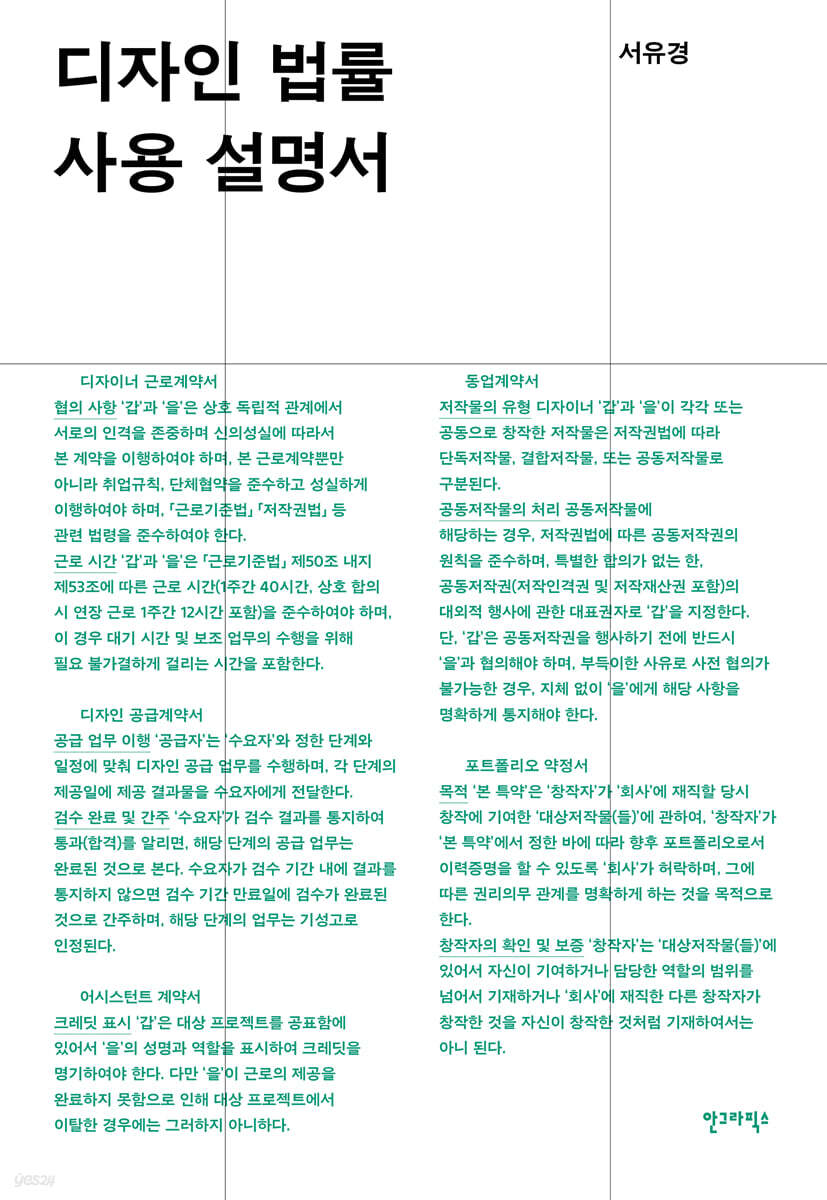
Design Law User Manual
 |
Description
Book Introduction
Attorney Seo Yu-kyung, a former designer turned lawyer and patent attorney, has compiled legal and business knowledge to help designers wisely address the various legal issues they encounter in their work.
What kind of employment contract should an in-house designer sign? Should they unconditionally accept a client's request for revisions? Who holds the copyright to joint creations? These are design contracts and legal common sense that any designer working in the design field should know.
What kind of employment contract should an in-house designer sign? Should they unconditionally accept a client's request for revisions? Who holds the copyright to joint creations? These are design contracts and legal common sense that any designer working in the design field should know.
- You can preview some of the book's contents.
Preview
index
Entering
Part 1: Designer Contracts and Negotiations
Chapter 1.
Contracts and Negotiations
1.
Why Designers Need to Know Contracts and Negotiations
2.
Design a contract
3.
Work promise, contract
4.
Good Negotiations and Bad Negotiations
5.
4 Steps to Getting What You Want
6.
Negotiation Checklist
7.
Communication methods and attitudes in negotiation
8.
When negotiating verbally, through phone calls and recordings
9.
Conclusion of negotiations
Part 2 Designer's Employment Contract
Chapter 2.
Designer recruitment and employment contracts
1.
Are freelance designers also workers?
2.
The Paradox of the Designer Hiring Market
3.
Verification of recruitment documents and portfolios
4.
Collection and Protection of Personal Information
5.
Freedom to resign and unauthorized resignation
Chapter 3.
In-house designer wages and performance
1.
Wage principles that companies must adhere to
2.
Designer's Achievements and Rewards
3.
In-house designer's copyright
4.
Special arrangements for in-house designers
Part 3: Designers and Clients
Chapter 4.
Design supply contract
1.
What is a Design Supply Agreement?
2.
Completion of the design and payment of the fee
3.
Design defect repair and compensation
Chapter 5.
Quotation for design supply contract
1.
Calculation of design fee standards
2.
Guide to Writing Design Quotations
3.
Who should prepare the comparative quotation?
Chapter 6.
Design Supply Agreement Contract
139 1.
Guide to Writing a Design Supply Contract
147 2.
Explanation of the text of the design supply contract
169 3.
Problems and Responses in Design Supply Contracts
Collaboration between four designers
Chapter 7.
Co-creation
1.
Communication and decision-making skills for working together
2.
Legal Relations Surrounding Joint Creation
3.
Assistants: A Blind Spot in the Creative World
Chapter 8.
Joint studio and partnership agreement
1.
The benefits of partnership and the bond or entanglement
2.
Types and legal nature of partnerships
3.
Guide to Writing a Partnership Agreement
Part 5 Creators and Platforms
Chapter 9.
From designer to creator
1.
Creator Economy and Paid Market
2.
Copyright protection and trademark registration
Chapter 10.
Incorporation of creators
1.
Freelancer, self-employed, corporate business
2.
Knowledge needed to run a one-person business
3.
Copyright issues between creators and corporations
Chapter 11.
platform business
1.
Definition and Interpretation of Platform Terms
2.
Platform revenue and settlement
Going out
Part 1: Designer Contracts and Negotiations
Chapter 1.
Contracts and Negotiations
1.
Why Designers Need to Know Contracts and Negotiations
2.
Design a contract
3.
Work promise, contract
4.
Good Negotiations and Bad Negotiations
5.
4 Steps to Getting What You Want
6.
Negotiation Checklist
7.
Communication methods and attitudes in negotiation
8.
When negotiating verbally, through phone calls and recordings
9.
Conclusion of negotiations
Part 2 Designer's Employment Contract
Chapter 2.
Designer recruitment and employment contracts
1.
Are freelance designers also workers?
2.
The Paradox of the Designer Hiring Market
3.
Verification of recruitment documents and portfolios
4.
Collection and Protection of Personal Information
5.
Freedom to resign and unauthorized resignation
Chapter 3.
In-house designer wages and performance
1.
Wage principles that companies must adhere to
2.
Designer's Achievements and Rewards
3.
In-house designer's copyright
4.
Special arrangements for in-house designers
Part 3: Designers and Clients
Chapter 4.
Design supply contract
1.
What is a Design Supply Agreement?
2.
Completion of the design and payment of the fee
3.
Design defect repair and compensation
Chapter 5.
Quotation for design supply contract
1.
Calculation of design fee standards
2.
Guide to Writing Design Quotations
3.
Who should prepare the comparative quotation?
Chapter 6.
Design Supply Agreement Contract
139 1.
Guide to Writing a Design Supply Contract
147 2.
Explanation of the text of the design supply contract
169 3.
Problems and Responses in Design Supply Contracts
Collaboration between four designers
Chapter 7.
Co-creation
1.
Communication and decision-making skills for working together
2.
Legal Relations Surrounding Joint Creation
3.
Assistants: A Blind Spot in the Creative World
Chapter 8.
Joint studio and partnership agreement
1.
The benefits of partnership and the bond or entanglement
2.
Types and legal nature of partnerships
3.
Guide to Writing a Partnership Agreement
Part 5 Creators and Platforms
Chapter 9.
From designer to creator
1.
Creator Economy and Paid Market
2.
Copyright protection and trademark registration
Chapter 10.
Incorporation of creators
1.
Freelancer, self-employed, corporate business
2.
Knowledge needed to run a one-person business
3.
Copyright issues between creators and corporations
Chapter 11.
platform business
1.
Definition and Interpretation of Platform Terms
2.
Platform revenue and settlement
Going out
Detailed image
.jpg)
Into the book
I wanted to be a good designer.
To be precise, I wanted to become a designer who deeply understood the system and principles of work.
I've always wondered how designers make money, how they work, how they protect their creations, and how they manage their careers.
But even when I asked my seniors questions, it was difficult to get a clear answer.
They say curiosity and creativity about design are important, but asking about the structure of the job, contract terms, or work environment seems to have been considered taboo.
--- p.5
When dealing with design-related laws, it would be more effective to lecture on things like "Copyright Protection Guide," "Design Rights Protection Know-How," and "Intellectual Property Rights Protection Strategies" to large corporations that charge high tuition fees, rather than introducing unfamiliar negotiation or contract laws.
But I think that because there are people who think like this, we need to educate people about contracts and negotiations that are suitable for the design industry.
--- p.14
Considering only the fact that they are freelancers, freelance designers cannot report to the Ministry of Labor for 'non-payment of wages'.
This is because freelancers are suppliers who have signed a service contract, not employees who have signed an employment contract.
The money that freelance designers do not receive is not "wages," but "compensation," and the legal stage for this is not the Ministry of Labor, but the "court."
However, even if the title of the contract is written as 'service' or 'consignment', we need to think more carefully about whether it can actually be considered an employment contract.
At this time, we examine how the contract was concluded, what kind of relationship was established with the user and what kind of money was received in return.
--- p.51
The principles of wage management that companies must adhere to are simple.
If it is money that must be paid according to law or contract, it must be paid.
Wages stipulated by law include, in addition to basic wages, overtime allowances, annual leave allowances, and retirement pay.
Stipulated allowances, such as bonuses or position allowances, specified in employment contracts or employment rules are also included in wages.
--- p.76
Service contracts enable strict management and supervision to ensure the efficiency of work performance.
However, excessive authoritarian control can limit the creativity and autonomy of contractors, which can lead to an imbalance in power relations and a lack of respect and understanding.
--- p.106
Sometimes, when we see cases where the price is set at an absurdly low or high amount and ask why, the answer we get is, “Because that’s how it was done in the past.”
Ultimately, the goal is to achieve a great design, but the price is just as important as the final product.
There needs to be an agreement on the amount of the fee so that both parties are comfortable and can focus on the design work.
--- p.124
Statements like “Doing this will be a great experience” or “Working on this project will help your resume” are common in creative fields.
But behind these seemingly encouraging words often lie real, important questions like, "Will my name be included in the credits?", "How can I put this work on my resume?", and "How much will I be paid?"
--- p.201
Before drafting a partnership agreement, smooth communication between the parties is essential.
If you emphasize an overly optimistic outlook in the early stages of a partnership, you risk overlooking problems.
Conversely, focusing only on practical issues may lead to doubts about the progress of the partnership.
What I've learned from observing conflict is that it's best to share opinions honestly.
If you hide your true feelings from each other before signing the contract and then a conflict arises later, the situation becomes very complicated.
If you see signs of trouble, it may be wise not to start a partnership at all.
--- p.219
On the other hand, platform markets do not have to worry about relationships with clients.
You sell items to an unspecified number of consumers and distribute profits according to the ratio agreed upon with the platform.
Platform markets follow a simple and intuitive principle: either it sells or it doesn't.
Designers are creators and businessmen who sell items and share the profits.
Characters, emoticons, videos, crafts, presentations, experiences and know-how—all of these are content and objects of trade.
To be precise, I wanted to become a designer who deeply understood the system and principles of work.
I've always wondered how designers make money, how they work, how they protect their creations, and how they manage their careers.
But even when I asked my seniors questions, it was difficult to get a clear answer.
They say curiosity and creativity about design are important, but asking about the structure of the job, contract terms, or work environment seems to have been considered taboo.
--- p.5
When dealing with design-related laws, it would be more effective to lecture on things like "Copyright Protection Guide," "Design Rights Protection Know-How," and "Intellectual Property Rights Protection Strategies" to large corporations that charge high tuition fees, rather than introducing unfamiliar negotiation or contract laws.
But I think that because there are people who think like this, we need to educate people about contracts and negotiations that are suitable for the design industry.
--- p.14
Considering only the fact that they are freelancers, freelance designers cannot report to the Ministry of Labor for 'non-payment of wages'.
This is because freelancers are suppliers who have signed a service contract, not employees who have signed an employment contract.
The money that freelance designers do not receive is not "wages," but "compensation," and the legal stage for this is not the Ministry of Labor, but the "court."
However, even if the title of the contract is written as 'service' or 'consignment', we need to think more carefully about whether it can actually be considered an employment contract.
At this time, we examine how the contract was concluded, what kind of relationship was established with the user and what kind of money was received in return.
--- p.51
The principles of wage management that companies must adhere to are simple.
If it is money that must be paid according to law or contract, it must be paid.
Wages stipulated by law include, in addition to basic wages, overtime allowances, annual leave allowances, and retirement pay.
Stipulated allowances, such as bonuses or position allowances, specified in employment contracts or employment rules are also included in wages.
--- p.76
Service contracts enable strict management and supervision to ensure the efficiency of work performance.
However, excessive authoritarian control can limit the creativity and autonomy of contractors, which can lead to an imbalance in power relations and a lack of respect and understanding.
--- p.106
Sometimes, when we see cases where the price is set at an absurdly low or high amount and ask why, the answer we get is, “Because that’s how it was done in the past.”
Ultimately, the goal is to achieve a great design, but the price is just as important as the final product.
There needs to be an agreement on the amount of the fee so that both parties are comfortable and can focus on the design work.
--- p.124
Statements like “Doing this will be a great experience” or “Working on this project will help your resume” are common in creative fields.
But behind these seemingly encouraging words often lie real, important questions like, "Will my name be included in the credits?", "How can I put this work on my resume?", and "How much will I be paid?"
--- p.201
Before drafting a partnership agreement, smooth communication between the parties is essential.
If you emphasize an overly optimistic outlook in the early stages of a partnership, you risk overlooking problems.
Conversely, focusing only on practical issues may lead to doubts about the progress of the partnership.
What I've learned from observing conflict is that it's best to share opinions honestly.
If you hide your true feelings from each other before signing the contract and then a conflict arises later, the situation becomes very complicated.
If you see signs of trouble, it may be wise not to start a partnership at all.
--- p.219
On the other hand, platform markets do not have to worry about relationships with clients.
You sell items to an unspecified number of consumers and distribute profits according to the ratio agreed upon with the platform.
Platform markets follow a simple and intuitive principle: either it sells or it doesn't.
Designers are creators and businessmen who sell items and share the profits.
Characters, emoticons, videos, crafts, presentations, experiences and know-how—all of these are content and objects of trade.
--- p.226
Publisher's Review
What kind of employment contract should a designer have?
Should we unconditionally accept the client's request for modifications?
Designers working in the design field face various legal issues in their work, whether they know it or not.
In-house designers must immediately negotiate an employment contract with the company, and if they are freelancers or run a studio, they cannot avoid legal relationships with clients through supply contracts (service contracts).
If you create together as a crew or team or partner in a studio, copyright issues may arise for joint creations. If you become a creator on YouTube or an online education platform, and even if you are a one-person company, if you become a corporation rather than an individual, you will acquire legal knowledge that is necessary for a corporation.
Is it enough for a designer to simply be good at design? Design is an industry, and legal rights are just as important as the creative process of design.
These processes, which seem unrelated to the design itself—writing estimates and contracts, negotiating strategies, copyright protection—are ultimately mechanisms to protect both the creative work and oneself.
This book allows designers unfamiliar with legal terminology or lacking experience with legal situations to intuitively understand and respond to legal issues through easy-to-understand explanations and examples.
Sample contracts, Q&As, and other useful materials can be applied immediately in the field.
The book, organized into five parts (10 chapters), Part 1, "Designer Contracts and Negotiations," presents practical strategies for designers to design and manage contracts and achieve desired results in negotiations they encounter in the real world, including pre-negotiation checklists, communication methods, and precautions for private negotiations, along with a team that can be used immediately.
Part 2, "Designer Contracts and Negotiations," covers legal issues that may arise when hiring designers, worker rights, wage and performance compensation systems, and copyright issues for in-house designers.
Part 3, "Designer and Client," compares the concepts of "service" and "services," and details the basic concepts of supply contracts, how to write estimates and contracts, and how to resolve post-contract issues such as defect repairs and damages.
Part 4, "Designer Collaboration," covers legal issues that may arise in partnerships, the communication skills needed for collaboration, and resolving conflicts of opinion. It also highlights blind spots that are easily overlooked, such as the legal status and rights of assistants.
Chapter 5, "Creators and Platforms," examines the process of designers transforming into creators and incorporating, copyright and trademark protection, interpretation of terms and conditions to consider when signing contracts with platforms, and revenue settlement methods. This book will serve as a reference and guide for designers to work more efficiently and proactively and wisely address the inevitable legal issues that arise when prevention alone is insufficient.
Should we unconditionally accept the client's request for modifications?
Designers working in the design field face various legal issues in their work, whether they know it or not.
In-house designers must immediately negotiate an employment contract with the company, and if they are freelancers or run a studio, they cannot avoid legal relationships with clients through supply contracts (service contracts).
If you create together as a crew or team or partner in a studio, copyright issues may arise for joint creations. If you become a creator on YouTube or an online education platform, and even if you are a one-person company, if you become a corporation rather than an individual, you will acquire legal knowledge that is necessary for a corporation.
Is it enough for a designer to simply be good at design? Design is an industry, and legal rights are just as important as the creative process of design.
These processes, which seem unrelated to the design itself—writing estimates and contracts, negotiating strategies, copyright protection—are ultimately mechanisms to protect both the creative work and oneself.
This book allows designers unfamiliar with legal terminology or lacking experience with legal situations to intuitively understand and respond to legal issues through easy-to-understand explanations and examples.
Sample contracts, Q&As, and other useful materials can be applied immediately in the field.
The book, organized into five parts (10 chapters), Part 1, "Designer Contracts and Negotiations," presents practical strategies for designers to design and manage contracts and achieve desired results in negotiations they encounter in the real world, including pre-negotiation checklists, communication methods, and precautions for private negotiations, along with a team that can be used immediately.
Part 2, "Designer Contracts and Negotiations," covers legal issues that may arise when hiring designers, worker rights, wage and performance compensation systems, and copyright issues for in-house designers.
Part 3, "Designer and Client," compares the concepts of "service" and "services," and details the basic concepts of supply contracts, how to write estimates and contracts, and how to resolve post-contract issues such as defect repairs and damages.
Part 4, "Designer Collaboration," covers legal issues that may arise in partnerships, the communication skills needed for collaboration, and resolving conflicts of opinion. It also highlights blind spots that are easily overlooked, such as the legal status and rights of assistants.
Chapter 5, "Creators and Platforms," examines the process of designers transforming into creators and incorporating, copyright and trademark protection, interpretation of terms and conditions to consider when signing contracts with platforms, and revenue settlement methods. This book will serve as a reference and guide for designers to work more efficiently and proactively and wisely address the inevitable legal issues that arise when prevention alone is insufficient.
GOODS SPECIFICS
- Date of issue: September 10, 2024
- Page count, weight, size: 264 pages | 524g | 160*232*17mm
- ISBN13: 9791168230798
You may also like
카테고리
korean


korean

![ELLE 엘르 스페셜 에디션 A형 : 12월 [2025]](http://librairie.coreenne.fr/cdn/shop/files/b8e27a3de6c9538896439686c6b0e8fb.jpg?v=1766436872&width=3840)


