

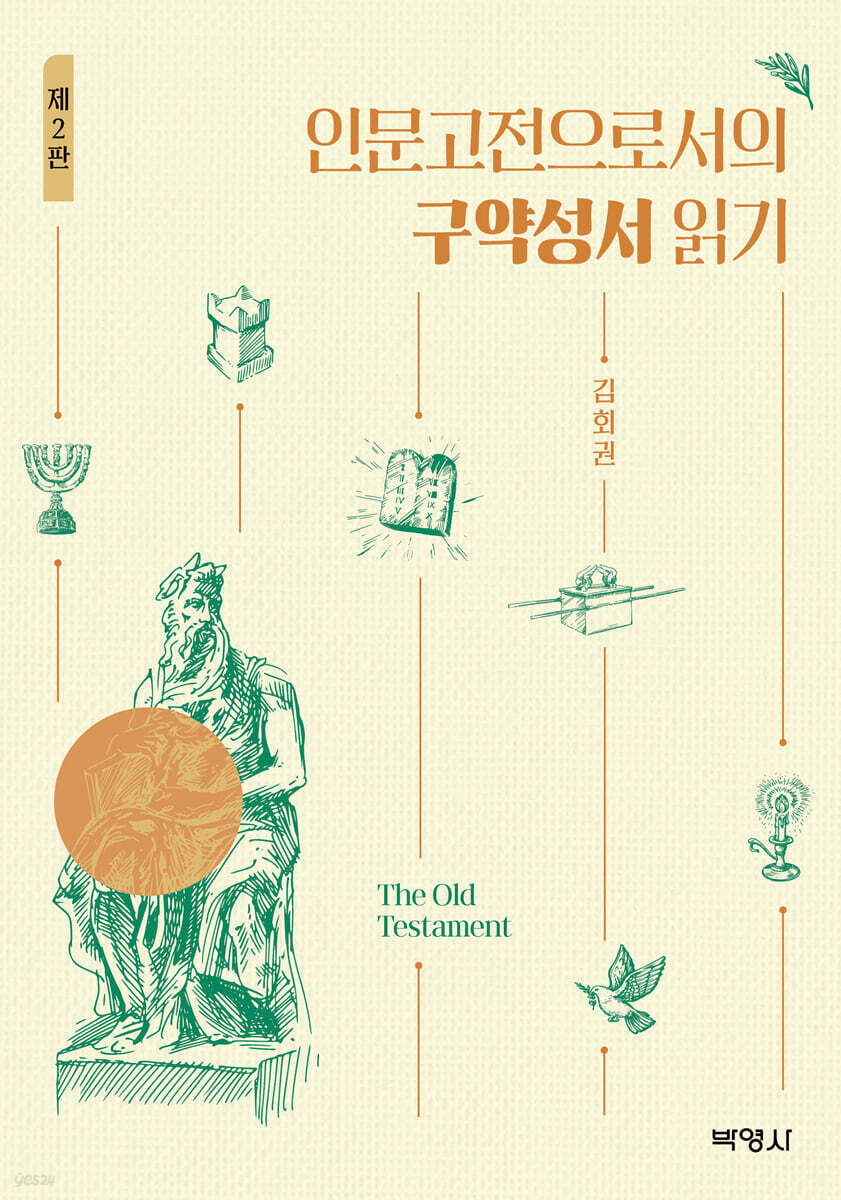
Reading the Old Testament as a Humanities Classic
 |
Description
Book Introduction
"Reading the Old Testament as a Humanistic Classic" seeks to demonstrate how the Old Testament can become a classic for humanity by revealing the wild, primitive, and pure face of Yahweh, revealed in the Old Testament text before it was packaged with religious doctrine.
This book examines the central themes of each book of the Old Testament, exploring how each book can be read as a classic of human history. The final two chapters offer specific examples of how the Old Testament can be read as a classic of the humanities.
This book examines the central themes of each book of the Old Testament, exploring how each book can be read as a classic of human history. The final two chapters offer specific examples of how the Old Testament can be read as a classic of the humanities.
index
Week 1 Lecture Notes
1-1 Introduction to the Bible for those entering the unfamiliar world of the Bible, Part 3
1-2 The Bible in World History, Biblical Chronology, and Maps 16
Introduction to Lecture 1
What are the classics of the humanities, and in what ways is the Bible a classic? · 29
Lecture 1-1
An Introductory Lecture on the Bible for Those Entering the Unfamiliar World of the Bible · 31
Lecture 1-2
The Bible in World History, Biblical Chronology, and Maps · 42
Week 2 Lecture Notes
2-1 Overview of the Complex Structure of the Old Testament 55
2-2 Genesis, the First Book of the Pentateuch: A "Compact File" of Israel's History Pentateuch 63
Introduction to Lecture 2
An Overview of the Complex Structure of the Old Testament · 69
Lecture 2-1
Classification of Old Testament Genres (Law, Prophets, Writings) · 71
2nd lecture-2
The Pentateuch and its First Book, Genesis · 82
Week 3 Lecture Notes
3-1 Exodus 93
3-2 Leviticus, Numbers 101
Introduction to Lecture 3
Understanding Exodus, Leviticus, and Numbers · 119
3rd lecture-1
Exodus 121
3rd lecture-2
Leviticus, Numbers · 132
Week 4 Lecture Notes
4-1 Summary of Deuteronomy and the Pentateuch 145
4-2 Overview of the Deuteronomic History Books from Joshua to 2 Kings 168
Introduction to the 4th lecture
The Uniqueness of the Deuteronomy History Book · 193
Semifinals-1
Summary of Deuteronomy and the Pentateuch · 195
Semifinals-2
Joshua to Judges · 208
Week 5 Lecture Notes
5-1 1 and 2 Samuel 225
5-2 1 and 2 Kings 233
Introduction to Lesson 5
1 and 2 Samuel and 1 and 2 Kings, covering crucial turning points in Israel's history · 245
5th lecture-1
1 and 2 Samuel 248
5th lecture-2
1 and 2 Kings · 261
Week 6 Lecture Notes
6-1 Chronicles 1 and 2 279
6-2 Ezra-Nehemiah 291
Introduction to Lesson 6
Chronicles: Ezra-Nehemiah, a Reinterpretation of Past History Like Replaying a Lost Game of Go? · 303
Round of 6-1
Chronicles 1 and 2 · 306
Round of 6-2
Ezra, Nehemiah · 315
Week 7 Lecture Notes
7-1 The Central Task of the Prophets of the 8th Century BC 329
7-2 Amos and Hosea 335
Introduction to Lesson 7
Prophecy as a Public Critical Discourse by Socially Critical and Power-Watching Intellectuals · 340
Lesson 7-1
The Central Task of the Prophets of the 8th Century BC · 343
Lesson 7-2
Amos, Hosea · 354
Week 8 Lecture Notes
8-1 Isaiah and Micah 369
8-2 BC Central Tasks of the 7th-6th Century Prophets, Jeremiah and Ezekiel 380
Introduction to the Quarterfinals
Isaiah and Micah, prophets of the 8th century BC, and Jeremiah and Ezekiel, prophets of the Babylonian Exile · 389
Quarterfinals-1
Isaiah, Micah · 392
Quarterfinals-2
7th-6th century BC prophets, Jeremiah and Ezekiel · 403
Week 9 Lecture Notes
9-1 Overview of Israel's History from Settlement in Canaan to Loss: The Birth of the Deuteronomic History 419
9-2 The Significance of the Babylonian Captivity: Various Responses to Catastrophic Disaster 432
Introduction to Lesson 9
A Multifaceted Analysis of the Influence of the Babylonian Exile on the Old Testament · 447
Lesson 9-1
Deuteronomy, Book of History · 450
Lesson 9-2
The Significance of the Babylonian Captivity: Various Responses to Catastrophic Disaster · 462
Week 10 Lecture Notes
10-1 Other Minor Prophets of the 7th-6th Century BC (Joel, Obadiah, Jonah, Nahum, Habakkuk, Zephaniah) 475
10-2 BC 6th-5th century prophets: Haggai, Zechariah, Malachi 478
Introduction to Lesson 10
An Overview of Prophets of the Destruction of the Kingdom and the Babylonian Exile · 483
10th lecture-1
Minor Prophets of the 7th-6th Century BC (Joel, Obadiah, Jonah, Nahum, Habakkuk, Zephaniah) · 485
10th round-2
Prophets of the 6th and 5th centuries BC: Haggai, Zechariah, Malachi · 497
Week 11 Lecture Notes
Psalm 11-1, Proverbs 511
11-2 Job, Ecclesiastes, Lamentations 525
Introduction to Lesson 11
An Overview of the Old Testament Writings · 538
Lesson 11-1
Overview of the Writings of the Old Testament: Psalms, Proverbs · 540
Lesson 11-2
Job, Ecclesiastes, and Lamentations · 553
Week 12 Lecture Notes
12-1 Daniel, Esther 571
Ruth 12-2, Song of Solomon 577
Introduction to Lesson 12
An Exemplary Approach to the Openness, Universality, and Internationality of the Holy Document · 585
Round of 12-1
Daniel, Esther · 587
Round of 12-2
Ruth, Song of Solomon · 601
Week 13 Lecture Notes
13-1 Reading the Old Testament as a Drama 617
13-2 Reading the Old Testament as a Humanities Classic: Case Study 1 622
Introduction to Lesson 13
The Difficulties and Benefits of Trying to Read the Old Testament as a Single Book · 630
Lesson 13-1
Reading the Old Testament as a Drama with a Rise, Development, Turn, and Conclusion · 632
Lesson 13-2
Reading the Old Testament as a Humanistic Classic: Case 1: A Humanistic Approach to the Problem of Evil and Suffering in the Old Testament · 646
Week 14 Lecture Notes
14-1 Reading the Old Testament as a Humanities Classic: Case Study 2 663
14-2 Reading the Old Testament as a Humanities Classic, Case Study 3: Old Testament Ethics and Ideal Political Philosophy 673
Introduction to Lesson 14
Reading the Old Testament as a Classic of the Humanities: Case Studies 2, 3 · 690
Round of 14-1
Reading the Old Testament as a Humanities Classic: Case 2: The Story of Noah's Flood in the Light of the Babylonian Flood Myth · 692
Round of 14-2
Reading the Old Testament as a Classic of the Humanities, Case Study 3: Old Testament Ethics and Ideal Political Philosophy · 706
Week 15 Lecture Notes
Chapter 15: Obstacles that Frustrate Reading the Old Testament as a Classic of the Humanities 721
15-1 Is the Old Testament's concept of the chosen people an obstacle to the era of global pluralism, multireligion, and multiracial coexistence?
15-2 Why did Yahweh, the God of the Old Testament, incite and command Israel's war to conquer Canaan? 728
15-3 The Source of the Mosaic Law: God and the Cries of the Common People 734
Week 16 Lecture Notes
Chapter 16 Overall Conclusion - The Significance of Reading the Old Testament as a Humanities Classic 743
Americas · 747
References · 757
1-1 Introduction to the Bible for those entering the unfamiliar world of the Bible, Part 3
1-2 The Bible in World History, Biblical Chronology, and Maps 16
Introduction to Lecture 1
What are the classics of the humanities, and in what ways is the Bible a classic? · 29
Lecture 1-1
An Introductory Lecture on the Bible for Those Entering the Unfamiliar World of the Bible · 31
Lecture 1-2
The Bible in World History, Biblical Chronology, and Maps · 42
Week 2 Lecture Notes
2-1 Overview of the Complex Structure of the Old Testament 55
2-2 Genesis, the First Book of the Pentateuch: A "Compact File" of Israel's History Pentateuch 63
Introduction to Lecture 2
An Overview of the Complex Structure of the Old Testament · 69
Lecture 2-1
Classification of Old Testament Genres (Law, Prophets, Writings) · 71
2nd lecture-2
The Pentateuch and its First Book, Genesis · 82
Week 3 Lecture Notes
3-1 Exodus 93
3-2 Leviticus, Numbers 101
Introduction to Lecture 3
Understanding Exodus, Leviticus, and Numbers · 119
3rd lecture-1
Exodus 121
3rd lecture-2
Leviticus, Numbers · 132
Week 4 Lecture Notes
4-1 Summary of Deuteronomy and the Pentateuch 145
4-2 Overview of the Deuteronomic History Books from Joshua to 2 Kings 168
Introduction to the 4th lecture
The Uniqueness of the Deuteronomy History Book · 193
Semifinals-1
Summary of Deuteronomy and the Pentateuch · 195
Semifinals-2
Joshua to Judges · 208
Week 5 Lecture Notes
5-1 1 and 2 Samuel 225
5-2 1 and 2 Kings 233
Introduction to Lesson 5
1 and 2 Samuel and 1 and 2 Kings, covering crucial turning points in Israel's history · 245
5th lecture-1
1 and 2 Samuel 248
5th lecture-2
1 and 2 Kings · 261
Week 6 Lecture Notes
6-1 Chronicles 1 and 2 279
6-2 Ezra-Nehemiah 291
Introduction to Lesson 6
Chronicles: Ezra-Nehemiah, a Reinterpretation of Past History Like Replaying a Lost Game of Go? · 303
Round of 6-1
Chronicles 1 and 2 · 306
Round of 6-2
Ezra, Nehemiah · 315
Week 7 Lecture Notes
7-1 The Central Task of the Prophets of the 8th Century BC 329
7-2 Amos and Hosea 335
Introduction to Lesson 7
Prophecy as a Public Critical Discourse by Socially Critical and Power-Watching Intellectuals · 340
Lesson 7-1
The Central Task of the Prophets of the 8th Century BC · 343
Lesson 7-2
Amos, Hosea · 354
Week 8 Lecture Notes
8-1 Isaiah and Micah 369
8-2 BC Central Tasks of the 7th-6th Century Prophets, Jeremiah and Ezekiel 380
Introduction to the Quarterfinals
Isaiah and Micah, prophets of the 8th century BC, and Jeremiah and Ezekiel, prophets of the Babylonian Exile · 389
Quarterfinals-1
Isaiah, Micah · 392
Quarterfinals-2
7th-6th century BC prophets, Jeremiah and Ezekiel · 403
Week 9 Lecture Notes
9-1 Overview of Israel's History from Settlement in Canaan to Loss: The Birth of the Deuteronomic History 419
9-2 The Significance of the Babylonian Captivity: Various Responses to Catastrophic Disaster 432
Introduction to Lesson 9
A Multifaceted Analysis of the Influence of the Babylonian Exile on the Old Testament · 447
Lesson 9-1
Deuteronomy, Book of History · 450
Lesson 9-2
The Significance of the Babylonian Captivity: Various Responses to Catastrophic Disaster · 462
Week 10 Lecture Notes
10-1 Other Minor Prophets of the 7th-6th Century BC (Joel, Obadiah, Jonah, Nahum, Habakkuk, Zephaniah) 475
10-2 BC 6th-5th century prophets: Haggai, Zechariah, Malachi 478
Introduction to Lesson 10
An Overview of Prophets of the Destruction of the Kingdom and the Babylonian Exile · 483
10th lecture-1
Minor Prophets of the 7th-6th Century BC (Joel, Obadiah, Jonah, Nahum, Habakkuk, Zephaniah) · 485
10th round-2
Prophets of the 6th and 5th centuries BC: Haggai, Zechariah, Malachi · 497
Week 11 Lecture Notes
Psalm 11-1, Proverbs 511
11-2 Job, Ecclesiastes, Lamentations 525
Introduction to Lesson 11
An Overview of the Old Testament Writings · 538
Lesson 11-1
Overview of the Writings of the Old Testament: Psalms, Proverbs · 540
Lesson 11-2
Job, Ecclesiastes, and Lamentations · 553
Week 12 Lecture Notes
12-1 Daniel, Esther 571
Ruth 12-2, Song of Solomon 577
Introduction to Lesson 12
An Exemplary Approach to the Openness, Universality, and Internationality of the Holy Document · 585
Round of 12-1
Daniel, Esther · 587
Round of 12-2
Ruth, Song of Solomon · 601
Week 13 Lecture Notes
13-1 Reading the Old Testament as a Drama 617
13-2 Reading the Old Testament as a Humanities Classic: Case Study 1 622
Introduction to Lesson 13
The Difficulties and Benefits of Trying to Read the Old Testament as a Single Book · 630
Lesson 13-1
Reading the Old Testament as a Drama with a Rise, Development, Turn, and Conclusion · 632
Lesson 13-2
Reading the Old Testament as a Humanistic Classic: Case 1: A Humanistic Approach to the Problem of Evil and Suffering in the Old Testament · 646
Week 14 Lecture Notes
14-1 Reading the Old Testament as a Humanities Classic: Case Study 2 663
14-2 Reading the Old Testament as a Humanities Classic, Case Study 3: Old Testament Ethics and Ideal Political Philosophy 673
Introduction to Lesson 14
Reading the Old Testament as a Classic of the Humanities: Case Studies 2, 3 · 690
Round of 14-1
Reading the Old Testament as a Humanities Classic: Case 2: The Story of Noah's Flood in the Light of the Babylonian Flood Myth · 692
Round of 14-2
Reading the Old Testament as a Classic of the Humanities, Case Study 3: Old Testament Ethics and Ideal Political Philosophy · 706
Week 15 Lecture Notes
Chapter 15: Obstacles that Frustrate Reading the Old Testament as a Classic of the Humanities 721
15-1 Is the Old Testament's concept of the chosen people an obstacle to the era of global pluralism, multireligion, and multiracial coexistence?
15-2 Why did Yahweh, the God of the Old Testament, incite and command Israel's war to conquer Canaan? 728
15-3 The Source of the Mosaic Law: God and the Cries of the Common People 734
Week 16 Lecture Notes
Chapter 16 Overall Conclusion - The Significance of Reading the Old Testament as a Humanities Classic 743
Americas · 747
References · 757
Publisher's Review
preface
The Old Testament is a scripture commonly revered by Judaism, Christianity, and Islam, which are followed by approximately 3 billion people.
There is no room for debate that the Old Testament is a scripture worshipped by a specific religious group, but in fact, the Old Testament is also a classic of humanity that is too precious to be belittled and reduced to a religious document.
Just as Homer's Iliad and Odyssey, which feature gods as main characters, are classics, and just as the philosophies of Parmenides and Socrates, who claimed to have developed their philosophies through divine revelations, are classics, the Old Testament, which highlights the active role of Yahweh, the guardian deity of the Israelites, is also a classic.
Because of the existence of Yahweh, the God who appeared in history and played the role of the protagonist, it is unfair to exclude the Old Testament from its place as a classic that provides universal education and spiritual nourishment to humanity.
Yahweh, who claims to be the patron deity of Israel throughout the Old Testament, appears at first glance to be a tribal god who favors Israel and is extremely harsh toward the Gentiles who oppose Israel.
However, this understanding is merely a superficial impressionistic critique, and is a misleading common view that is difficult to find support for anywhere in the Old Testament text.
This is because the God of the Old Testament, Yahweh, is a God who thoroughly subverts the system, criticizes power, and protects the weak.
Throughout the 39 books of the Old Testament, there is not a single passage that supports Israel's nationalistic and self-serving ideology.
In the Old Testament, 'Israel' is the name of a specific people, but in reality, it represents refugees who have been robbed of their homes by absolute oppressors or powerful people on this earth and are seeking a safe haven, and it also represents 'slaves' who are forced into forced labor without even resting.
The ancestors of Israel, who produced the Old Testament, were refugees and slaves, and the entire Old Testament presents a subversive God who personally makes covenants with refugees and slaves exiled to the precipice of life and civilization, and who defeats and dismantles the oppressors and rulers of fortified cities who dominate the center stage of history.
This book seeks to show how the Old Testament can become a classic for humanity by revealing the wild, primitive, and pure face of Yahweh, revealed in the Old Testament text before it was packaged with religious doctrine.
This book examines the central themes of each book of the Old Testament, exploring how each book can be read as a classic of human history. The final two chapters offer specific examples of how the Old Testament can be read as a classic of the humanities.
This book was originally conceived as a textbook for “Reading the Bible as a Humanities Classic - Old Testament,” which was initially offered as an online liberal arts course at Soongsil University and then converted to a K-MOOC course, and is still open to Bible students outside Soongsil University.
This book is divided into lecture notes written in a theoretical descriptive style and lecture notes written in a colloquial style that are condensed and explained orally.
At the end of every written lecture, a spoken lecture is attached.
Although some of the content overlaps, readers who have difficulty reading the written lecture notes will still be able to grasp the overall outline of the book by reading only the spoken lecture notes.
The lecture notes in written form are a significantly revised and supplemented manuscript based on the “Old Testament” section of “Modern People and the Bible” (co-authored by Kim Hoe-kwon et al.), published by Soongsil University Press in 2006.
Although this book was originally intended for young readers, it will also be accessible to young readers of all generations with youthful curiosity and intellectual passion.
I sincerely hope that readers of this book will become more familiar with the Old Testament as a classic of the humanities.
I would like to take this opportunity to express my gratitude to the Soongsil University students who took the online liberal arts course "Reading the Bible as a Classic of Humanities - Old Testament" and sent me many helpful comments and feedback.
My fellow students, who participated in weekly discussions and quizzes, helped make this course a meaningful learning experience for them, and this was a positive stimulus that gave me the courage to write this book.
I would also like to express my sincere gratitude to the two teaching assistants, Hyunsu Kim and Seongnam Kim, who served as teaching assistants for this course.
They contributed to making this course a beloved course among Soongsil students by providing timely assistance through smooth communication with hundreds of fellow students.
Lastly, I would like to express my sincere gratitude to Mr. Jeong Seong-hyeok of Park Young-sa, who suggested the planning of this book, and to Mr. Kim Min-jo, who oversaw the editing of the book.
Thanks to Professor Kim Min-jo's prompt and meticulous proofreading and editing, this book was able to be used as a textbook starting this fall semester.
As always, my wife, Jeong Seon-hee, read each sentence with all her heart and proofread it, correcting any errors, big or small.
I would like to express my sincere gratitude to my wife, Jeong Seon-hee, a devoted colleague and friend who joyfully endured the arduous manuscript review process from the initial stages of authorship to the final proofreading.
Author Kim Hoe-kwon, September 2021
The Old Testament is a scripture commonly revered by Judaism, Christianity, and Islam, which are followed by approximately 3 billion people.
There is no room for debate that the Old Testament is a scripture worshipped by a specific religious group, but in fact, the Old Testament is also a classic of humanity that is too precious to be belittled and reduced to a religious document.
Just as Homer's Iliad and Odyssey, which feature gods as main characters, are classics, and just as the philosophies of Parmenides and Socrates, who claimed to have developed their philosophies through divine revelations, are classics, the Old Testament, which highlights the active role of Yahweh, the guardian deity of the Israelites, is also a classic.
Because of the existence of Yahweh, the God who appeared in history and played the role of the protagonist, it is unfair to exclude the Old Testament from its place as a classic that provides universal education and spiritual nourishment to humanity.
Yahweh, who claims to be the patron deity of Israel throughout the Old Testament, appears at first glance to be a tribal god who favors Israel and is extremely harsh toward the Gentiles who oppose Israel.
However, this understanding is merely a superficial impressionistic critique, and is a misleading common view that is difficult to find support for anywhere in the Old Testament text.
This is because the God of the Old Testament, Yahweh, is a God who thoroughly subverts the system, criticizes power, and protects the weak.
Throughout the 39 books of the Old Testament, there is not a single passage that supports Israel's nationalistic and self-serving ideology.
In the Old Testament, 'Israel' is the name of a specific people, but in reality, it represents refugees who have been robbed of their homes by absolute oppressors or powerful people on this earth and are seeking a safe haven, and it also represents 'slaves' who are forced into forced labor without even resting.
The ancestors of Israel, who produced the Old Testament, were refugees and slaves, and the entire Old Testament presents a subversive God who personally makes covenants with refugees and slaves exiled to the precipice of life and civilization, and who defeats and dismantles the oppressors and rulers of fortified cities who dominate the center stage of history.
This book seeks to show how the Old Testament can become a classic for humanity by revealing the wild, primitive, and pure face of Yahweh, revealed in the Old Testament text before it was packaged with religious doctrine.
This book examines the central themes of each book of the Old Testament, exploring how each book can be read as a classic of human history. The final two chapters offer specific examples of how the Old Testament can be read as a classic of the humanities.
This book was originally conceived as a textbook for “Reading the Bible as a Humanities Classic - Old Testament,” which was initially offered as an online liberal arts course at Soongsil University and then converted to a K-MOOC course, and is still open to Bible students outside Soongsil University.
This book is divided into lecture notes written in a theoretical descriptive style and lecture notes written in a colloquial style that are condensed and explained orally.
At the end of every written lecture, a spoken lecture is attached.
Although some of the content overlaps, readers who have difficulty reading the written lecture notes will still be able to grasp the overall outline of the book by reading only the spoken lecture notes.
The lecture notes in written form are a significantly revised and supplemented manuscript based on the “Old Testament” section of “Modern People and the Bible” (co-authored by Kim Hoe-kwon et al.), published by Soongsil University Press in 2006.
Although this book was originally intended for young readers, it will also be accessible to young readers of all generations with youthful curiosity and intellectual passion.
I sincerely hope that readers of this book will become more familiar with the Old Testament as a classic of the humanities.
I would like to take this opportunity to express my gratitude to the Soongsil University students who took the online liberal arts course "Reading the Bible as a Classic of Humanities - Old Testament" and sent me many helpful comments and feedback.
My fellow students, who participated in weekly discussions and quizzes, helped make this course a meaningful learning experience for them, and this was a positive stimulus that gave me the courage to write this book.
I would also like to express my sincere gratitude to the two teaching assistants, Hyunsu Kim and Seongnam Kim, who served as teaching assistants for this course.
They contributed to making this course a beloved course among Soongsil students by providing timely assistance through smooth communication with hundreds of fellow students.
Lastly, I would like to express my sincere gratitude to Mr. Jeong Seong-hyeok of Park Young-sa, who suggested the planning of this book, and to Mr. Kim Min-jo, who oversaw the editing of the book.
Thanks to Professor Kim Min-jo's prompt and meticulous proofreading and editing, this book was able to be used as a textbook starting this fall semester.
As always, my wife, Jeong Seon-hee, read each sentence with all her heart and proofread it, correcting any errors, big or small.
I would like to express my sincere gratitude to my wife, Jeong Seon-hee, a devoted colleague and friend who joyfully endured the arduous manuscript review process from the initial stages of authorship to the final proofreading.
Author Kim Hoe-kwon, September 2021
GOODS SPECIFICS
- Date of issue: September 10, 2024
- Page count, weight, size: 780 pages | 176*248*40mm
- ISBN13: 9791130320755
- ISBN10: 1130320758
You may also like
카테고리
korean


korean

![ELLE 엘르 스페셜 에디션 A형 : 12월 [2025]](http://librairie.coreenne.fr/cdn/shop/files/b8e27a3de6c9538896439686c6b0e8fb.jpg?v=1766436872&width=3840)


