

Concept-based classes, this is how to do it!
 |
Description
Book Introduction
The teaching steps for implementing concept-based learning were based on the 7-step teaching model of concept-based inquiry learning proposed by Carla Marshall & Rachel French.
The stages of the lesson are relating, focusing, investigating, organizing and arranging, generalizing, transferring, and reflecting.
For each stage, examples are provided of how to implement classes in the classroom based on the 2022 revised curriculum achievement standards.
The stages of the lesson are relating, focusing, investigating, organizing and arranging, generalizing, transferring, and reflecting.
For each stage, examples are provided of how to implement classes in the classroom based on the 2022 revised curriculum achievement standards.
index
Chapter 1: Understanding Concept-Based Learning
1.
Understanding the Concept 3
2.
Classical Views on Concept Learning: Concept Acquisition 5
3.
An Alternative Perspective on Conceptual Learning: Inference and Utilization 9
4.
Understanding Concept-Based Learning 15
5.
Concept-Based Learning and Inductive Learning 21
6.
Teaching, Learning, and Assessment Strategies for Concept-Based Learning 24
Chapter 2: Understanding Concept-Based Curriculum
1.
Trends in Concept-Based Curriculum 39
2.
Key Theories of Concept-Based Curriculum 54
3.
Unit Design for Concept-Based Curriculum 63
Chapter 3: 2022 Revised Curriculum and Instructional Design Directions
1.
Understanding the 2022 Revised Curriculum 71
2.
Lesson Design Based on the 2022 Revised Curriculum 87
Chapter 4: Concept-Based Inquiry Stage-by-Stage Class Activities
1.
Relationship Building 105
Design and Implementation of Concept-Based Korean Language Classes for Grades 1 and 2 105
2.
Focus 132
Design and Implementation of Integrated Concept-Based Mathematics Lessons for Grades 1 and 2 132
3.
Investigation 161
Design and Implementation of Social Studies Concept-Based Lessons for Grades 3 and 4 161
4.
Organizing and Organizing 185
Design and Implementation of Science and Concept-Based Instruction for Grades 3 and 4 185
5.
Generalizing 212
Design and Implementation of Concept-Based English Classes for Grades 3 and 4 212
6.
Transfer 234
Design and Implementation of Concept-Based Social Studies Lessons for Grades 5 and 6 234
7.
Reflection 266
Design and Implementation of Science and Concept-Based Instruction for Grades 5 and 6 266
Item Index 286
Biographical Index 289
1.
Understanding the Concept 3
2.
Classical Views on Concept Learning: Concept Acquisition 5
3.
An Alternative Perspective on Conceptual Learning: Inference and Utilization 9
4.
Understanding Concept-Based Learning 15
5.
Concept-Based Learning and Inductive Learning 21
6.
Teaching, Learning, and Assessment Strategies for Concept-Based Learning 24
Chapter 2: Understanding Concept-Based Curriculum
1.
Trends in Concept-Based Curriculum 39
2.
Key Theories of Concept-Based Curriculum 54
3.
Unit Design for Concept-Based Curriculum 63
Chapter 3: 2022 Revised Curriculum and Instructional Design Directions
1.
Understanding the 2022 Revised Curriculum 71
2.
Lesson Design Based on the 2022 Revised Curriculum 87
Chapter 4: Concept-Based Inquiry Stage-by-Stage Class Activities
1.
Relationship Building 105
Design and Implementation of Concept-Based Korean Language Classes for Grades 1 and 2 105
2.
Focus 132
Design and Implementation of Integrated Concept-Based Mathematics Lessons for Grades 1 and 2 132
3.
Investigation 161
Design and Implementation of Social Studies Concept-Based Lessons for Grades 3 and 4 161
4.
Organizing and Organizing 185
Design and Implementation of Science and Concept-Based Instruction for Grades 3 and 4 185
5.
Generalizing 212
Design and Implementation of Concept-Based English Classes for Grades 3 and 4 212
6.
Transfer 234
Design and Implementation of Concept-Based Social Studies Lessons for Grades 5 and 6 234
7.
Reflection 266
Design and Implementation of Science and Concept-Based Instruction for Grades 5 and 6 266
Item Index 286
Biographical Index 289
Detailed image
Publisher's Review
The paradigm of classes changes with the times.
We tend to generally perceive classes as a time for acquiring knowledge.
However, in class, the method of 'how' is more important than the content of 'what'.
Rather than simply conveying the content, we must place greater emphasis on what we can cultivate in relation to that content.
The educational reform in the United States in the 1990s stemmed from reflection on the learning methods used to deliver the curriculum.
Schmidt's criticism of 'a mile wide and an inch deep' is not a criticism of the textbook or curriculum itself, but rather a criticism of the teaching method.
Until now, classes at school have focused on conveying a lot of fact-based content, and as a result, superficial class development has limited the cognitive development of learners (Erickson, 2002).
Since the way a class is taught and the way it is thought about and explored differs depending on the method used, a method that discusses the content is preferable to a lecture-style or injection-style class.
Ultimately, it can be said that the method is more important than the content.
In this way, the thinking skills and inquiry skills developed through classes go beyond simply acquiring class content. They form perspectives that can be used to solve various problems experienced both inside and outside of school in real-world contexts, ultimately developing capabilities.
Developing students' thinking skills at school is directly related to the type of talent the country needs to cultivate.
The recent 2022 revised curriculum calls for improvements in how we think in class.
It emphasizes ‘deep learning.’
Concept-based learning related to this is also a recent teaching and learning method of the International Baccalaureate (IBO).
There is a demand for a change in the paradigm of education, both domestically and internationally.
From a national perspective, this is a sensitive issue for our country, which has relied on human resources to drive the national economy, as it is a way to cultivate competitive talent.
As previously stated, IBO applies concept-based learning.
This is closely related to the concept-based curriculum and instruction (CBCI) proposed by Erickson & Lanning and French, and is also closely related to Understanding by Design (UbD) proposed by Wiggins & McTighe.
It is emphasized that classes should be conducted in a way that maximizes the effectiveness of concept-based learning by considering not only efficiency in learning but also transfer to real life.
In this way, concept-based learning has influenced our country's curriculum, and is linked to the 2015 revised curriculum and the 2022 revised curriculum.
Several of the authors of this book have published several books on concept-based curriculum and instructional design.
However, textbooks that focus on design have limited practical help for teachers in the field on how to implement classes.
Therefore, this book was written with a focus on the implementation of concept-based learning to overcome these problems.
This is an attempt to provide some help to the many teachers who are considering and trying to implement concept-based learning methods, as well as to those who are interested in researching concept-based curricula and applying them in the field.
In addition, the purpose of class design based on concept-based learning was to overcome the limitation that it only raises awareness of the problem and has no way of properly establishing it in school classrooms.
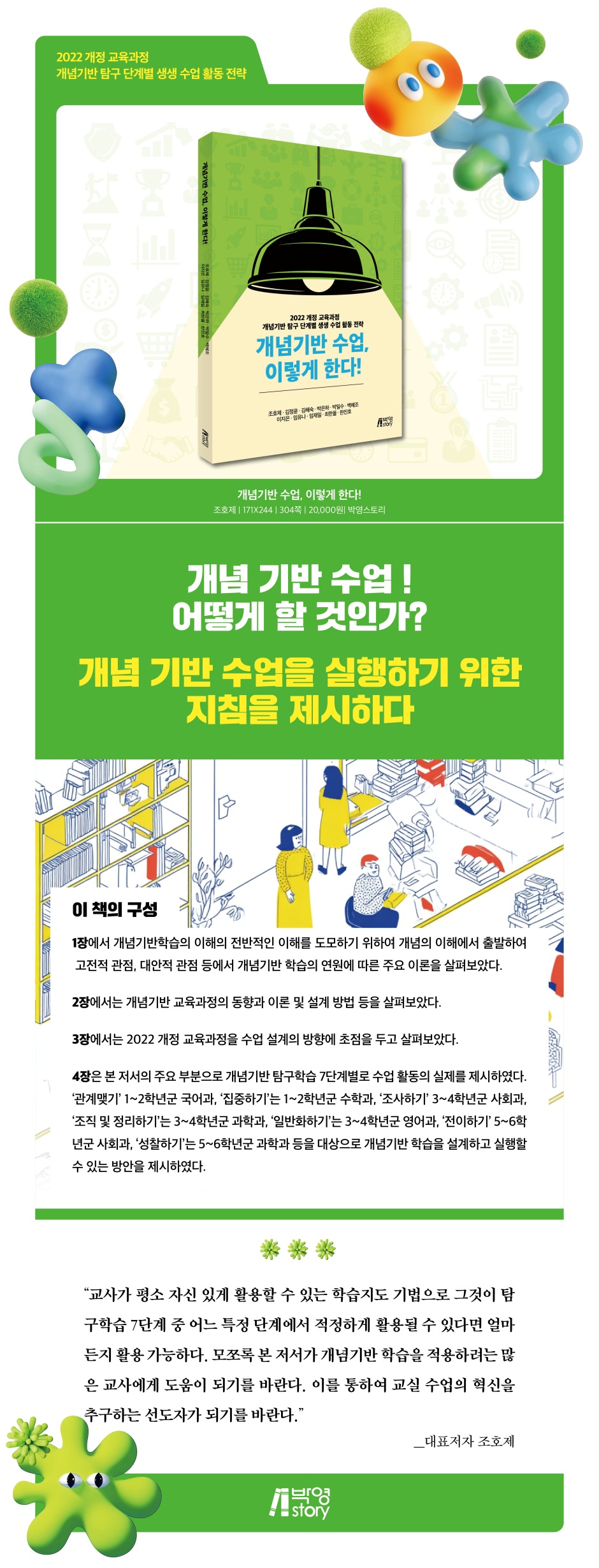
The teaching steps for implementing concept-based learning were based on the 7-step teaching model of concept-based inquiry learning proposed by Carla Marshall & Rachel French.
The stages of the lesson are relating, focusing, investigating, organizing and arranging, generalizing, transferring, and reflecting.
For each stage, examples are provided of how to implement classes in the classroom based on the 2022 revised curriculum achievement standards.
This textbook focuses on the class stage as its core content, but also presents background knowledge and related theories necessary to understand and utilize it. The main contents are as follows.
In Chapter 1, in order to promote a comprehensive understanding of concept-based learning, we started with an understanding of concepts and examined the major theories according to the origins of concept-based learning from classical and alternative perspectives.
Chapter 2 examines trends, theories, and design methods of concept-based curricula.
In Chapter 3, we examined the 2022 revised curriculum with a focus on the direction of lesson design.
This is because the 2022 revised curriculum provides the basis for designing a concept-based curriculum.
Chapter 4 is the main part of this book and presents practical teaching activities for each of the seven stages of concept-based inquiry learning.
If you select a specific unit and present the flow of all seven stages of the lesson, it will not be difficult for the reader to understand the flow of the content.
However, the authors felt that it was difficult to experience various situations in which learning was designed and implemented at each stage, so they presented learning activities at each stage by different grade levels and subjects.
We presented a plan to design and implement concept-based learning for the following subjects: 'Building Relationships' for Korean language arts in grades 1-2, 'Concentrating' for mathematics in grades 1-2, 'Investigating' for social studies in grades 3-4, 'Organizing and Organizing' for science in grades 3-4, 'Generalizing' for English in grades 3-4, 'Transferring' for social studies in grades 5-6, and 'Reflecting' for science in grades 5-6.
It is expected that the cases presented here will serve as a guideline for teachers and researchers to implement concept-based classes.
However, considering that classes are dynamic and situational, and that they are conducted in a variety of ways, this book highlights the potential for other learning methods that are not presented in this book.
It is a teaching technique that teachers can confidently use on a regular basis, and if it can be appropriately utilized at any specific stage among the seven stages of inquiry learning, it can be used in any way.
I hope that this book will be helpful to many teachers who want to apply concept-based learning.
Through this, we hope to become leaders in pursuing innovation in classroom instruction.
In the process of writing this book, the authors put a lot of thought into mobilizing ideas.
It was written after being confirmed and verified through multiple interactions.
Thanks to all the authors.
And I would like to thank everyone at Park Young Story who helped me with various tasks leading up to the publication of this book.
March 2024
Representative author Dream
We tend to generally perceive classes as a time for acquiring knowledge.
However, in class, the method of 'how' is more important than the content of 'what'.
Rather than simply conveying the content, we must place greater emphasis on what we can cultivate in relation to that content.
The educational reform in the United States in the 1990s stemmed from reflection on the learning methods used to deliver the curriculum.
Schmidt's criticism of 'a mile wide and an inch deep' is not a criticism of the textbook or curriculum itself, but rather a criticism of the teaching method.
Until now, classes at school have focused on conveying a lot of fact-based content, and as a result, superficial class development has limited the cognitive development of learners (Erickson, 2002).
Since the way a class is taught and the way it is thought about and explored differs depending on the method used, a method that discusses the content is preferable to a lecture-style or injection-style class.
Ultimately, it can be said that the method is more important than the content.
In this way, the thinking skills and inquiry skills developed through classes go beyond simply acquiring class content. They form perspectives that can be used to solve various problems experienced both inside and outside of school in real-world contexts, ultimately developing capabilities.
Developing students' thinking skills at school is directly related to the type of talent the country needs to cultivate.
The recent 2022 revised curriculum calls for improvements in how we think in class.
It emphasizes ‘deep learning.’
Concept-based learning related to this is also a recent teaching and learning method of the International Baccalaureate (IBO).
There is a demand for a change in the paradigm of education, both domestically and internationally.
From a national perspective, this is a sensitive issue for our country, which has relied on human resources to drive the national economy, as it is a way to cultivate competitive talent.
As previously stated, IBO applies concept-based learning.
This is closely related to the concept-based curriculum and instruction (CBCI) proposed by Erickson & Lanning and French, and is also closely related to Understanding by Design (UbD) proposed by Wiggins & McTighe.
It is emphasized that classes should be conducted in a way that maximizes the effectiveness of concept-based learning by considering not only efficiency in learning but also transfer to real life.
In this way, concept-based learning has influenced our country's curriculum, and is linked to the 2015 revised curriculum and the 2022 revised curriculum.
Several of the authors of this book have published several books on concept-based curriculum and instructional design.
However, textbooks that focus on design have limited practical help for teachers in the field on how to implement classes.
Therefore, this book was written with a focus on the implementation of concept-based learning to overcome these problems.
This is an attempt to provide some help to the many teachers who are considering and trying to implement concept-based learning methods, as well as to those who are interested in researching concept-based curricula and applying them in the field.
In addition, the purpose of class design based on concept-based learning was to overcome the limitation that it only raises awareness of the problem and has no way of properly establishing it in school classrooms.
The teaching steps for implementing concept-based learning were based on the 7-step teaching model of concept-based inquiry learning proposed by Carla Marshall & Rachel French.
The stages of the lesson are relating, focusing, investigating, organizing and arranging, generalizing, transferring, and reflecting.
For each stage, examples are provided of how to implement classes in the classroom based on the 2022 revised curriculum achievement standards.
This textbook focuses on the class stage as its core content, but also presents background knowledge and related theories necessary to understand and utilize it. The main contents are as follows.
In Chapter 1, in order to promote a comprehensive understanding of concept-based learning, we started with an understanding of concepts and examined the major theories according to the origins of concept-based learning from classical and alternative perspectives.
Chapter 2 examines trends, theories, and design methods of concept-based curricula.
In Chapter 3, we examined the 2022 revised curriculum with a focus on the direction of lesson design.
This is because the 2022 revised curriculum provides the basis for designing a concept-based curriculum.
Chapter 4 is the main part of this book and presents practical teaching activities for each of the seven stages of concept-based inquiry learning.
If you select a specific unit and present the flow of all seven stages of the lesson, it will not be difficult for the reader to understand the flow of the content.
However, the authors felt that it was difficult to experience various situations in which learning was designed and implemented at each stage, so they presented learning activities at each stage by different grade levels and subjects.
We presented a plan to design and implement concept-based learning for the following subjects: 'Building Relationships' for Korean language arts in grades 1-2, 'Concentrating' for mathematics in grades 1-2, 'Investigating' for social studies in grades 3-4, 'Organizing and Organizing' for science in grades 3-4, 'Generalizing' for English in grades 3-4, 'Transferring' for social studies in grades 5-6, and 'Reflecting' for science in grades 5-6.
It is expected that the cases presented here will serve as a guideline for teachers and researchers to implement concept-based classes.
However, considering that classes are dynamic and situational, and that they are conducted in a variety of ways, this book highlights the potential for other learning methods that are not presented in this book.
It is a teaching technique that teachers can confidently use on a regular basis, and if it can be appropriately utilized at any specific stage among the seven stages of inquiry learning, it can be used in any way.
I hope that this book will be helpful to many teachers who want to apply concept-based learning.
Through this, we hope to become leaders in pursuing innovation in classroom instruction.
In the process of writing this book, the authors put a lot of thought into mobilizing ideas.
It was written after being confirmed and verified through multiple interactions.
Thanks to all the authors.
And I would like to thank everyone at Park Young Story who helped me with various tasks leading up to the publication of this book.
March 2024
Representative author Dream
GOODS SPECIFICS
- Date of issue: April 12, 2024
- Page count, weight, size: 304 pages | 176*248*30mm
- ISBN13: 9791165199739
- ISBN10: 1165199734
You may also like
카테고리
korean


korean

![ELLE 엘르 스페셜 에디션 A형 : 12월 [2025]](http://librairie.coreenne.fr/cdn/shop/files/b8e27a3de6c9538896439686c6b0e8fb.jpg?v=1766436872&width=3840)


