

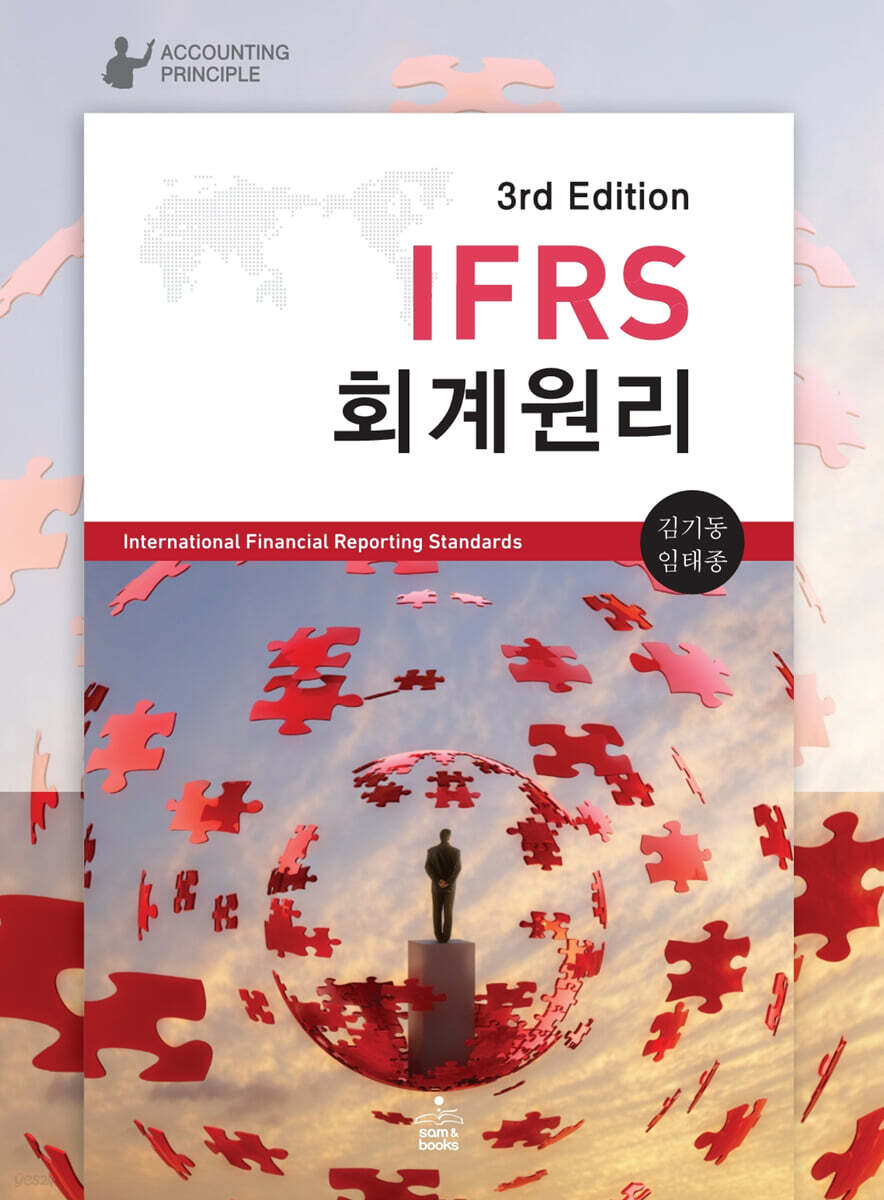
IFRS accounting principles
 |
Description
Book Introduction
We have now completed the publication of all books related to financial accounting, from accounting principles to intermediate accounting, advanced accounting, objective financial accounting, financial accounting practice, and past exam questions for accountants and tax accountants.
In 2002, I left Samil Accounting Corporation and started giving lectures.
At that time, I was giving lectures using books written by others, and I only had a vague thought that there would come a day when I could teach all lectures related to financial accounting using books I wrote myself.
Starting with the 2005 "Interpretation of Corporate Accounting Standards," that vague dream gradually became a reality, and now, with the 2014 "IFRS Accounting Principles," it has come to an end.
I am well aware that as much as I am proud, I also feel a sense of burden and responsibility.
In 2002, I left Samil Accounting Corporation and started giving lectures.
At that time, I was giving lectures using books written by others, and I only had a vague thought that there would come a day when I could teach all lectures related to financial accounting using books I wrote myself.
Starting with the 2005 "Interpretation of Corporate Accounting Standards," that vague dream gradually became a reality, and now, with the 2014 "IFRS Accounting Principles," it has come to an end.
I am well aware that as much as I am proud, I also feel a sense of burden and responsibility.
- You can preview some of the book's contents.
Preview
index
Chapter 1: The Financial Accounting Environment
Section 1: The Meaning of Accounting 1-3
Section 2 Financial Accounting 1-10
Section 3 Financial Reporting and Accounting Principles 1-14
External Auditor's Audit Report 1-19
Practice Problem 1-32
Chapter 2 Measurement and Recording of Corporate Transactions
Section 1: Principles of Double-Entry Bookkeeping 2-3
Section 2 Measurement and Reporting of Financial Status and Management Performance 2-12
Section 3 Accounts and Invoices 2-19
Boran Trial Balance Sheet 2-35
Practice Problem 2-37
Chapter 3: The Accounting Cycle
Section 1 Preparation of the revised balance sheet 3-3
Section 2, Amendment to Settlement 3-7
Section 3 Closing Statement 3-20
Practice Problem 3-26
Chapter 4 Accounting Treatment of Commodity Trading Companies
Section 1: Accounting Cycle of a Commodity Trading Company 4-3
Section 2: Accounting Cycle with Beginning Balances 4-22
Practice Problem 4-29
Chapter 5 Corporate Activities and Financial Statements
Section 1 General Purpose Financial Statements 5-3
Section 2 Types of General Purpose Financial Statements 5-7
Practice Problem 5-17
Chapter 6 Cash and Receivables
Section 1 Cash and Financial Institution Deposits 6-3
Section 2 Internal Control System for Cash 6-12
Section 3 Receivables and Payables 6-19
Section 4 Other Claims and Debts 6-30
Accounting for Notes Receivable 6-34
Practice Problem 6-38
Chapter 7 Inventory Assets
Section 1: Meaning and Types of Inventory Assets 7-3
Section 2 Acquisition Cost of Inventory Assets 7-6
Section 3 Cost Allocation of Inventory Assets 7-11
Section 4: Inventory Shortages and Valuation 7-26
Section 5: Inventory Valuation Method by Estimation 7-33
Practice Problem 7-39
Chapter 8 Tangible and Intangible Assets
Section 1: The Meaning of Tangible Assets 8-3
Section 2 Acquisition of Tangible Assets 8-5
Section 3 Depreciation 8-9
Section 4: Subsequent Costs and Elimination 8-20
Section 5 Intangible Assets 8-23
Section 6 Revaluation of Tangible and Intangible Assets 8-30
Section 7 Investment Real Estate 8-34
Practice Problem 8-37
Chapter 9: Debt and Present Value Concepts
Section 1 Current Liabilities 9-3
Section 2 Non-current Liabilities and Present Value 9-10
Section 3: Debentures 9-17
Section 4 Provisions 9-29
Section 5: The Time Value of Money 9-35
Practice Problem 9-44
Chapter 10 Capital
Section 1: The Meaning of Capital 10-3
Section 2 Accounting for Capital Transactions 10-7
Section 3 Accounting for Profit and Loss Transactions 10-18
Section 4 Disposition of Undistributed Retained Earnings 10-24
Section 5 Statement of Changes in Equity 10-26
Practice Problem 10-29
Chapter 11 Investment Financial Assets
Section 1 Investment Financial Assets 11-3
Section 2 Investment Equity Products 11-8
Section 3 Investment Debt Products 11-16
Practice Problem 11-28
Chapter 12 Cash Flow Statement
Section 1 General Statement of Cash Flows 12-3
Section 2 Cash Flows from Operating Activities 12-13
Section 3 Cash Flows from Investing Activities 12-34
Section 4 Cash Flows from Financing Activities 12-38
Practice Problem 12-44
Chapter 13 Financial Statement Analysis
Section 1: General Financial Statement Analysis 13-3
Section 2 Financial Ratio Analysis 13-7
Practice Problems 13-18
Appendix Time Value of Money Coefficient Table
Section 1: The Meaning of Accounting 1-3
Section 2 Financial Accounting 1-10
Section 3 Financial Reporting and Accounting Principles 1-14
External Auditor's Audit Report 1-19
Practice Problem 1-32
Chapter 2 Measurement and Recording of Corporate Transactions
Section 1: Principles of Double-Entry Bookkeeping 2-3
Section 2 Measurement and Reporting of Financial Status and Management Performance 2-12
Section 3 Accounts and Invoices 2-19
Boran Trial Balance Sheet 2-35
Practice Problem 2-37
Chapter 3: The Accounting Cycle
Section 1 Preparation of the revised balance sheet 3-3
Section 2, Amendment to Settlement 3-7
Section 3 Closing Statement 3-20
Practice Problem 3-26
Chapter 4 Accounting Treatment of Commodity Trading Companies
Section 1: Accounting Cycle of a Commodity Trading Company 4-3
Section 2: Accounting Cycle with Beginning Balances 4-22
Practice Problem 4-29
Chapter 5 Corporate Activities and Financial Statements
Section 1 General Purpose Financial Statements 5-3
Section 2 Types of General Purpose Financial Statements 5-7
Practice Problem 5-17
Chapter 6 Cash and Receivables
Section 1 Cash and Financial Institution Deposits 6-3
Section 2 Internal Control System for Cash 6-12
Section 3 Receivables and Payables 6-19
Section 4 Other Claims and Debts 6-30
Accounting for Notes Receivable 6-34
Practice Problem 6-38
Chapter 7 Inventory Assets
Section 1: Meaning and Types of Inventory Assets 7-3
Section 2 Acquisition Cost of Inventory Assets 7-6
Section 3 Cost Allocation of Inventory Assets 7-11
Section 4: Inventory Shortages and Valuation 7-26
Section 5: Inventory Valuation Method by Estimation 7-33
Practice Problem 7-39
Chapter 8 Tangible and Intangible Assets
Section 1: The Meaning of Tangible Assets 8-3
Section 2 Acquisition of Tangible Assets 8-5
Section 3 Depreciation 8-9
Section 4: Subsequent Costs and Elimination 8-20
Section 5 Intangible Assets 8-23
Section 6 Revaluation of Tangible and Intangible Assets 8-30
Section 7 Investment Real Estate 8-34
Practice Problem 8-37
Chapter 9: Debt and Present Value Concepts
Section 1 Current Liabilities 9-3
Section 2 Non-current Liabilities and Present Value 9-10
Section 3: Debentures 9-17
Section 4 Provisions 9-29
Section 5: The Time Value of Money 9-35
Practice Problem 9-44
Chapter 10 Capital
Section 1: The Meaning of Capital 10-3
Section 2 Accounting for Capital Transactions 10-7
Section 3 Accounting for Profit and Loss Transactions 10-18
Section 4 Disposition of Undistributed Retained Earnings 10-24
Section 5 Statement of Changes in Equity 10-26
Practice Problem 10-29
Chapter 11 Investment Financial Assets
Section 1 Investment Financial Assets 11-3
Section 2 Investment Equity Products 11-8
Section 3 Investment Debt Products 11-16
Practice Problem 11-28
Chapter 12 Cash Flow Statement
Section 1 General Statement of Cash Flows 12-3
Section 2 Cash Flows from Operating Activities 12-13
Section 3 Cash Flows from Investing Activities 12-34
Section 4 Cash Flows from Financing Activities 12-38
Practice Problem 12-44
Chapter 13 Financial Statement Analysis
Section 1: General Financial Statement Analysis 13-3
Section 2 Financial Ratio Analysis 13-7
Practice Problems 13-18
Appendix Time Value of Money Coefficient Table
Publisher's Review
The features of this book are as follows:
1.
Presenting a methodology for understandable accounting
Accounting is not a subject to be memorized.
Therefore, it is most important to understand the basic principles of accounting and learn financial accounting.
This book explains the accounting principles of a company based on double-entry bookkeeping without using a mechanical approach, but rather by explaining the logical background of why accounting must be done that way, so that students can naturally understand the principles of accounting.
2.
Perfect reflection of Korean adoption of International Financial Reporting Standards
There are two types of generally accepted accounting principles in Korea: Korean International Financial Reporting Standards (K-IFRS) for listed companies and General Accounting Principles (GAAP) for unlisted companies.
However, since studying accounting for exam purposes requires a prior understanding of accounting standards for listed companies, this book explains accounting principles based on the Korean International Financial Reporting Standards.
This book reflects all of the international accounting standards adopted by Korea that have been published to date. However, because the content is too difficult or complex at the accounting principles level, it may cause a loss of interest in accounting, so I have boldly postponed it to the author's intermediate and advanced accounting courses.
3.
Maximizing visual effects through various pictures
We have moved away from descriptive textbooks that simply list repetitive accounting procedures and focus on memorization, and have strived to ensure that even students encountering the book for the first time can easily understand more principles at a glance.
This will enable you to see the forest, not the trees, which is the learning principle of accounting, and you can expect a natural learning effect through pictures.
4.
Distinction between financial statement account items and comprehensive income statement account items
What do students find most challenging in financial accounting? One of them is understanding the characteristics of numerous accounting items and performing perfect accounting procedures.
To this end, this book performed accounting processing by distinguishing between the financial statement account subjects and the comprehensive income statement account subjects.
The account subjects in the statement of financial position were colored 'black', the current profit and loss account in the statement of comprehensive income was colored 'gray', and the other comprehensive income account was colored 'blue'.
This is a method that has never been attempted in existing financial accounting books, allowing readers to visually distinguish the differences between account subjects.
5.
Presentation of the order of accounting processing
Another thing that students find most difficult when studying financial accounting is the accounting treatment of double-entry bookkeeping.
In order to handle double-entry bookkeeping, it is necessary to be able to identify the impact of changes in assets, liabilities, and capital resulting from accounting transactions, and to be able to reclassify and reconcile these into debits and credits. Therefore, it is bound to be difficult for students studying financial accounting for the first time.
Accounting is said to be the language of business.
Just as we are confused when we first learn English because of the different word order compared to our own language, we are bound to be confused when we first encounter accounting, the language of business, because of the order of accounting processing.
For this purpose, this book presents the order of accounting processing using numbers.
When students perform accounting procedures while reading the book, I believe that they will be able to naturally solve the difficulties of accounting procedures by following the suggested order of ① → ② → ③ → ④.
This is also an original explanation method that has not been attempted in any existing financial accounting textbook.
I received help from many people before publishing this textbook.
I would like to express my gratitude to CEO Lee Nak-gyu and his staff at Sam & Books, who have spared no effort in providing both material and spiritual support, including editing and design work, to ensure that this book is a visually appealing read.
I hope this book will be of some help to the accounting field in our country, and I promise to continue revising and improving it to make it even better.
1.
Presenting a methodology for understandable accounting
Accounting is not a subject to be memorized.
Therefore, it is most important to understand the basic principles of accounting and learn financial accounting.
This book explains the accounting principles of a company based on double-entry bookkeeping without using a mechanical approach, but rather by explaining the logical background of why accounting must be done that way, so that students can naturally understand the principles of accounting.
2.
Perfect reflection of Korean adoption of International Financial Reporting Standards
There are two types of generally accepted accounting principles in Korea: Korean International Financial Reporting Standards (K-IFRS) for listed companies and General Accounting Principles (GAAP) for unlisted companies.
However, since studying accounting for exam purposes requires a prior understanding of accounting standards for listed companies, this book explains accounting principles based on the Korean International Financial Reporting Standards.
This book reflects all of the international accounting standards adopted by Korea that have been published to date. However, because the content is too difficult or complex at the accounting principles level, it may cause a loss of interest in accounting, so I have boldly postponed it to the author's intermediate and advanced accounting courses.
3.
Maximizing visual effects through various pictures
We have moved away from descriptive textbooks that simply list repetitive accounting procedures and focus on memorization, and have strived to ensure that even students encountering the book for the first time can easily understand more principles at a glance.
This will enable you to see the forest, not the trees, which is the learning principle of accounting, and you can expect a natural learning effect through pictures.
4.
Distinction between financial statement account items and comprehensive income statement account items
What do students find most challenging in financial accounting? One of them is understanding the characteristics of numerous accounting items and performing perfect accounting procedures.
To this end, this book performed accounting processing by distinguishing between the financial statement account subjects and the comprehensive income statement account subjects.
The account subjects in the statement of financial position were colored 'black', the current profit and loss account in the statement of comprehensive income was colored 'gray', and the other comprehensive income account was colored 'blue'.
This is a method that has never been attempted in existing financial accounting books, allowing readers to visually distinguish the differences between account subjects.
5.
Presentation of the order of accounting processing
Another thing that students find most difficult when studying financial accounting is the accounting treatment of double-entry bookkeeping.
In order to handle double-entry bookkeeping, it is necessary to be able to identify the impact of changes in assets, liabilities, and capital resulting from accounting transactions, and to be able to reclassify and reconcile these into debits and credits. Therefore, it is bound to be difficult for students studying financial accounting for the first time.
Accounting is said to be the language of business.
Just as we are confused when we first learn English because of the different word order compared to our own language, we are bound to be confused when we first encounter accounting, the language of business, because of the order of accounting processing.
For this purpose, this book presents the order of accounting processing using numbers.
When students perform accounting procedures while reading the book, I believe that they will be able to naturally solve the difficulties of accounting procedures by following the suggested order of ① → ② → ③ → ④.
This is also an original explanation method that has not been attempted in any existing financial accounting textbook.
I received help from many people before publishing this textbook.
I would like to express my gratitude to CEO Lee Nak-gyu and his staff at Sam & Books, who have spared no effort in providing both material and spiritual support, including editing and design work, to ensure that this book is a visually appealing read.
I hope this book will be of some help to the accounting field in our country, and I promise to continue revising and improving it to make it even better.
GOODS SPECIFICS
- Date of issue: December 22, 2023
- Page count, weight, size: 648 pages | 188*257*35mm
- ISBN13: 9791156264705
- ISBN10: 1156264707
You may also like
카테고리
korean


korean

![GQ KOREA Mark (Monthly): December [2025]](http://librairie.coreenne.fr/cdn/shop/files/8ef265dbbfbf186523ed75ba7319009d.jpg?v=1765340328&width=3840)


